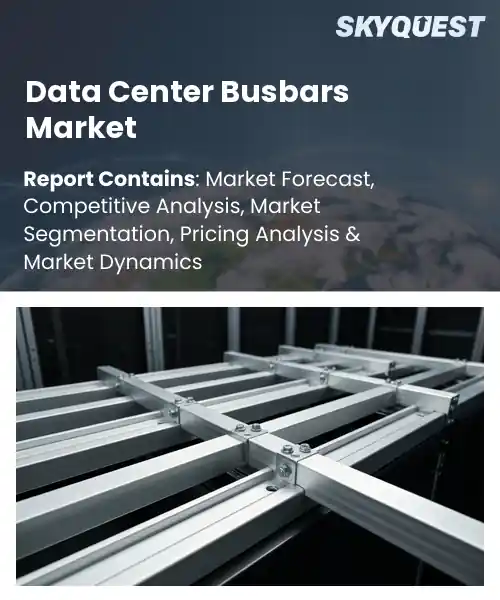
Data Center Busbars Market
Report ID: SQMIG45K2246
Report ID: SQMIG45K2246
[email protected]
USA +1 351-333-4748
Report ID:
SQMIG45K2246 |
Region:
Global |
Published Date: March, 2026
Pages:
157
|Tables:
142
|Figures:
78


Global Data Center Busbars Market size was valued at USD 1.8 Billion in 2024 and is poised to grow from USD 1.95 Billion in 2025 to USD 3.75 Billion by 2033, growing at a CAGR of 8.5% during the forecast period (2026-2033).
The electricity distribution system drivers for the global data center busbars market growth according to the increased power requirements for rack and facility operations, which force operators to implement power distribution systems that use space more efficiently while delivering dependable performance. Busbars serve as conductive systems that replace heavy cable systems for delivering higher electrical power while minimizing energy waste, because they enable faster installation work and better thermal efficiency and easier system upkeep.
The market transition from copper cable trays to busway systems occurred during the last ten years because hyperscale cloud providers and colocation facilities requiredelectrical systems that could grow according to their needs. Businesses adopted edge sites because they needed to comply with regulations that focused on energy efficiency while their operations were running.
In addition, the global data center busbars market penetration results from the growing preference for prefabricated busbar systems which use modular architecture, because standardized busbar components enable faster construction work and reduced installation expenses, which makes it possible to use these systems for projects that need to achieve high performance in both edge and scalable deployments. Data center operators can use slot in busway segments together with rack mounted busbars to create power systems outside of the main facility, which helps to decrease operational interruptions while providing better control over predefined installation times.
The space limitations of micro data centers require compact high current distribution systems because facilities need to install more power capacity through existing infrastructure, which enables current space to remain operational for future power needs.
How is AI Improving Efficiency and Reliability in the Data Center Busbars Market?
Data center busbars function as the power distribution system, which transfers electrical energy between rack systems and switchgear. AI improves operational performance by transforming continuous sensor data into useful thermal regulation and fault detection and equipment maintenance information. The current data center busbars industry prefers modular trunking systems with built-in monitoring functions, because AI-based systems help reduce unexpected downtime while extending the operational lifespan of various equipment. Digital twin systems together with automated load balancing technology enable operators to achieve optimal capacity usage while creating installations that provide both greater density and flexible adaptability. Busbar solutions present numerous advantages over traditional cabling systems, which makes them more suitable for today's high-density data center environments.
The company Siemens introduced its Electrification X Asset Management system in September 2025, which enables users to monitor busbar assets through their current status and system health, while AI uses temperature and partial discharge sensor data to create maintenance alerts that predict equipment failures, which results in more operational uptime and reduced maintenance expenses.
Market snapshot - (2026-2033)
Global Market Size
USD 1.8 Billion
Largest Segment
Copper Busbars
Fastest Growth
Aluminum Busbars
Growth Rate
8.5% CAGR
To get more insights on this market click here to Request a Free Sample Report
The global data center busbars market is categorized based on conductor material, insulation type, power rating, installation/integration, data center type, and region. By conductor material, the market is divided into copper busbars and aluminum busbars. In terms of insulation type, it includes air insulated busbars, sandwich/compact busbars, and PVC/epoxy insulated busbars. Based on power rating, the market is segmented into low voltage, medium voltage, and high voltage. By installation or integration, it is classified into floor-mounted and overhead or rack-integrated systems. According to data center type, the market comprises hyperscale/cloud data centers, colocation facilities, and enterprise/edge data centers. Regionally, the market is segmented into North America, Europe, Asia Pacific, Latin America, and the Middle East & Africa.
According to the global data center busbars market analysis, the Copper Busbars market segment maintains its leading position, because its excellent electrical conductivity and thermal properties help decrease power distribution losses, which permits tighter spacing between racks while maintaining uninterrupted system operation. The established manufacturing process together with its compatibility to various switchgear and connector systems leads to lower integration risks, while its long-lasting durability and consistent lifecycle performance enable quicker maintenance processes and faster critical infrastructure certification, which makes this system the optimal choice for high-stakes operational environments.
However, the most popular choice for power distribution systems now consists of Aluminum Busbars, which reached their highest growth rate during this period, because the lower material weight combined with reduced raw material costs and improved surface treatment technology allow faster installation work at remote and edge sites. Built-in lightweight and cost-effective features create rapid market acceptance, because upcoming power infrastructure systems need to develop scalable solutions for power distribution needs.
As per the global data center busbars market forecast, Engineers can develop busways with small space needs while achieving their highest current capacity requirements because Sandwich/Compact Busbars segment maintains its market leadership through its special insulation and conductor combination. The use of prefabricated enclosed structures prevents electromagnetic interference while minimizing cooling system needs, which enables efficient installation work inside small spaces, while their design matches modular deployment requirements, leading operators to choose them for both new constructions and building renovation projects.
The PVC/Epoxy Insulated busbars segment will hold the largest data center busbars market share because resin-based solutions improve dielectric strength while enhancing fire safety performance, which enables compliance with more demanding safety standards. The prefabricated assembly process requires easier manufacturing work and reduced handling risks, which leads to faster product adoption, while retrofit and edge deployment areas need insulation solutions that can withstand harsh conditions while offering quick installation capabilities.
To get detailed segments analysis, Request a Free Sample Report
As per the data center busbars market regional forecast, the dominance of Asia Pacific region results from its heavy investment in hyperscale and enterprise cloud infrastructure, which creates efficient supply chain operations for component manufacturing, all while the region maintains a strong pool of engineering experts who specialize in power distribution technologies. The electrical distribution solutions that regional operators choose must meet their needs for efficient and scalable systems, which enables them to maintain operational density and continuous service, thus driving the use of advanced busbar systems. The presence of nearby raw material suppliers and electrical component manufacturers decreases lead times while they provide the ability to create custom solutions that meet both thermal and mechanical specifications.
Industrial ecosystems which support industry needs in critical markets establish conditions for data center developers to work with both OEMs and testing laboratories, which leads to faster qualification processes and deployment activities. The market shows a preference for modular systems which use low-loss busbar technologies because they comply with power requirements of mission critical facilities around the world while simultaneously meeting energy efficiency standards and achieving reliability through utility partnerships.
The Data Center Busbars sector Japan operates through its advanced electrical engineering capabilities and established supplier network to enable its cloud and enterprise system deployments. The capability to produce goods in-house allows for immediate product changes while maintaining the necessary quality standards required for high availability systems. The three organizations create thermal and mechanical requirements through their work which links integrators and utilities and testing entities. The drive to create power distribution systems with both space-saving design and easy maintenance requirements leads to the widespread use of modular busbar systems in data center environments that need higher space efficiency and continuous operational capacity.
The Data Center Busbars Market in South Korea relies on its strong semiconductor and electronics industries to develop power distribution systems that meet the needs of hyperscale data centers. Local manufacturers excel in precision fabrication and thermal design, which enables them to create busbar assemblies that fulfill rigorous reliability requirements. The three organizations, which include data center operators and engineering firms and component suppliers, work together to speed up the deployment of modular building systems. The need for energy-efficient systems that maintain operational strength leads to increased use of low-loss busbar systems.
The North American market experiences fast growth because of the high demand for hyperscale and colocation and enterprise data center capacity which operators seek to meet through effective operational methods and maximum uptime. Operators select busbar systems because they need less space and installation work while providing better thermal management than conventional cabling systems, which leads to faster product specifications by designers and integrators. The combination of local manufacturing capabilities and supply chain flexibility enables the creation of customized products with shortened qualification processes. The market establishes power distribution systems that are both resilient and energy-efficient through its regulatory frameworks and utility programs.
The partnership between technology providers and system integrators and major cloud customers leads to the development of modular busbar designs which meet the needs of high-density racks and prefabricated modular data centers, making the region an important market for new busbar power distribution systems and their complete lifecycle management.
The United States Data Center Busbars Market is defined through its hyperscale activities and adoption of prefabricated modular approaches which support scalable power distribution systems. The presence of cloud service providers and colocation businesses creates a market need for busbar systems which require less maintenance and take up less space for quick installation work. The three organizations, which include OEMs and integrators, and testing laboratories, work together to enhance product testing and market launch processes. The design of critical systems uses energy-efficient modular busbar systems which create low-power loss outcomes for mission crucial facilities.
The Data Center Busbars Market in Canada benefits from its proximity to urban areas which support colocation facilities and its links to cross-border cloud systems, both of which require dependable and efficient power distribution networks. Domestic integrators and suppliers deliver tailored busbar solutions for modular builds and retrofit projects. The utility organizations work together with testing authorities to enable the resources to meet both thermal and performance standards. The requirement to maintain system reliability together with system scalability leads to the use of compact low-loss busbar systems which match data center power needs.
European countries establish stronger market presence through their implementation of strict energy efficiency requirements while they develop standardized protocols and their increased focus on building data centers with decentralized and resilient designs. Regional manufacturers and engineering firms create busbar systems which serve as thermal management solutions while their designs achieve both modular functionality and efficient material use to comply with existing sustainability and regulatory standards. The utility companies work together with system integrators and research institutions to conduct joint development projects which help them achieve faster certification of new busbar technologies for both large-scale facilities and modular edge deployment environments.
Enterprise customers and hyperscale facilities and industrial clients demand power distribution systems that are both compact and easily serviceable which leads them to select busbar solutions that meet European standards for safety and performance and sustainability throughout the entire product lifecycle to establish Europe as a key inventor of power distribution solutions which serve critical business functions in different operational environments across the globe.
The Data Center Busbars Market in Germany benefits from its strong industrial engineering sector and precision manufacturing capabilities which enable the production of high-quality busbars. Data centers achieve exceptional thermal performance and mechanical strength through their supply chain partnerships, which enable them to create advanced thermal management solutions. Equipment manufacturers and integrators and certification bodies work together to confirm that their unique systems meet validation requirements. Facilities adopt modular busbar designs which minimize energy losses because they support energy efficiency goals and operational resilience and safety standards requirements.
The Data Center Busbars Market in the United Kingdom utilizes its data center design knowledge and established colocation industry to advance the implementation of modern power distribution systems. Engineering firms focus on modular and retrofit busbar installations that meet rigorous performance and safety expectations. Organizations that work with utilities and standards bodies create a system which helps them validate their low-loss systems and execute their implementation process. Urban areas and edge environments both require facilities to implement compact busbar systems which maintainoperational performance during all times of their operations.
The Data Center Busbars Market in France requires both energy efficient systems and power systems engineering expertise to establish its infrastructure and power systems building requirements. The manufacturers and integrators create custom built busbar systems which will deliver maximum thermal performance while allowing easy installation into modular construction projects. Research institutions and utility companies need to cooperate with other organizations to ensure that testing and compliance with safety standards can be done without restrictions.
To know more about the market opportunities by region and country, click here to
Buy The Complete Report
Hyperscale Data Center Expansion
The rapid expansion of hyperscale data centers drives demand for advanced busbar solutions because these facilities require high current capacity, compact power distribution, and reliable connections that traditional wiring struggles to provide. Busbars allow operators to achieve their objectives of maintaining system availability while simplifying maintenance tasks through their modular design, which decreases installation requirements and enhances thermal performance. Vendors create custom busbar designs which enable flexible power distribution systems that match facility specifications because this connection between busbar benefits and facility specifications drives market expansion to include more large-scale systems.
Growing Edge Computing Deployments
The growing number of edge computing facilities creates new opportunities for busbar market expansion because distributed sites require power distribution systems which take up minimal space while delivering dependable performance and efficient energy usage. The design of busbars enables smaller facilities to achieve their space requirements through power delivery systems which eliminate the need for multiple cables while reducing thermal issues which helps recycled designs to be built faster. Customizable busbar modules from suppliers enable operators to establish standard power distribution systems for edge locations, which leads to quicker deployment and wider acceptance in the market while expanding their customer base.
High Initial Capital Requirements
The data center industry experiences a market slowdown because data center projects choose to implement standard cable systems which restrict expenses to predetermined budget limits. Operators need firsthand engineering to evaluate all existing electrical systems before they can begin to create their customized busbar systems. Procurement decisions for busbar solutions experience delays because customers face financial risks and lengthy times to integrate into their systems which restrict busbar solutions from replacing conventional distribution systems.
Compatibility with Legacy Infrastructure
The market suffers from slow growth because existing data centers use standard cabling systems and switchgear and power distribution units that do not support busbar technology. Retrofitting projects need to start with a complete analysis which will determine if existing switchgear needs to be changed while the project team must synchronize their work schedule with the active operational timetable to prevent any disruptions to operations which creates additional challenges. Operators face integration challenges which lead them to choose between incremental system updates or full system shutdowns until operating systems become outdated enough to require replacement which causes slower busbar adoption throughout existing technologies.
Request Free Customization of this report to help us to meet your business objectives.
The competitive environment in the market exists because companies use their acquisition and partnership and new busway design capabilities to acquire AI and hyperscale workloads. Legrand has acquiredbusbar specialists through multiple bolt-on purchases while Vertiv has introduced its double stack busway system for AI-based high-density rack applications and Siemens has developed the LData busbar system that comes with built-in monitoring capabilities and Eaton have acquired a stake in a Chinese busway enterprise.
Modular Power Architecture Adoption: Data center operators are now choosing modular power designs which include busbar assemblies that come preassembled because these systems allow them to install power systems faster while they can upgrade their systems with less effort. The facilities can meet their essential operational needs using standardized interfaces together with pre-validated modules which enable them to change their capacity requirements between core areas and edge zones. The ecosystem enables suppliers to establish connections with customers through factory testing, which leads to faster service delivery and better operational performance. The system enables organizations to build their infrastructure according to their workload demands while allowing them to extend their system capacity for future needs without creating major operation disruptions during technology updates.
Sustainable Conductor Material Innovation: Busbars need conductor materials that meet environmental standards while being reusable throughout their life cycle because procurement policies and environmental requirements drive innovation in conductor materials. Manufacturers adopt low impact alloys together with advanced surface treatments and closed loop reclamation to create products that maintain their conductive properties while reducing both energy consumption and recycling value during their product lifespan. Supply chain transparency and certification promote greener components together with partners who work together to develop circular solutions which can be used at larger scales. The new system enables vendors to control their business processes while helping companies achieve their environmental targets, thus reducing the environmental risks that power distribution systems create throughout their operational life.
SkyQuest’s ABIRAW (Advanced Business Intelligence, Research & Analysis Wing) is our Business Information Services team that Collects, Collates, Correlates, and Analyses the Data collected by means ofPrimary Exploratory Research backed by robust Secondary Desk research.
As per SkyQuest analysis, the demand for compact busbar systems that offer efficient power distribution solutions has increased because facilities now need to handle higher power loads to sustain their operations and edge computing systems require power modules that occupy minimal space. The high initial costs of custom busbar systems lead operators to delay their implementation because they need to assess the expense of making changes to their existing systems compared to the ongoing energy savings that will result from these enhancements. Asia Pacific leads the market because it has high hyperscale investments and combined manufacturing capabilities which support the dominance of copper busbars based on their thermal performance and electrical conductivity and established operational lifetime. The trend toward prefabricated systems and modular designs with built-in monitoring systems will continue to drive market expansion because operators need to achieve continuous operation while they require fast system installations.
| Report Metric | Details |
|---|---|
| Market size value in 2024 | USD 1.8 Billion |
| Market size value in 2033 | USD 3.75 Billion |
| Growth Rate | 8.5% |
| Base year | 2024 |
| Forecast period | (2026-2033) |
| Forecast Unit (Value) | USD Billion |
| Segments covered |
|
| Regions covered | North America (US, Canada), Europe (Germany, France, United Kingdom, Italy, Spain, Rest of Europe), Asia Pacific (China, India, Japan, Rest of Asia-Pacific), Latin America (Brazil, Rest of Latin America), Middle East & Africa (South Africa, GCC Countries, Rest of MEA) |
| Companies covered |
|
| Customization scope | Free report customization with purchase. Customization includes:-
|
To get a free trial access to our platform which is a one stop solution for all your data requirements for quicker decision making. This platform allows you to compare markets, competitors who are prominent in the market, and mega trends that are influencing the dynamics in the market. Also, get access to detailed SkyQuest exclusive matrix.
Table Of Content
Executive Summary
Market overview
Parent Market Analysis
Market overview
Market size
KEY MARKET INSIGHTS
COVID IMPACT
MARKET DYNAMICS & OUTLOOK
Market Size by Region
KEY COMPANY PROFILES
Methodology
For the Data Center Busbars Market, our research methodology involved a mixture of primary and secondary data sources. Key steps involved in the research process are listed below:
1. Information Procurement: This stage involved the procurement of Market data or related information via primary and secondary sources. The various secondary sources used included various company websites, annual reports, trade databases, and paid databases such as Hoover's, Bloomberg Business, Factiva, and Avention. Our team did 45 primary interactions Globally which included several stakeholders such as manufacturers, customers, key opinion leaders, etc. Overall, information procurement was one of the most extensive stages in our research process.
2. Information Analysis: This step involved triangulation of data through bottom-up and top-down approaches to estimate and validate the total size and future estimate of the Data Center Busbars Market.
3. Report Formulation: The final step entailed the placement of data points in appropriate Market spaces in an attempt to deduce viable conclusions.
4. Validation & Publishing: Validation is the most important step in the process. Validation & re-validation via an intricately designed process helped us finalize data points to be used for final calculations. The final Market estimates and forecasts were then aligned and sent to our panel of industry experts for validation of data. Once the validation was done the report was sent to our Quality Assurance team to ensure adherence to style guides, consistency & design.
Analyst Support
Customization Options
With the given market data, our dedicated team of analysts can offer you the following customization options are available for the Data Center Busbars Market:
Product Analysis: Product matrix, which offers a detailed comparison of the product portfolio of companies.
Regional Analysis: Further analysis of the Data Center Busbars Market for additional countries.
Competitive Analysis: Detailed analysis and profiling of additional Market players & comparative analysis of competitive products.
Go to Market Strategy: Find the high-growth channels to invest your marketing efforts and increase your customer base.
Innovation Mapping: Identify racial solutions and innovation, connected to deep ecosystems of innovators, start-ups, academics, and strategic partners.
Category Intelligence: Customized intelligence that is relevant to their supply Markets will enable them to make smarter sourcing decisions and improve their category management.
Public Company Transcript Analysis: To improve the investment performance by generating new alpha and making better-informed decisions.
Social Media Listening: To analyze the conversations and trends happening not just around your brand, but around your industry as a whole, and use those insights to make better Marketing decisions.
REQUEST FOR SAMPLE
 REQUEST FREE CUSTOMIZATION
Global Data Center Busbars Market size was valued at USD 1.8 Billion in 2024 and is poised to grow from USD 1.95 Billion in 2025 to USD 3.75 Billion by 2033, growing at a CAGR of 8.5% during the forecast period (2026-2033).
Competitive dynamics are shaped by consolidation and targeted product innovation, with companies using acquisitions, partnerships, and new busway designs to win hyperscale and AI workloads. Examples include Legrand's recent bolt on purchases of busbar specialists, Vertiv's double stack busway rollout for high density AI racks, Siemens' LData busbar with integrated monitoring, and Eaton's stake in a Chinese busway business. 'Schneider Electric', 'Eaton Corporation', 'Legrand (Starline)', 'Siemens AG', 'ABB Ltd.', 'Vertiv Holdings', 'Rittal', 'Delta Electronics', 'Chint Group', 'Methode Electronics', 'C&S Electric', 'Anord Mardix', 'Powerbar Gulf', 'Naxso', 'EAE Elekter', 'DAKE', 'Triad Magnetics', 'Oriental Copper', 'Godrej (Busbar Div)', 'Busbar Services'
The rapid expansion of hyperscale data centers drives demand for advanced busbar solutions because these facilities require high current capacity, compact power distribution and reliable connections that traditional wiring struggles to provide. Busbars offer modularity, reduced installation time, and improved thermal performance, which align with operators’ goals to maximize uptime and simplify maintenance. Vendors respond with tailored busbar designs that support scalable power distribution architectures, and this alignment between facility requirements and busbar advantages directly supports market growth through broader adoption across large-scale deployments.
Modular Power Architecture Adoption: Data center operators are increasingly adopting modular power architectures featuring prefabricated busbar assemblies that enable faster deployment and simplified upgrades. Standardized interfaces and prevalidated modules reduce on site customization, lower integration risk, and support flexible capacity scaling across core and edge facilities. This trend encourages ecosystems of interoperable suppliers, accelerates time to service, and improves operational reliability through factory testing. It facilitates iterative expansion and easier maintenance, aligning infrastructure investment with shifting workload demands, minimizing disruption during technology refresh cycles.
Asia-Pacific Dominates the Global Data Center Busbars Market. As per the data center busbars market regional forecast, the dominance of the Asia-Pacific region results from its heavy investment in hyperscale and enterprise cloud infrastructure, which creates efficient supply chain operations for component manufacturing, all while the region maintains a strong pool of engineering experts who specialize in power distribution technologies.


Want to customize this report? This report can be personalized according to your needs. Our analysts and industry experts will work directly with you to understand your requirements and provide you with customized data in a short amount of time. We offer $1000 worth of FREE customization at the time of purchase.
Feedback From Our Clients


 USA (+1) 351-333-4748

