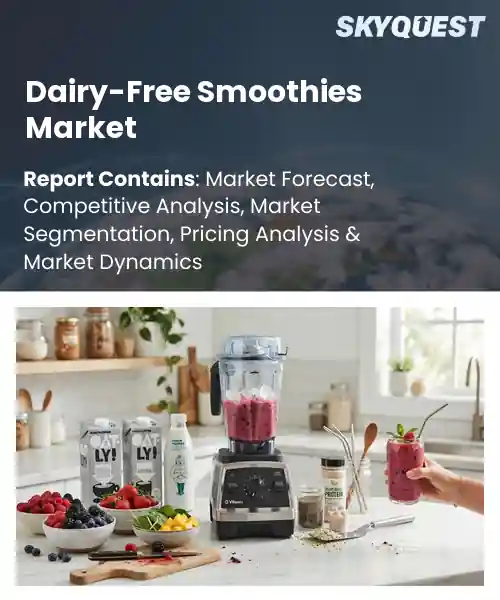
Dairy-Free Smoothies Market
Report ID: SQMIG30I3236
Report ID: SQMIG30I3236
[email protected]
USA +1 351-333-4748
Report ID:
SQMIG30I3236 |
Region:
Global |
Published Date: September, 2026
Pages:
157
|Tables:
125
|Figures:
77


Global Dairy-Free Smoothies Market size was valued at USD 24.8 Billion in 2024 and is poised to grow from USD 26.71 Billion in 2025 to USD 48.35 Billion by 2033, growing at a CAGR of 7.7% during the forecast period (2026-2033).
The global dairy‑free smoothies market comprises ready‑to‑drink and homemade blends that substitute cow’s milk with plant‑based milks as almond, oat, and coconut. Its relevance stems from rising lactose intolerance, vegan lifestyles, and health consciousness that push consumers toward lower‑calorie, cholesterol‑free options. Historically the sector emerged in the early 2010s when specialty coffee chains introduced oat‑milk lattes, prompting small manufacturers to experiment with fruit‑nut combinations. By 2020, sales had tripled, exemplified by brands like Oatly launching a line of pre‑packaged smoothies that captured millennial shoppers seeking nutrition. This evolution underscores a shift from niche stores to mainstream grocery aisles widely today. Consumer demand for clean labels drives the key factor innovation in plant‑based blends that improve texture and nutrition. When manufacturers replace dairy whey with pea, soy, or hemp isolates, smoothies gain creaminess while adding fiber and amino acids, which attracts fitness‑oriented buyers seeking recovery drinks. Retail chains such as Whole Foods have responded by allocating shelf space to dairy‑free options, prompting smaller brands to secure private‑label contracts with large distributors. This symbiotic relationship expands market reach, lowers production costs through economies of scale, and accelerates adoption among health‑conscious families, creating a feedback loop that fuels further research into functional ingredients today.
How is AI-driven personalization influencing the dairy‑free smoothies market?
AI driven personalization is reshaping the dairy free smoothies market by tailoring flavor profiles, ingredient blends, and nutritional targets to individual preferences. Brands now collect taste data through apps and smart packaging then use machine learning to match consumers with recipes that suit their dietary goals and flavor cravings. This approach creates a more engaging shopping experience and reduces trial waste as customers receive suggestions that feel custom made. Examples include platforms that suggest banana spinach combos for energy seekers or tropical blends for post workout recovery turning routine purchases into curated experiences that keep shoppers returning.Daily Harvest June 2023, introduced an AI powered recommendation engine that curates dairy free smoothie blends based on individual taste feedback, boosting repeat purchases and streamlining inventory by aligning production with personalized demand. The system learns from each order, refining flavor suggestions and reducing waste, demonstrating how AI driven personalization can accelerate growth and operational efficiency in the dairy free smoothies sector.
Market snapshot - (2026-2033)
Global Market Size
USD 24.8 Billion
Largest Segment
Plant-Based Milk
Fastest Growth
Plant-Based Yogurt
Growth Rate
7.7% CAGR
To get more insights on this market click here to Request a Free Sample Report
Global dairy-free smoothies market is segmented by base type, flavor, distribution channel, end user and region. Based on base type, the market is segmented into Plant-Based Milk, Plant-Based Yogurt, Fruit-Based, Vegetable-Based, Water-Based and Others. Based on flavor, the market is segmented into Fruit, Chocolate, Vanilla, Green & Vegetable and Others. Based on distribution channel, the market is segmented into Supermarkets & Hypermarkets, Convenience Stores, Foodservice, Online Retail and Others. Based on end user, the market is segmented into Adults, Children, Athletes & Fitness Enthusiasts and Others. Based on region, the market is segmented into North America, Europe, Asia Pacific, Latin America and Middle East & Africa.
Fruit flavor segment stands out because it satisfies the fundamental consumer craving for sweet, familiar tastes while offering endless variety through seasonal fruits. Its natural appeal simplifies marketing, encourages repeat purchases, and dovetails with clean‑label positioning that resonates across demographics. Brands thus concentrate on fruit‑centric portfolios, leveraging strong taste acceptance to maintain market prominence. They also benefit from low cost sourcing and high consumer trust, which further solidifies their leading position.
Meanwhile, green & vegetable flavor is witnessing the strongest growth momentum because eco‑conscious shoppers are seeking functional beverages that deliver nutrients beyond sugar. Advances in taste masking and superfood blends make vegetable profiles palatable, prompting retailers to expand shelf space and encouraging brands to experiment with innovative recipes that capture wellness‑driven demand.
Plant-based milk segment dominates because it aligns seamlessly with consumer demand for creamy texture without dairy, offering a versatile base that blends well with diverse flavors. Its natural mouthfeel and compatibility with fortification enable brands to deliver nutrition and taste simultaneously, fostering brand loyalty. Consequently, manufacturers prioritize plant milks to anchor product lines, reinforcing market leadership and they benefit from established supply chains that support sustainable sourcing, enhancing overall brand credibility.
However, plant-based yogurt is emerging as the most rapidly expanding base because its thicker consistency meets growing consumer interest in probiotic benefits and indulgent textures. Innovative fermentation techniques and flavor‑infused varieties attract health‑conscious buyers, propelling new product launches and broadening the market’s creative possibilities for brands seeking differentiation in the category.
To get detailed segments analysis, Request a Free Sample Report
North America leads the market through a confluence of health‑focused consumer attitudes, extensive retail networks, and a culture of culinary experimentation. Consumers in this region actively seek plant‑based alternatives that deliver both nutrition and indulgence, prompting manufacturers to invest heavily in flavor diversity and functional ingredients. The presence of large‑scale producers and sophisticated supply chains ensures consistent availability of high‑quality dairy‑free bases, while strong marketing ecosystems amplify brand visibility. Moreover, regulatory frameworks that support clean‑label claims and transparent labeling reinforce consumer confidence, further entrenching the region’s leadership position.
Dairy-Free Smoothies Market in the United States benefits from a vibrant health‑conscious community that embraces innovative plant‑based beverages. Retail channels ranging from premium grocery outlets to online platforms provide broad distribution, while collaborations with nutrition influencers drive trial and adoption. Product development focuses on functional blends that incorporate superfoods, protein, and adaptogens, aligning with consumer demand for wellness‑oriented options.
Dairy-Free Smoothies Market in Canada is shaped by a strong preference for natural ingredients and sustainability. Consumers gravitate toward locally sourced plant milks and organic fruit components, prompting manufacturers to highlight provenance and eco‑friendly packaging. The market is further supported by a collaborative ecosystem of specialty retailers and health‑focused cafés that champion dairy‑free offerings as part of a balanced lifestyle.
Europe’s expansion is propelled by heightened environmental awareness, progressive food regulations, and a sophisticated palate for premium flavors. Consumers across the continent are increasingly prioritizing plant‑based nutrition as a means to reduce ecological footprints, prompting brands to emphasize sustainable sourcing and transparent ingredient stories. Regulatory encouragement of clean‑label claims and reduced sugar content fuels product innovation, while a strong café culture and specialty retailers provide platforms for experiential consumption. The convergence of these factors creates a fertile environment for rapid market growth and diversification across European nations.
Dairy-Free Smoothies Market in Germany reflects a dominant position driven by a robust demand for functional beverages that combine health benefits with taste. Consumers favor formulations that incorporate locally sourced berries and fortified plant proteins, while retailers emphasize premium shelf‑life and natural preservation methods. The market benefits from a well‑established network of health food stores that champion dairy‑free options as part of everyday nutrition.
Dairy-Free Smoothies Market in the United Kingdom experiences the fastest growth as consumers seek convenient, on‑the‑go nutrition that aligns with plant‑based lifestyles. Innovation centers on bold flavor pairings and fortified blends that cater to active lifestyles, with a strong presence in both high‑street supermarkets and specialty coffee chains. Marketing narratives often highlight sustainability and ethical sourcing, resonating with a socially conscious audience.
Dairy-Free Smoothies Market in France is emerging through a focus on artisanal quality and culinary heritage. Brands integrate classic French fruit varieties and elegant flavor profiles, positioning dairy‑free smoothies as a sophisticated alternative to traditional dairy drinks. Boutique retailers and gourmet cafés play a pivotal role in introducing these products to consumers who value taste refinement alongside health benefits.
Asia Pacific is advancing its market role by leveraging a rapidly expanding middle class, a growing appetite for novel taste experiences, and increasing awareness of dairy intolerance and lactose sensitivity. Manufacturers are tailoring formulations to local flavor preferences, incorporating tropical fruits and regionally favored plant milks, while also emphasizing functional attributes such as energy boost and digestive health. The rise of digital commerce and on‑demand delivery platforms accelerates product accessibility, and collaborative ventures with local influencers amplify cultural relevance. These dynamics collectively reinforce the region’s emerging prominence in the global dairy‑free smoothie landscape.
Dairy-Free Smoothies Market in Japan is shaped by a refined consumer base that values subtle flavor balance and high‑quality ingredients. Product development often features delicate fruit blends and low‑sweetness profiles, aligning with traditional taste preferences. Retail distribution includes convenience stores and specialty health sections, where emphasis on purity and meticulous packaging enhances consumer trust.
Dairy-Free Smoothies Market in South Korea thrives on a dynamic blend of youthful trend adoption and health‑focused consumption. Brands experiment with bold, vibrant flavors and incorporate functional botanicals that appeal to a tech‑savvy audience. The market benefits from strong e‑commerce channels and a culture of rapid product iteration, ensuring that dairy‑free smoothies remain a prominent choice for modern, health‑conscious consumers.
To know more about the market opportunities by region and country, click here to
Buy The Complete Report
Increasing Consumer Health Awareness
Rise Of Sustainable Lifestyle Choices
Higher Production Costs Compared
Regulatory Labeling Challenges Persist
Request Free Customization of this report to help us to meet your business objectives.
Top Player’s Company Profile
Recent Developments
SkyQuest’s ABIRAW (Advanced Business Intelligence, Research & Analysis Wing) is our Business Information Services team that Collects, Collates, Correlates, and Analyses the Data collected by means of Primary Exploratory Research backed by robust Secondary Desk research. As per SkyQuest analysis, the global dairy‑free smoothies market is propelled primarily by increasing consumer health awareness, which fuels demand for nutrient‑rich, lactose‑free beverages, while a second driver of sustainable lifestyle choices further boosts adoption as shoppers seek lower‑impact products. The plant‑based milk base remains the dominant segment, delivering the creamy texture that buyers expect, and North America continues to lead the market thanks to its mature retail infrastructure and strong health‑focused consumer base. However, significantly higher production costs for premium plant ingredients act as a restraint, limiting price competitiveness and slowing broader penetration, especially in cost‑sensitive regions and beyond.
| Report Metric | Details |
|---|---|
| Market size value in 2024 | USD 24.8 Billion |
| Market size value in 2033 | USD 48.35 Billion |
| Growth Rate | 7.7% |
| Base year | 2024 |
| Forecast period | (2026-2033) |
| Forecast Unit (Value) | USD Billion |
| Segments covered |
|
| Regions covered | North America (US, Canada), Europe (Germany, France, United Kingdom, Italy, Spain, Rest of Europe), Asia Pacific (China, India, Japan, Rest of Asia-Pacific), Latin America (Brazil, Rest of Latin America), Middle East & Africa (South Africa, GCC Countries, Rest of MEA) |
| Companies covered |
|
| Customization scope | Free report customization with purchase. Customization includes:-
|
To get a free trial access to our platform which is a one stop solution for all your data requirements for quicker decision making. This platform allows you to compare markets, competitors who are prominent in the market, and mega trends that are influencing the dynamics in the market. Also, get access to detailed SkyQuest exclusive matrix.
Table Of Content
Executive Summary
Market overview
Parent Market Analysis
Market overview
Market size
KEY MARKET INSIGHTS
COVID IMPACT
MARKET DYNAMICS & OUTLOOK
Market Size by Region
KEY COMPANY PROFILES
Methodology
For the Dairy-Free Smoothies Market, our research methodology involved a mixture of primary and secondary data sources. Key steps involved in the research process are listed below:
1. Information Procurement: This stage involved the procurement of Market data or related information via primary and secondary sources. The various secondary sources used included various company websites, annual reports, trade databases, and paid databases such as Hoover's, Bloomberg Business, Factiva, and Avention. Our team did 45 primary interactions Globally which included several stakeholders such as manufacturers, customers, key opinion leaders, etc. Overall, information procurement was one of the most extensive stages in our research process.
2. Information Analysis: This step involved triangulation of data through bottom-up and top-down approaches to estimate and validate the total size and future estimate of the Dairy-Free Smoothies Market.
3. Report Formulation: The final step entailed the placement of data points in appropriate Market spaces in an attempt to deduce viable conclusions.
4. Validation & Publishing: Validation is the most important step in the process. Validation & re-validation via an intricately designed process helped us finalize data points to be used for final calculations. The final Market estimates and forecasts were then aligned and sent to our panel of industry experts for validation of data. Once the validation was done the report was sent to our Quality Assurance team to ensure adherence to style guides, consistency & design.
Analyst Support
Customization Options
With the given market data, our dedicated team of analysts can offer you the following customization options are available for the Dairy-Free Smoothies Market:
Product Analysis: Product matrix, which offers a detailed comparison of the product portfolio of companies.
Regional Analysis: Further analysis of the Dairy-Free Smoothies Market for additional countries.
Competitive Analysis: Detailed analysis and profiling of additional Market players & comparative analysis of competitive products.
Go to Market Strategy: Find the high-growth channels to invest your marketing efforts and increase your customer base.
Innovation Mapping: Identify racial solutions and innovation, connected to deep ecosystems of innovators, start-ups, academics, and strategic partners.
Category Intelligence: Customized intelligence that is relevant to their supply Markets will enable them to make smarter sourcing decisions and improve their category management.
Public Company Transcript Analysis: To improve the investment performance by generating new alpha and making better-informed decisions.
Social Media Listening: To analyze the conversations and trends happening not just around your brand, but around your industry as a whole, and use those insights to make better Marketing decisions.
REQUEST FOR SAMPLE
 REQUEST FREE CUSTOMIZATION


Want to customize this report? This report can be personalized according to your needs. Our analysts and industry experts will work directly with you to understand your requirements and provide you with customized data in a short amount of time. We offer $1000 worth of FREE customization at the time of purchase.
Feedback From Our Clients


 USA (+1) 351-333-4748

