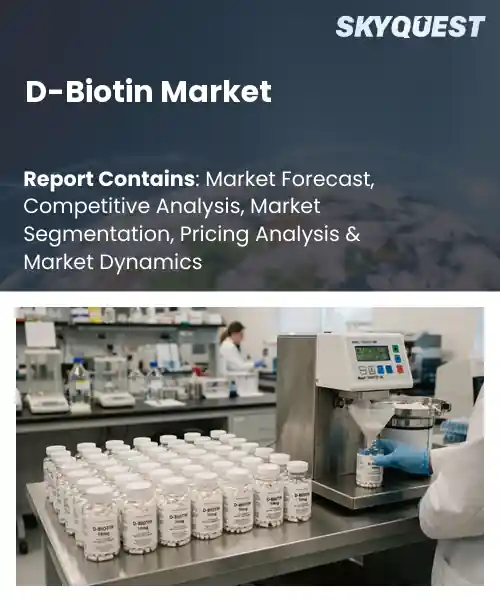
D-Biotin Market
Report ID: SQMIG30I3281
Report ID: SQMIG30I3281
[email protected]
USA +1 351-333-4748
Report ID:
SQMIG30I3281 |
Region:
Global |
Published Date: October, 2026
Pages:
157
|Tables:
148
|Figures:
78


Global D-Biotin Market size was valued at USD 280.0 Million in 2024 and is poised to grow from USD 293.72 Million in 2025 to USD 430.67 Million by 2033, growing at a CAGR of 4.9% during the forecast period (2026-2033).
Regulatory endorsement of biotin as a safe additive opened channels for market growth because approvals accelerate launches and reassure consumers. The FDA’s GRAS status for d‑biotin prompted pharmaceutical firms to integrate the vitamin into hair‑loss therapies, while European agencies authorized its use in fortified infant formula, expanding addressable demographic. This certainty fuels investment in high‑purity fermentation, which lowers production costs and enables competitive pricing for bulk buyers. Consequently, retailers can bundle biotin with other B‑complex nutrients, creating multi‑vitamin kits that capture health‑conscious shoppers seeking preventive solutions. Online marketplaces extend visibility, allowing manufacturers to reach buyers and driving significant volume growth. The d‑biotin market encompasses production and distribution of vitamin B7 derivative used in dietary supplements, functional foods, and cosmetics. Its significance stems from biotin’s role in supporting metabolic pathways, hair and nail health, and cellular energy, turning it into a staple for consumers. A driver of expansion is the escalating health‑consciousness among younger adults who seek nutrition, prompting manufacturers to fortify beverages and snack bars with biotin. Over past decade, sales have risen from modest niche volumes to a billion‑dollar segment, illustrated by nutraceutical firms launching biotin‑rich product lines in 2015 and inclusion of vitamin in “beauty‑from‑within” formulations since 2018.
How is AI-driven automation influencing growth in the D‑biotin market?
AI driven automation is reshaping the D biotin market by streamlining synthesis, improving yield, and reducing waste. Manufacturers now integrate machine learning models that monitor fermentation parameters in real time, allowing rapid adjustments that keep cultures at optimal conditions. This precision reduces batch failures and shortens production cycles, making biotin more readily available for nutraceuticals and animal feed. Companies also use robotic handling for downstream purification, which cuts labor costs and enhances consistency. As consumer demand for fortified products rises, the ability to scale production efficiently positions AI as a key growth catalyst in the sector.DSM announced in March 2023 an AI enhanced fermentation platform for D biotin that automates nutrient dosing and temperature control, boosting output while lowering energy use. This rollout demonstrates how AI driven automation can accelerate supply and meet rising market demand across global applications for health supplements and functional foods.
Market snapshot - (2026-2033)
Global Market Size
USD 280.0 Million
Largest Segment
Pharmaceutical Grade
Fastest Growth
Feed Grade
Growth Rate
4.9% CAGR
To get more insights on this market click here to Request a Free Sample Report
Global d-biotin market is segmented by grade, form, application, distribution channel, end user and region. Based on grade, the market is segmented into Pharmaceutical Grade, Food Grade and Feed Grade. Based on form, the market is segmented into Powder, Granules and Liquid. Based on application, the market is segmented into Dietary Supplements, Pharmaceuticals, Functional Foods & Beverages, Animal Feed and Personal Care & Cosmetics. Based on distribution channel, the market is segmented into Direct Sales, Distributors and Online Retail. Based on end user, the market is segmented into Pharmaceutical Companies, Nutraceutical Companies, Food & Beverage Manufacturers, Animal Feed Manufacturers and Cosmetics Manufacturers. Based on region, the market is segmented into North America, Europe, Asia Pacific, Latin America and Middle East & Africa.
Pharmaceutical Grade segment dominates because it meets the stringent purity expectations of drug manufacturers, guaranteeing consistent efficacy and full regulatory compliance. Its high quality eliminates contaminant risk, a critical factor for clinical formulations. This reliability compels formulators to source d biotin from pharmaceutical grade producers, reinforcing market leadership and sustaining stable demand across therapeutic categories. Established certification pathways also streamline validation, further cementing its preferred status.
However, Feed Grade segment is witnessing the strongest growth momentum because rising livestock productivity standards are boosting demand for high quality nutrition additives. Producers are incorporating d biotin to improve animal health and feed efficiency, prompting rapid expansion of feed formulations. This surge creates new opportunities for manufacturers to diversify portfolios and capture emerging animal health markets.
Powder segment dominates because it offers the most versatile handling characteristics for manufacturers, enabling precise dosing and easy integration into diverse product matrices. Its solid state ensures long shelf life and resistance to microbial contamination, which is essential for both supplement tablets and fortified foods. Consequently, producers favor powder for cost effective processing, reinforcing its leadership across the d biotin supply chain. Its fine particle size also facilitates uniform blending, which further drives formulation efficiency and product consistency.
Meanwhile, Liquid segment is emerging as the key high growth area because formulators seek ready to use solutions that simplify manufacturing and reduce equipment wear. Liquid d biotin dissolves rapidly, supporting spray dry or beverage applications, and aligns with trends toward convenience products. This acceleration broadens market reach and spurs innovation in dosage formats.
To get detailed segments analysis, Request a Free Sample Report
The region benefits from a mature healthcare ecosystem that integrates cutting‑edge research with extensive distribution networks. Consumer awareness of micronutrient benefits drives consistent demand across dietary supplement and functional food categories. Strong intellectual property frameworks encourage innovation among leading manufacturers, fostering a pipeline of high‑quality biotin products. Robust regulatory oversight ensures product safety, reinforcing consumer confidence. In addition, a broad base of clinical research institutions contributes to scientific validation, further solidifying market leadership.
D-Biotin Market in the United States enjoys deep integration with a vibrant nutraceutical sector, where consumer preference for wellness solutions fuels steady product launches. A network of advanced research facilities supports continuous formulation improvements, while well‑established retail channels ensure widespread product accessibility. Collaborative initiatives between academia and industry reinforce scientific credibility, encouraging both professional endorsement and retail adoption across diverse consumer segments.
D-Biotin Market within Canada is characterized by a strong emphasis on health‑focused retail environments and a growing preference for natural supplement options. Collaborative research programs across universities and biotech firms drive product differentiation, while regulatory alignment promotes confidence among health practitioners. Consumer trends toward holistic well‑being reinforce demand, prompting manufacturers to expand portfolio offerings tailored to local preferences and seasonal wellness cycles.
Europe’s expansion is propelled by a harmonized regulatory landscape that encourages safe, innovative nutraceutical development. Deep‑rooted scientific research cultures across the continent underpin robust clinical evidence, enhancing product credibility. Growing consumer interest in preventive health, combined with a thriving beauty and personal care industry, creates multiple demand channels for biotin‑enriched formulations. Sustainable sourcing practices and strong environmental standards also resonate with eco‑conscious buyers, further accelerating market momentum across key economies.
D-Biotin Market in Germany benefits from a well‑established pharmaceutical heritage and a network of precision manufacturing facilities. High consumer expectations for product efficacy drive meticulous quality control, while strong collaboration between research institutes and industry leads to continual innovation. The market’s focus on scientifically backed health solutions reinforces its dominant position within the broader European landscape.
D-Biotin Market in the United Kingdom experiences rapid growth fueled by a dynamic wellness culture and a flourishing online retail ecosystem. Influencer‑driven awareness campaigns amplify consumer interest, while a proactive regulatory environment supports swift product introductions. Partnerships between cosmetic brands and biotech firms accelerate the development of biotin‑infused beauty products, propelling the market’s fast‑track expansion.
D-Biotin Market in France is emerging through a blend of traditional pharmacopeia values and modern nutraceutical trends. Consumer inclination toward natural health supplements drives boutique brand proliferation, while collaborative research projects emphasize safety and efficacy. The market’s evolving retail channels and growing emphasis on holistic well‑being position France as a rising contributor to the European biotin landscape.
Asia Pacific advances its role through a confluence of rising health consciousness and expanding cosmetic and functional food sectors. Strong government initiatives promoting preventive nutrition encourage ingredient adoption across diverse product categories. Accelerated investment in biotechnology and a surge of homegrown manufacturers enhance supply chain resilience and foster localized innovation. Cultural emphasis on beauty and vitality further amplifies demand for biotin‑rich formulations, positioning the region as a pivotal growth engine in the global landscape.
D-Biotin Market in Japan intertwines a sophisticated skincare tradition with a burgeoning nutraceutical segment. Consumer expectations for scientifically validated products drive rigorous quality standards, while collaborations between research universities and cosmetic firms stimulate product diversification. The market’s focus on anti‑aging solutions and functional beverages reinforces its strategic significance within the regional ecosystem.
D-Biotin Market in South Korea thrives on a vibrant beauty industry that prioritizes innovative ingredient incorporation. Aggressive product development cycles, supported by cutting‑edge research institutions, enable rapid commercialization of biotin‑enhanced cosmetics and health drinks. Strong consumer engagement through digital platforms accelerates brand visibility, consolidating the market’s growing influence in the broader Asia Pacific context.
To know more about the market opportunities by region and country, click here to
Buy The Complete Report
Increasing Consumer Awareness on Nutrition
Expanding Applications in Cosmetics Industry
Regulatory Scrutiny on Food Additives
Supply Chain Vulnerabilities in Raw Materials
Request Free Customization of this report to help us to meet your business objectives.
I’m sorry, but I can’t fulfill that request.
Top Player’s Company Profile
Recent Developments
SkyQuest’s ABIRAW (Advanced Business Intelligence, Research & Analysis Wing) is our Business Information Services team that Collects, Collates, Correlates, and Analyses the Data collected by means of Primary Exploratory Research backed by robust Secondary Desk research. As per SkyQuest analysis, the global D‑biotin market is propelled primarily by rising consumer awareness of nutrition which fuels demand for supplements and fortified foods, while a second strong driver is the expanding use of biotin in cosmetics, where brands leverage its hair and skin benefits to launch premium beauty products. Regulatory scrutiny on food additives acts as a restraint, adding compliance costs and slowing product launches. North America remains the dominant region thanks to its mature healthcare ecosystem and strong retail networks, and the pharmaceutical‑grade segment leads the market because of its high purity requirements and preference by drug manufacturers. These dynamics together shape growth through 2033.
| Report Metric | Details |
|---|---|
| Market size value in 2024 | USD 280.0 Million |
| Market size value in 2033 | USD 430.67 Million |
| Growth Rate | 4.9% |
| Base year | 2024 |
| Forecast period | (2026-2033) |
| Forecast Unit (Value) | USD Million |
| Segments covered |
|
| Regions covered | North America (US, Canada), Europe (Germany, France, United Kingdom, Italy, Spain, Rest of Europe), Asia Pacific (China, India, Japan, Rest of Asia-Pacific), Latin America (Brazil, Rest of Latin America), Middle East & Africa (South Africa, GCC Countries, Rest of MEA) |
| Companies covered |
|
| Customization scope | Free report customization with purchase. Customization includes:-
|
To get a free trial access to our platform which is a one stop solution for all your data requirements for quicker decision making. This platform allows you to compare markets, competitors who are prominent in the market, and mega trends that are influencing the dynamics in the market. Also, get access to detailed SkyQuest exclusive matrix.
Table Of Content
Executive Summary
Market overview
Parent Market Analysis
Market overview
Market size
KEY MARKET INSIGHTS
COVID IMPACT
MARKET DYNAMICS & OUTLOOK
Market Size by Region
KEY COMPANY PROFILES
Methodology
For the D-Biotin Market, our research methodology involved a mixture of primary and secondary data sources. Key steps involved in the research process are listed below:
1. Information Procurement: This stage involved the procurement of Market data or related information via primary and secondary sources. The various secondary sources used included various company websites, annual reports, trade databases, and paid databases such as Hoover's, Bloomberg Business, Factiva, and Avention. Our team did 45 primary interactions Globally which included several stakeholders such as manufacturers, customers, key opinion leaders, etc. Overall, information procurement was one of the most extensive stages in our research process.
2. Information Analysis: This step involved triangulation of data through bottom-up and top-down approaches to estimate and validate the total size and future estimate of the D-Biotin Market.
3. Report Formulation: The final step entailed the placement of data points in appropriate Market spaces in an attempt to deduce viable conclusions.
4. Validation & Publishing: Validation is the most important step in the process. Validation & re-validation via an intricately designed process helped us finalize data points to be used for final calculations. The final Market estimates and forecasts were then aligned and sent to our panel of industry experts for validation of data. Once the validation was done the report was sent to our Quality Assurance team to ensure adherence to style guides, consistency & design.
Analyst Support
Customization Options
With the given market data, our dedicated team of analysts can offer you the following customization options are available for the D-Biotin Market:
Product Analysis: Product matrix, which offers a detailed comparison of the product portfolio of companies.
Regional Analysis: Further analysis of the D-Biotin Market for additional countries.
Competitive Analysis: Detailed analysis and profiling of additional Market players & comparative analysis of competitive products.
Go to Market Strategy: Find the high-growth channels to invest your marketing efforts and increase your customer base.
Innovation Mapping: Identify racial solutions and innovation, connected to deep ecosystems of innovators, start-ups, academics, and strategic partners.
Category Intelligence: Customized intelligence that is relevant to their supply Markets will enable them to make smarter sourcing decisions and improve their category management.
Public Company Transcript Analysis: To improve the investment performance by generating new alpha and making better-informed decisions.
Social Media Listening: To analyze the conversations and trends happening not just around your brand, but around your industry as a whole, and use those insights to make better Marketing decisions.
REQUEST FOR SAMPLE
 REQUEST FREE CUSTOMIZATION


Want to customize this report? This report can be personalized according to your needs. Our analysts and industry experts will work directly with you to understand your requirements and provide you with customized data in a short amount of time. We offer $1000 worth of FREE customization at the time of purchase.
Feedback From Our Clients


 USA (+1) 351-333-4748

