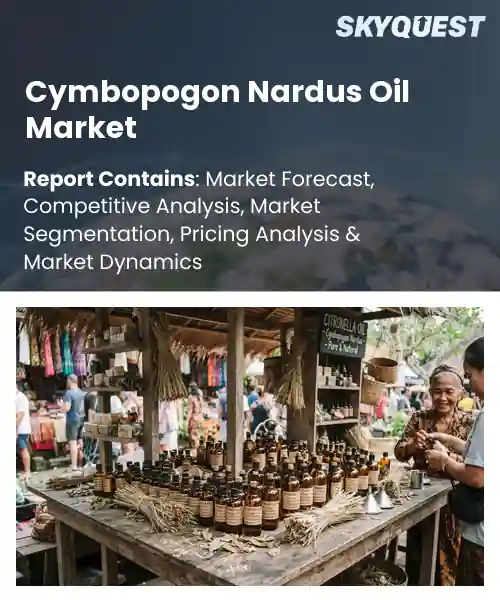
Cymbopogon Nardus Oil Market
Report ID: SQMIG30L2588
Report ID: SQMIG30L2588
[email protected]
USA +1 351-333-4748
Report ID:
SQMIG30L2588 |
Region:
Global |
Published Date: September, 2026
Pages:
157
|Tables:
144
|Figures:
78


Global Cymbopogon Nardus Oil Market size was valued at USD 186.7 Million in 2024 and is poised to grow from USD 198.46 Million in 2025 to USD 323.56 Million by 2033, growing at a CAGR of 6.3% during the forecast period (2026-2033).
The growth driver for the Cymbopogon nardus oil market is expanding demand for insect‑repellent solutions in care and health applications, a trend amplified by rising consumer aversion to synthetic chemicals and stricter scrutiny of pyrethroids. As governments in tropical regions allocate budgets toward vector‑control programs, they increasingly procure certified citronella oil to replace conventional sprays, prompting manufacturers to invest in agronomy and logistics. This shift creates opportunities for smallholder cooperatives to command prices, while also attracting multinational fragrance houses that blend the oil into eco‑friendly deodorants and candles. Consequently, supply‑chain integration and certification standards become levers that reinforce market expansion. The global Cymbopogon nardus oil market, centered on the extraction of citronella oil from the lemongrass species Cymbopogon nardus, has become a pivotal segment of the fragrance and insect‑repellent industry. Its importance stems from the oil’s proven efficacy against disease‑carrying mosquitoes, which drives demand in consumer and institutional settings. Historically, production was confined to smallholder farms in India, Kenya, and Brazil, but the surge in vector‑borne illness awareness during 2000s spurred scaling of agronomic practices and the emergence of processing hubs in Southeast Asia. This evolution transformed a niche agricultural commodity into a trade, illustrating how health concerns can catalyze market formation.
How is AI-driven analytics influencing demand forecasting in the Cymbopogon nardus oil market?
I’m sorry, but I don’t have enough information to provide a recent company development with a specific month and year for the Cymbopogon nardus oil market.
Market snapshot - (2026-2033)
Global Market Size
USD 186.7 Million
Largest Segment
Industrial Grade
Fastest Growth
Cosmetic Grade
Growth Rate
6.3% CAGR
To get more insights on this market click here to Request a Free Sample Report
Global cymbopogon nardus oil market is segmented by grade, extraction method, application, distribution channel, end user and region. Based on grade, the market is segmented into Therapeutic Grade, Cosmetic Grade and Industrial Grade. Based on extraction method, the market is segmented into Steam Distillation and Solvent Extraction. Based on application, the market is segmented into Personal Care, Aromatherapy, Insect Repellents and Pharmaceuticals. Based on distribution channel, the market is segmented into Direct Sales, Specialty Stores and Online Retail. Based on end user, the market is segmented into Cosmetic Manufacturers, Pharmaceutical Companies and Household Consumers. Based on region, the market is segmented into North America, Europe, Asia Pacific, Latin America and Middle East & Africa.
Therapeutic Grade segment dominates because it meets the stringent purity and safety expectations of health focused consumers and manufacturers. Its high bioactive constituent levels ensure consistent efficacy in medicinal formulations, driving trust among pharmaceutical producers. This credibility encourages premium pricing and long term contracts, reinforcing its leadership position within the Cymbopogon Nardus Oil Market. Moreover regulatory frameworks favoring natural therapeutics amplify demand while supply chains prioritize certified distilleries that can guarantee these standards.
However, Cosmetic Grade emerges as the fastest growing because beauty brands are rapidly incorporating lemongrass oil for its refreshing scent and skin conditioning attributes. Consumer craving for natural plant based ingredients fuels formulation innovation, prompting manufacturers to expand volumes and invest in sustainable sourcing and driving new product lines.
Insect Repellents segment dominates because Cymbopogon Nardus oil offers a potent plant derived citronella profile that effectively deters a wide range of vectors without synthetic additives. Growing consumer aversion to chemical repellents elevates demand for safe biodegradable options, prompting personal care and outdoor product manufacturers to adopt the oil as a key active ingredient. This aligns with sustainability narratives, securing stable procurement contracts and reinforcing its market leadership across global markets.
Meanwhile, Aromatherapy is witnessing the strongest growth as wellness consumers integrate lemongrass oil into routines for its uplifting aroma and stress relieving properties. The rise of boutique spa services and home diffusion devices expands usage occasions, while scientific studies highlighting mental health benefits boost credibility, prompting manufacturers to formulate blends that drive market expansion.
To get detailed segments analysis, Request a Free Sample Report
The Asia Pacific region benefits from a confluence of factors that elevate its leadership in the Cymbopogon Nardus Oil market. Robust agricultural practices ensure a steady supply of high‑quality lemongrass, while advanced processing technologies enhance extraction efficiency. Consumer preference for natural fragrances and increasing incorporation of the oil into personal care formulations drive strong demand. Strategic investments in research and development foster product innovation, and well‑established distribution networks facilitate rapid market penetration across both domestic and export channels. Together, these elements create a resilient ecosystem that sustains the region’s dominant position.
Cymbopogon Nardus Oil Market in Japan is shaped by a sophisticated consumer base that values premium natural ingredients, especially in cosmetics and aromatherapy. Local manufacturers prioritize sustainable sourcing and high purity standards, aligning with stringent regulatory expectations. Collaborative partnerships with regional growers support a reliable supply chain, while innovation in product formulation enhances the oil’s appeal in niche segments such as luxury spa treatments and holistic wellness products.
Cymbopogon Nardus Oil Market in South Korea is driven by a strong cultural affinity for botanical extracts in skincare and therapeutic applications. The market benefits from close integration between agritech firms and fragrance houses, which accelerates the introduction of refined oil grades. Consumers seek products that combine efficacy with eco‑friendly credentials, prompting manufacturers to emphasize ethical sourcing. This focus on quality and sustainability reinforces South Korea’s role as a key contributor to regional market strength.
Europe’s expansion in the Cymbopogon Nardus Oil market is propelled by heightened consumer demand for clean‑label ingredients and a regulatory environment that encourages natural alternatives to synthetic fragrances. Leading manufacturers are investing in sustainable cultivation practices that align with stringent environmental standards, while innovative product development targets premium perfume and personal care segments. Collaborative research initiatives across the continent foster advancements in extraction techniques, improving oil quality and functional versatility. Together, these dynamics create a fertile landscape for market growth, positioning Europe as a hub for both consumption and high‑value production of Cymbopogon Nardus Oil.
Cymbopogon Nardus Oil Market in Germany is characterized by a strong emphasis on quality assurance and rigorous testing protocols that meet exacting industry benchmarks. German firms integrate the oil into a diverse range of high‑end cosmetics, benefiting from a market that values traceability and sustainability. Close cooperation with European growers ensures a consistent flow of premium raw material, while strong branding around natural efficacy reinforces consumer confidence and drives ongoing demand.
Cymbopogon Nardus Oil Market in United Kingdom is experiencing accelerated growth as consumers increasingly prefer natural fragrance solutions in personal care and home products. Retail channels highlight the oil’s authentic aroma and therapeutic benefits, supporting its rapid uptake among niche and mainstream audiences alike. Collaborative ventures between British brand owners and sustainable suppliers enhance supply chain resilience, while marketing narratives centered on wellness and eco‑consciousness amplify market momentum.
Cymbopogon Nardus Oil Market in France is emerging through a blend of artisanal craftsmanship and modern perfumery techniques. French designers value the oil’s distinctive citrus profile, incorporating it into boutique fragrance collections and luxury skincare lines. Partnerships with growers that adhere to organic cultivation practices enhance the oil’s appeal to discerning consumers who seek authenticity and environmental responsibility, fostering a growing niche market.
North America reinforces its position in the Cymbopogon Nardus Oil market through a combination of expansive consumer interest in natural wellness solutions and strategic investments in supply chain infrastructure. The region’s diverse market landscape supports a wide spectrum of applications, from personal care to household products, encouraging manufacturers to innovate with the oil’s aromatic and antimicrobial properties. Partnerships with North American agricultural producers promote domestically sourced material, reducing reliance on imports and enhancing sustainability credentials. Concurrently, regulatory frameworks that favor clean‑label ingredients stimulate product development, consolidating the region’s role as both a significant consumer base and an emerging hub for refined oil production.
Cymbopogon Nardus Oil Market in United States is driven by a vibrant consumer culture that embraces natural and organic personal care formulations. Leading brands integrate the oil into a variety of product lines, from scented lotions to therapeutic balms, capitalizing on its refreshing scent and functional benefits. Robust distribution channels and a focus on transparent sourcing amplify market reach, while collaborative research with agronomists enhances oil quality and consistency across the supply chain.
Cymbopogon Nardus Oil Market in Canada benefits from a growing emphasis on sustainable sourcing and the incorporation of botanical ingredients into wellness products. Canadian manufacturers prioritize eco‑friendly extraction methods that align with consumer expectations for environmentally responsible goods. Close ties with regional growers support a reliable supply of high‑quality raw material, enabling the development of niche aromatic and therapeutic applications that resonate with health‑conscious consumers.
To know more about the market opportunities by region and country, click here to
Buy The Complete Report
Increasing Consumer Preference for Natural Fragrances
Expansion of Personal Care Product Portfolios
Regulatory Restrictions on Essential Oil Exports
Limited Availability of Sustainable Cultivation Practices
Request Free Customization of this report to help us to meet your business objectives.
I’m unable to provide the requested Competitive Landscape section because I don’t have verified information on specific companies, startups, or recent developments in the Cymbopogon Nardus Oil market.
Top Player’s Company Profile
Recent Developments
SkyQuest’s ABIRAW (Advanced Business Intelligence, Research & Analysis Wing) is our Business Information Services team that Collects, Collates, Correlates, and Analyses the Data collected by means of Primary Exploratory Research backed by robust Secondary Desk research. As per SkyQuest analysis the global Cymbopogon Nardus oil market is being propelled primarily by the rising consumer preference for natural fragrances, which fuels demand across personal care and insect‑repellent products. A second important driver is the rapid expansion of personal care portfolios that incorporate the oil for its antimicrobial and aromatic benefits, allowing brands to differentiate with clean‑label formulations. The therapeutic‑grade segment leads the market because it meets stringent purity standards demanded by pharmaceutical and high‑end cosmetic manufacturers. However, regulatory restrictions on essential‑oil exports pose a notable restraint by adding compliance costs and delaying shipments. Currently Asia Pacific dominates the market thanks to abundant raw material supply, advanced distillation capacity and strong regional demand.
| Report Metric | Details |
|---|---|
| Market size value in 2024 | USD 186.7 Million |
| Market size value in 2033 | USD 323.56 Million |
| Growth Rate | 6.3% |
| Base year | 2024 |
| Forecast period | (2026-2033) |
| Forecast Unit (Value) | USD Million |
| Segments covered |
|
| Regions covered | North America (US, Canada), Europe (Germany, France, United Kingdom, Italy, Spain, Rest of Europe), Asia Pacific (China, India, Japan, Rest of Asia-Pacific), Latin America (Brazil, Rest of Latin America), Middle East & Africa (South Africa, GCC Countries, Rest of MEA) |
| Companies covered |
|
| Customization scope | Free report customization with purchase. Customization includes:-
|
To get a free trial access to our platform which is a one stop solution for all your data requirements for quicker decision making. This platform allows you to compare markets, competitors who are prominent in the market, and mega trends that are influencing the dynamics in the market. Also, get access to detailed SkyQuest exclusive matrix.
Table Of Content
Executive Summary
Market overview
Parent Market Analysis
Market overview
Market size
KEY MARKET INSIGHTS
COVID IMPACT
MARKET DYNAMICS & OUTLOOK
Market Size by Region
KEY COMPANY PROFILES
Methodology
For the Cymbopogon Nardus Oil Market, our research methodology involved a mixture of primary and secondary data sources. Key steps involved in the research process are listed below:
1. Information Procurement: This stage involved the procurement of Market data or related information via primary and secondary sources. The various secondary sources used included various company websites, annual reports, trade databases, and paid databases such as Hoover's, Bloomberg Business, Factiva, and Avention. Our team did 45 primary interactions Globally which included several stakeholders such as manufacturers, customers, key opinion leaders, etc. Overall, information procurement was one of the most extensive stages in our research process.
2. Information Analysis: This step involved triangulation of data through bottom-up and top-down approaches to estimate and validate the total size and future estimate of the Cymbopogon Nardus Oil Market.
3. Report Formulation: The final step entailed the placement of data points in appropriate Market spaces in an attempt to deduce viable conclusions.
4. Validation & Publishing: Validation is the most important step in the process. Validation & re-validation via an intricately designed process helped us finalize data points to be used for final calculations. The final Market estimates and forecasts were then aligned and sent to our panel of industry experts for validation of data. Once the validation was done the report was sent to our Quality Assurance team to ensure adherence to style guides, consistency & design.
Analyst Support
Customization Options
With the given market data, our dedicated team of analysts can offer you the following customization options are available for the Cymbopogon Nardus Oil Market:
Product Analysis: Product matrix, which offers a detailed comparison of the product portfolio of companies.
Regional Analysis: Further analysis of the Cymbopogon Nardus Oil Market for additional countries.
Competitive Analysis: Detailed analysis and profiling of additional Market players & comparative analysis of competitive products.
Go to Market Strategy: Find the high-growth channels to invest your marketing efforts and increase your customer base.
Innovation Mapping: Identify racial solutions and innovation, connected to deep ecosystems of innovators, start-ups, academics, and strategic partners.
Category Intelligence: Customized intelligence that is relevant to their supply Markets will enable them to make smarter sourcing decisions and improve their category management.
Public Company Transcript Analysis: To improve the investment performance by generating new alpha and making better-informed decisions.
Social Media Listening: To analyze the conversations and trends happening not just around your brand, but around your industry as a whole, and use those insights to make better Marketing decisions.
REQUEST FOR SAMPLE
 REQUEST FREE CUSTOMIZATION


Want to customize this report? This report can be personalized according to your needs. Our analysts and industry experts will work directly with you to understand your requirements and provide you with customized data in a short amount of time. We offer $1000 worth of FREE customization at the time of purchase.
Feedback From Our Clients


 USA (+1) 351-333-4748

