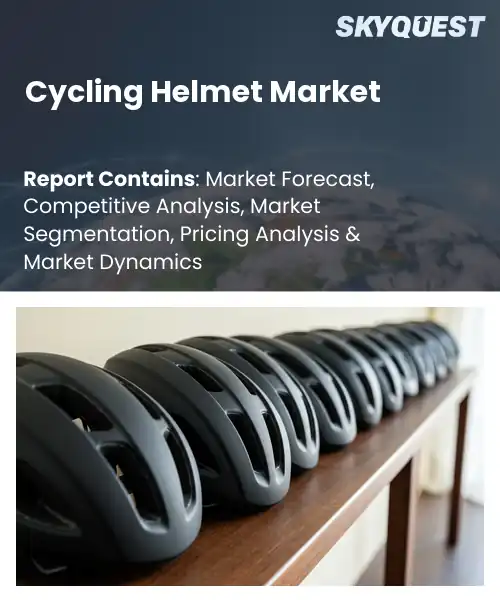
Cycling Helmet Market
Report ID: SQMIG25J2243
Report ID: SQMIG25J2243
[email protected]
USA +1 351-333-4748
Report ID:
SQMIG25J2243 |
Region:
Global |
Published Date: July, 2026
Pages:
157
|Tables:
203
|Figures:
80


Global Cycling Helmet Market size was valued at USD 724.3 Million in 2024 and is poised to grow from USD 743.86 Million in 2025 to USD 920.56 Million by 2033, growing at a CAGR of 2.7% during the forecast period (2026-2033).
The global cycling helmet market comprises protective headgear designed for recreational, commuter, and competitive cyclists, a sector that has expanded alongside rising bicycle usage worldwide. Its importance lies in mitigating traumatic brain injuries, a concern amplified by increasing road accidents and heightened safety regulations. The primary driver today is the surge in urban cycling, where cities such as Amsterdam, Portland, and Shenzhen have invested in bike lanes and incentive programs, prompting more commuters to adopt helmets as a norm.
Beyond urban commuting, the second major factor fueling the market is technological innovation, which creates a feedback loop that pushes consumer demand. Advanced materials such as MIPS and expanded polystyrene reduce rotational forces, encouraging professional teams and casual riders to replace legacy helmets with models. As manufacturers launch smart helmets equipped with integrated lights, Bluetooth communication, and crash‑detection sensors, insurers begin offering premium reductions for users who adopt these devices, thereby lowering risk premiums. This cause‑and‑effect chain innovation prompting adoption, which then triggers policy incentives opens opportunities for niche segments like e‑bike enthusiasts and youth safety programs, expanding the market’s reach.
How is IoT integration driving innovation in the cycling helmet market?
IoT integration is reshaping cycling helmets by embedding sensors that monitor impact, heart rate and route data. Real time alerts to smartphones help riders react to crashes and improve training. Connectivity also enables firmware updates that keep safety standards current without replacing the shell. Manufacturers are pairing lightweight composites with low power Bluetooth modules, creating products that feel like traditional helmets but deliver digital insights. As urban commuting rises, riders value helmets that double as personal safety assistants and performance coaches. This blend of protection and data is attracting tech savvy cyclists and expanding the market beyond pure sport enthusiasts.
Giro announced a new IoT enabled helmet in May 2026, adding integrated crash detection and live location sharing that syncs with rider apps. This feature set illustrates how connected technology is boosting safety appeal and driving broader adoption across casual and competitive cyclists.
Market snapshot - (2026-2033)
Global Market Size
USD 724.3 Million
Largest Segment
Road Helmets
Fastest Growth
Urban/Commuter Helmets
Growth Rate
2.7% CAGR
To get more insights on this market click here to Request a Free Sample Report
Global cycling helmet market is segmented by type, technology, material, application, end user, distribution channel, price range and region. Based on type, the market is segmented into Road Helmets, Mountain Bike (MTB) Helmets, Urban/Commuter Helmets, BMX Helmets, Full-Face/Downhill Helmets, Kids' Helmets and Others. Based on technology, the market is segmented into Conventional Helmets and Smart Helmets. Based on material, the market is segmented into Polycarbonate, Carbon Fiber, Fiberglass, Expanded Polystyrene (EPS) and Others. Based on application, the market is segmented into Commuting & Urban Mobility, Road Cycling, Mountain Biking, Sports & Racing and Recreational Cycling. Based on end user, the market is segmented into Adults and Children. Based on distribution channel, the market is segmented into Offline Retail and Online Retail. Based on price range, the market is segmented into Economy, Mid-Range and Premium. Based on region, the market is segmented into North America, Europe, Asia Pacific, Latin America and Middle East & Africa.
Road helmets segment dominates with large cycling helmet market share because cyclists prioritize aerodynamic efficiency, weight reduction, and precision fit for speed oriented riding. Enthusiasts and competitive athletes gravitate toward designs that integrate ventilation, impact absorbing liners, and sleek aesthetics, reinforcing brand loyalty. Manufacturers focus R&D on advanced shell molding and strap systems to meet these expectations, creating a virtuous cycle of product refinement and consumer preference that keeps road helmets at the forefront of market demand.
As per cycling helmet market outlook, smart helmets segment is witnessing the strongest growth momentum as connectivity features like real time navigation, crash detection, and integrated audio appeal to tech savvy riders. These innovations expand the helmet’s functional value beyond safety, prompting new purchase triggers and opening avenues for data driven services, thereby accelerating market expansion.
As per cycling helmet market forecast, carbon fiber segment dominates because its high strength to weight ratio satisfies demanding performance riders seeking ultra light protection. The material enables intricate shell geometries that enhance ventilation while preserving impact absorption, reinforcing perceived premium quality. Brands leverage carbon fiber to differentiate product lines, justifying higher price points and fostering a loyal customer base that fuels sustained market leadership. It also aligns with sustainability narratives as manufacturers recycle scrap fibers, enhancing brand ethos.
Meanwhile, polycarbonate segment is emerging as the key high growth area as manufacturers adopt advanced molding techniques to improve impact distribution while keeping costs low. This material’s adaptability supports mass production of stylish designs, attracting broader consumer groups and meeting regulatory safety standards, thereby unlocking new market volumes and encouraging widespread adoption across price tiers.
To get detailed segments analysis, Request a Free Sample Report
Europe’s dominance drives from a mature cycling culture combined with rigorous safety standards that encourage widespread helmet adoption. Strong governmental policies promote protective equipment, while well‑established retail networks ensure easy accessibility. Consumers demonstrate heightened awareness of personal safety, reinforced by extensive public‑health campaigns and a tradition of active mobility. Leading manufacturers benefit from advanced research facilities and collaborative innovation ecosystems across the region, fostering continuous product improvement. Moreover, the integration of cycling into urban planning and tourism supports sustained demand, reinforcing Europe’s position at the forefront of the global market.
As per cycling helmet market regional outlook, Germany thrives on a robust framework of safety legislation that mandates protective gear for many cycling activities. Consumer confidence is bolstered by a reputation for engineering excellence, encouraging preference for high‑performance helmets. Retail channels are well‑distributed, ranging from specialty stores to online platforms, facilitating convenient access. Collaborative partnerships between academic institutions and industry drive ongoing material and design advancements. Cultural emphasis on outdoor recreation further sustains interest and purchase behavior.
As per cycling helmet market regional forecast, United Kingdom is propelled by strong public‑health messaging that underscores the importance of head protection. Urban cycling initiatives and expanding bike‑share schemes increase visibility of safety gear, reinforcing habitual use. A diverse array of domestic and international brands compete on quality and style, appealing to varied consumer tastes. Retail presence spans independent bike shops and major e‑commerce sites, ensuring broad market coverage. Continuous engagement from advocacy groups maintains momentum for safety‑first attitudes among cyclists.
France benefits from a deep‑rooted appreciation for cycling as both sport and daily transport. Government incentives encourage active mobility, indirectly fostering higher helmet uptake. Design innovation is supported by collaborations between fashion entities and technical manufacturers, creating products that blend safety with aesthetic appeal. Distribution networks are extensive, reaching urban centers and rural communities alike. Public campaigns highlighting injury prevention reinforce consumer commitment to wearing helmets across all riding contexts.
North America experiences rapid expansion due to a convergence of heightened safety consciousness and growing participation in both recreational and commuter cycling. Influential advocacy groups and insurance incentives promote helmet usage, while retail environments adapt to increasingly fashion‑forward consumer preferences. Technological progress, particularly in lightweight composites, elevates performance expectations, spurring demand for premium products. Urban development strategies that prioritize bike infrastructure further embed cycling into daily life, amplifying market opportunities. Collaborative efforts between manufacturers, sports organizations, and health agencies create a synergistic environment that accelerates growth across the region.
As per cycling helmet industry analysis, United States is shaped by widespread advocacy for helmet use in schools, sports programs, and community events. A vibrant ecosystem of manufacturers leverages cutting‑edge materials to meet diverse performance criteria. Retail channels incorporate experiential showrooms and extensive online platforms, enhancing consumer engagement. Partnerships with cycling clubs and professional athletes amplify visibility and desirability of protective gear. Ongoing public‑education initiatives reinforce the perception of helmets as essential components of responsible riding.
Canada reflects strong governmental support for safe active transportation and winter cycling adaptations. Consumer preferences lean toward versatile designs that address varying weather conditions while maintaining safety standards. Distribution networks balance specialty bike stores with broad‑reach e‑commerce options, ensuring accessibility across remote and urban areas. Collaborative research between academic institutions and manufacturers drives material innovation suited to cold environments. Community programs and health campaigns sustain awareness, encouraging consistent helmet adoption among cyclists of all ages.
Asia Pacific is strengthening its position through a blend of rapid urbanization, rising health awareness, and investment in advanced manufacturing capabilities. Growing middle‑class populations are embracing cycling as a lifestyle choice, prompting demand for protective gear that aligns with both performance and style. Governments are introducing policies that support safe cycling infrastructure, indirectly boosting helmet uptake. The region’s manufacturing base excels at integrating cutting‑edge materials at competitive costs, attracting global brand collaborations. Cultural shifts toward environmentally friendly mobility further embed helmets as standard accessories for the expanding cyclist community.
Japan is driven by meticulous attention to safety standards and a cultural emphasis on precision engineering. Consumers value helmets that combine lightweight construction with superior impact protection, prompting manufacturers to prioritize material innovation. Retail environments range from dedicated cycling boutiques to high‑tech department stores, offering curated selections. Collaborations with professional racing teams elevate brand credibility and inspire adoption among enthusiasts. Public health campaigns reinforce the norm of helmet use across both urban commuters and recreational riders.
South Korea benefits from a tech‑savvy consumer base that embraces smart and connected accessories. Integration of sensor technology and ergonomic design appeals to cyclists seeking enhanced safety features. Strong domestic manufacturing expertise enables rapid prototyping and adaptation to market trends. Retail strategies include immersive flagship stores and dynamic online platforms, fostering interactive shopping experiences. Government initiatives promoting active transport and safe riding practices support widespread acceptance of helmets as essential cycling equipment.
To know more about the market opportunities by region and country, click here to
Buy The Complete Report
Increasing Safety Awareness
Technology Integration in Helmets
High Product Cost
Regulatory Variation Across Regions
Request Free Customization of this report to help us to meet your business objectives.
The competitive landscape of the global cycling helmet industry is shaped by intense rivalry among established manufacturers and emerging tech‑focused entrants, driving innovations such as integrated sensor systems, lightweight composite materials, and collaborations with sports brands to launch co‑branded collections; recent M&A activity includes larger firms acquiring niche safety‑technology startups to broaden product portfolios and accelerate time‑to‑market for advanced helmet solutions.
SkyQuest’s ABIRAW (Advanced Business Intelligence, Research & Analysis Wing) is our Business Information Services team that Collects, Collates, Correlates, and Analyses the Data collected by means of Primary Exploratory Research backed by robust Secondary Desk research.
As per SkyQuest analysis the global cycling helmet market growth is being propelled primarily by rising safety awareness among commuters and recreational riders, while the surge in smart‑technology integration such as crash‑detection sensors and Bluetooth connectivity serves as a second strong driver expanding product appeal. High product cost, however, remains a restraint that limits adoption in price‑sensitive segments and emerging economies. Europe dominates the market due to mature cycling culture, stringent safety regulations and extensive retail networks. Within the product landscape road helmets hold the largest share, driven by demand for aerodynamic performance and lightweight composites. The global cycling helmet market trend is experiencing steady growth driven by increasing awareness of cyclist safety, rising adoption of bicycles for fitness, recreation, commuting, and eco-friendly transportation.
| Report Metric | Details |
|---|---|
| Market size value in 2024 | USD 724.3 Million |
| Market size value in 2033 | USD 920.56 Million |
| Growth Rate | 2.7% |
| Base year | 2024 |
| Forecast period | (2026-2033) |
| Forecast Unit (Value) | USD Million |
| Segments covered |
|
| Regions covered | North America (US, Canada), Europe (Germany, France, United Kingdom, Italy, Spain, Rest of Europe), Asia Pacific (China, India, Japan, Rest of Asia-Pacific), Latin America (Brazil, Rest of Latin America), Middle East & Africa (South Africa, GCC Countries, Rest of MEA) |
| Companies covered |
|
| Customization scope | Free report customization with purchase. Customization includes:-
|
To get a free trial access to our platform which is a one stop solution for all your data requirements for quicker decision making. This platform allows you to compare markets, competitors who are prominent in the market, and mega trends that are influencing the dynamics in the market. Also, get access to detailed SkyQuest exclusive matrix.
Table Of Content
Executive Summary
Market overview
Parent Market Analysis
Market overview
Market size
KEY MARKET INSIGHTS
COVID IMPACT
MARKET DYNAMICS & OUTLOOK
Market Size by Region
KEY COMPANY PROFILES
Methodology
For the Cycling Helmet Market, our research methodology involved a mixture of primary and secondary data sources. Key steps involved in the research process are listed below:
1. Information Procurement: This stage involved the procurement of Market data or related information via primary and secondary sources. The various secondary sources used included various company websites, annual reports, trade databases, and paid databases such as Hoover's, Bloomberg Business, Factiva, and Avention. Our team did 45 primary interactions Globally which included several stakeholders such as manufacturers, customers, key opinion leaders, etc. Overall, information procurement was one of the most extensive stages in our research process.
2. Information Analysis: This step involved triangulation of data through bottom-up and top-down approaches to estimate and validate the total size and future estimate of the Cycling Helmet Market.
3. Report Formulation: The final step entailed the placement of data points in appropriate Market spaces in an attempt to deduce viable conclusions.
4. Validation & Publishing: Validation is the most important step in the process. Validation & re-validation via an intricately designed process helped us finalize data points to be used for final calculations. The final Market estimates and forecasts were then aligned and sent to our panel of industry experts for validation of data. Once the validation was done the report was sent to our Quality Assurance team to ensure adherence to style guides, consistency & design.
Analyst Support
Customization Options
With the given market data, our dedicated team of analysts can offer you the following customization options are available for the Cycling Helmet Market:
Product Analysis: Product matrix, which offers a detailed comparison of the product portfolio of companies.
Regional Analysis: Further analysis of the Cycling Helmet Market for additional countries.
Competitive Analysis: Detailed analysis and profiling of additional Market players & comparative analysis of competitive products.
Go to Market Strategy: Find the high-growth channels to invest your marketing efforts and increase your customer base.
Innovation Mapping: Identify racial solutions and innovation, connected to deep ecosystems of innovators, start-ups, academics, and strategic partners.
Category Intelligence: Customized intelligence that is relevant to their supply Markets will enable them to make smarter sourcing decisions and improve their category management.
Public Company Transcript Analysis: To improve the investment performance by generating new alpha and making better-informed decisions.
Social Media Listening: To analyze the conversations and trends happening not just around your brand, but around your industry as a whole, and use those insights to make better Marketing decisions.
REQUEST FOR SAMPLE
 REQUEST FREE CUSTOMIZATION
Global Cycling Helmet Market size was valued at USD 724.3 Million in 2024 and is poised to grow from USD 743.86 Million in 2025 to USD 920.56 Million by 2033, growing at a CAGR of 2.7% during the forecast period (2026-2033).
The competitive landscape of the global cycling helmet market is shaped by intense rivalry among established manufacturers and emerging tech‑focused entrants, driving innovations such as integrated sensor systems, lightweight composite materials, and collaborations with sports brands to launch co‑branded collections; recent M&A activity includes larger firms acquiring niche safety‑technology startups to broaden product portfolios and accelerate time‑to‑market for advanced helmet solutions. 'Vista Outdoor Operations LLC', 'Giant Manufacturing Co., Ltd.', 'Merida Industry Co., Ltd.', 'Trek Bicycle Corporation', 'Specialized Bicycle Components, Inc.', 'SCOTT Sports SA', 'Uvex Sports GmbH & Co. KG', 'ABUS August Bremicker Söhne KG', 'MET S.p.A.', 'KASK S.p.A.', 'Limar S.r.l.', 'Lazer Sport NV', 'POC Sweden AB', 'Bell Sports, Inc.', 'Louis Garneau Sports Inc.', 'OGK Kabuto Co., Ltd.', 'Shenzhen Moon Helmet Co., Ltd.', 'Endura Limited', 'Rudy Project S.p.A.', 'CASCO Helmets GmbH'
Consumers are becoming more conscious of head injury risks, prompting them to prioritize protective gear when cycling. This heightened awareness is driven by widespread media coverage of accident statistics and advocacy campaigns emphasizing personal safety. As a result, demand for high‑performance helmets rises across recreational, commuter, and competitive segments. Manufacturers respond by expanding product portfolios and emphasizing safety certifications, further reinforcing consumer confidence and encouraging broader market penetration. Retail channels also enhance visibility through targeted promotions, while online platforms provide detailed product information that educates buyers about impact mitigation features.
Smart Connectivity Integration: The convergence of wearable technology and cycling helmets is driving a shift toward helmets equipped with Bluetooth, built‑in navigation, and real‑time health monitoring. Riders increasingly expect seamless data exchange with smartphones and fitness platforms, prompting manufacturers to embed sensors and low‑power communication modules. This trend enhances safety through crash detection alerts and offers added convenience, positioning helmets as multifunctional accessories rather than single‑purpose protective gear, thereby expanding consumer appeal and creating new revenue streams for ancillary services.
Why does Europe Dominate the Global Cycling Helmet Market? |@12


Want to customize this report? This report can be personalized according to your needs. Our analysts and industry experts will work directly with you to understand your requirements and provide you with customized data in a short amount of time. We offer $1000 worth of FREE customization at the time of purchase.
Feedback From Our Clients


 USA (+1) 351-333-4748

