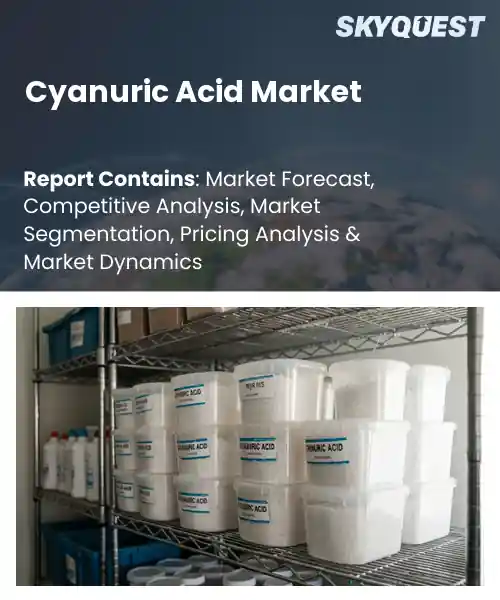
Cyanuric Acid Market
Report ID: SQMIG15A2790
Report ID: SQMIG15A2790
[email protected]
USA +1 351-333-4748
Report ID:
SQMIG15A2790 |
Region:
Global |
Published Date: June, 2026
Pages:
157
|Tables:
117
|Figures:
77


Global Cyanuric Acid Market size was valued at USD 0.852 Billion in 2024 and is poised to grow from USD 0.9 Billion in 2025 to USD 1.352 Billion by 2033, growing at a CAGR of 5.32% during the forecast period (2026-2033).
Rising demand for water treatment chemicals, increasing adoption of stabilized chlorination products, rising emphasis on hygiene and sanitation, expansion of recreational swimming facilities, and growing industrial disinfection requirements are driving sales of cyanuric acid.
Growing need for effective chlorine stabilization in swimming pools and water treatment applications is expected to primarily drive cyanuric acid market growth. Investments in commercial and home swimming pools, water recreation facilities, and industrial sanitation plants are propelling the demand for cyanuric acid and its derivatives. The increasing levels of knowledge of water quality management and the enhancement of chlorine effectiveness are catalyzing the market growth. The growing dependency on chlorinated isocyanurate disinfectants, expansions in hospitality infrastructure, and boosting ecological programs in public installations are other factors spurring the growth. The efforts of developers to enhance product quality, raise production volumes, and fortify supply chains are further anticipated to bridge development in the market throughout the world.
In contrast, volatility in raw material prices, stringent environmental regulations, fluctuations in feedstock availability, and growing concerns regarding chemical handling and disposal are anticipated to slow down cyanuric acid market penetration across the study period.
How is AI Improving Demand Forecasting in Global Cyanuric Acid Supply Chains?
AI enhances demand forecasting in the cyanuric acid industry through processing larger input data sets and delivering optimized projections. AI helps manufacturers to better plan for production, inventory and procurement in a volatile environment of seasonal demand and raw material price fluctuations. Machine learning models can pick up the trend, seasonal pattern, and forecast future trends, while natural language processing can be used to monitor early market signals from shipment reports, industry notes, and general market messages. AI can also facilitate scenario planning and simulation to anticipate how potential supply disruptions, demand surges or logistics problems are likely to influence the industry, and thus avoid stock-outs and inventory shortages, and finally, improve supply chain operation.
Market snapshot - (2026-2033)
Global Market Size
USD 0.852 Billion
Largest Segment
Water Treatment Grade
Fastest Growth
Water Treatment Grade
Growth Rate
5.32% CAGR
To get more insights on this market click here to Request a Free Sample Report
Global cyanuric acid market is segmented by grade, application, end-use industry, distribution channel, and region. Based on grade, the market is segmented into industrial grade and water treatment grade. Based on application, the market is segmented into swimming pool stabilizer, chlorinated isocyanurates (trichloroisocyanuric acid), herbicides (triazines), and plastics (melamine substitutes). Based on end-use industry, the market is segmented into water treatment, agriculture, and textile & paper. Based on distribution channel, the market is segmented into direct, pool chemical distributors, and agricultural dealers. Based on region, the market is segmented into North America, Europe, Asia Pacific, Latin America, and Middle East & Africa.
The water treatment grade segment is projected to account for the highest global cyanuric acid market share going forward. It meets the highest purity and performance requirements established by most urban & industrial water treatment systems for assured chlorine stabilization and protracted disinfectant action. As a result of its customized specifications, quality documentation and assurance and sourcing arrangements, public and private utilities and bulk water operators prioritize purchasing which previously reignited upstream manufacturing activities and investment to deliver performance standardization, quality assurance and formulation positioning support long term planning.
However, industrial grade is emerging as the fastest growing segment backed by wider industrial applications and as an intermediate in the production of other specialty chemicals to create further demand. Lower cost base, flexible formulations and increase in bulk distribution channels promote consumption in manufacturing, creating procurement opportunities and provides suppliers with opportunity to invest in large scale supply capability.
The swimming pool stabilizer segment is estimated to lead the global cyanuric acid market revenue generation through 2033. It exemplifies the most readily available and marketed variation of cyanuric acid, influencing consumer, and commercial buying decisions with tangible benefit in chlorine protection from sunlight and slowing down discoloration due to disinfectant breakdown. Wide adoption by pool operators, the ability to be incorporated into finished pool chemical blends, and existing retail and distributor distribution provide a predictable end user buying pattern that motivates manufacturers to adhere to stable formulations, branding and consumer education over a prolonged period.
Conversely, Chlorinated Isocyanurates (Trichloroisocyanuric Acid) is emerging as the fastest growing application segment as per this cyanuric acid market forecast, as the need for strong commercial disinfectants and combined stabilization and disinfectants grow, innovative formulations that enable easier dosing and increase application opportunities are putting cyanuric acid into institutional sanitation channels and driving new purchasing routes and integrated product opportunities.
To get detailed segments analysis, Request a Free Sample Report
Robust manufacturing capacity, integrated supply chains, and proximity to key raw material sources that enable cost efficient production and scalable output aid the dominance of this region. Asia Pacific suppliers are taking advantage of their own export channels as well as being supported by government policies promoting growth of specialty chemicals. As a result, there has been continued product innovation, both in formulation and process efficiency, with a concentration on upgrading existing plant technologies. Suppliers are also using collaboration between their industries and research institutions to develop new products based on purity and/or performance attributes. The strength of production hubs in the regions is driven by the continuing development of resilient supply chains and their strategic locations to support both domestic customers and export markets. In addition, there is a positive application of regulatory standards and access to trained technical professionals to support the production of high-quality goods. The passion for sustainable production also serves to increase the attractiveness of the region and therefore draw further private investment.
Cyanuric acid demand in Japan benefits from advanced chemical engineering capabilities, focus on high-quality standards, and close collaboration between manufacturers and research institutions. Demand for pool water treatment and industrial applications is driven by strict safety and performance requirements under which it stimulates the development of specialty products. Strong infrastructure and export orientation readily enable Japan to produce and export to regional buyers but keep a lid on the integration of complete systems and the adoption of optimization measures in production processes.
Cyanuric acid market in South Korea is characterized by agile specialty chemical producers, strong integration with electronics and industrial water treatment sectors, and active engagement in innovation for product purity and performance. Domestic demand concentrated on operational focus on pools and industrial plants with exports alongside. The concentration on regulatory adherence, manufacturing plants and public-private industry-academic centers partnership enables product differentiation and supply-chain resilience capability.
Multi sector demand growth and emphasis on product quality and regulatory compliance that support broader adoption of stabilized chlorine systems supporting steady cyanuric acid demand in the region. Existing manufacturing and distribution networks have allowed for efficient entry into the market as well as continued investment from both public and private sectors in renovating and expanding existing infrastructure which creates a steady source of demand downstream from end users. In response to this newfound demand, manufacturers have created a variety of specialty grades and services for various segments of the market including pool care and institutional/industrial water treatment. Collaborative relationships between suppliers and end users along with service providers have led to faster development and adoption of new products/technologies. The North American market is becoming mature enough where value-added services such as technical support and product customization are becoming increasingly common among suppliers. Environmental performance and supply chain transparency continue to strengthen a supplier's position within the market and their ability to respond rapidly to changing customer needs. Strategic partnerships with logistic partners and chemical distributors provide manufacturers with access to a broader array of end-use channels.
Cyanuric acid sales in United States are supported by extensive distribution networks, diverse downstream demand across residential and commercial segments, and strong technical service offerings from suppliers. Manufacturers emphasize product quality, compliance issues, and custom formulations. Infrastructure spending and private investment meet the demand for water treatment chemistries. Companies targeted for sustainability and transparency of supply chain will extend suppliers’ positions to achieve water treatment product acceptance through national end use channels.
Cyanuric acid market in Canada is shaped by a mix of industrial water treatment needs with strong emphasis on recreational pool maintenance. Local manufacturers and suppliers find ways to accommodate dispersed demand in the urban and remote areas by emphasizing quality, regulatory standards, and close service support. Suppliers work with municipal operators to make sure products suit the local water quality. Sustainability and logistics are taken into account during the market expanding process.
Regulatory compliance, product quality, and sustainable manufacturing practices that align with regional environmental priorities are shaping sales of cyanuric acid products in the region. Manufacturers are making significant investments in developing specialty grades and improving the purity of their products to consistently meet a broad range of stringent expectations of municipal, industrial, and leisure end-users. Providing strong technical service and forming solid relationships between chemical suppliers and providers of water treatment has yielded many tailored solutions for different chemistries associated with water. The support of distribution networks and trade relationships provides the necessary infrastructure to enable the establishment of cross border availability. The continued focus on establishing circular economies and reducing environmental footprint will help European companies differentiate themselves and remain competitive. Policy clarity and the establishment of industry standards encourage the ongoing improvement and development of formulations and process efficiency, thereby allowing European companies to expand their presence both domestically and into adjacent international markets. Through continued research and partnerships with universities, European companies will continue to innovate in the development of application-specific chemistries, which will enable them to build supply chain resiliency and find alternative sources for feedstock through optimized processes.
Cyanuric acid market in Germany is driven by strong industrial water treatment demand and high standards for chemical quality and safety. Local manufacturers emphasize process efficiency, purity, and technical support to meet demanding end user requirements. Collaboration with engineering firms and municipal operators enables customized application solutions. Environmental compliance and focus on circular manufacturing practices encourage adoption of cleaner production techniques and supply chain transparency, enhancing competitiveness in regional markets.
Cyanuric acid market in United Kingdom benefits from close integration with service providers offering pool and industrial water treatment solutions. Suppliers highlight formulation quality, regulatory compliance and technical support. Market players utilize extensive distribution strengths targeted at leisure industries. Working with research institutions aids product innovation with respect to native water chemistries. Prioritization of environmental stewardship and traceability in supply chains fosters differentiation and future survival.
Cyanuric acid market in France is influenced by emphasis on environmental regulation compliance and high standards for product safety. Suppliers emphasize formulation development and service provision to satisfy requirements of municipal, industrial, and recreational water treatment operators. Close relationships between formulation and engineering suppliers facilitate customized offerings for various water sources. Emphasis on sustainable raw material procurement and manufacturing processes, as well as logistics capacity, underpin supply and differentiated offerings in domestic markets.
To know more about the market opportunities by region and country, click here to
Buy The Complete Report
Increasing Demand In Pool Care
Expanding Use In Industrial Applications
Regulatory Restrictions on Usage
Supply Chain and Raw Material Issues
Request Free Customization of this report to help us to meet your business objectives.
Competitive landscape in the global cyanuric acid market is increasingly defined by capacity expansion among Asian producers, industry collaboration on cyanuric acid stewardship, and product differentiation driven by concerns over over stabilization in pools, prompting firms to pursue vertical integration, targeted acquisitions and formulation innovation, for example Clear Blue Water Tech’s manufacturing acquisition, the CYA Smart Alliance collaboration, and enzyme based cyanuric acid reducer developments.
SkyQuest’s ABIRAW (Advanced Business Intelligence, Research & Analysis Wing) is our Business Information Services team that Collects, Collates, Correlates, and Analyses the Data collected by means of Primary Exploratory Research backed by robust Secondary Desk research.
As per SkyQuest analysis, increasing adoption of stabilized chlorination products, and rising emphasis on hygiene and sanitation are anticipated to drive the demand for cyanuric acid going forward. However, volatility in raw material prices and stringent environmental regulations are slated to slow down the adoption of cyanuric acid in the future. North America is slated to spearhead the demand for cyanuric acid owing to high swimming pool ownership rates, strong water treatment infrastructure, and widespread use of chlorinated disinfectant products. AI-powered demand forecasting platforms and the development of high-purity cyanuric acid products for water treatment and disinfection applications are anticipated to be key trends driving the cyanuric acid industry in the long run.
| Report Metric | Details |
|---|---|
| Market size value in 2024 | USD 0.852 Billion |
| Market size value in 2033 | USD 1.352 Billion |
| Growth Rate | 5.32% |
| Base year | 2024 |
| Forecast period | (2026-2033) |
| Forecast Unit (Value) | USD Billion |
| Segments covered |
|
| Regions covered | North America (US, Canada), Europe (Germany, France, United Kingdom, Italy, Spain, Rest of Europe), Asia Pacific (China, India, Japan, Rest of Asia-Pacific), Latin America (Brazil, Rest of Latin America), Middle East & Africa (South Africa, GCC Countries, Rest of MEA) |
| Companies covered |
|
| Customization scope | Free report customization with purchase. Customization includes:-
|
To get a free trial access to our platform which is a one stop solution for all your data requirements for quicker decision making. This platform allows you to compare markets, competitors who are prominent in the market, and mega trends that are influencing the dynamics in the market. Also, get access to detailed SkyQuest exclusive matrix.
Table Of Content
Executive Summary
Market overview
Parent Market Analysis
Market overview
Market size
KEY MARKET INSIGHTS
COVID IMPACT
MARKET DYNAMICS & OUTLOOK
Market Size by Region
KEY COMPANY PROFILES
Methodology
For the Cyanuric Acid Market, our research methodology involved a mixture of primary and secondary data sources. Key steps involved in the research process are listed below:
1. Information Procurement: This stage involved the procurement of Market data or related information via primary and secondary sources. The various secondary sources used included various company websites, annual reports, trade databases, and paid databases such as Hoover's, Bloomberg Business, Factiva, and Avention. Our team did 45 primary interactions Globally which included several stakeholders such as manufacturers, customers, key opinion leaders, etc. Overall, information procurement was one of the most extensive stages in our research process.
2. Information Analysis: This step involved triangulation of data through bottom-up and top-down approaches to estimate and validate the total size and future estimate of the Cyanuric Acid Market.
3. Report Formulation: The final step entailed the placement of data points in appropriate Market spaces in an attempt to deduce viable conclusions.
4. Validation & Publishing: Validation is the most important step in the process. Validation & re-validation via an intricately designed process helped us finalize data points to be used for final calculations. The final Market estimates and forecasts were then aligned and sent to our panel of industry experts for validation of data. Once the validation was done the report was sent to our Quality Assurance team to ensure adherence to style guides, consistency & design.
Analyst Support
Customization Options
With the given market data, our dedicated team of analysts can offer you the following customization options are available for the Cyanuric Acid Market:
Product Analysis: Product matrix, which offers a detailed comparison of the product portfolio of companies.
Regional Analysis: Further analysis of the Cyanuric Acid Market for additional countries.
Competitive Analysis: Detailed analysis and profiling of additional Market players & comparative analysis of competitive products.
Go to Market Strategy: Find the high-growth channels to invest your marketing efforts and increase your customer base.
Innovation Mapping: Identify racial solutions and innovation, connected to deep ecosystems of innovators, start-ups, academics, and strategic partners.
Category Intelligence: Customized intelligence that is relevant to their supply Markets will enable them to make smarter sourcing decisions and improve their category management.
Public Company Transcript Analysis: To improve the investment performance by generating new alpha and making better-informed decisions.
Social Media Listening: To analyze the conversations and trends happening not just around your brand, but around your industry as a whole, and use those insights to make better Marketing decisions.
REQUEST FOR SAMPLE
 REQUEST FREE CUSTOMIZATION
Global Cyanuric Acid Market size was valued at USD 0.852 Billion in 2024 and is poised to grow from USD 0.9 Billion in 2025 to USD 1.352 Billion by 2033, growing at a CAGR of 5.32% during the forecast period (2026-2033).
Competitive landscape in the global cyanuric acid market is increasingly defined by capacity expansion among Asian producers, industry collaboration on cyanuric acid stewardship, and product differentiation driven by concerns over over stabilization in pools, prompting firms to pursue vertical integration, targeted acquisitions and formulation innovation, for example Clear Blue Water Tech’s manufacturing acquisition, the CYA Smart Alliance collaboration, and enzyme based cyanuric acid reducer developments. 'Ercros SA', 'Airedale Chemical', 'Nissan Chemical Corporation', 'Lonza Group (formerly)', 'BioLab (KIK Consumer Products)', 'Haviland Enterprises', 'Occidental Chemical', 'HTH (Arch Chemicals/Lonza)', 'Innovative Water Care (IWC)', 'Arch Chemicals (now Lonza)', 'Jihong Chemical', 'Taian City Sanjiang Chemicals', 'Hebei Chengxin Co.', 'Shandong Wolan Biology Technology', 'Zhejiang Yuchi Chemical', 'Shikoku Chemicals', 'Tokyo Chemical Industry', 'Merck KGaA', 'Sigma-Aldrich', 'TCI Chemicals'
Cyanuric acid serves as a stabilizer for chlorine in outdoor swimming pools, extending disinfectant effectiveness under sunlight. This functional benefit reduces the frequency of chlorine replenishment and improves sanitation reliability, making cyanuric acid a preferred additive for pool operators and homeowners. Growing consumer preference for low-maintenance water treatment and widespread awareness among pool service providers encourage adoption. The material’s compatibility with existing chlorination practices and straightforward application processes further support sustained uptake, reinforcing consistent demand across residential, commercial, and leisure pool segments.
Sustainability Driven Reformulations: Manufacturers are reformulating products to reduce environmental footprint and align with customer demand for greener chemistries. Emphasis on biodegradable co formulants, lower persistent byproducts, and transparency in sourcing is driving collaboration between producers and brand owners. This trend encourages investment in alternative synthesis routes and adoption of cleaner production practices, while enabling premium positioning and term contracts. Market players offering lifecycle insights and certification ready grades can differentiate, supporting sustainability commitments across downstream segments without compromising performance expectations and partnerships.
Why does Asia Pacific Dominate the Global Cyanuric Acid Market? |@12


Want to customize this report? This report can be personalized according to your needs. Our analysts and industry experts will work directly with you to understand your requirements and provide you with customized data in a short amount of time. We offer $1000 worth of FREE customization at the time of purchase.
Feedback From Our Clients


 USA (+1) 351-333-4748

