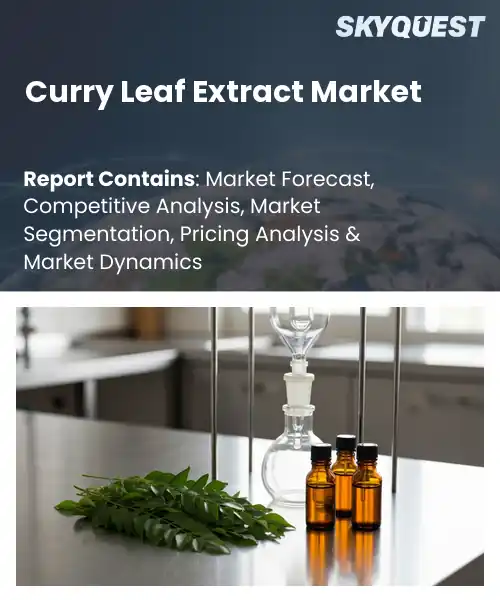
Curry Leaf Extract Market
Report ID: SQMIG30I2819
Report ID: SQMIG30I2819
[email protected]
USA +1 351-333-4748
Report ID:
SQMIG30I2819 |
Region:
Global |
Published Date: February, 2026
Pages:
157
|Tables:
117
|Figures:
77


Global Curry Leaf Extract Market size was valued at USD 36.30 Million in 2024 and is poised to grow from USD 39.49 Million in 2025 to USD 77.55 Million by 2033, growing at a CAGR of 8.8% during the forecast period (2026-2033).
As a global trend, the curry leaf extract market share is growing steadily with an increase in demand across various sectors, including food, nutraceutical, cosmetic, and pharmaceutical. Derived from the leaves of the Murraya koenigii tree; curry leaf extract has strong antioxidant, anti-inflammatory and antimicrobial properties. The extract is a natural flavour contributor and a functional ingredient for health-related products. Several factors are driving the market: the growing number of consumers who prefer naturally derived ingredients, dietary supplements designed to support metabolic and digestive health.
An expanding number of personal care products formulated with curry leaf extract for their skin benefits. The greatest growth in the curry leaf extract market is found in the Asia Pacific region, especially in India, where curry leaf has been part of the traditional cuisine for centuries. There has been significant growth in North America and Europe due to herbal supplements gaining popularity in these regions, as well as consumers looking for clean label products.
The technological advancements and the development of distribution channels are shaping the market. To satisfy the rising demand for curry leaf extract around the world, companies are forming partnerships and building production capacity. The primary issues facing the curry leaf extract industry are inconsistent supply of raw materials and inconsistent quality standards for formulation, both of which are being addressed through a combination of strategic sourcing and improvements to current extraction technologies.
How is AI Enhancing Quality Control in the Curry Leaf Extract Market?
AI has enhanced the quality control of the curry leaf extract market using computer vision, machine learning techniques for spectroscopy, and predictive analytics for detection of contaminants and standardization of active compounds. Image analysis is utilized to identify damaged leaves and remove them from the batch, and spectral fingerprinting can be used to verify phytochemical identity and, using models, extraction parameters can be adjusted in real-time.
Market snapshot - 2026-2033
Global Market Size
USD 36.3 Million
Largest Segment
Conventional
Fastest Growth
Organic
Growth Rate
8.8% CAGR
To get more insights on this market click here to Request a Free Sample Report
The curry leaf extract market is segmented into source, form, application, distribution channel and region. Based on source, the market is segmented into organic and conventional. Based on form, the market is segmented into powder, liquid, capsules, and tablets. Based on application, the market is segmented into pharmaceuticals, cosmetics & personal care, food & beverages, and animal feed. Based on distribution channel, the market is segmented into online and offline. Based on region, the market is segmented into North America, Europe, Asia Pacific, Latin America and Middle East & Africa.
Organic segment leads in market due to an increase in consumer demand for natural and clean label ingredients, which results in the perception of higher product quality and brand trust. As a result, manufacturers increasingly seek certified extracts to position their products as premium products. Additionally, the growing adoption of organic cultivation practices produces cleaner residues and more sustainable credentials, which retailers accept more readily and use to develop their marketing stories. Certified residues and traceable processes reduce uncertainty in the supply chain and allow for longer-term partnerships between formulating manufacturers and suppliers, creating a bias toward the use of organic inputs in formulated products across the food, cosmetic, and pharmaceutical industries.
As per curry leaf extract market outlook, conventional segment is experiencing the fastest growth due to supplier scaling of high-yield crop cultivation and cost-effective processing, making these extracts more affordable for manufacturers with budget constraints, allowing for more widespread use of Conventional extracts in food and animal feed formulations, promoting bulk buying and private label development, and creating greater commercial opportunities to expand market coverage and throughput in manufacturing.
As per curry leaf extract market forecast, powder segment dominates because its concentrated, dry form simplifies accurate dosing and seamless integration into dry blends, seasonings, nutraceuticals, and topical powders, reducing handling complexity for manufacturers. The ability of powders to maintain their potency through excellent shelf-life stability and reduced transportation costs minimizes the potential for reformulating, and the ability of powders to be compatible with different forms of processing (e.g., blending, encapsulating) makes it easier for manufacturers to "scale up" their production of these types of products. The above-listed advantages are the reasons that powder is the norm in the majority of workflows throughout the product development and manufacturing process.
As per curry leaf extract market analysis, capsules are becoming the biggest area of growth due to consumers’ increasing preferences for quickly accessible, ready-to-use nutraceuticals and more accurate dosing of nutrients in nutritional supplements. The use of new technologies in the encapsulation of nutrients has improved the bioavailability of nutrients in general and, specifically, allowed for standardized curry leaf extract delivery systems. As supplement companies expand their product offerings into new delivery forms, this trend may result in contract manufacturing agreements and in the development of fortified, convenience-based products, which will lead to the development of new commercial opportunities.
To get detailed segments analysis, Request a Free Sample Report
Curry leaf extract has strong roots to Asia Pacific dominance with a culmination of cultural familiarity, established agronomic capacity, and developed processing ecosystems that offer strong support for large-scale production and product innovation. The long-standing culinary and traditional medicinal usage of curry leaves creates vibrant domestic demand by driving consumer acceptance of concentrated extracts in food, nutraceutical and personal care formulations.
Japan Curry Leaf Extract Market
Curry leaf extract market regional outlook in Japan illustrates premiumization, detailed quality standards, and a significant connection to high-value nutraceuticals and cosmetics formulations. Japanese manufacturers prioritize purity, traceability and adherence to demanding governmental regulations; furthermore, academic institutions partner with private companies in the development of advanced extraction and stabilization technologies.
South Korea Curry Leaf Extract Market
The South Korea curry leaf extract market regional forecast benefits from dynamic wellness and cosmetics industries, that place high importance on innovative botanical products and effective extracts. South Korean Companies utilize their formulation expertise and fast time to market to develop curry leaf extract-infused skin care products and dietary supplements, utilizing robust marketing structures and aspirations to export. The emphasis on innovation, strict quality control, and partnerships between ingredient suppliers and brand manufacturers all position curry leaf extract as a unique, natural ingredient in trend-driven consumer segments.
The North America expansion of products using natural or plant-based ingredients for food, supplements and personal care is being accelerated by a defined trend toward natural, plant-based ingredients for all these products, along with increased use of sophisticated distribution channels that speed up product introduction. Clean label and functional benefit consumers have prompted the use of botanical-derived extracts, such as curry leaf in product formulations with antioxidant and wellness benefits.
United States Curry Leaf Extract Market
The curry leaf extract market analysis in the United States reflects consumer interest in natural and functional ingredients for their food innovation, dietary supplement and personal care products. The ingredient suppliers and contract manufacturers focus on providing standardized extracts along with the necessary documentation to satisfy retailer and regulatory requirements. As a result, the brands emphasize marketing their products' transparency and are willing to provide scientific evidence to support their claims.
Canada Curry Leaf Extract Market
The curry leaf extract indusrty trends in Canada reflects the significant consumer demand for clean label and naturally derived health products, with various regulatory standards that necessitate documentation and quality assurance processes to ensure compliance. As such, both suppliers and brands place an emphasis on sustainability, traceability, and certification to meet consumer needs, while leveraging cross border trade and distribution partnerships with their United States counterparts to drive market access.
As per curry leaf extract market regional outlook, Europe is increasing its influence on the market by placing more importance on the quality of botanicals, meeting strict regulations, and providing evidence of sustainability that meets strict consumer and organization standards. Businesses throughout Europe are investing in standardization, traceability, and scientific backing of their claims to access pharmacies and specialty retailers. The increased demand for natural cosmetic products, functional foods, and scientifically validated nutraceuticals has led many manufacturers to start using curry leaf extract, and to create proper documentation and quality control systems for these products. The growth of intra-European trade and the strength of several key European markets make it easier to produce at scale and efficiently distribute products.
Germany Curry Leaf Extract Market
As per curry leaf extract market regional forecast, market trends in Europe related to curry leaf extract are influenced by strong cultural associations with herbal medicine and a strict regulatory framework that creates a demand for well-documented extracts. In both the supplier and the manufacturing sectors, there is a strong emphasis on scientific documentation and quality assurance at the time of order fulfillment, as well as through distribution channels in pharmacies and specialty health retailers. Manufacturers who produce functional foods and supplements also want to ensure they have measurable effectiveness and traceability of their ingredients; this helps them communicate to their customer base about what they are doing.
United Kingdom Curry Leaf Extract Market
The curry leaf extract industry in the UK is being driven primarily through wellness trends, the growing beauty and supplements sector, and increasingly complex retail and online marketplaces that promote rapid innovation. Brands focus heavily on transparency, sustainability, and compelling storytelling when launching a botanical-based ingredient, while regulatory body scrutiny promotes complete documentation and clear claims. Relationships between suppliers of ingredients and creative brand teams provide an opportunity for differentiation within products, while appealing to consumers who desire natural provenance as well as proven benefits.
France Curry Leaf Extract Market
The curry leaf extract market in France is also benefiting from a cultural appreciation of botanicals; the French cosmetics industry places great value on high-quality natural extracts. Manufacturers and brands are prioritizing sensory quality, integrity of sourcing, and regulatory compliance when incorporating curry leaf extract into their premium beauty and nutraceutical products. Consumers tend to be very choosy in relation to where a product is from and its effectiveness, which pushes suppliers to produce extract(s) that can be traced back and characterized, while working with domestic formulators and retailers to fulfill market expectations.
To know more about the market opportunities by region and country, click here to
Buy The Complete Report
Rising Demand for Natural Ingredients
Growth of Functional Food Applications
Variability in Raw Material Quality
Regulatory and Compliance Challenges
Request Free Customization of this report to help us to meet your business objectives.
The rise in demand for health products and an increase in competition for those health products, along with an increasingly fragmented supplier market, is resulting in companies seeking partnerships and supply contracts to standardize their products, source their ingredients from certified suppliers, and decrease time to market. For example, Jeeva Organic has partnered with Green Jeeva in the USA and has formed an agreement with a local supplier to create a standardized curry leaf product and a certified supply chain. Other ingredient companies are promoting their curry leaf products and establishing certified supply chains to do the same, while distributors and extract businesses are securing retail or contract manufacturing deals to differentiate themselves from their competitors.
Natural Positioning and Clean Label
Novel Application Product Innovation
SkyQuest’s ABIRAW (Advanced Business Intelligence, Research & Analysis Wing) is our Business Information Services team that Collects, Collates, Correlates, and Analyses the Data collected by means of Primary Exploratory Research backed by robust Secondary Desk research.
As per SkyQuest analysis, growth within the global curry leaf extract industry will continue because consumers are turning more toward natural and functional ingredients; while innovations in extraction and standardization have helped to increase yields and consistency of these products, variability in raw material quality resulting from different cultivars and practices at both the harvest and post-harvest stages create challenges to manufacturers who want to establish a standardized product. In terms of geography, the Asia Pacific region continues to lead the industry because of its cultural ties/relationship with curry, strong agriculture base, as well as highly integrated supply chains. From a product category standpoint, powdered curry leaf extract is by far the largest segment of the market due to its dosing convenience, shelf stability, and compatibility with manufacturing processes. For continued momentum in the growth of the global curry leaf extract market, additional investment must be made into traceability systems and establishing standardized supply chain processes.
| Report Metric | Details |
|---|---|
| Market size value in 2024 | USD 36.30 Million |
| Market size value in 2033 | USD 77.55 Million |
| Growth Rate | 8.8% |
| Base year | 2024 |
| Forecast period | 2026-2033 |
| Forecast Unit (Value) | USD Million |
| Segments covered |
|
| Regions covered | North America (US, Canada), Europe (Germany, France, United Kingdom, Italy, Spain, Rest of Europe), Asia Pacific (China, India, Japan, Rest of Asia-Pacific), Latin America (Brazil, Rest of Latin America), Middle East & Africa (South Africa, GCC Countries, Rest of MEA) |
| Companies covered |
|
| Customization scope | Free report customization with purchase. Customization includes:-
|
To get a free trial access to our platform which is a one stop solution for all your data requirements for quicker decision making. This platform allows you to compare markets, competitors who are prominent in the market, and mega trends that are influencing the dynamics in the market. Also, get access to detailed SkyQuest exclusive matrix.
Table Of Content
Executive Summary
Market overview
Parent Market Analysis
Market overview
Market size
KEY MARKET INSIGHTS
COVID IMPACT
MARKET DYNAMICS & OUTLOOK
Market Size by Region
KEY COMPANY PROFILES
Methodology
For the Curry Leaf Extract Market, our research methodology involved a mixture of primary and secondary data sources. Key steps involved in the research process are listed below:
1. Information Procurement: This stage involved the procurement of Market data or related information via primary and secondary sources. The various secondary sources used included various company websites, annual reports, trade databases, and paid databases such as Hoover's, Bloomberg Business, Factiva, and Avention. Our team did 45 primary interactions Globally which included several stakeholders such as manufacturers, customers, key opinion leaders, etc. Overall, information procurement was one of the most extensive stages in our research process.
2. Information Analysis: This step involved triangulation of data through bottom-up and top-down approaches to estimate and validate the total size and future estimate of the Curry Leaf Extract Market.
3. Report Formulation: The final step entailed the placement of data points in appropriate Market spaces in an attempt to deduce viable conclusions.
4. Validation & Publishing: Validation is the most important step in the process. Validation & re-validation via an intricately designed process helped us finalize data points to be used for final calculations. The final Market estimates and forecasts were then aligned and sent to our panel of industry experts for validation of data. Once the validation was done the report was sent to our Quality Assurance team to ensure adherence to style guides, consistency & design.
Analyst Support
Customization Options
With the given market data, our dedicated team of analysts can offer you the following customization options are available for the Curry Leaf Extract Market:
Product Analysis: Product matrix, which offers a detailed comparison of the product portfolio of companies.
Regional Analysis: Further analysis of the Curry Leaf Extract Market for additional countries.
Competitive Analysis: Detailed analysis and profiling of additional Market players & comparative analysis of competitive products.
Go to Market Strategy: Find the high-growth channels to invest your marketing efforts and increase your customer base.
Innovation Mapping: Identify racial solutions and innovation, connected to deep ecosystems of innovators, start-ups, academics, and strategic partners.
Category Intelligence: Customized intelligence that is relevant to their supply Markets will enable them to make smarter sourcing decisions and improve their category management.
Public Company Transcript Analysis: To improve the investment performance by generating new alpha and making better-informed decisions.
Social Media Listening: To analyze the conversations and trends happening not just around your brand, but around your industry as a whole, and use those insights to make better Marketing decisions.
REQUEST FOR SAMPLE
 REQUEST FREE CUSTOMIZATION
Global Curry Leaf Extract Market size was valued at USD 36.3 Million in 2024 and is poised to grow from USD 39.49 Million in 2025 to USD 77.55 Million by 2033, growing at a CAGR of 8.8% during the forecast period (2026-2033).
Dr. Behr GmbH, K.-W. Pfannenschmidt GmbH, Amin Herbals Extracts, Givaudan, Firmenich, Synlogic, PentaPure, Herbal Hills, Sabinsa Corporation, DōTERRA, Aromaaz Natural Products, R. S. Sharma & Co., Ayurvedic Herbs, Plant Extracts International, Eligo Herbals, Nature’s Way Products, Alchemy Ingredients, Indena S.p.A, Nutraceutical Corporation, Organic India
The key driver of the Curry Leaf Extract Market is the increasing demand for natural and herbal ingredients in food, nutraceutical, and cosmetic products. Growing consumer preference for plant-based health supplements and traditional Ayurvedic remedies, along with the recognized antioxidant and medicinal properties of curry leaf extract, is significantly driving market growth.
A key market trend in the Curry Leaf Extract Market is the increasing use of curry leaf extract in nutraceuticals, functional foods, and natural cosmetic formulations. Rising consumer demand for plant-based, clean-label, and herbal ingredients is encouraging manufacturers to incorporate curry leaf extract into health supplements, skincare, and haircare products.
Asia-Pacific accounted for the largest share in the Curry Leaf Extract Market, driven by the widespread cultivation and consumption of curry leaves in countries such as India, Sri Lanka, and Thailand. The region’s strong tradition of Ayurvedic medicine, herbal products, and natural food ingredients also supports market growth.


Want to customize this report? This report can be personalized according to your needs. Our analysts and industry experts will work directly with you to understand your requirements and provide you with customized data in a short amount of time. We offer $1000 worth of FREE customization at the time of purchase.
Feedback From Our Clients


 USA (+1) 351-333-4748

