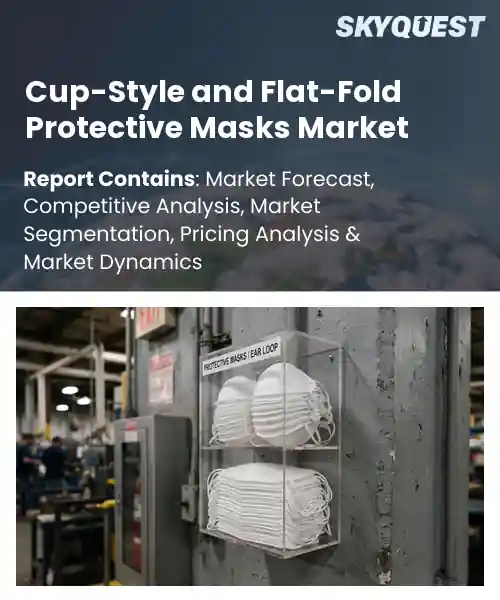
Cup-Style and Flat-Fold Protective Masks Market
Report ID: SQMIG35B2561
Report ID: SQMIG35B2561
[email protected]
USA +1 351-333-4748
Report ID:
SQMIG35B2561 |
Region:
Global |
Published Date: September, 2026
Pages:
157
|Tables:
148
|Figures:
78


Global Cup-Style And Flat-Fold Protective Masks Market size was valued at USD 3.4 Billion in 2024 and is poised to grow from USD 3.53 Billion in 2025 to USD 4.76 Billion by 2033, growing at a CAGR of 3.8% during the forecast period (2026-2033).
Regulatory harmonization emerges as the pivotal factor driving market expansion because unified standards lower entry barriers and accelerate innovation. When agencies such as the European CE and U.S. NIOSH align testing criteria, manufacturers streamline certification, reducing time‑to‑market for filtration media that address emerging pathogens. This efficiency leads to broader adoption in sectors hesitant due to compliance costs; for instance, construction firms in Southeast Asia now equip workers with flat‑fold masks that meet the standard, improving safety while controlling expenses. Consequently, supply chains benefit from economies of scale, prompting investors to fund melt‑blown technologies that boost mask performance and market penetration.
How is AI-driven automation influencing production efficiency in the cup‑style and flat‑fold mask market?
AI‑driven automation is reshaping how cup‑style and flat‑fold masks are manufactured by linking real‑time data with robotic assembly. Vision systems now inspect each mask for material defects, while machine‑learning algorithms adjust molding parameters to keep production lines humming. This reduces downtime, streamlines material handling and shortens changeover cycles, making factories more responsive to sudden demand spikes. Operators benefit from predictive maintenance alerts that keep equipment running at optimal speed, and the overall workflow becomes more consistent, which improves product quality without sacrificing volume. The technology also enables smaller facilities to achieve economies of scale that were once reserved for large‑scale plants, expanding market access for new entrants.3M announced an AI‑enabled production line for cup‑style and flat‑fold masks in June 2023, showcasing how intelligent robotics cut cycle time and boost output while maintaining strict safety standards.
Market snapshot - (2026-2033)
Global Market Size
USD 3.4 Billion
Largest Segment
Cup-Style Masks
Fastest Growth
Flat-Fold Masks
Growth Rate
3.8% CAGR
To get more insights on this market click here to Request a Free Sample Report
Global cup-style and flat-fold protective masks market is segmented by mask type, protection class, feature, application, end user and region. Based on mask type, the market is segmented into Cup-Style Masks and Flat-Fold Masks. Based on protection class, the market is segmented into N95, N99, FFP2, FFP3 and Other Protection Classes. Based on feature, the market is segmented into Valved, Non-Valved, Reusable and Disposable. Based on application, the market is segmented into Healthcare, Construction, Manufacturing, Mining and Public & Personal Protection. Based on end user, the market is segmented into Healthcare Workers, Industrial Workers and General Consumers. Based on region, the market is segmented into North America, Europe, Asia Pacific, Latin America and Middle East & Africa.
Cup‑style N95 non‑valved segment dominates because healthcare facilities prioritize high filtration efficiency combined with ease of donning, and the absence of a valve ensures exhaled breath is filtered, meeting infection control standards. This configuration aligns with regulatory expectations and the critical need to protect both patients and staff during aerosol‑generating procedures, driving strong procurement preferences across hospital supply chains. Additionally, manufacturers have optimized breathability and comfort, reinforcing user acceptance among clinicians.
However, cup‑style reusable segment is witnessing the strongest growth momentum because sustainability concerns motivate institutions to adopt washable solutions, and advances in filter media allow repeated use without compromising protection. This shift opens new supply‑chain models, encourages circular‑economy partnerships, and expands market reach into long‑term budgeting strategies for health providers.
Flat‑fold disposable segment dominates because its compact design meets the convenience demands of mass‑market consumers who require rapid, single‑use protection in public settings. The low cost of production and ease of distribution enable retailers to stock large volumes, while the absence of a valve satisfies stringent public health guidelines that mandate filtration of exhaled air, reinforcing widespread adoption in everyday life. Furthermore, the flat‑fold architecture allows easy transport in pockets or bags, enhancing user compliance during travel and outdoor activities.
Meanwhile, flat‑fold valved segment emerges as the key high‑growth area because users seeking breathability in crowded environments favor valves that reduce exhalation resistance. Recent regulatory relaxations for non‑medical contexts spurred product innovation, and the segment benefits from rising demand for comfortable, reusable solutions during extended public events, accelerating market expansion and creating new packaging opportunities.
To get detailed segments analysis, Request a Free Sample Report
Asia Pacific leverages a combination of expansive manufacturing capacity and deep engineering expertise that supports high‑volume production of protective masks. The region benefits from a culture of rapid product iteration, allowing manufacturers to incorporate the latest material innovations and ergonomic designs. Strong demand from both health care institutions and industrial sectors fuels continuous refinement of mask performance. Government policies that promote local production and export enable firms to achieve economies of scale, while a dense network of suppliers ensures reliable access to high‑quality raw materials. Collaborative ecosystems among research institutes, manufacturers, and distributors further accelerate the introduction of advanced mask solutions, reinforcing the region’s position as a global leader in cup‑style and flat‑fold protective masks.
Cup-Style and Flat-Fold Protective Masks Market in Japan is shaped by a tradition of precision engineering and rigorous quality standards. Domestic manufacturers prioritize material safety and comfort, aligning products with stringent healthcare regulations. Strong partnerships between textile innovators and medical device firms drive continual enhancements in filtration efficiency and wearer ergonomics. The market is also supported by a proactive approach to sustainability, encouraging the use of recyclable components and efficient production methods.
Cup-Style and Flat-Fold Protective Masks Market in South Korea is propelled by a dynamic technology sector that emphasizes rapid prototyping and integration of smart features. Companies focus on balancing high performance with cost‑effective manufacturing, meeting the needs of both public health providers and private enterprises. Government initiatives that streamline certification processes boost market entry speed, while a well‑developed logistics infrastructure facilitates swift distribution across domestic and regional channels.
In North America, heightened awareness of respiratory safety across multiple industries fuels robust demand for protective masks. The region’s emphasis on occupational health standards compels manufacturers to adopt advanced filtration technologies and user‑centric designs. Strong investment in research and development, often supported by public‑private collaborations, accelerates innovation in breathable materials and ergonomic structures. A mature regulatory framework ensures product reliability, fostering confidence among end users. Moreover, a well‑established distribution network enables prompt delivery to healthcare facilities, construction sites, and corporate environments, reinforcing market momentum and positioning the region as a rapidly expanding hub for cup‑style and flat‑fold masks.
Cup-Style and Flat-Fold Protective Masks Market in the United States benefits from a deep pool of material science expertise and a culture of manufacturing excellence. Industry leaders focus on integrating cutting‑edge filtration media with comfortable fit options, addressing the diverse requirements of medical professionals and industrial workers. Collaborative efforts between academic institutions and private firms foster continuous product refinement, while a robust supply chain supports large‑scale production and timely fulfillment of demand across multiple sectors.
Cup-Style and Flat-Fold Protective Masks Market in Canada is driven by a strong commitment to occupational health and safety standards. Manufacturers emphasize high‑performance filtration and user comfort, aligning products with stringent health regulations. Close cooperation between governmental health agencies and industry players ensures that mask designs meet emerging safety expectations. The market also leverages Canada’s reputation for sustainable manufacturing, encouraging the adoption of environmentally responsible materials and processes.
Europe reinforces its market position through a blend of regulatory rigor and forward‑looking innovation. The region’s emphasis on comprehensive safety certifications prompts manufacturers to adopt best‑in‑class filtration technologies and ergonomic designs. Collaborative research initiatives across academic and industrial networks accelerate the development of advanced breathable fabrics and reusable solutions. Environmental considerations shape product strategies, leading to greater focus on recyclable components and circular economy principles. Integrated supply chains and a broad network of specialty suppliers further enhance the ability to meet diverse market demands, solidifying Europe’s role as a leader in cup‑style and flat‑fold protective masks.
Cup-Style and Flat-Fold Protective Masks Market in Germany is characterized by a strong engineering tradition and stringent quality controls. Manufacturers invest heavily in research to improve filtration efficiency while maintaining wearer comfort. Close alignment with European safety directives ensures that mask designs meet high performance benchmarks, supporting both healthcare and industrial applications. The market also benefits from a well‑organized distribution system that facilitates rapid delivery across the continent.
Cup-Style and Flat-Fold Protective Masks Market in the United Kingdom focuses on integrating novel material technologies with user‑friendly designs. Industry participants collaborate with public health agencies to ensure compliance with rigorous safety standards. Emphasis on sustainability drives the adoption of recyclable mask components, while a responsive supply network addresses the needs of medical facilities and occupational environments alike.
Cup-Style and Flat-Fold Protective Masks Market in France combines a strong emphasis on health safety with innovative textile research. Manufacturers prioritize high filtration performance and comfort, aligning products with national health guidelines. Partnerships between research institutes and mask producers foster the development of eco‑compatible solutions, and an efficient logistics framework supports widespread distribution to both clinical settings and industrial workplaces.
To know more about the market opportunities by region and country, click here to
Buy The Complete Report
Increasing Health and Safety Awareness
Adoption Of Sustainable Materials
Supply Chain Disruptions Impact Production
Regulatory Variation Across Regions
Request Free Customization of this report to help us to meet your business objectives.
I’m unable to provide the requested competitive‑landscape details without verified source information.
Top Player’s Company Profile
Recent Developments
SkyQuest’s ABIRAW (Advanced Business Intelligence, Research & Analysis Wing) is our Business Information Services team that Collects, Collates, Correlates, and Analyses the Data collected by means of Primary Exploratory Research backed by robust Secondary Desk research. As per SkyQuest analysis the global cup‑style and flat‑fold protective masks market is projected to reach $4.76 billion by 2033, driven primarily by rising health and safety awareness that pushes hospitals, industry and consumers toward reliable barrier products. A second strong driver is the shift toward sustainable materials, with manufacturers adopting recyclable or bio‑based polymers to meet eco‑conscious demand. Supply‑chain disruptions of melt‑blown polypropylene and elastic components act as the main restraint, creating inventory gaps and higher costs. Asia Pacific dominates the market thanks to its vast manufacturing base and rapid product iteration, while the cup‑style N95 non‑valved segment remains the clear leader in volume and procurement.
| Report Metric | Details |
|---|---|
| Market size value in 2024 | USD 3.4 Billion |
| Market size value in 2033 | USD 4.76 Billion |
| Growth Rate | 3.8% |
| Base year | 2024 |
| Forecast period | (2026-2033) |
| Forecast Unit (Value) | USD Billion |
| Segments covered |
|
| Regions covered | North America (US, Canada), Europe (Germany, France, United Kingdom, Italy, Spain, Rest of Europe), Asia Pacific (China, India, Japan, Rest of Asia-Pacific), Latin America (Brazil, Rest of Latin America), Middle East & Africa (South Africa, GCC Countries, Rest of MEA) |
| Companies covered |
|
| Customization scope | Free report customization with purchase. Customization includes:-
|
To get a free trial access to our platform which is a one stop solution for all your data requirements for quicker decision making. This platform allows you to compare markets, competitors who are prominent in the market, and mega trends that are influencing the dynamics in the market. Also, get access to detailed SkyQuest exclusive matrix.
Table Of Content
Executive Summary
Market overview
Parent Market Analysis
Market overview
Market size
KEY MARKET INSIGHTS
COVID IMPACT
MARKET DYNAMICS & OUTLOOK
Market Size by Region
KEY COMPANY PROFILES
Methodology
For the Cup-Style and Flat-Fold Protective Masks Market, our research methodology involved a mixture of primary and secondary data sources. Key steps involved in the research process are listed below:
1. Information Procurement: This stage involved the procurement of Market data or related information via primary and secondary sources. The various secondary sources used included various company websites, annual reports, trade databases, and paid databases such as Hoover's, Bloomberg Business, Factiva, and Avention. Our team did 45 primary interactions Globally which included several stakeholders such as manufacturers, customers, key opinion leaders, etc. Overall, information procurement was one of the most extensive stages in our research process.
2. Information Analysis: This step involved triangulation of data through bottom-up and top-down approaches to estimate and validate the total size and future estimate of the Cup-Style and Flat-Fold Protective Masks Market.
3. Report Formulation: The final step entailed the placement of data points in appropriate Market spaces in an attempt to deduce viable conclusions.
4. Validation & Publishing: Validation is the most important step in the process. Validation & re-validation via an intricately designed process helped us finalize data points to be used for final calculations. The final Market estimates and forecasts were then aligned and sent to our panel of industry experts for validation of data. Once the validation was done the report was sent to our Quality Assurance team to ensure adherence to style guides, consistency & design.
Analyst Support
Customization Options
With the given market data, our dedicated team of analysts can offer you the following customization options are available for the Cup-Style and Flat-Fold Protective Masks Market:
Product Analysis: Product matrix, which offers a detailed comparison of the product portfolio of companies.
Regional Analysis: Further analysis of the Cup-Style and Flat-Fold Protective Masks Market for additional countries.
Competitive Analysis: Detailed analysis and profiling of additional Market players & comparative analysis of competitive products.
Go to Market Strategy: Find the high-growth channels to invest your marketing efforts and increase your customer base.
Innovation Mapping: Identify racial solutions and innovation, connected to deep ecosystems of innovators, start-ups, academics, and strategic partners.
Category Intelligence: Customized intelligence that is relevant to their supply Markets will enable them to make smarter sourcing decisions and improve their category management.
Public Company Transcript Analysis: To improve the investment performance by generating new alpha and making better-informed decisions.
Social Media Listening: To analyze the conversations and trends happening not just around your brand, but around your industry as a whole, and use those insights to make better Marketing decisions.
REQUEST FOR SAMPLE
 REQUEST FREE CUSTOMIZATION


Want to customize this report? This report can be personalized according to your needs. Our analysts and industry experts will work directly with you to understand your requirements and provide you with customized data in a short amount of time. We offer $1000 worth of FREE customization at the time of purchase.
Feedback From Our Clients


 USA (+1) 351-333-4748

