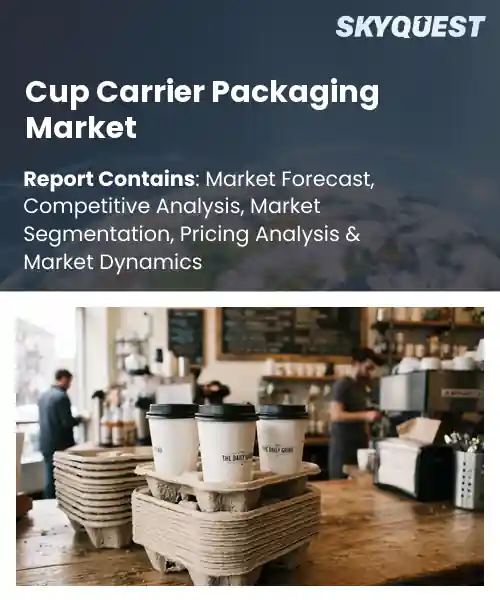
Cup Carrier Packaging Market
Report ID: SQMIG15H2311
Report ID: SQMIG15H2311
[email protected]
USA +1 351-333-4748
Report ID:
SQMIG15H2311 |
Region:
Global |
Published Date: August, 2026
Pages:
157
|Tables:
144
|Figures:
78


Global Cup Carrier Packaging Market size was valued at USD 2.68 Billion in 2024 and is poised to grow from USD 2.84 Billion in 2025 to USD 4.49 Billion by 2033, growing at a CAGR of 5.9% during the forecast period (2026-2033).
Sustainability now drives the cup carrier packaging market, because retailers aim to meet circular‑economy goals. When brands switch to biodegradable or recycled carriers, landfill pressure falls, which satisfies stricter government directives and attracts eco‑conscious consumers. This cause‑effect chain opens opportunities: suppliers can secure premium pricing for certified green products, and coffee shops can differentiate through visible sustainability statements on carriers. For example, a multinational café chain partnered with a pulp‑based supplier to launch a compostable carrier that decomposes in twelve weeks, allowing the chain to meet regional waste‑reduction targets and draw millennials who prioritize environmental impact in the broader marketplace.
How is AI driving sustainability innovations in the cup carrier packaging market?
AI is reshaping the cup carrier packaging market by turning data into greener design choices. Machine‑learning models analyze thousands of material combinations to suggest lighter, recyclable structures that still meet strength requirements. Predictive analytics forecast demand spikes, allowing manufacturers to align production with actual need and cut waste. Real‑time monitoring of supply chains highlights energy‑intensive steps, prompting adjustments that lower carbon footprints. These capabilities turn sustainability from a buzzword into an operational advantage, attracting eco‑conscious brands and reducing costs across the value chain. The result is a more agile market where innovation is guided by precise, environmentally aware insights.Eco‑Products announced an AI‑driven material‑optimization platform in March 2024, showcasing how intelligent design reduces raw‑material use while maintaining performance, thereby accelerating sustainable growth in the cup carrier sector.
Market snapshot - (2026-2033)
Global Market Size
USD 2.68 Billion
Largest Segment
Plastic
Fastest Growth
Biodegradable Materials
Growth Rate
5.9% CAGR
To get more insights on this market click here to Request a Free Sample Report
Global cup carrier packaging market is segmented by material, capacity, application, distribution channel, end user and region. Based on material, the market is segmented into Molded Fiber, Paperboard, Plastic and Biodegradable Materials. Based on capacity, the market is segmented into Two-Cup Carriers, Four-Cup Carriers and Six-Cup Carriers. Based on application, the market is segmented into Coffee Shops, Quick Service Restaurants and Food Delivery. Based on distribution channel, the market is segmented into Direct Sales, Distributors and Online Retail. Based on end user, the market is segmented into Foodservice and Beverage Chains. Based on region, the market is segmented into North America, Europe, Asia Pacific, Latin America and Middle East & Africa.
Paperboard segment dominates because its balance of cost efficiency, structural integrity, and ease of printing meets the core demands of cup carrier manufacturers. The material offers sufficient rigidity to support multiple cups while remaining lightweight for distribution. Its compatibility with existing high‑speed conversion lines reduces capital expenditures, encouraging widespread adoption. Additionally, consumer familiarity and retailer preference for recyclable paper reinforce its position as the preferred choice across the market.
However, Biodegradable materials segment emerges as the fastest growing because escalating environmental regulations and consumer demand for compostable options drive rapid adoption. Innovations in plant‑based fibers and barrier technologies enhance performance, allowing brands to launch greener cup carriers without compromising functionality. This momentum fuels product development and opens revenue streams.
Four‑cup carriers segment leads because it aligns closely with the most common serving size in coffee shops and quick service venues, offering an optimal balance of convenience and material usage. The configuration fits standard cup dimensions, minimizing waste while simplifying handling for staff and consumers. Its versatility supports both dine‑in and takeaway models, reinforcing broad acceptance across the sector and sustaining high volume production throughout the supply chain.
Meanwhile, Six‑cup carriers segment is witnessing the strongest growth momentum because group coffee orders and family‑size consumption are rising, prompting establishments to adopt larger capacity carriers. The format reduces the need for multiple single carriers, cutting handling time and packaging waste. This efficiency drive encourages manufacturers to scale production and refine designs.
To get detailed segments analysis, Request a Free Sample Report
North America leads the cup carrier packaging market through a convergence of mature coffee consumption habits, sophisticated supply chain infrastructure, and proactive sustainability initiatives. The region benefits from extensive retail networks that integrate packaged coffee solutions seamlessly into everyday purchasing patterns. Companies operating in this market invest heavily in research and development to produce carriers that combine strength, lightweight design, and recyclable or compostable material attributes. Regulatory frameworks encourage the adoption of environmentally responsible packaging, prompting manufacturers to innovate beyond traditional plastics. Consumer awareness regarding waste reduction drives demand for carriers that align with circular economy principles. Collaborative partnerships between beverage brands and packaging suppliers further accelerate the rollout of customized solutions tailored to diverse market segments, reinforcing the region’s leadership position.
United States Cup Carrier Packaging Market
Cup Carrier Packaging Market in the United States thrives on a robust coffee shop culture that values convenience and sustainability. Leading manufacturers prioritize the development of recyclable and compostable carriers, responding to consumer expectations for reduced environmental impact. Strong collaboration between major beverage brands and packaging innovators supports the introduction of tailored designs that enhance usability while meeting regulatory guidelines. This synergy fuels continuous improvement and reinforces market prominence.
Canada Cup Carrier Packaging Market
Cup Carrier Packaging Market in Canada is shaped by a growing emphasis on eco‑friendly solutions and a widespread preference for on‑the‑go coffee consumption. Packaging firms focus on integrating renewable material options and lightweight carrier constructions that align with national waste reduction goals. Partnerships with local coffee chains enable the adaptation of carrier designs to regional taste profiles and logistical requirements. This collaborative environment sustains market growth and reinforces Canada’s role in the broader North American landscape.
Europe experiences rapid expansion of the cup carrier packaging market driven by heightened environmental consciousness, stringent packaging directives, and a vibrant café culture across multiple countries. Consumers increasingly demand carriers that are recyclable, compostable, or derived from renewable resources, prompting manufacturers to adopt innovative material blends and design efficiencies. Regulatory pressure encourages the phase‑out of single‑use plastics, creating a fertile ground for advanced carrier solutions. Collaborative ecosystems involving beverage producers, packaging firms, and sustainability agencies accelerate the rollout of standardized yet adaptable carrier formats, supporting cross‑border trade and reinforcing Europe’s position as a leader in sustainable packaging practices.
Germany Cup Carrier Packaging Market
Cup Carrier Packaging Market in Germany stands out as a dominant force owing to the nation’s strong engineering heritage and proactive sustainability policies. Producers emphasize high‑performance carriers made from recyclable polymers and bio‑based materials, catering to discerning coffee retailers. Close cooperation between German coffee chains and packaging innovators drives the creation of customized carrier solutions that balance durability with environmental stewardship. This focus on technical excellence and regulatory compliance sustains Germany’s leading market status.
United Kingdom Cup Carrier Packaging Market
Cup Carrier Packaging Market in the United Kingdom is characterized by the fastest growth, propelled by a dynamic specialty coffee scene and aggressive waste‑reduction campaigns. Brands increasingly adopt carriers constructed from compostable fibers and recycled content to meet consumer expectations for greener packaging. Government initiatives encourage the transition away from conventional plastics, fostering an environment ripe for innovative carrier designs. Collaborative efforts between UK coffee outlets and packaging specialists accelerate the diffusion of versatile, eco‑friendly carriers throughout the market.
France Cup Carrier Packaging Market
Cup Carrier Packaging Market in France is emerging as a promising segment, driven by rising consumer awareness of environmental impacts and a flourishing café culture. French manufacturers are experimenting with novel biodegradable carrier materials and lightweight designs that align with national recycling objectives. Partnerships with boutique coffee retailers enable the development of aesthetically appealing carriers that complement French culinary traditions. This emerging focus on sustainability and design innovation positions France as a growing contributor to the European market.
Asia Pacific is strengthening its position in the cup carrier packaging market through rapid adoption of sustainable packaging practices and expanding coffee consumption across urban centers. Regional manufacturers leverage advanced material technologies to produce carriers that are both lightweight and environmentally friendly, meeting the expectations of increasingly eco‑conscious consumers. Supportive government policies promote the reduction of single‑use plastics, encouraging investment in recyclable and compostable carrier solutions. Collaborative networks among beverage brands, packaging firms, and research institutions foster continuous innovation, enabling the region to capture a larger share of the global market while aligning with circular economy goals.
Japan Cup Carrier Packaging Market
Cup Carrier Packaging Market in Japan benefits from a sophisticated coffee culture that values precision and convenience. Packaging providers focus on high‑quality carriers made from recyclable polymers and bio‑based films, reflecting the nation’s commitment to waste minimization. Close collaboration with Japanese coffee chains facilitates the customization of carrier designs that enhance user experience while adhering to strict environmental standards. This dedication to quality and sustainability reinforces Japan’s influential role within the Asia Pacific market.
South Korea Cup Carrier Packaging Market
Cup Carrier Packaging Market in South Korea is propelled by a vibrant café landscape and strong governmental emphasis on sustainable packaging. Korean manufacturers prioritize the development of carriers utilizing recycled materials and compostable fibers, aligning with national directives to curb plastic waste. Partnerships with local coffee brands support the introduction of innovative carrier formats that combine practicality with eco‑friendly attributes. This synergistic approach accelerates market adoption and solidifies South Korea’s contribution to the region’s growing prominence.
To know more about the market opportunities by region and country, click here to
Buy The Complete Report
Rising Demand for Sustainable Solutions
Growth of On‑the‑Go Consumption Trends
High Cost of Advanced Materials
Stringent Regulatory Compliance Requirements
Request Free Customization of this report to help us to meet your business objectives.
I’m unable to provide the requested Competitive Landscape section without verified, up‑to‑date information on the companies and recent developments in the global cup carrier packaging market.
Top Player’s Company Profile
Recent Developments
SkyQuest’s ABIRAW (Advanced Business Intelligence, Research & Analysis Wing) is our Business Information Services team that Collects, Collates, Correlates, and Analyses the Data collected by means of Primary Exploratory Research backed by robust Secondary Desk research. As per SkyQuest analysis, the market is propelled primarily by the rising demand for sustainable solutions, with biodegradable and recycled carriers gaining traction among coffee retailers. A second catalyst is the growing on‑the‑go consumption trend, which pushes venues to adopt ergonomically designed carriers that speed service and reduce handling. North America remains the dominant region, driven by mature coffee habits and strong sustainability regulations. The paperboard material segment leads the market thanks to its cost‑effectiveness, structural strength and printability, while the biodegradable materials segment records the fastest growth. However, higher costs associated with advanced eco‑friendly materials act as a restraint, tempering broader adoption.
| Report Metric | Details |
|---|---|
| Market size value in 2024 | USD 2.68 Billion |
| Market size value in 2033 | USD 4.49 Billion |
| Growth Rate | 5.9% |
| Base year | 2024 |
| Forecast period | (2026-2033) |
| Forecast Unit (Value) | USD Billion |
| Segments covered |
|
| Regions covered | North America (US, Canada), Europe (Germany, France, United Kingdom, Italy, Spain, Rest of Europe), Asia Pacific (China, India, Japan, Rest of Asia-Pacific), Latin America (Brazil, Rest of Latin America), Middle East & Africa (South Africa, GCC Countries, Rest of MEA) |
| Companies covered |
|
| Customization scope | Free report customization with purchase. Customization includes:-
|
To get a free trial access to our platform which is a one stop solution for all your data requirements for quicker decision making. This platform allows you to compare markets, competitors who are prominent in the market, and mega trends that are influencing the dynamics in the market. Also, get access to detailed SkyQuest exclusive matrix.
Table Of Content
Executive Summary
Market overview
Parent Market Analysis
Market overview
Market size
KEY MARKET INSIGHTS
COVID IMPACT
MARKET DYNAMICS & OUTLOOK
Market Size by Region
KEY COMPANY PROFILES
Methodology
For the Cup Carrier Packaging Market, our research methodology involved a mixture of primary and secondary data sources. Key steps involved in the research process are listed below:
1. Information Procurement: This stage involved the procurement of Market data or related information via primary and secondary sources. The various secondary sources used included various company websites, annual reports, trade databases, and paid databases such as Hoover's, Bloomberg Business, Factiva, and Avention. Our team did 45 primary interactions Globally which included several stakeholders such as manufacturers, customers, key opinion leaders, etc. Overall, information procurement was one of the most extensive stages in our research process.
2. Information Analysis: This step involved triangulation of data through bottom-up and top-down approaches to estimate and validate the total size and future estimate of the Cup Carrier Packaging Market.
3. Report Formulation: The final step entailed the placement of data points in appropriate Market spaces in an attempt to deduce viable conclusions.
4. Validation & Publishing: Validation is the most important step in the process. Validation & re-validation via an intricately designed process helped us finalize data points to be used for final calculations. The final Market estimates and forecasts were then aligned and sent to our panel of industry experts for validation of data. Once the validation was done the report was sent to our Quality Assurance team to ensure adherence to style guides, consistency & design.
Analyst Support
Customization Options
With the given market data, our dedicated team of analysts can offer you the following customization options are available for the Cup Carrier Packaging Market:
Product Analysis: Product matrix, which offers a detailed comparison of the product portfolio of companies.
Regional Analysis: Further analysis of the Cup Carrier Packaging Market for additional countries.
Competitive Analysis: Detailed analysis and profiling of additional Market players & comparative analysis of competitive products.
Go to Market Strategy: Find the high-growth channels to invest your marketing efforts and increase your customer base.
Innovation Mapping: Identify racial solutions and innovation, connected to deep ecosystems of innovators, start-ups, academics, and strategic partners.
Category Intelligence: Customized intelligence that is relevant to their supply Markets will enable them to make smarter sourcing decisions and improve their category management.
Public Company Transcript Analysis: To improve the investment performance by generating new alpha and making better-informed decisions.
Social Media Listening: To analyze the conversations and trends happening not just around your brand, but around your industry as a whole, and use those insights to make better Marketing decisions.
REQUEST FOR SAMPLE
 REQUEST FREE CUSTOMIZATION


Want to customize this report? This report can be personalized according to your needs. Our analysts and industry experts will work directly with you to understand your requirements and provide you with customized data in a short amount of time. We offer $1000 worth of FREE customization at the time of purchase.
Feedback From Our Clients


 USA (+1) 351-333-4748

