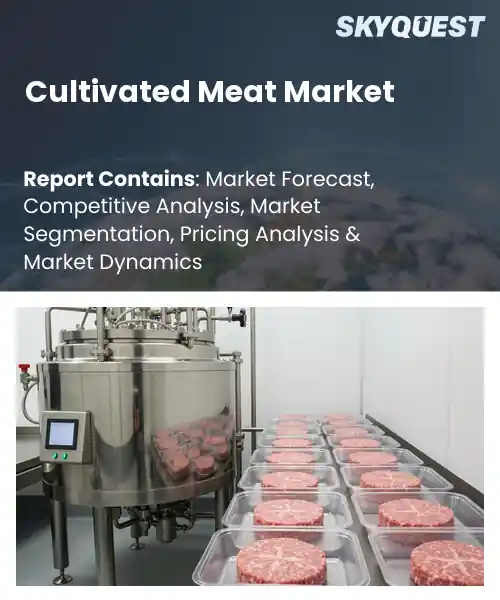
Cultivated Meat Market
Report ID: SQMIG30I2956
Report ID: SQMIG30I2956
[email protected]
USA +1 351-333-4748
Report ID:
SQMIG30I2956 |
Region:
Global |
Published Date: June, 2026
Pages:
157
|Tables:
142
|Figures:
78


Global Cultivated Meat Market size was valued at USD 303.1 Million in 2024 and is poised to grow from USD 404.94 Million in 2025 to USD 4110.02 Million by 2033, growing at a CAGR of 33.6% during the forecast period (2026-2033).
Cost reduction serves as the pivotal factor shaping the cultivated meat market because lower production expenses unlock price parity with conventional meat, which drives consumer adoption. Advances in fed‑batch bioreactors and the shift to recombinant growth factors have cut the cost of a kilogram of cultured beef from thousands of dollars to under a hundred, prompting retailers such as Whole Foods to pilot chicken nuggets. This price compression encourages investment from protein firms, enabling construction of hubs that benefit from economies of scale and create resilience. As affordability improves, segments including families and operators appear, expanding distribution beyond niche restaurants and accelerating consumption. The cultivated meat market produces animal‑cell tissue in bioreactors, offering an alternative to traditional livestock farming. Its significance stems from the ability to slash greenhouse‑gas emissions, reduce water use, and address animal‑welfare concerns, positioning it as a cornerstone of sustainable food systems. Rising consumer awareness of climate impact, coupled with breakthroughs in cell‑culture techniques such as serum‑free media and scaffold‑free scaffolding, serves as the primary driver of market emergence. Early commercial launches 2020 cultivated chicken strips in Singapore and 2021 beef burger in the United States illustrate how regulatory approval and venture‑capital inflows have spurred scaling across multiple regions globally in coming years.
How is AI-driven automation shaping cost reduction in the cultivated meat market?
AI driven automation is becoming a core lever for lowering production costs in cultivated meat. It works by using machine learning to predict optimal cell growth conditions, by automating bioreactor monitoring and by streamlining media formulation. Today several labs integrate sensor data with algorithms that adjust temperature, oxygen and nutrient levels in real time, which cuts waste and shortens cycle times. The technology also supports robotic handling of cell cultures, reducing labor intensity and improving consistency. As these tools mature they enable producers to scale more efficiently while keeping expenses under control. Investors are watching these efficiencies closely as they promise to bring price parity with conventional protein.Aleph Farms 2025, introduced an AI guided bioprocess platform that automatically tunes nutrient blends and reduces batch variability, helping the company lower media costs and accelerate scale up. This step demonstrates how AI driven automation directly supports cost reduction and market growth, and positions cultivated meat as a viable alternative for mainstream consumers.
Market snapshot - (2026-2033)
Global Market Size
USD 303.1 Million
Largest Segment
Poultry Alternatives
Fastest Growth
Seafood Alternatives
Growth Rate
33.6% CAGR
To get more insights on this market click here to Request a Free Sample Report
Global cultivated meat market is segmented by meat biological category, production cultivation technique, final culinary form factor, end-use application market, distribution sales channel and region. Based on meat biological category, the market is segmented into Poultry Alternatives, Red Meat Alternatives and Seafood Alternatives. Based on production cultivation technique, the market is segmented into Scaffold-Based Tissue Structuring, Suspension-Based Bioreactor Scaling and Tissue-Based Direct Maturation. Based on final culinary form factor, the market is segmented into Minced Meat Formulations and Whole-Cut Product Structuring. Based on end-use application market, the market is segmented into Human Food Industry and Pet Food Manufacturing. Based on distribution sales channel, the market is segmented into Foodservice and Restaurants, Retail Grocery Supermarkets and Specialized Digital E-Commerce Platforms. Based on region, the market is segmented into North America, Europe, Asia Pacific, Latin America and Middle East & Africa.
Poultry alternatives segment dominates because consumer preference for familiar taste and lower perceived risk drives rapid acceptance of cultivated proteins. Established familiarity with chicken dishes encourages early trial, while the relatively simple cell line requirements reduce production complexity. This convergence of taste familiarity, streamlined manufacturing, and strong brand alignment fuels investment and accelerates scale up, positioning poultry alternatives at the forefront of market entry and consumer confidence across multiple channels.
Meanwhile, red meat alternatives segment is witnessing the strongest growth momentum because emerging ethical concerns and rising demand for premium protein experiences spur investment in beef and lamb cell lines. Innovative texture replication and targeted marketing attract discerning diners, expanding the cultivated market footprint and unlocking new revenue streams for producers.
Suspension based bioreactor scaling segment leads because it enables continuous cell growth at industrial volumes, reducing reliance on labor intensive scaffold processes. The fluidic environment simplifies nutrient distribution and waste removal, allowing manufacturers to achieve economies of scale and lower unit costs. This operational efficiency meets investor expectations for rapid commercialization and supports broad market rollout across diverse product categories while fostering collaborations with equipment suppliers and advancing process automation.
On the other hand, tissue based direct maturation segment emerges as the key high growth area because it bypasses scaffold dependency and delivers tissue that more closely mimics native muscle architecture. adopters leverage this approach to create premium whole cut experiences, attracting gourmet outlets and accelerating consumer willingness to pay a premium.
To get detailed segments analysis, Request a Free Sample Report
North America benefits from a confluence of advanced biotechnology ecosystems, robust venture capital networks, and a consumer base that values sustainability and innovation. Established research institutions and a supportive regulatory environment foster rapid product development and commercialization. Strong collaboration between startups, large food corporations, and academic labs accelerates scaling of production processes. High consumer awareness and acceptance of alternative proteins create market momentum, while supply chain infrastructure supports efficient distribution. Together these factors position North America as a leader shaping industry standards and driving global adoption of cultivated meat technologies.
United States Cultivated Meat Market
Cultivated Meat Market in the United States thrives on a vibrant entrepreneurial culture, extensive research funding, and early adoption by major food brands. Collaborative clusters in biotech hubs promote knowledge exchange, while consumer curiosity fuels demand for novel protein experiences. Strategic partnerships with agricultural enterprises help integrate cultivated products into existing retail channels, enhancing visibility and accessibility for a broad audience.
Canada Cultivated Meat Market
Cultivated Meat Market in Canada draws strength from government incentives that encourage clean technology development and a strong emphasis on environmental stewardship. Academic institutions excel in cell‑culture research, fostering talent pipelines for industry growth. Consumer interest aligns with national values of sustainable sourcing, prompting food retailers to explore cultivated offerings. Collaborative initiatives between provincial agencies and private firms accelerate pathway development for commercial scale production.
Europe’s expansion is propelled by a unified commitment to climate goals, a sophisticated food safety framework, and a culture that embraces culinary innovation. Policy incentives across the region encourage investment in sustainable protein solutions, while consumer preferences for ethical and health‑conscious foods create a receptive market. Strong academic research networks and cross‑border collaborations streamline technological advancement. Established food heritage and gourmet sensibilities inspire product differentiation, allowing cultivated meat to integrate into diverse culinary traditions. These synergistic elements reinforce Europe’s position as a dynamic hub for cultivated meat development.
Germany Cultivated Meat Market
Cultivated Meat Market in Germany is anchored by world‑class research institutions and a robust industrial base that supports precision manufacturing. Government programs emphasize environmental impact reduction, providing a favorable landscape for emerging producers. Consumer awareness of ecological footprints drives interest, while established food retailers experiment with pilot offerings. Collaborative platforms among biotech firms and traditional meat processors enable knowledge transfer and accelerate scale‑up activities.
United Kingdom Cultivated Meat Market
Cultivated Meat Market in the United Kingdom experiences rapid growth due to proactive regulatory pathways and a vibrant venture capital scene. Academic excellence in cellular biology fuels innovation pipelines, while public discourse around sustainability accelerates consumer acceptance. Leading restaurant groups and supermarkets actively trial cultivated products, creating early market exposure. Collaborative ecosystems linking startups with established food brands foster rapid iteration and market readiness.
France Cultivated Meat Market
Cultivated Meat Market in France is emerging within a culinary culture that prizes quality and innovation. Government initiatives promote research in alternative proteins, encouraging collaborations between chefs and biotech firms. Consumer interest in gourmet experiences aligns with the novelty of cultivated offerings, prompting boutique retailers to showcase pilot products. Academic institutions contribute expertise in cell culture, supporting the development of French‑style cultivated meat concepts.
Asia Pacific advances its role through strategic integration of cutting‑edge biotechnology with deep culinary traditions and expanding middle‑class demand for premium protein options. Regional governments prioritize food security and environmental resilience, offering support for sustainable protein initiatives. Strong manufacturing expertise and cost‑effective production capabilities enable competitive scaling. Consumer openness to novel food experiences, reinforced by a vibrant foodservice sector, drives trial and adoption. International partnerships bring expertise and capital, accelerating technology transfer and market entry across the region.
Japan Cultivated Meat Market
Cultivated Meat Market in Japan leverages a sophisticated food culture that values precision and safety, aligning well with scientifically produced proteins. Governmental support for innovative food technologies encourages research collaborations between universities and biotech firms. High consumer interest in health‑focused diets creates a receptive environment for cultivated products. Leading food conglomerates explore integration of cultivated meat into traditional dishes, fostering acceptance through familiar culinary contexts.
South Korea Cultivated Meat Market
Cultivated Meat Market in South Korea benefits from strong government investment in biotech research and a tech‑savvy consumer base eager for novel food solutions. Academic centers excel in cellular agriculture, driving rapid advancements. Food companies actively partner with startups to develop localized product concepts that resonate with Korean taste preferences. Rapid adoption of digital retail platforms facilitates early market exposure, supporting momentum for cultivated meat integration into everyday meals.
To know more about the market opportunities by region and country, click here to
Buy The Complete Report
Increasing Consumer Acceptance
Technological Innovations Reducing Production Costs
Regulatory Uncertainty Limits Expansion
High Capital Investment Requirements
Request Free Customization of this report to help us to meet your business objectives.
Intense competition in cultivated meat is driven by the race to achieve cost‑effective scale, prompting firms to pursue consolidation, strategic alliances and rapid tech upgrades. The 2026 State of the Industry report notes increased M&A activity as smaller players merge, while 2025 fundraising of $73.9 million funded bioreactor innovations and partnerships with food distributors to accelerate market entry.
Top Player’s Company Profile
Recent Developments
SkyQuest’s ABIRAW (Advanced Business Intelligence, Research & Analysis Wing) is our Business Information Services team that Collects, Collates, Correlates, and Analyses the Data collected by means of Primary Exploratory Research backed by robust Secondary Desk research. As per SkyQuest analysis the cultivated meat market is expanding rapidly, driven chiefly by cost‑reduction breakthroughs such as AI‑guided bioprocess automation that lower production expenses and move products toward price parity with conventional meat. A second important catalyst is growing consumer acceptance fueled by heightened awareness of sustainability and animal‑welfare benefits. The market is most strongly anchored in North America where advanced biotech ecosystems, ample venture capital and supportive regulations accelerate commercialization. Within product categories poultry alternatives dominate because familiar flavors and simpler cell lines ease early adoption. However, regulatory uncertainty across regions remains a major restraint, slowing full‑scale rollout and adding compliance costs for producers.
| Report Metric | Details |
|---|---|
| Market size value in 2024 | USD 303.1 Million |
| Market size value in 2033 | USD 4110.02 Million |
| Growth Rate | 33.6% |
| Base year | 2024 |
| Forecast period | (2026-2033) |
| Forecast Unit (Value) | USD Million |
| Segments covered |
|
| Regions covered | North America (US, Canada), Europe (Germany, France, United Kingdom, Italy, Spain, Rest of Europe), Asia Pacific (China, India, Japan, Rest of Asia-Pacific), Latin America (Brazil, Rest of Latin America), Middle East & Africa (South Africa, GCC Countries, Rest of MEA) |
| Companies covered |
|
| Customization scope | Free report customization with purchase. Customization includes:-
|
To get a free trial access to our platform which is a one stop solution for all your data requirements for quicker decision making. This platform allows you to compare markets, competitors who are prominent in the market, and mega trends that are influencing the dynamics in the market. Also, get access to detailed SkyQuest exclusive matrix.
Table Of Content
Executive Summary
Market overview
Parent Market Analysis
Market overview
Market size
KEY MARKET INSIGHTS
COVID IMPACT
MARKET DYNAMICS & OUTLOOK
Market Size by Region
KEY COMPANY PROFILES
Methodology
For the Cultivated Meat Market, our research methodology involved a mixture of primary and secondary data sources. Key steps involved in the research process are listed below:
1. Information Procurement: This stage involved the procurement of Market data or related information via primary and secondary sources. The various secondary sources used included various company websites, annual reports, trade databases, and paid databases such as Hoover's, Bloomberg Business, Factiva, and Avention. Our team did 45 primary interactions Globally which included several stakeholders such as manufacturers, customers, key opinion leaders, etc. Overall, information procurement was one of the most extensive stages in our research process.
2. Information Analysis: This step involved triangulation of data through bottom-up and top-down approaches to estimate and validate the total size and future estimate of the Cultivated Meat Market.
3. Report Formulation: The final step entailed the placement of data points in appropriate Market spaces in an attempt to deduce viable conclusions.
4. Validation & Publishing: Validation is the most important step in the process. Validation & re-validation via an intricately designed process helped us finalize data points to be used for final calculations. The final Market estimates and forecasts were then aligned and sent to our panel of industry experts for validation of data. Once the validation was done the report was sent to our Quality Assurance team to ensure adherence to style guides, consistency & design.
Analyst Support
Customization Options
With the given market data, our dedicated team of analysts can offer you the following customization options are available for the Cultivated Meat Market:
Product Analysis: Product matrix, which offers a detailed comparison of the product portfolio of companies.
Regional Analysis: Further analysis of the Cultivated Meat Market for additional countries.
Competitive Analysis: Detailed analysis and profiling of additional Market players & comparative analysis of competitive products.
Go to Market Strategy: Find the high-growth channels to invest your marketing efforts and increase your customer base.
Innovation Mapping: Identify racial solutions and innovation, connected to deep ecosystems of innovators, start-ups, academics, and strategic partners.
Category Intelligence: Customized intelligence that is relevant to their supply Markets will enable them to make smarter sourcing decisions and improve their category management.
Public Company Transcript Analysis: To improve the investment performance by generating new alpha and making better-informed decisions.
Social Media Listening: To analyze the conversations and trends happening not just around your brand, but around your industry as a whole, and use those insights to make better Marketing decisions.
REQUEST FOR SAMPLE
 REQUEST FREE CUSTOMIZATION


Want to customize this report? This report can be personalized according to your needs. Our analysts and industry experts will work directly with you to understand your requirements and provide you with customized data in a short amount of time. We offer $1000 worth of FREE customization at the time of purchase.
Feedback From Our Clients


 USA (+1) 351-333-4748

