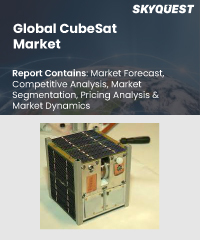
CubeSat Market
Report ID: SQMIG45B2072
Report ID: SQMIG45B2072
[email protected]
USA +1 351-333-4748
Report ID:
SQMIG45B2072 |
Region:
Global |
Published Date: December, 2025
Pages:
197
|Tables:
64
|Figures:
77


Global CubeSat Market size was valued at USD 483.81 Million in 2024 and is poised to grow from USD 560.74 Million in 2025 to USD 1825.68 Million by 2033, growing at a CAGR of 15.9% during the forecast period (2026–2033).
CubeSats are perfect for exploring future technologies and concepts because of their smaller size, lightweight, and cost-efficient platform. The CubeSats are smaller spacecraft that are easier to design, develop, and launch in comparison with conventional satellites. Furthermore, these spacecrafts are used by commercial organizations, government & military bodies, along with non-profit firms. The growing usage of CubeSats is also contributing to the advancement of internet of things (IoT). It helps in communication through space-based infrastructure in remote areas that do not have terrestrial networks.
Moreover, with the advancement of electronics and communication technologies CubeSats are being adopted for various applications like space mining and removal of space debris. There are some commercial organizations who have already started the extraction of minerals, energy resources, and water from space. The CubeSat market is gaining momentum due to the strong demand for Earth observation. These applications are important for collecting data regarding the environment, natural disasters, agriculture, urban development and many more. High-resolution images and data can be captured at a considerably lower costs due to satellite technology miniaturization. This opens the field of space exploration for developing countries and organizations allowing everyone to utilize satellite data for research. The easy accessibility and cost-efficiency of CubeSats makes it perfect for the earth observation sector.
Market snapshot - 2026-2033
Global Market Size
USD 417.44 million
Largest Segment
Government and Military
Fastest Growth
Commercial
Growth Rate
15.9% CAGR
To get more insights on this market click here to Request a Free Sample Report
Global CubeSat Market is segmented by Size, Subsystem, Application, End-Users and region. Based on Size, the market is segmented into 0.25U to 1U, 1U to 3U, 3U to 6U, 6U to 12U and 12U and Above. Based on Subsystem, the market is segmented into Payloads, Structures, Electrical Power Systems, Command and Data Handling, Propulsion Systems and Attitude Determination and Control Systems. Based on Application, the market is segmented into Earth Observation and Traffic Monitoring, Science, Technology, and Education, Space Observation and Communication. Based on End-Users, the market is segmented into Government and Military, Commercial and Non-profit Organizations. Based on region, the market is segmented into North America, Europe, Asia Pacific, Latin America and Middle East & Africa.
Based on application, the earth observation and traffic monitoring segment are dominating with the largest CubeSat market share. The earth observation and traffic monitoring segment are leading the market because of progression done in satellite imaging technologies and increasing requirements for real-time data. CubeSats are developed with high resolution cameras and sensors that are being utilized for monitoring environmental change, urban expansion, and disaster management. Furthermore, these small but powerful satellites play an invaluable role in traffic management because they help in providing information that is useful for navigation systems and smart city projects. The increasing requirement for accurate and low-cost solutions for earth observation makes CubeSats an important consideration for governments, research agencies, and private companies. The segment is also growing because of the increasing demand for accuracy of data and quick deployment of systems, along with partnerships between space agencies and commercial satellite companies.
The communication segment is expected to grow at a significant CAGR during the forecast period. The communication category is the most important one for the CubeSat market and is arguably the most influential in changing the way people communicate globally. There is a growing uptake of CubeSats for the development of communication networks that are low in cost and high in effectiveness, especially in the more challenged and remote areas. CubeSats assist in providing broadband as well as IoT and emergency communication systems. The low cost and high deployment potential of CubeSats constellation appeals to both the private sector and government programs. As the need for smooth and dependable communication services continues to escalate, this segment is bound to surge driven by higher investments in space communication infrastructure.
Based on end use, the government and military segment is dominating the CubeSat market. In the sector of government and the military, CubeSats are revolutionizing the way intelligence, surveillance, and reconnaissance (ISR) operations are carried out. These satellites enable quick and cost-effective means of conducting defense monitoring, improving situational awareness, and securing the national boundary. Moreover, governments are utilizing CubeSat constellations for signal intelligence, early warning, and data transmission purposes. In addition, the integration of sovereign satellite capabilities and the collaboration of defense and private industries are driving the growth in this segment. While geopolitical conflicts will continue to accelerate funding in ISR advanced technologies, it is believed that CubeSat will greatly influence the development of modern defense strategies.
As per CubeSat market analysis, commercial segment is experiencing tremendous growth in recent years. The commercial segment represents an ever-expanding growth potential for the CubeSat market. This is because of the increasing participation of private sector organizations into the space economy. CubeSats enable commercial purposes such as asset tracking, remote sensing, and global navigation system. Both startup firms and big corporations are beginning to adopt CubeSat technologies to improve their service and performance. Furthermore, the integration of CubeSat data commercially and collaboration of private firms and research facilities are increasing the opportunities in the market. This segment is expected to be very successful, fueled by multifaceted innovation, the rising demand for space data services, and business initiatives.
To get detailed segments analysis, Request a Free Sample Report
North America is dominating with the largest CubeSat market share. The CubeSat market is doing exceedingly well in North America specifically owing to the advanced space research programs undertaken by the countries in the region. The market in the region has also been shaped by the global presence of expanding companies like SpaceX and NASA. The United States is dominating due to its adoption of CubeSats with a focus on the applications for Earth observation, defense, and telecommunications. The expansion of the region's market further resulted from increased government allocations and private expenditure into satellites technologies. Partnership between educational institutions and businesses has also fueled enhanced technological development and such new CubeSat products have emerged. Considering the increasing focus towards low-Earth orbit (LEO) satellite constellation, it is expected that the market will continue to grow in this region.
Over the course of the projected period, it is anticipated that the CubeSat market in Asia Pacific would expand with the highest growth rate. The CubeSat market in the Asia Pacific region is moving too rapidly as CubeSats are being utilized by countries like China, India and Japan for disaster management, environmental monitoring and communication. These countries are making investments in space technology, which is boosting the growth of the CubeSat market in the region. Moreover, government institutions like India's ISRO program, and China's plans for global space dominance have served to boost the regional market. In addition, the growing trend of private space companies in the region also provides a healthy competitive environment. CubeSat development projects are being pursued by academic institutions within the Asia Pacific region, which would boast new inventions while offering cheaper options. The region's objectives on improving its space capabilities clearly demonstrates its ambition to become a strong competitor in the global CubeSat market.
To know more about the market opportunities by region and country, click here to
Buy The Complete Report
Drivers
Growing Demand for Smaller and Lighter Satellites
The CubeSat Design Specification (CSD) is generally known as the CubeSat standard. It is the document that outlines the characteristics of the nanosatellites class referred to as CubeSats. The primary advantage of CubeSat satellite is that it requires less time to manufacture compared to the traditional satellites. The CubeSat can be produced and placed in orbit based on the specification, which is cost-efficient in comparison with the expenses required for traditional satellite missions. This is because CubeSats are smaller compared to other satellites.
Growing Demand of Satellites in Different Sectors
The CubeSats can be smaller in size and weight, but this does not reduce the abilities of the satellites. They are increasingly used in various commercial applications such as communication, internet of things, geolocation, logistics, and signal monitoring. The expanding usage of CubeSat has also increased opportunities for using internet of things (IoT) globally. The usage of sensor-driven devices is increasing rapidly, which requires communication and connections, fueling the growth of the CubeSat market. Furthermore, this satellite can be used for managing the process of locating and monitoring assets in areas where there is no land like ships and aircrafts.
Restraints
Reduced Payload Capacity of CubeSat to Restrict Growth
One of the main constraints regarding space activities performed by CubeSats is their ability to host payloads. The compact nature of the CubeSat also greatly restricts the volume allocated to its propulsion, payload and other subsystems. Higher V (impulse required to perform a maneuver) missions would require an increase in the amount of fuel which in turn restricts the volume set aside for scientific instruments and other payloads that the CubeSat is intended to carry. Due to the internal volume constraints, CubeSats cannot carry essential subsystems that are important in order to perform intricate missions.
Growing Congestion in Low Earth Orbit
There’s a growing concern about the congestion in the low Earth orbit (LEO) as it leads to a risk of collisions and space debris. It becomes more important with the increasing number of CubeSats being put in orbit to conduct operations in space sustainably and safely. Regulatory barriers such as licensing and spectrum allocation can also be significant constraints to both entry and growth in the markets concerned. Furthermore, given the fastmoving environment, CubeSat makers have to come up with new ideas, which imposes pressure on resources and budgets.
Request Free Customization of this report to help us to meet your business objectives.
The CubeSat market offers stiff competition with major competitors targeting innovations, joint ventures and expanding the range of their products. Companies that are making a transition in the CubeSat technologies include Planet Labs, Tyvak Nano–Satellite Systems and AAC Clyde Space. At the same time, new companies are emerging in the market, which focus on low-cost production and service delivery as a market entry strategy. Partnerships between commercial companies and government agencies have become a strategy to satisfy the market and strengthen the technological potential. Furthermore, the growing interest of academia and research institutions to participate in CubeSat missions is creating distinct and active competition for the market.
SkyQuest's ABIRAW (Advanced Business Intelligence, Research & Analysis Wing) is our Business Information Services team that Collects, Collates, Correlates, and Analyses the Data collected by means of Primary Exploratory Research backed by robust Secondary Desk research.
As per SkyQuest analysis, over the last few years, there has been a considerable expansion of the CubeSat industry that can be attributed to developments in technologies related to miniature satellites and the rising use of satellite-based services. Cost-efficient and compact CubeSats are used for different purposes including Earth observation, telecommunications, scientific and even military applications. Their relatively low cost in both production and launch, as well as their short development periods, have made them suitable for business and academic funding projects. CubeSat projects are being funded by governments as well as private companies and educational institutions, encouraging innovation and collaboration in the market. In addition, the market is expected to grow with the emergence of space exploration undertakings and the growth of satellite constellations, therefore giving the stakeholders immense opportunities for the future.
| Report Metric | Details |
|---|---|
| Market size value in 2024 | USD 483.81 Million |
| Market size value in 2033 | USD 1825.68 Million |
| Growth Rate | 15.9% |
| Base year | 2024 |
| Forecast period | 2026-2033 |
| Forecast Unit (Value) | USD Million |
| Segments covered |
|
| Regions covered | North America (US, Canada), Europe (Germany, France, United Kingdom, Italy, Spain, Rest of Europe), Asia Pacific (China, India, Japan, Rest of Asia-Pacific), Latin America (Brazil, Rest of Latin America), Middle East & Africa (South Africa, GCC Countries, Rest of MEA) |
| Companies covered |
|
| Customization scope | Free report customization with purchase. Customization includes:-
|
To get a free trial access to our platform which is a one stop solution for all your data requirements for quicker decision making. This platform allows you to compare markets, competitors who are prominent in the market, and mega trends that are influencing the dynamics in the market. Also, get access to detailed SkyQuest exclusive matrix.
Table Of Content
Executive Summary
Market overview
Parent Market Analysis
Market overview
Market size
KEY MARKET INSIGHTS
COVID IMPACT
MARKET DYNAMICS & OUTLOOK
Market Size by Region
KEY COMPANY PROFILES
Methodology
For the CubeSat Market, our research methodology involved a mixture of primary and secondary data sources. Key steps involved in the research process are listed below:
1. Information Procurement: This stage involved the procurement of Market data or related information via primary and secondary sources. The various secondary sources used included various company websites, annual reports, trade databases, and paid databases such as Hoover's, Bloomberg Business, Factiva, and Avention. Our team did 45 primary interactions Globally which included several stakeholders such as manufacturers, customers, key opinion leaders, etc. Overall, information procurement was one of the most extensive stages in our research process.
2. Information Analysis: This step involved triangulation of data through bottom-up and top-down approaches to estimate and validate the total size and future estimate of the CubeSat Market.
3. Report Formulation: The final step entailed the placement of data points in appropriate Market spaces in an attempt to deduce viable conclusions.
4. Validation & Publishing: Validation is the most important step in the process. Validation & re-validation via an intricately designed process helped us finalize data points to be used for final calculations. The final Market estimates and forecasts were then aligned and sent to our panel of industry experts for validation of data. Once the validation was done the report was sent to our Quality Assurance team to ensure adherence to style guides, consistency & design.
Analyst Support
Customization Options
With the given market data, our dedicated team of analysts can offer you the following customization options are available for the CubeSat Market:
Product Analysis: Product matrix, which offers a detailed comparison of the product portfolio of companies.
Regional Analysis: Further analysis of the CubeSat Market for additional countries.
Competitive Analysis: Detailed analysis and profiling of additional Market players & comparative analysis of competitive products.
Go to Market Strategy: Find the high-growth channels to invest your marketing efforts and increase your customer base.
Innovation Mapping: Identify racial solutions and innovation, connected to deep ecosystems of innovators, start-ups, academics, and strategic partners.
Category Intelligence: Customized intelligence that is relevant to their supply Markets will enable them to make smarter sourcing decisions and improve their category management.
Public Company Transcript Analysis: To improve the investment performance by generating new alpha and making better-informed decisions.
Social Media Listening: To analyze the conversations and trends happening not just around your brand, but around your industry as a whole, and use those insights to make better Marketing decisions.
REQUEST FOR SAMPLE
 REQUEST FREE CUSTOMIZATION


Want to customize this report? This report can be personalized according to your needs. Our analysts and industry experts will work directly with you to understand your requirements and provide you with customized data in a short amount of time. We offer $1000 worth of FREE customization at the time of purchase.
Feedback From Our Clients


 USA (+1) 351-333-4748

