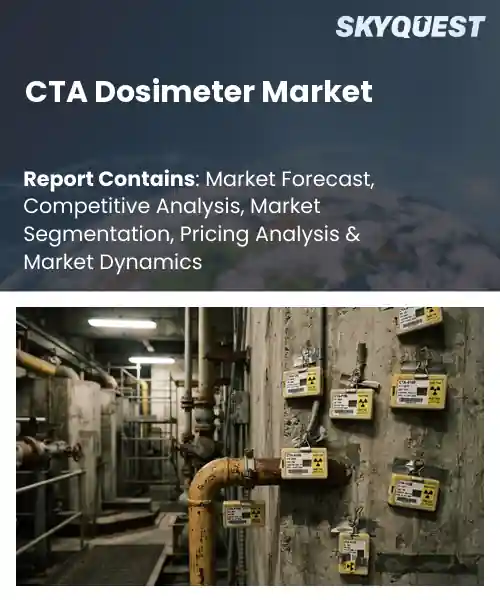
CTA Dosimeter Market
Report ID: SQMIG35A4421
Report ID: SQMIG35A4421
[email protected]
USA +1 351-333-4748
Report ID:
SQMIG35A4421 |
Region:
Global |
Published Date: August, 2026
Pages:
157
|Tables:
123
|Figures:
77


Global Cta Dosimeter Market size was valued at USD 342.6 Million in 2024 and is poised to grow from USD 364.53 Million in 2025 to USD 598.78 Million by 2033, growing at a CAGR of 6.4% during the forecast period (2026-2033).
Regulatory pressure represents a compelling catalyst for the CTA dosimeter market, because compliance mandates compel healthcare providers to invest in dose‑recording solutions. When authorities tighten permissible exposure limits, hospitals must replace legacy film badges with digital CTA systems that offer traceability and automated alerts. This shift unlocks opportunities for vendors to supply software platforms that link dosimeter data with management systems, exemplified by a partnership between a dosimeter manufacturer and an information system provider in Europe. As a result, adoption expands beyond oncology units into cardiology suites, where real‑time monitoring reduces complications and supports reimbursement models tied to safety metrics.
How is AI improving calibration accuracy in the CTA dosimeter market?
AI is sharpening calibration accuracy in CTA dosimeters by automating data interpretation, refining sensor drift correction, and enabling adaptive learning models that adjust for temperature, pressure and radiation field variations. Machine‑learning algorithms compare real‑time measurements with a vast library of reference scans, instantly flagging anomalies and suggesting optimal correction factors. This reduces manual tweaking, shortens setup time and improves reproducibility across different imaging centers. The technology also supports predictive maintenance, alerting technicians before a detector drifts out of tolerance, which keeps workflows smooth and patient dosing consistent. As CTA procedures expand, AI‑driven calibration becomes a key differentiator for manufacturers seeking higher reliability and lower operational costs.In June 2024, Mirion Technologies introduced an AI‑enhanced calibration platform, which streamlines dose‑setting and boosts measurement confidence, directly supporting market growth and operational efficiency.
Market snapshot - (2026-2033)
Global Market Size
USD 342.6 Million
Largest Segment
Software
Fastest Growth
Services
Growth Rate
6.4% CAGR
To get more insights on this market click here to Request a Free Sample Report
Global cta dosimeter market is segmented by dosimeter type, radiation type, application, end user and region. Based on dosimeter type, the market is segmented into Electronic Personal Dosimeters, Electronic Area Dosimeters and Other Electronic Dosimeters. Based on radiation type, the market is segmented into X-Ray, Gamma Ray, Beta Radiation and Neutron Radiation. Based on application, the market is segmented into Medical & Healthcare, Nuclear Power, Industrial, Research & Laboratories, Defense & Homeland Security and Other Applications. Based on end user, the market is segmented into Hospitals & Diagnostic Centers, Nuclear Facilities, Industrial Facilities, Research Institutions and Government & Defense Organizations. Based on region, the market is segmented into North America, Europe, Asia Pacific, Latin America and Middle East & Africa.
X-ray segment dominates because it addresses the most prevalent source of occupational exposure in medical imaging, industrial radiography, and security scanning. The widespread use of X-ray equipment creates a constant demand for precise dose measurement, prompting manufacturers to tailor dosimeters with high sensitivity and energy discrimination for this spectrum. Consequently, regulatory compliance pressures and the need for accurate patient dose tracking reinforce its central role in the CTA dosimeter market.
Meanwhile, Neutron radiation segment emerges as the key high growth area because expanding nuclear energy programs and advanced research facilities are increasing demand for neutron‑specific monitoring. Innovations in detector materials enhance sensitivity to fast neutrons, enabling compliance with stricter safety standards and opening new market opportunities that accelerate overall CTA dosimeter market expansion.
Electronic Personal Dosimeters segment dominates because they provide real‑time individual exposure monitoring, which is critical for occupational safety in high‑risk environments. Their portability, user‑friendly interfaces, and integration with wireless data platforms enable immediate hazard identification and compliance with stringent radiation protection regulations. Consequently, they are preferred by health‑care workers, nuclear plant staff, and defense personnel, driving widespread adoption across the CTA dosimeter market and supporting continuous risk mitigation strategies.
However, Electronic Area Dosimeters segment is witnessing the strongest growth momentum because expanding facility‑wide monitoring requirements and advances in sensor miniaturization are boosting their appeal. Their ability to network across large zones, deliver aggregated exposure data, and integrate with safety management systems positions them as a catalyst for broader market expansion.
To get detailed segments analysis, Request a Free Sample Report
North America retains a leading position in the CTA dosimeter market due to a confluence of mature healthcare ecosystems, robust research and development capabilities, and a regulatory framework that encourages innovation. Established clinical networks and academic institutions drive early adoption of advanced dosimetry solutions, while a deep pool of specialized talent sustains continuous product refinement. The region benefits from extensive investment in precision oncology and radiotherapy, creating demand for accurate dose monitoring tools. Strong collaboration between device manufacturers, hospitals, and technology providers further accelerates market penetration. Additionally, well‑structured reimbursement pathways and proactive policy initiatives support broader deployment across both large academic centers and community practices, reinforcing North America’s dominant status. The presence of leading multinational firms and a culture of early technology adoption also contribute to sustained market momentum.
CTA Dosimeter Market in the United States benefits from a deep ecosystem of academic research hospitals that prioritize cutting‑edge radiation therapy techniques. The presence of renowned cancer centers drives rigorous validation of dosimetry tools, while a strong venture capital environment fuels start‑up development. Collaborative frameworks linking manufacturers with clinical end‑users accelerate product refinement, and well‑defined reimbursement pathways encourage widespread adoption across both large integrated health systems and specialized clinics nationwide.
CTA Dosimeter Market in Canada is shaped by a strong public health system that emphasizes equitable access to advanced oncology services. Provincial cancer agencies coordinate procurement and standardization, fostering consistent deployment of dosimetry solutions across urban and regional treatment centers. Close ties between research institutes and radiotherapy providers promote collaborative validation studies, while a focus on cost‑effectiveness supports the selection of reliable, high‑precision devices. This integrated approach underpins steady market momentum throughout the country.
Europe experiences rapid expansion of the CTA dosimeter market driven by a harmonized regulatory landscape, strong public health investment, and a collaborative research environment. Cross‑border clinical trials and integrated cancer networks facilitate swift diffusion of sophisticated dosimetry technologies. The region’s emphasis on patient safety and precision treatment aligns closely with the capabilities of CTA dosimeters, prompting early adoption by leading oncology centers. Government incentives for digital health transformation further stimulate demand, while a dense concentration of specialized manufacturers and academic spin‑outs fuels continuous innovation. These factors collectively position Europe as a dynamic hub for market growth and technological advancement. Additionally, strong patient advocacy groups and a focus on evidence‑based practice encourage hospitals to integrate CTA dosimetry into routine protocols, reinforcing the continent’s momentum.
CTA Dosimeter Market in Germany benefits from a highly organized healthcare framework and a tradition of precision engineering. National cancer registries supply comprehensive data that inform clinical adoption strategies, while strong ties between medical device firms and research hospitals accelerate technology transfer. Government-backed innovation programs encourage development of next‑generation dosimetry platforms, and reimbursement policies prioritize clinically validated solutions. These elements combine to sustain Germany’s leading role in the European landscape.
CTA Dosimeter Market in the United Kingdom is propelled by a dynamic NHS structure that actively embraces digital health integration. Centralized procurement mechanisms streamline acquisition of advanced dosimetry equipment, while collaborative research consortia between universities and cancer centers foster rapid clinical testing. Policy initiatives that reward outcome‑based care further incentivize the uptake of precise dose measurement tools. This supportive ecosystem accelerates the United Kingdom’s reputation as the fastest‑growing market in Europe.
CTA Dosimeter Market in France is emerging as a result of progressive health policy and increasing focus on personalized cancer care. National cancer plans highlight the importance of accurate dose monitoring, prompting hospitals to evaluate CTA solutions alongside conventional systems. Strong academic partnerships with leading oncology institutes drive pilot implementations, while reimbursement reforms increasingly accommodate innovative dosimetry technologies. This supportive environment is gradually expanding market presence across major treatment centers.
Asia Pacific is strengthening its position in the CTA dosimeter market through a combination of rapid healthcare modernization, expanding radiotherapy infrastructure, and a cultural emphasis on technology adoption. Governments across the region are investing in advanced cancer treatment facilities, creating demand for precise dose measurement solutions. Growing collaboration between regional manufacturers and global technology leaders accelerates knowledge transfer and product localization. The increasing prevalence of multidisciplinary cancer centers promotes integration of CTA dosimetry into standard treatment protocols. Together, these dynamics foster a fertile environment for sustained market growth and heightened regional competitiveness. In addition, emerging digital health initiatives and cross‑border regulatory harmonization are reducing barriers to entry, enabling faster adoption of innovative dosimetry platforms. The region’s commitment to training clinicians in advanced radiation techniques further ensures that CTA dosimeters are effectively integrated into patient care pathways, reinforcing Asia Pacific’s rising influence on the global stage.
CTA Dosimeter Market in Japan is characterized by a technologically sophisticated environment and strong emphasis on patient safety. National cancer treatment guidelines prioritize precise dose verification, encouraging hospitals to adopt CTA solutions. Close collaboration between leading medical device firms and university research centers accelerates innovation cycles, while a robust reimbursement framework supports procurement of high‑performance dosimetry equipment. These factors collectively embed CTA dosimeters as a standard component of modern radiotherapy practice.
CTA Dosimeter Market in South Korea is rapidly advancing, driven by a strategic focus on cutting‑edge cancer therapies and strong government support. National health initiatives prioritize investment in advanced radiotherapy infrastructure, creating a receptive environment for precise dose monitoring technologies. Partnerships between domestic manufacturers and international research institutes facilitate rapid adaptation of CTA systems to local clinical workflows. Reimbursement incentives and a culture of continuous medical education further encourage clinicians to integrate dosimetry tools into routine practice.
To know more about the market opportunities by region and country, click here to
Buy The Complete Report
Adopting Advanced Technologies
Growing Awareness Of Radiation Safety
High Initial Capital Expenditure
Stringent Regulatory Approval Processes
Request Free Customization of this report to help us to meet your business objectives.
The CTA dosimeter market is intensely competitive, with established players such as RaySafe, RTI Group, IBA, SPC Doza, QUART, PTW Freiburg and LANDAUER actively defending market share against a wave of new entrants. Companies are accelerating technology innovation, expanding distribution networks and forming strategic collaborations to differentiate their offerings and meet rising demand for precise dose monitoring in radiotherapy.
Top Player’s Company Profile
Recent Developments
SkyQuest’s ABIRAW (Advanced Business Intelligence, Research & Analysis Wing) is our Business Information Services team that Collects, Collates, Correlates, and Analyses the Data collected by means of Primary Exploratory Research backed by robust Secondary Desk research. As per SkyQuest analysis, the global CTA dosimeter market is expanding at a 6.4% CAGR driven primarily by the adoption of advanced wireless and AI‑enhanced calibration technologies that improve accuracy and streamline workflow, while heightened awareness of radiation safety provides a second boost by prompting organizations to invest in real‑time monitoring. The market’s growth is tempered by high upfront capital costs that discourage smaller facilities from upgrading. North America remains the dominant region, benefitting from mature healthcare systems and strong reimbursement pathways. Within the product landscape, electronic personal dosimeters lead the market, offering portable, real‑time exposure tracking that aligns with regulatory demands.
| Report Metric | Details |
|---|---|
| Market size value in 2024 | USD 342.6 Million |
| Market size value in 2033 | USD 598.78 Million |
| Growth Rate | 6.4% |
| Base year | 2024 |
| Forecast period | (2026-2033) |
| Forecast Unit (Value) | USD Million |
| Segments covered |
|
| Regions covered | North America (US, Canada), Europe (Germany, France, United Kingdom, Italy, Spain, Rest of Europe), Asia Pacific (China, India, Japan, Rest of Asia-Pacific), Latin America (Brazil, Rest of Latin America), Middle East & Africa (South Africa, GCC Countries, Rest of MEA) |
| Companies covered |
|
| Customization scope | Free report customization with purchase. Customization includes:-
|
To get a free trial access to our platform which is a one stop solution for all your data requirements for quicker decision making. This platform allows you to compare markets, competitors who are prominent in the market, and mega trends that are influencing the dynamics in the market. Also, get access to detailed SkyQuest exclusive matrix.
Table Of Content
Executive Summary
Market overview
Parent Market Analysis
Market overview
Market size
KEY MARKET INSIGHTS
COVID IMPACT
MARKET DYNAMICS & OUTLOOK
Market Size by Region
KEY COMPANY PROFILES
Methodology
For the CTA Dosimeter Market, our research methodology involved a mixture of primary and secondary data sources. Key steps involved in the research process are listed below:
1. Information Procurement: This stage involved the procurement of Market data or related information via primary and secondary sources. The various secondary sources used included various company websites, annual reports, trade databases, and paid databases such as Hoover's, Bloomberg Business, Factiva, and Avention. Our team did 45 primary interactions Globally which included several stakeholders such as manufacturers, customers, key opinion leaders, etc. Overall, information procurement was one of the most extensive stages in our research process.
2. Information Analysis: This step involved triangulation of data through bottom-up and top-down approaches to estimate and validate the total size and future estimate of the CTA Dosimeter Market.
3. Report Formulation: The final step entailed the placement of data points in appropriate Market spaces in an attempt to deduce viable conclusions.
4. Validation & Publishing: Validation is the most important step in the process. Validation & re-validation via an intricately designed process helped us finalize data points to be used for final calculations. The final Market estimates and forecasts were then aligned and sent to our panel of industry experts for validation of data. Once the validation was done the report was sent to our Quality Assurance team to ensure adherence to style guides, consistency & design.
Analyst Support
Customization Options
With the given market data, our dedicated team of analysts can offer you the following customization options are available for the CTA Dosimeter Market:
Product Analysis: Product matrix, which offers a detailed comparison of the product portfolio of companies.
Regional Analysis: Further analysis of the CTA Dosimeter Market for additional countries.
Competitive Analysis: Detailed analysis and profiling of additional Market players & comparative analysis of competitive products.
Go to Market Strategy: Find the high-growth channels to invest your marketing efforts and increase your customer base.
Innovation Mapping: Identify racial solutions and innovation, connected to deep ecosystems of innovators, start-ups, academics, and strategic partners.
Category Intelligence: Customized intelligence that is relevant to their supply Markets will enable them to make smarter sourcing decisions and improve their category management.
Public Company Transcript Analysis: To improve the investment performance by generating new alpha and making better-informed decisions.
Social Media Listening: To analyze the conversations and trends happening not just around your brand, but around your industry as a whole, and use those insights to make better Marketing decisions.
REQUEST FOR SAMPLE
 REQUEST FREE CUSTOMIZATION


Want to customize this report? This report can be personalized according to your needs. Our analysts and industry experts will work directly with you to understand your requirements and provide you with customized data in a short amount of time. We offer $1000 worth of FREE customization at the time of purchase.
Feedback From Our Clients


 USA (+1) 351-333-4748

