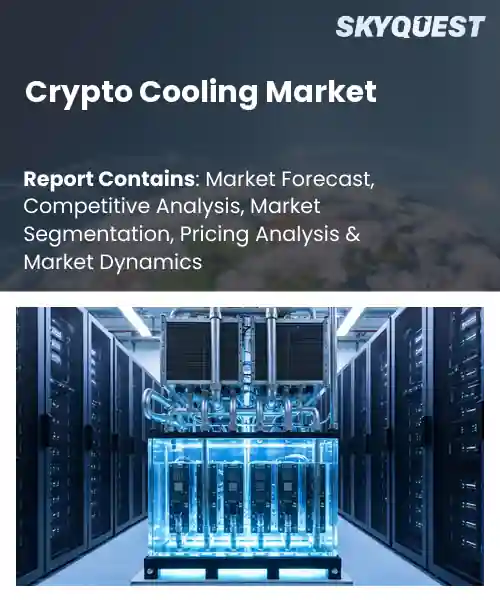
Crypto Cooling Market
Report ID: SQMIG45I2415
Report ID: SQMIG45I2415
[email protected]
USA +1 351-333-4748
Report ID:
SQMIG45I2415 |
Region:
Global |
Published Date: June, 2026
Pages:
157
|Tables:
139
|Figures:
78


Global Crypto Cooling Market size was valued at USD 1.27 Billion in 2024 and is poised to grow from USD 1.54 Billion in 2025 to USD 7.22 Billion by 2033, growing at a CAGR of 21.3% during the forecast period (2026-2033).
The crypto cooling industry is dominated by an urgent need to dissipate a tremendous amount of heat generated from concentrated mining rigs, which is the main driving force behind operators seeking better thermal management solutions. The crypto cooling market consists of air chillers, direct-to-chip liquid cooling, two-phase immersion systems and retrofit and monitoring services. Efficient cooling is critical to hashing performance, hardware life expectancy and energy economics. Historically, projects transitioned from the use of commodity air conditioning units in small mining operations to the use of liquid and/or immersion cooling systems at hyperscale facilities where vendors such as Green Revolution Cooling and Iceotope showed their ability to improve Power Usage Effectiveness (PUE) and accelerate overall industry usage of their products.
The energy efficiency goal is therefore the largest driving force for growth in the crypto cooling market. Improving energy efficiency minimizes operating expenses and improves the margin realized by miners, which encourages further investment in advanced thermal management solutions. With increasing energy costs and additional regulations related to decarbonization, operators continued to adopt immersion cooling solutions as a way to positively impact PUE and take advantage of the concentrated waste heat for reuse in district energy systems, greenhouses and industrial applications. Use cases in Iceland and northern Europe show miners monetizing heat, while colocated containerized immersion farms enable rapid scaling and a reinforcing loop that sustains broader market expansion and higher profitability.
How is AI Optimizing Thermal Management In The Crypto Cooling Market?
AI is revolutionizing thermal management within the crypto cooling industry by utilizing sensor-driven models and predictive control to provide real-time temperature and airflow management. Key features of the technology include continuous telemetry from miner rigs, on-demand workload aware pump and fan control and model-based optimization that will minimize hotspot occurrences and maximize the life expectancy of mining equipment. The trend in the cooling marketplace is toward liquid and immersion cooling for high-density mining stacks; within this context, AI is empowering the proper balancing of coolant flow to the racks in order to achieve optimal power distribution to the mining rigs.
While using digital twins for thermal simulation and generative designs for the design of cold plates provides for faster and lower-risk hardware tuning, thus leading to increased reliability and reduced risk of scale-up; an announcement from Bitdeer in June 2026 confirms the introduction of a new hydro-cooled miner that incorporates intelligent thermal control, and sensor-based feedback, thus validating the benefits of using embedded AI to enable better control of coolant flow and cooling setpoints for maximizing uptime and improving operational performance.
Market snapshot - (2026-2033)
Global Market Size
USD 1.27 Billion
Largest Segment
Air Cooling
Fastest Growth
Liquid Cooling
Growth Rate
21.3% CAGR
To get more insights on this market click here to Request a Free Sample Report
Global crypto cooling market is segmented by cooling type, component, mining type, deployment type, end-user and region. Based on cooling type, the market is segmented into Air Cooling and Liquid Cooling. Based on component, the market is segmented into Solutions and Services. Based on mining type, the market is segmented into Bitcoin Mining and Altcoin Mining. Based on deployment type, the market is segmented into On-Premise Mining Facilities and Colocation Mining Facilities. Based on end-user, the market is segmented into Crypto Mining Farms and Data Centers (Blockchain / HPC). Based on region, the market is segmented into North America, Europe, Asia Pacific, Latin America and Middle East & Africa.
Due to superior heat transfer capabilities, liquid cooling technologies are by far the largest segment of the cooling market today because they support extremely high thermal densities as is common in today’s mining rigs. Improving the extraction of that heat to chip-level results in lower concentrations of heat (or hotspot formation), improving the reliability of the hardware and allowing operators to push the performance of their hardware while controlling operating temperatures. Innovative vendor designs in immersion and direct-to-chip cooling are providing the opportunity for improved maintenance and routing of energy with minimal uncertainty, generating substantial demand among large-scale miners looking for the most efficient and reliable means of operation and the continuous uptime of their equipment.
As per crypto cooling market analysis, air cooling technologies are experiencing the fastest growth rate for newer, smaller scale miners due to lower initial capital costs and ease of retrofitting existing older air-cooled infrastructure. Enhancements in airflow design and smart fan control have allowed for greater efficiencies without making any major infrastructure changes to the existing facility allowing for much faster installations and incremental growth. The less complicated installation process increases the available customer base for air-cooled technologies, and the relative simplicity of modular product design has led to continued innovation in the manufacture of modular products creating ongoing opportunities in the marketplace.
The colocation mining facility segment is currently the leader in the market, as centralized providers have built out professional-engineered cooling infrastructures to meet the high uptime of large mining operations. The economies of scale and standardized rack design encourage investments into advanced chilled water loops, immersion pools, and redundant airflow systems that decrease complexity for individual operators as well as improve the speed of deployment. Additionally, service level agreements and continuous monitoring by operators increase the likelihood of operational risks, potentially leading to greater adoption by large-scale miners that value a predictable approach to performance.
As per crypto cooling market outlook, the on-premise mining facility segment has been growing at the fastest rate, as it allows operators to gain full control over the cooling and energy integration of their operations. The ability to customize setups enables operators to reuse waste heat and create a coordinated approach to the cooling of power, which has created a demand for modular and interoperable cooling products and specialized services. This shift towards tailored infrastructure continually drives innovation in vendor offerings, resulting in new operational and revenue models.
To get detailed segments analysis, Request a Free Sample Report
The Asia Pacific region is the leader in the cryptocurrency cooling market because of the high concentration of mining and high-density data processing that take place there, as well as due to having advanced thermal design and manufacturing technologies in the region. The strong industrial ecosystems in Japan and South Korea allow for rapid development and commercialization of innovations associated with air, liquid and immersion cooling technologies. Policymakers and utilities in key crypto markets are concentrating on grid interoperability and energy management strategies that support the use of cooling technology. Local Original Equipment Manufacturers (OEMs) and engineers have been working closely with large miners and hyperscale operators to develop customized cooling systems that provide the right balance of performance, dependability and operating cost. Because the region has a high concentration of suppliers located nearby and a highly-skilled workforce, it is able to provide highly specialized cooling solutions for the cryptocurrency industry.
With advanced engineering capabilities and strong collaboration between component makers and systems integrators, the crypto cooling market in Japan is thriving. There is high demand for these types of products due to the high-performance computing clusters and mining operations that exist within Japan. Companies in Japan are emphasizing the importance of providing reliable, efficient thermal solutions since all of their products must meet all applicable safety and energy standards. The current market conditions have led to the development of different types of immersion or liquid-cooled technologies and, as a result, there has been a great deal of collaboration between businesses in Japan and global companies.
The crypto cooling sector in South Korea is an excellent example of the nation's ability to manufacture electronics and thermal management expertise. Because of this infrastructure, modular liquid and immersion cooling solutions are being rapidly adopted. South Korean engineering teams work together with hyperscale operators and component suppliers in order to deliver large-scale systems that are designed to meet the demands of aggressive density deployments. The level of R&D investment that is available and the strong collaboration between universities and the private sector have created an environment of innovation creating a large number of pilot projects and customized systems designed to improve energy efficiency, reliability and operational flexibility.
North America is experiencing rapid expansion in the crypto cooling market driven by a mature cloud and data center ecosystem, high concentration of enterprise computing demand and a favorable investor and service provider network that fuels deployment of advanced thermal management. Large-scale operators in the United States and Canada prioritize energy efficient and easily deployable cooling architectures, prompting adoption of immersion, liquid and hybrid systems. A dynamic vendor landscape, encompassing OEMs, integrators and specialized service firms, supports installation, maintenance and optimization for crypto workloads. Regulatory dialogues around energy sourcing and grid resilience encourage integration of flexible cooling platforms that can align with sustainability objectives. The market also benefits from strong collaboration between research institutions and industry to validate performance and reduce operational risk.
Crypto Cooling Market in United States is driven by a concentration of hyperscale data centers and a mature service ecosystem that accelerates adoption of advanced thermal technologies. Operators seek scalable retrofit solutions that reduce operational complexity and align with corporate sustainability goals. Vendors and integrators emphasize modular designs and standardized deployment. Interaction between research labs, utilities and industry stakeholders supports practical validation and broader commercial adoption of novel cooling approaches.
Crypto Cooling Market in Canada benefits from access to diverse energy sources and climate conditions that support efficient heat rejection at scale. Regional operators favor solutions that integrate with utility frameworks and emphasize low operational cost. Canadian vendors provide customized system design, installation and maintenance for mining farms and data processing facilities. Collaboration with utilities and research centers supports demonstration projects and tailored cooling strategies focused on reliability and sustainability.
Europe is strengthening its position in the crypto cooling market through coordinated emphasis on energy efficiency, regulatory engagement and modernization of data center infrastructure. Germany, United Kingdom and France leverage strong manufacturing bases and engineering expertise to develop tailored cooling systems that meet stringent operational and environmental requirements. Market participants prioritize interoperability and modularity to facilitate retrofits and rapid deployment across heterogeneous sites. Public and private collaborations support pilot projects that validate liquid and immersion cooling under diverse grid conditions, while standards bodies and utilities engage to align technical requirements with sustainability objectives. The regional focus on lowering operational risk and enhancing system resiliency, combined with local supply chain maturity, positions Europe as an increasingly influential market for specialized crypto cooling solutions.
Crypto Cooling Market in Germany is driven by a strong industrial base and engineering expertise that support development of robust, standards compliant cooling systems. Operators and vendors focus on integration with grid management and renewable energy to deliver reliable, efficient solutions. German integrators emphasize retrofit capabilities for existing data centers and targeted systems for high-density deployments. Collaboration between manufacturers, utilities and research institutes advances testing and certification of cooling technologies.
Crypto Cooling Market in United Kingdom is shaped by concentrated data center hubs and cloud service sectors that require resilient thermal solutions. Vendors emphasize flexible modular architectures that accommodate urban sites while meeting regulatory and environmental expectations. Partnerships between integrators, utilities and academic centers enable pilot deployments and performance validation. Focus on energy efficiency and heat reuse supports wider acceptance of liquid and immersion cooling strategies across diverse installation contexts.
Crypto Cooling Market in France benefits from strong engineering capabilities and a policy environment that emphasizes energy efficiency and industrial innovation. Local manufacturers and system integrators develop tailored liquid and immersion cooling solutions suited to new builds and urban retrofits. Collaboration with utilities and research centers supports demonstration projects that validate performance and energy integration. French market participants strongly prioritize reliability, regulatory compliance, heat recovery and operational flexibility at scale.
To know more about the market opportunities by region and country, click here to
Buy The Complete Report
Institutional Adoption Momentum
Enhanced Exchange Risk Controls
Regulatory Uncertainty Across Jurisdictions
High Implementation Complexity
Request Free Customization of this report to help us to meet your business objectives.
Competitive landscape is marked by incumbents acquiring specialist immersion and direct cooling firms while startups secure strategic supplier and systems partnerships to win crypto mining and AI cooling contracts. Competition is driven by rising chip level power densities and concentrated mining deployments that demand differentiated thermal architectures. Recent moves include Trane Technologies acquiring LiquidStack and Modine buying TMGcore assets while startups partner with fluid suppliers such as Cargill to scale solutions.
SkyQuest’s ABIRAW (Advanced Business Intelligence, Research & Analysis Wing) is our Business Information Services team that Collects, Collates, Correlates, and Analyses the Data collected by means of Primary Exploratory Research backed by robust Secondary Desk research.
As per SkyQuest analysis, the global crypto cooling market is propelled primarily by the pursuit of energy efficiency that lowers operating costs and improves miner margins, with a secondary driver being advances in AI-driven thermal management that enable predictive control and optimized coolant flow. Growth is tempered by regulatory uncertainty across jurisdictions, which complicates compliance and slows deployment. Asia Pacific leads the market thanks to concentrated mining activity, advanced thermal engineering and integrated supply chains. Liquid cooling, including direct-to-chip and immersion solutions, dominates due to superior heat transfer and support for high thermal densities, making it the preferred choice for hyperscale and high-performance crypto operations.
| Report Metric | Details |
|---|---|
| Market size value in 2024 | USD 1.27 Billion |
| Market size value in 2033 | USD 7.22 Billion |
| Growth Rate | 21.3% |
| Base year | 2024 |
| Forecast period | (2026-2033) |
| Forecast Unit (Value) | USD Billion |
| Segments covered |
|
| Regions covered | North America (US, Canada), Europe (Germany, France, United Kingdom, Italy, Spain, Rest of Europe), Asia Pacific (China, India, Japan, Rest of Asia-Pacific), Latin America (Brazil, Rest of Latin America), Middle East & Africa (South Africa, GCC Countries, Rest of MEA) |
| Companies covered |
|
| Customization scope | Free report customization with purchase. Customization includes:-
|
To get a free trial access to our platform which is a one stop solution for all your data requirements for quicker decision making. This platform allows you to compare markets, competitors who are prominent in the market, and mega trends that are influencing the dynamics in the market. Also, get access to detailed SkyQuest exclusive matrix.
Table Of Content
Executive Summary
Market overview
Parent Market Analysis
Market overview
Market size
KEY MARKET INSIGHTS
COVID IMPACT
MARKET DYNAMICS & OUTLOOK
Market Size by Region
KEY COMPANY PROFILES
Methodology
For the Crypto Cooling Market, our research methodology involved a mixture of primary and secondary data sources. Key steps involved in the research process are listed below:
1. Information Procurement: This stage involved the procurement of Market data or related information via primary and secondary sources. The various secondary sources used included various company websites, annual reports, trade databases, and paid databases such as Hoover's, Bloomberg Business, Factiva, and Avention. Our team did 45 primary interactions Globally which included several stakeholders such as manufacturers, customers, key opinion leaders, etc. Overall, information procurement was one of the most extensive stages in our research process.
2. Information Analysis: This step involved triangulation of data through bottom-up and top-down approaches to estimate and validate the total size and future estimate of the Crypto Cooling Market.
3. Report Formulation: The final step entailed the placement of data points in appropriate Market spaces in an attempt to deduce viable conclusions.
4. Validation & Publishing: Validation is the most important step in the process. Validation & re-validation via an intricately designed process helped us finalize data points to be used for final calculations. The final Market estimates and forecasts were then aligned and sent to our panel of industry experts for validation of data. Once the validation was done the report was sent to our Quality Assurance team to ensure adherence to style guides, consistency & design.
Analyst Support
Customization Options
With the given market data, our dedicated team of analysts can offer you the following customization options are available for the Crypto Cooling Market:
Product Analysis: Product matrix, which offers a detailed comparison of the product portfolio of companies.
Regional Analysis: Further analysis of the Crypto Cooling Market for additional countries.
Competitive Analysis: Detailed analysis and profiling of additional Market players & comparative analysis of competitive products.
Go to Market Strategy: Find the high-growth channels to invest your marketing efforts and increase your customer base.
Innovation Mapping: Identify racial solutions and innovation, connected to deep ecosystems of innovators, start-ups, academics, and strategic partners.
Category Intelligence: Customized intelligence that is relevant to their supply Markets will enable them to make smarter sourcing decisions and improve their category management.
Public Company Transcript Analysis: To improve the investment performance by generating new alpha and making better-informed decisions.
Social Media Listening: To analyze the conversations and trends happening not just around your brand, but around your industry as a whole, and use those insights to make better Marketing decisions.
REQUEST FOR SAMPLE
 REQUEST FREE CUSTOMIZATION
Global Crypto Cooling Market size was valued at USD 1.27 Billion in 2024 and is poised to grow from USD 1.54 Billion in 2025 to USD 7.22 Billion by 2033, growing at a CAGR of 21.3% during the forecast period (2026-2033).
Competitive landscape is marked by incumbents acquiring specialist immersion and direct cooling firms while startups secure strategic supplier and systems partnerships to win crypto mining and AI cooling contracts. Competition is driven by rising chip level power densities and concentrated mining deployments that demand differentiated thermal architectures. Recent moves include Trane Technologies acquiring LiquidStack and Modine buying TMGcore assets while startups partner with fluid suppliers such as Cargill to scale solutions. 'Vertiv', 'Schneider Electric', 'STULZ GmbH', 'Rittal GmbH & Co. KG', 'Asetek', 'Submer', 'LiquidStack', 'Green Revolution Cooling (GRC)', 'Engineered Fluids', 'Midas Immersion Cooling', 'Bitmain Technologies', 'Canaan Inc.', 'Hive Digital Technologies', 'Riot Platforms', 'Bitfury Group', 'CoolIT Systems', 'Boyd Corporation', 'Fujitsu', 'Delta Electronics', 'Iceotope Technologies'
Institutional demand for secure custody and risk mitigation leads major financial firms and custodians to prioritize crypto cooling solutions, encouraging service expansion and innovation. Institutional requirements for auditability, operational controls, and segregated cold storage drive vendors to broaden offerings and improve integration with trading and custody workflows. As a result, market participants invest in technology and operational processes, creating a competitive environment that increases availability, trust, and adoption among additional customers, thereby supporting sustained growth of the global crypto cooling market.
Waste Heat Valorization: Operators increasingly capture and repurpose waste heat from mining facilities to create new revenue streams and improve sustainability profiles. Deployment models emphasize integration with local district heating, aquaculture, and industrial processes, enabling closer partnerships with urban planners and utilities. This shift motivates equipment designs prioritizing heat exchange efficiency, modular placement, and remote management to align with circular economy objectives. Market participants view heat valorization as a differentiator for site permitting and community acceptance while reducing net energy footprint through reuse.
Why does Asia Pacific Dominate the Global Crypto Cooling Market? |@12


Want to customize this report? This report can be personalized according to your needs. Our analysts and industry experts will work directly with you to understand your requirements and provide you with customized data in a short amount of time. We offer $1000 worth of FREE customization at the time of purchase.
Feedback From Our Clients


 USA (+1) 351-333-4748

