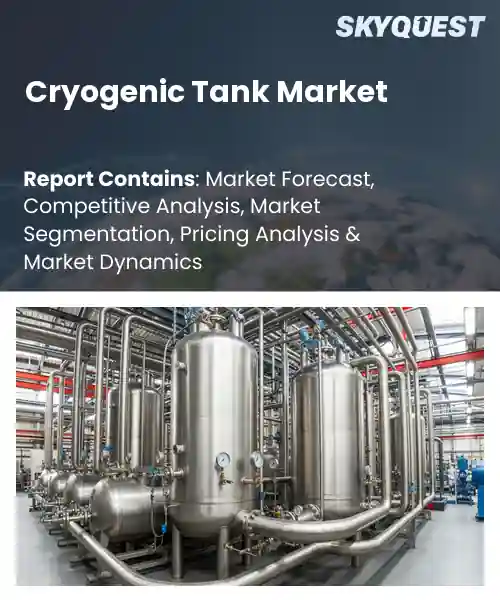
Cryogenic Tank Market
Report ID: SQMIG15G2176
Report ID: SQMIG15G2176
[email protected]
USA +1 351-333-4748
Report ID:
SQMIG15G2176 |
Region:
Global |
Published Date: June, 2026
Pages:
157
|Tables:
121
|Figures:
77


Global Cryogenic Tank Market size was valued at USD 7.52 Billion in 2024 and is poised to grow from USD 7.93 Billion in 2025 to USD 12.07 Billion by 2033, growing at a CAGR of 5.4% during the forecast period (2026-2033).
The global cryogenic tank market comprises manufacturers and suppliers of insulated vessels designed to store gases such as liquefied natural gas, hydrogen, and oxygen at extremely low temperatures. Its relevance stems from the rising demand for clean‑energy carriers and the need for secure, efficient transport of volatile gases in sectors ranging from petrochemicals to space exploration. Historically, the market expanded in the 1990s when LNG trade accelerated, prompting investments in double‑walled, vacuum‑jacketed tanks. Recent examples include the deployment of large‑scale hydrogen storage tanks in Europe’s green‑hydrogen hubs, illustrating how regulatory incentives and infrastructure projects have propelled market maturation rapidly globally. The dominant growth factor now is the transition toward hydrogen‑based energy systems, which creates a cascade of demand for high‑performance cryogenic storage. As governments set ambitious decarbonization targets, firms invest in electrolyzers and must pair them with tanks capable of maintaining hydrogen at 253 °C, prompting a surge in orders from utilities and industrial gas companies. This cause‑effect chain is evident in Japan’s Fukushima hydrogen project, where newly built tanks enable continuous fuel supply to power‑to‑gas plants. Consequently, manufacturers are expanding capacity, adopting composite materials to reduce weight, and targeting emerging markets in Southeast Asia, thereby unlocking significant revenue opportunities future.
How are AI-driven predictive analytics improving safety and efficiency in the cryogenic tank market?
AI-driven predictive analytics are reshaping the cryogenic tank sector by continuously monitoring temperature, pressure and structural integrity. Machine learning models analyze sensor streams to forecast anomalies before they become hazardous, allowing operators to intervene early and reduce downtime. The technology also optimizes fill cycles and routing, improving overall efficiency and lowering energy consumption. As demand for hydrogen and LNG storage rises, these analytics provide a proactive safety layer that aligns with stricter regulatory expectations. Companies are integrating cloud platforms that aggregate data from multiple tanks, creating a holistic view that supports faster decision making and resource allocation.In October 2025 Chart Industries launched a next generation cryogenic tank that embeds AI predictive analytics to monitor real time conditions and alert operators to potential failures. This innovation demonstrates how advanced analytics enhance safety margins and streamline operations, reinforcing market growth and reliability.
Market snapshot - (2026-2033)
Global Market Size
USD 7.52 Billion
Largest Segment
Steel Formulations
Fastest Growth
Nickel Alloy Compositions
Growth Rate
5.4% CAGR
To get more insights on this market click here to Request a Free Sample Report
Global cryogenic tank market is segmented by raw material substrate, cryogenic liquid type, application mode, end-use industrial sector and region. Based on raw material substrate, the market is segmented into Steel Formulations, Nickel Alloy Compositions and Aluminum Alloys. Based on cryogenic liquid type, the market is segmented into Liquefied Natural Gas, Liquid Nitrogen, Liquid Oxygen, Liquid Hydrogen and Liquid Argon. Based on application mode, the market is segmented into Stationary Storage Tanks and Transport Distribution Tanks. Based on end-use industrial sector, the market is segmented into Metal Processing and Metallurgy, Energy Generation and Utilities, Electronics and Semiconductor Manufacturing, Medical Technology and Healthcare Infrastructure, Food Processing Facilities and Others. Based on region, the market is segmented into North America, Europe, Asia Pacific, Latin America and Middle East & Africa.
Liquid hydrogen segment dominates because it enables zero emission propulsion and energy storage, aligning with decarbonization goals. Its ultra low boiling point demands specialized tank designs that prioritize insulation and safety, driving innovation and premium pricing. The strategic push for hydrogen economies intensifies demand, securing its leading status among cryogenic fluids across multiple industries including transport and power generation applications that require high energy density and long term storage.
Meanwhile, liquid nitrogen segment emerges as the fastest growing area as its versatility expands beyond traditional food processing into electronics cooling and medical cryotherapy. Rising adoption of nitrogen based additive manufacturing and increased demand for ultra pure cooling solutions stimulate tank development, creating new market entry points and accelerating overall sector expansion.
Aluminum alloys segment dominates because its lightweight nature reduces tank mass while maintaining sufficient strength for low temperature service, enabling easier transportation and installation. Designers value the corrosion resistance and manufacturability of aluminum, which support faster production cycles and lower lifecycle costs, reinforcing its preference in applications where efficiency and portability are critical.
However, steel formulations segment is witnessing the strongest growth momentum as manufacturers leverage advances in high‑strength steel to improve durability and safety under extreme cryogenic conditions. Emerging standards for pressure containment and the need for robust infrastructure in large‑scale storage projects drive adoption, expanding market opportunities and prompting increased investment in steel‑based tank solutions.
To get detailed segments analysis, Request a Free Sample Report
North America leads the cryogenic tank market through a combination of mature industrial infrastructure, strong research and development ecosystems, and extensive downstream demand across aerospace, energy, and healthcare sectors. Advanced manufacturing capabilities and a high level of technical expertise enable the region to produce sophisticated tanks that meet stringent safety and performance standards. Robust supply chains and deep investments in hydrogen and liquefied natural gas projects further reinforce market leadership. Collaborative frameworks between government agencies, academic institutions, and private firms accelerate innovation, while regulatory environments that prioritize safety and environmental compliance support sustained dominance.
Cryogenic Tank Market in the United States benefits from a broad base of aerospace and defense activities, fostering cutting‑edge designs and high‑volume production. Significant investment in hydrogen infrastructure and renewable energy initiatives drives demand for advanced storage solutions. Established standards and a skilled workforce ensure reliability and rapid adoption of new technologies across industrial and medical applications.
Cryogenic Tank Market in Canada is shaped by its strong focus on clean energy transition and extensive natural resource extraction operations. Growing initiatives in hydrogen fuel and liquefied natural gas export bolster the need for high‑performance storage systems. Collaborative research programs and supportive policy frameworks encourage local manufacturing and technology integration, positioning Canada as an influential player in the regional supply chain.
The Asia Pacific region experiences rapid expansion driven by escalating demand for energy diversification, increasing investments in hydrogen and liquefied natural gas projects, and a surge in medical and biotech applications requiring ultra‑low temperature storage. Government incentives and strategic national roadmaps prioritize low‑carbon technologies, prompting infrastructure development and capacity building. Strong engineering talent pools and emerging manufacturing hubs enhance the region’s ability to design and produce reliable cryogenic solutions. Integration of advanced materials and digital monitoring systems further accelerates market adoption across diverse industrial segments.
Cryogenic Tank Market in Japan is propelled by its advanced aerospace sector and a proactive stance on hydrogen energy adoption. Leading research institutions collaborate with manufacturers to refine tank designs for safety and efficiency, while industrial gas applications continue to expand. High standards for precision engineering and rigorous quality control reinforce Japan’s reputation for reliable cryogenic storage solutions.
Cryogenic Tank Market in South Korea benefits from a dynamic petrochemical industry and aggressive rollout of hydrogen fuel cell infrastructure. Strong corporate investment in next‑generation materials and smart monitoring technologies enhances tank performance. Government support for clean energy transitions stimulates demand across transportation, power generation, and medical sectors, positioning South Korea as a fast‑growing market contributor.
Europe strengthens its position through coordinated policy frameworks that promote decarbonisation, comprehensive funding for hydrogen corridors, and a focus on high‑value manufacturing excellence. The region’s deep engineering heritage, coupled with stringent safety regulations, fosters the development of sophisticated cryogenic tanks for energy, industrial, and scientific applications. Collaborative research clusters across member states accelerate the integration of innovative materials and digital analytics, ensuring product reliability and sustainability. Strategic partnerships between OEMs, research institutes, and utilities enhance market resilience and expand the adoption of cryogenic storage across emerging low‑carbon ecosystems.
Cryogenic Tank Market in Germany is driven by its robust industrial base and leadership in hydrogen technology development. Strong engineering competencies and a network of specialist suppliers support the production of high‑performance tanks for automotive, energy, and medical sectors. Government initiatives and industry consortia promote standardisation and accelerate market uptake.
Cryogenic Tank Market in the United Kingdom benefits from a vibrant aerospace sector and growing hydrogen supply chain projects. Collaborative research programmes link universities with industry to innovate tank materials and safety systems. Policy incentives encourage investment in low‑carbon storage solutions across power generation and healthcare.
Cryogenic Tank Market in France is shaped by its emphasis on renewable energy integration and advanced medical research. National programs supporting hydrogen infrastructure drive demand for reliable storage solutions, while precision engineering firms deliver tanks meeting stringent regulatory standards. Cross‑border collaborations enhance technology transfer and market expansion.
To know more about the market opportunities by region and country, click here to
Buy The Complete Report
Increasing Demand for LNG Infrastructure
Advancements In Cryogenic Insulation Materials
High Capital Expenditure Requirements
Stringent Safety and Regulatory Standards
Request Free Customization of this report to help us to meet your business objectives.
The competitive landscape is sharpening as manufacturers vie for hydrogen‑fuel and LNG storage market share; rising demand for low‑carbon energy carriers is prompting intense product differentiation. Leading firms such as Chart Industries have rolled out next‑generation composite cryogenic tanks for hydrogen and LNG, supported by a $25 million investment, illustrating a clear tech‑innovation push to outpace rivals and secure high‑margin contracts.
Top Player’s Company Profile
Recent Developments
SkyQuest’s ABIRAW (Advanced Business Intelligence, Research & Analysis Wing) is our Business Information Services team that Collects, Collates, Correlates, and Analyses the Data collected by means of Primary Exploratory Research backed by robust Secondary Desk research. As per SkyQuest analysis, the surge in hydrogen infrastructure is the primary driver propelling demand for advanced cryogenic tanks, while breakthroughs in insulation materials serve as a second catalyst that lowers boil‑off and expands application scope. High upfront capital costs act as a notable restraint, slowing adoption among smaller players. North America remains the dominant region thanks to its mature supply chains, strong R&D base and extensive energy projects. Across product categories, the liquid hydrogen segment leads the market, reflecting the shift toward zero‑emission fuels. Together these forces shape a market poised for steady growth despite financial and regulatory hurdles.
| Report Metric | Details |
|---|---|
| Market size value in 2024 | USD 7.52 Billion |
| Market size value in 2033 | USD 12.07 Billion |
| Growth Rate | 5.4% |
| Base year | 2024 |
| Forecast period | (2026-2033) |
| Forecast Unit (Value) | USD Billion |
| Segments covered |
|
| Regions covered | North America (US, Canada), Europe (Germany, France, United Kingdom, Italy, Spain, Rest of Europe), Asia Pacific (China, India, Japan, Rest of Asia-Pacific), Latin America (Brazil, Rest of Latin America), Middle East & Africa (South Africa, GCC Countries, Rest of MEA) |
| Companies covered |
|
| Customization scope | Free report customization with purchase. Customization includes:-
|
To get a free trial access to our platform which is a one stop solution for all your data requirements for quicker decision making. This platform allows you to compare markets, competitors who are prominent in the market, and mega trends that are influencing the dynamics in the market. Also, get access to detailed SkyQuest exclusive matrix.
Table Of Content
Executive Summary
Market overview
Parent Market Analysis
Market overview
Market size
KEY MARKET INSIGHTS
COVID IMPACT
MARKET DYNAMICS & OUTLOOK
Market Size by Region
KEY COMPANY PROFILES
Methodology
For the Cryogenic Tank Market, our research methodology involved a mixture of primary and secondary data sources. Key steps involved in the research process are listed below:
1. Information Procurement: This stage involved the procurement of Market data or related information via primary and secondary sources. The various secondary sources used included various company websites, annual reports, trade databases, and paid databases such as Hoover's, Bloomberg Business, Factiva, and Avention. Our team did 45 primary interactions Globally which included several stakeholders such as manufacturers, customers, key opinion leaders, etc. Overall, information procurement was one of the most extensive stages in our research process.
2. Information Analysis: This step involved triangulation of data through bottom-up and top-down approaches to estimate and validate the total size and future estimate of the Cryogenic Tank Market.
3. Report Formulation: The final step entailed the placement of data points in appropriate Market spaces in an attempt to deduce viable conclusions.
4. Validation & Publishing: Validation is the most important step in the process. Validation & re-validation via an intricately designed process helped us finalize data points to be used for final calculations. The final Market estimates and forecasts were then aligned and sent to our panel of industry experts for validation of data. Once the validation was done the report was sent to our Quality Assurance team to ensure adherence to style guides, consistency & design.
Analyst Support
Customization Options
With the given market data, our dedicated team of analysts can offer you the following customization options are available for the Cryogenic Tank Market:
Product Analysis: Product matrix, which offers a detailed comparison of the product portfolio of companies.
Regional Analysis: Further analysis of the Cryogenic Tank Market for additional countries.
Competitive Analysis: Detailed analysis and profiling of additional Market players & comparative analysis of competitive products.
Go to Market Strategy: Find the high-growth channels to invest your marketing efforts and increase your customer base.
Innovation Mapping: Identify racial solutions and innovation, connected to deep ecosystems of innovators, start-ups, academics, and strategic partners.
Category Intelligence: Customized intelligence that is relevant to their supply Markets will enable them to make smarter sourcing decisions and improve their category management.
Public Company Transcript Analysis: To improve the investment performance by generating new alpha and making better-informed decisions.
Social Media Listening: To analyze the conversations and trends happening not just around your brand, but around your industry as a whole, and use those insights to make better Marketing decisions.
REQUEST FOR SAMPLE
 REQUEST FREE CUSTOMIZATION


Want to customize this report? This report can be personalized according to your needs. Our analysts and industry experts will work directly with you to understand your requirements and provide you with customized data in a short amount of time. We offer $1000 worth of FREE customization at the time of purchase.
Feedback From Our Clients


 USA (+1) 351-333-4748

