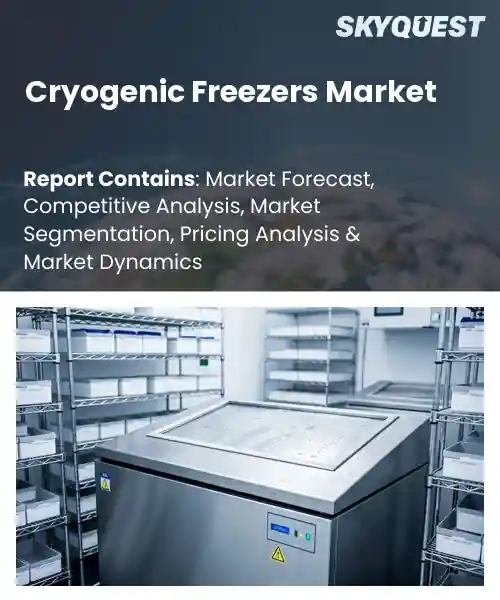
Cryogenic Freezers Market
Report ID: SQMIG20I3109
Report ID: SQMIG20I3109
[email protected]
USA +1 351-333-4748
Report ID:
SQMIG20I3109 |
Region:
Global |
Published Date: June, 2026
Pages:
157
|Tables:
118
|Figures:
77


Global Cryogenic Freezers Market size was valued at USD 229.0 Million in 2024 and is poised to grow from USD 239.99 Million in 2025 to USD 349.21 Million by 2033, growing at a CAGR of 4.8% during the forecast period (2026-2033).
The global cryogenic freezers market comprises ultra‑low temperature devices that preserve biological samples at 80 °C or lower, a capability critical for biopharmaceutical research, vaccine production, and cell‑therapy development. Its relevance grew as gene‑editing technologies and personalized medicine created a surge in the volume of specimens requiring long‑term storage. Early adopters such as university biobanks and large pharma firms invested in liquid‑nitrogen‑based units during the 2000s, driving incremental capacity expansions. Over the past decade, regulatory mandates for cold‑chain integrity have accelerated adoption, prompting manufacturers to introduce energy‑efficient models that meet stringent safety standards. This trajectory positions the market for rapid growth. Demand from the emerging biologics pipeline now drives the next wave of expansion, because manufacturers must guarantee sample integrity during multi‑stage clinical trials and global distribution. Cryogenic freezers enable pharmaceutical firms to maintain vaccine potency across temperature‑sensitive logistics chains, a need highlighted by the COVID‑19 rollout when cold‑room shortages forced rapid procurement of high‑capacity units. Simultaneously, the rise of decentralized research centers creates a market for modular, plug‑and‑play systems that require minimal on‑site support. These developments invite equipment vendors to invest in IoT‑based monitoring and service contracts, thereby unlocking recurring‑revenue streams while addressing the industry’s reliability concerns for long‑term sustainability.
How is AI-driven automation enhancing efficiency in the cryogenic freezers market?
AI driven automation is reshaping the cryogenic freezer sector by linking sensor data to predictive algorithms that adjust temperature set points in real time. The market is expanding as laboratories and biobanks demand higher reliability and lower energy use. Machine learning models analyze cooling cycles, flagging inefficiencies before they cause drift. Integrated dashboards give operators a clear view of performance and allow remote fine tuning. This reduces manual interventions and extends compressor life while maintaining strict sample integrity. The result is a smoother workflow that supports growing demand for ultra low temperature storage. By continuously learning from operational patterns the system can suggest optimal maintenance windows and predict component wear before failure.In March 2024, a major supplier launched an AI enabled monitoring platform, delivering real time alerts that cut down on downtime and streamline energy consumption. The rollout demonstrates how intelligent automation directly boosts efficiency and supports the market’s rapid growth by reducing manual checks and improving temperature stability across multiple units.
Market snapshot - (2026-2033)
Global Market Size
USD 229.0 Million
Largest Segment
Laboratory Sample Storage Units
Fastest Growth
Growth Rate
4.8% CAGR
To get more insights on this market click here to Request a Free Sample Report
Global cryogenic freezers market is segmented by freezer architecture type, temperature range capability, volumetric storage capacity, end-use industry vertical and region. Based on freezer architecture type, the market is segmented into Industrial Food Freezing Systems and Laboratory Sample Storage Units. Based on temperature range capability, the market is segmented into -40 to -80 Degrees Celsius, -80 to -120 Degrees Celsius and Below -120 Degrees Celsius. Based on volumetric storage capacity, the market is segmented into Less than 100 Liters, 100 to 300 Liters, 301 to 500 Liters and Above 500 Liters. Based on end-use industry vertical, the market is segmented into Food and Beverages, Medical and Healthcare, Pharmaceuticals and Biotechnology and Others. Based on region, the market is segmented into North America, Europe, Asia Pacific, Latin America and Middle East & Africa.
-80 To -120 Degrees Celsius segment dominates because it aligns with the critical temperature window required for preserving high‑value biological specimens and advanced materials. The ability to maintain stability at this range reduces degradation risk, which makes manufacturers and research institutions prioritize equipment that reliably reaches these levels. Consequently, product development focuses on energy efficiency and reliability within this band, reinforcing its central position in market adoption.
However, Below -120 Degrees Celsius segment is witnessing the strongest growth momentum as emerging quantum computing and ultra‑cold plasma research demand temperatures beyond traditional limits. Innovations in insulation and cryocooler technology are lowering cost barriers, prompting new entrants to explore applications that accelerate market expansion and create novel opportunities.
Pharmaceuticals and Biotechnology segment leads because the sector relies on ultra‑low temperature storage to maintain drug stability, biologics efficacy, and cell‑therapy viability. Regulatory expectations for cold‑chain integrity drive manufacturers to invest in sophisticated freezer systems, and the high value of these products justifies premium pricing, reinforcing market preference for dedicated solutions. Additionally, collaborations between pharma firms and equipment providers accelerate customization, ensuring compliance with evolving Good Manufacturing Practice standards and fostering deeper market penetration.
Meanwhile, Medical and Healthcare segment is emerging as the key high‑growth area because outpatient clinics and hospitals are expanding their biobank capabilities to support personalized medicine. Rising demand for cryopreserved blood products and tissue samples drives procurement of compact, energy‑efficient units, creating fresh revenue streams and expanding the market’s application base.
To get detailed segments analysis, Request a Free Sample Report
North America’s leadership stems from a well‑established infrastructure for advanced research and a broad base of high‑tech manufacturing capability. Strong collaboration between academic institutions, specialized equipment manufacturers, and end‑user industries such as pharmaceuticals and biotechnology fuels continuous innovation. Robust funding ecosystems support the development of next‑generation cryogenic technologies, while stringent regulatory standards ensure product reliability and safety. Market participants benefit from a highly skilled workforce and a culture of early adoption, which together create a favorable environment for scaling production and deploying sophisticated freezer solutions across multiple sectors.
Cryogenic Freezers Market in the United States thrives on deep integration with biomedical research hubs and a mature supply chain that delivers high‑performance components. The extensive network of research hospitals and biotech clusters drives demand for reliable ultra‑low temperature storage, encouraging manufacturers to invest in cutting‑edge design and service capabilities. A collaborative ecosystem of suppliers, system integrators, and end users promotes rapid feedback loops that accelerate product refinement and market readiness.
Cryogenic Freezers Market in Canada is bolstered by strong government support for scientific innovation and a growing emphasis on sustainable laboratory practices. The concentration of life‑science firms in key innovation corridors creates a steady demand for advanced thermal management solutions. Collaborative research programs and partnerships with international technology leaders enhance local expertise, fostering a climate where customized freezer solutions can be developed to meet specific regulatory and operational requirements.
Europe’s expansion is propelled by an intense focus on precision medicine, environmental sustainability, and stringent quality standards that demand reliable ultra‑cold storage. The region benefits from a dense network of research institutions and a tradition of cross‑border collaboration, which accelerates technology transfer and harmonises regulatory frameworks. Strong public and private investment in health‑care infrastructure fuels the adoption of sophisticated cryogenic solutions, while an emerging emphasis on energy‑efficient designs aligns with Europe’s broader green initiatives. These factors collectively create a fertile environment for both established manufacturers and innovative startups to expand their presence across the continent.
Cryogenic Freezers Market in Germany is anchored by a robust engineering tradition and a concentration of life‑science clusters that prioritize precision and reliability. German manufacturers emphasize high‑quality standards and integrate advanced automation into freezer designs, meeting the exacting needs of pharmaceutical and research institutions. Ongoing collaboration between academia, industry, and regulatory bodies ensures that product development aligns with stringent safety expectations, reinforcing the country's dominant position in the European landscape.
Cryogenic Freezers Market in the United Kingdom is emerging rapidly due to renewed investment in biomedical research and a vibrant startup ecosystem. The UK’s focus on translational science and personalized medicine drives demand for scalable cryogenic storage solutions. Partnerships between universities, health‑care providers, and technology firms foster innovation, while supportive policy frameworks encourage the adoption of energy‑efficient freezer technologies, positioning the United Kingdom as an increasingly important market participant.
Cryogenic Freezers Market in France is experiencing fast growth as the nation emphasizes advanced therapeutics and cutting‑edge biological research. French research institutes and biotech companies seek high‑performance freezer systems to support complex experiments and clinical trials. Collaborative initiatives linking national research agencies with private manufacturers accelerate the development of next‑generation cryogenic technologies, while a strong commitment to sustainability drives interest in low‑energy consumption designs.
Asia Pacific is advancing its role through rapid industrialisation, expanding biotech sectors, and increasing emphasis on cold‑chain reliability for both medical and industrial applications. The region benefits from a sizable pool of engineering talent and a growing number of domestic manufacturers that are scaling production capabilities. Strategic partnerships with global technology leaders facilitate technology transfer and localised innovation, while government incentives for research and development encourage the adoption of state‑of‑the‑art cryogenic equipment. This blend of capacity building, collaborative development, and supportive policy creates a momentum that elevates the region’s significance in the global market.
Cryogenic Freezers Market in Japan leverages a long‑standing reputation for precision engineering and a strong commitment to quality control. Japanese firms integrate sophisticated sensor technologies and automated monitoring systems to meet the stringent requirements of pharmaceutical and materials research. Close cooperation between industrial conglomerates and research institutes drives continuous improvement, while an emphasis on miniaturisation and energy efficiency aligns with the country’s broader technological trends.
Cryogenic Freezers Market in South Korea is propelled by aggressive investment in biotechnology and a fast‑growing life‑science ecosystem. Korean manufacturers focus on high‑density storage solutions and incorporate cutting‑edge digital diagnostics to enhance operational reliability. Collaborative programs between universities, government agencies, and private enterprises accelerate the development of innovative cryogenic platforms, positioning South Korea as an emerging hub for advanced freezer technologies.
To know more about the market opportunities by region and country, click here to
Buy The Complete Report
Rising Demand For Biopharma Samples
Adoption Of Advanced Storage Technologies
High Initial Capital Expenditure
Stringent Energy Consumption Regulations
Request Free Customization of this report to help us to meet your business objectives.
Competition in the global cryogenic freezers market intensifies as manufacturers vie for share in rapidly expanding biomedical and food‑preservation segments. Key drivers include rising demand for ultra‑low temperature storage and regulatory pressure for energy‑efficient solutions. Companies are differentiating through advanced LN2 insulation designs and expanding distribution networks across emerging regions.
Top Player’s Company Profile
Recent Developments
SkyQuest’s ABIRAW (Advanced Business Intelligence, Research & Analysis Wing) is our Business Information Services team that Collects, Collates, Correlates, and Analyses the Data collected by means of Primary Exploratory Research backed by robust Secondary Desk research. As per SkyQuest analysis, the global cryogenic freezers market is being propelled primarily by the rising demand for biopharma samples, which requires ultra‑low temperature storage to keep vaccines, cell therapies and other biologics viable. A second significant driver is the rapid adoption of advanced storage technologies such as AI‑enabled monitoring and predictive maintenance that improve efficiency and lower operating costs. The market’s growth is tempered by the high initial capital expenditure needed for these specialized units, which can delay purchases by smaller labs. North America remains the dominant region thanks to its strong research infrastructure and early‑adopter culture, while the -80 to -120 °C temperature‑range segment leads in volume because it matches the critical preservation window for high‑value biological specimens.
| Report Metric | Details |
|---|---|
| Market size value in 2024 | USD 229.0 Million |
| Market size value in 2033 | USD 349.21 Million |
| Growth Rate | 4.8% |
| Base year | 2024 |
| Forecast period | (2026-2033) |
| Forecast Unit (Value) | USD Million |
| Segments covered |
|
| Regions covered | North America (US, Canada), Europe (Germany, France, United Kingdom, Italy, Spain, Rest of Europe), Asia Pacific (China, India, Japan, Rest of Asia-Pacific), Latin America (Brazil, Rest of Latin America), Middle East & Africa (South Africa, GCC Countries, Rest of MEA) |
| Companies covered |
|
| Customization scope | Free report customization with purchase. Customization includes:-
|
To get a free trial access to our platform which is a one stop solution for all your data requirements for quicker decision making. This platform allows you to compare markets, competitors who are prominent in the market, and mega trends that are influencing the dynamics in the market. Also, get access to detailed SkyQuest exclusive matrix.
Table Of Content
Executive Summary
Market overview
Parent Market Analysis
Market overview
Market size
KEY MARKET INSIGHTS
COVID IMPACT
MARKET DYNAMICS & OUTLOOK
Market Size by Region
KEY COMPANY PROFILES
Methodology
For the Cryogenic Freezers Market, our research methodology involved a mixture of primary and secondary data sources. Key steps involved in the research process are listed below:
1. Information Procurement: This stage involved the procurement of Market data or related information via primary and secondary sources. The various secondary sources used included various company websites, annual reports, trade databases, and paid databases such as Hoover's, Bloomberg Business, Factiva, and Avention. Our team did 45 primary interactions Globally which included several stakeholders such as manufacturers, customers, key opinion leaders, etc. Overall, information procurement was one of the most extensive stages in our research process.
2. Information Analysis: This step involved triangulation of data through bottom-up and top-down approaches to estimate and validate the total size and future estimate of the Cryogenic Freezers Market.
3. Report Formulation: The final step entailed the placement of data points in appropriate Market spaces in an attempt to deduce viable conclusions.
4. Validation & Publishing: Validation is the most important step in the process. Validation & re-validation via an intricately designed process helped us finalize data points to be used for final calculations. The final Market estimates and forecasts were then aligned and sent to our panel of industry experts for validation of data. Once the validation was done the report was sent to our Quality Assurance team to ensure adherence to style guides, consistency & design.
Analyst Support
Customization Options
With the given market data, our dedicated team of analysts can offer you the following customization options are available for the Cryogenic Freezers Market:
Product Analysis: Product matrix, which offers a detailed comparison of the product portfolio of companies.
Regional Analysis: Further analysis of the Cryogenic Freezers Market for additional countries.
Competitive Analysis: Detailed analysis and profiling of additional Market players & comparative analysis of competitive products.
Go to Market Strategy: Find the high-growth channels to invest your marketing efforts and increase your customer base.
Innovation Mapping: Identify racial solutions and innovation, connected to deep ecosystems of innovators, start-ups, academics, and strategic partners.
Category Intelligence: Customized intelligence that is relevant to their supply Markets will enable them to make smarter sourcing decisions and improve their category management.
Public Company Transcript Analysis: To improve the investment performance by generating new alpha and making better-informed decisions.
Social Media Listening: To analyze the conversations and trends happening not just around your brand, but around your industry as a whole, and use those insights to make better Marketing decisions.
REQUEST FOR SAMPLE
 REQUEST FREE CUSTOMIZATION


Want to customize this report? This report can be personalized according to your needs. Our analysts and industry experts will work directly with you to understand your requirements and provide you with customized data in a short amount of time. We offer $1000 worth of FREE customization at the time of purchase.
Feedback From Our Clients


 USA (+1) 351-333-4748

