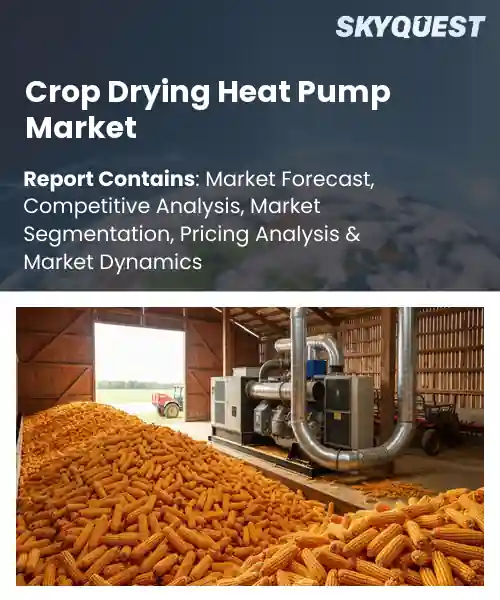
Crop Drying Heat Pump Market
Report ID: SQMIG20H2095
Report ID: SQMIG20H2095
[email protected]
USA +1 351-333-4748
Report ID:
SQMIG20H2095 |
Region:
Global |
Published Date: June, 2026
Pages:
157
|Tables:
173
|Figures:
79


Global Crop Drying Heat Pump Market size was valued at USD 1247.8 Million in 2024 and is poised to grow from USD 1388.8 Million in 2025 to USD 3270.41 Million by 2033, growing at a CAGR of 11.3% during the forecast period (2026-2033).
High demand for energy-efficient drying technologies, increasing focus on reducing post-harvest losses, rising government support for sustainable agriculture, advancements in heat pump technologies, and stringent carbon emission regulations are driving sales of crop-drying heat pumps.
Growing penetration of heat pump drying systems enable farmers as well as food processors to reduce cost of operation, augment the drying efficiency, and retain the high quality of the crop. Stringent guidelines on environmental standards, along with policies aimed at incentives for supporting low-carbon agricultural processes, are fueling the transition from traditional fuel-based dryers to energy-efficient heat pump systems. Innovative developments on heat recovery solutions, smart drying mechanisms, and energy-efficient heat pumps are anticipated to drive market progression through constant enhancement of product portfolios. Moreover, mounting investments toward sustainable agriculture and food processing infrastructures will create enormous opportunities for crop drying heat pump manufacturers. Rising demand for efficient post-harvest management and increasing emphasis on reducing energy consumption in agricultural operations are expected to primarily drive crop-drying heat pump market growth.
On the contrary, high initial installation costs, limited awareness among small-scale farmers, complex system integration requirements, and dependence on reliable electricity infrastructure are anticipated to slow down crop-drying heat pump market penetration across the study period and beyond.
How is AI-driven Automation Influencing The Efficiency Of Crop Drying Heat Pump Systems?
AI is advancing the crop drying heat pump industry by enhancing the efficiency of operation, the quality of the dried products, and the control of drying processes. Sensors feed information on crop moisture content, temperature, and airflow to computer systems, while machine learning models process the information to find the most efficient set points for the drying. Automated control systems expand compressor, airflow, and valve settings in real time, lowering usage of energy while keeping the quality of products constant.
Market snapshot - (2026-2033)
Global Market Size
USD 1247.8 Million
Largest Segment
Fastest Growth
Growth Rate
11.3% CAGR
To get more insights on this market click here to Request a Free Sample Report
Global crop drying heat pump market is segmented by product type, crop type, drying capacity, end user, installation type, sales channel, and region. Based on product type, the market is segmented into air source heat pump dryers, water source heat pump dryers, hybrid heat pump dryers, and others. Based on crop type, the market is segmented into grains, fruits, vegetables, and others. Based on drying capacity, the market is segmented into small capacity systems, medium capacity systems, and large capacity systems. Based on end user, the market is segmented into farms, agricultural cooperatives, food processing companies, and others. Based on installation type, the market is segmented into new installations and retrofit installations. Based on sales channel, the market is segmented into direct sales, agricultural equipment dealers, and others. Based on region, the market is segmented into North America, Europe, Asia Pacific, Latin America, and Middle East & Africa.
The air source heat pump segment is slated to lead the global crop drying heat pump market revenue generation. Its adaptability to a range of climate types means growers can use it without the need for significant additional water needs. Its relatively low capital input and ease of retrofitting onto current drying barns mean large uptake will take place in relatively little time. Its established track record and relative ease of use also make it extremely attractive to a lot of growers looking for a reliable and cost-effective drying method which will save a significant amount of energy over the long term.
Meanwhile, water source heat pump segment exhibits strong CAGR through 2033 as per this crop drying heat pump industry analysis, since it can take heat from irrigation canals, which also corresponds to the subject of sustainability. Connecting naturally to water systems reduces operating costs and improves farm energy use, encouraging other plants to install the system and making it an important aspect of market expansion.
The large commercial processor segment is estimated to account for the largest global crop drying heat pump market share going forward. Its high throughput requirements lead to a need for uniform, high-capacity drying solutions that optimize crop quality and minimize loss. These operators have the resources to invest in complex control systems and can achieve reduced unit costs through economies of scale. Therefore, they are highly likely to push for reliable heat pump installations. Their concern for productivity and compliance with standards ensures that they will influence market specifications and supplier requirements and sustainability plans for both efficiency and emissions reductions.
Conversely, smallholder farmer segment experiences the strongest growth as affordable modular heat pump units allow them to maintain quality after harvest without complex infrastructure. In addition to the affordability of the entry point and targeted financing programs, the increase in awareness of added value market premiums provides incentives to quickly adopt this technology and develop new local supply chains.
To get detailed segments analysis, Request a Free Sample Report
Comprehensive policy environment that prioritizes energy efficiency and carbon reduction across agriculture are helping this region lead crop drying heat pump sales on a global level. Extensive collaboration exists between leading research centers and manufacturers of highly efficient pump technologies, as they develop tailored solutions for many crop types throughout Europe. Strong incentives for early adoption by growers coupled with well-defined logistics assist in integrating new pump technologies into existing operations. In addition to driving innovation in the agricultural sector, Europe’s focus on circular economy principles fosters development of solutions that deliver cost savings due to improved efficiencies while being environmentally responsible. This combination of policy, innovation and infrastructure provides an ideal environment to maintain Europe’s position as a significant player in the market.
Crop Drying Heat Pump Market in Germany benefits from a legacy of engineering excellence and a highly coordinated industrial ecosystem. Leading manufacturers partner with agricultural cooperatives to fine‑tune system performance for the nation’s grain and specialty crops. Government programmes reinforce the transition to low‑carbon drying processes, while vocational training equips technicians with specialized skills. The result is a mature market where reliability and efficiency are paramount, supporting both domestic production and export‑focused technology firms.
Crop drying heat pump sales in the United Kingdom are propelled by a vibrant research community and proactive government incentives aimed at sustainable farming. Several equipment manufacturers partnered with universities to trial novel heat pump concepts to overcome the drying obstacles in a temperate climate. Policy narrative promotes the transition from traditional fuel based systems, to encourage technology adoption and accelerate diffusion of solutions. This in turn enhances the UK's reputation as a green machinery manufacturing country.
Crop drying heat pump demand in France is anchored by the country’s extensive cereal and vineyard sectors, which demand consistent quality and energy‑efficient drying. National policies encourage the use of heat pumps, positioning this technology as a key element in climatesmart farming. Collaboration between regional research centres and equipment producers is assisting with the rapid implementation of specific solutions. The emphasis on lowering operation-based emissions is something that appeals to both producers and consumers, allowing France to build on its increasingly important leadership role in dryers of the future.
Emphasis on stabilizing crop quality amid variable weather patterns and rising energy costs are supporting steady sales of crop drying heat pumps across the region. Large commercial agriculture farms want available reliable low-emission alternatives to conventional drying solutions, which drives increased interest in advanced heat pump systems. The presence of supportive regulatory environments facilitates investment in renewable technologies; additionally, private sector investments accelerate product development and adoption. Collaborative networks of agribusinesses, technology companies, and research entities promote ongoing enhancement of agriculturally based products to meet regional needs. The synergy created from market demand, regulatory encouragement and innovation will support the increasing growth of this sector.
Crop drying heat pump demand in the United States reflects the country’s extensive agricultural base and appetite for technological advancement. Major crop regions embrace heat pump solutions to achieve consistent drying while curbing fuel consumption. Industry alliances link equipment innovators with growers, facilitating rapid field testing and feedback loops. Government programmes that reward energy‑saving practices further incentivize adoption, positioning the United States as a dynamic arena for next‑generation drying technologies.
Crop drying heat pump adoption in Canada is shaped by the nation’s cooler climate, which heightens the importance of efficient heat management for grain and oilseed drying. The federal and provincial management programs are supporting agriculture to adopt renewable energy solutions and for growers to reconsider traditional drying systems. Consensus research branches aim to tailor heat pump development to the nutritional needs of Canadian crops to create a customer base sensitive to performance and green issues.
High-tech manufacturing capabilities and a strategic emphasis on sustainable agriculture are helping support steady crop drying heat pump adoption across the region. Countries within this region invest heavily in R&D activities that incorporate the technology for heat pumps and digital agriculture to produce highly accurate management systems for controlling the drying of product. Governments in this region encourage the use of carbon-neutral technologies through various incentive programs; these policies help accelerate the adoption of innovative solutions into the marketplace while also promoting fast-track logistics through a highly developed network of supply chains. At the same time, the region's focus on producing goods for export makes it an important contributor to global supplies. Together, these elements provide a solid foundation for positioning the entire Asia-Pacific region as a strong candidate to be the leading player in this industry over the coming years.
Crop drying heat pump demand in Japan leverages the country’s reputation for compact, high‑efficiency engineering. Companies prioritize integration of heat pump systems with smart farm management tools, delivering precise temperature regulation for rice and specialty crops. Government initiatives that promote energy‑saving agriculture encourage early adoption, while collaboration between universities and manufacturers accelerates product refinement. This synergy sustains a market focused on reliability, space‑saving designs, and carbon‑neutral drying processes.
Crop drying heat pump sales in South Korea are driven by a strong culture of automation and renewable technology adoption. Local companies utilize advanced heat pump technology in tune with the nation's hi-tech horticulture to produce sensor-based control and energy efficiency. National legislation to encourage green innovation creates an ideal climate for the spread of these technologies into grain and horticultural markets. Consequently, the country has a burgeoning industry combining hypermodern engineering with green consciousness.
To know more about the market opportunities by region and country, click here to
Buy The Complete Report
Rising Demand for Energy Efficiency
Adoption of Renewable Power Sources
High Initial Capital Investment
Limited Technical Expertise Availability
Request Free Customization of this report to help us to meet your business objectives.
The crop‑drying heat‑pump sector is intensifying as firms race to embed energy‑efficient drying solutions into agribusinesses. Competitive pressure is driving rapid tech innovation, strategic partnerships and capital inflows. For example, Harvest secured a seed round led by Astia Angels to accelerate its smart heat‑pump deployment, while Munich‑based nuuEnergy raised €4.3 million to scale its natural‑refrigerant platform across European farms.
SkyQuest’s ABIRAW (Advanced Business Intelligence, Research & Analysis Wing) is our Business Information Services team that Collects, Collates, Correlates, and Analyses the Data collected by means of Primary Exploratory Research backed by robust Secondary Desk research.
As per SkyQuest analysis, increasing focus on reducing post-harvest losses, and rising government support for sustainable agriculture are anticipated to drive the demand for crop-drying heat pumps going forward. However, high initial installation costs and limited awareness among small-scale farmers are slated to slow down the adoption of crop-drying heat pumps in the future. North America is slated to spearhead the demand for crop-drying heat pumps owing to increasing adoption of precision agriculture, supportive government incentives for energy-efficient farming equipment, and strong focus on reducing carbon emissions in agricultural operations. AI-powered drying optimization and development of intelligent heat pump control systems are anticipated to be key trends driving the crop-drying heat pump industry through 2033.
| Report Metric | Details |
|---|---|
| Market size value in 2024 | USD 1247.8 Million |
| Market size value in 2033 | USD 3270.41 Million |
| Growth Rate | 11.3% |
| Base year | 2024 |
| Forecast period | (2026-2033) |
| Forecast Unit (Value) | USD Million |
| Segments covered |
|
| Regions covered | North America (US, Canada), Europe (Germany, France, United Kingdom, Italy, Spain, Rest of Europe), Asia Pacific (China, India, Japan, Rest of Asia-Pacific), Latin America (Brazil, Rest of Latin America), Middle East & Africa (South Africa, GCC Countries, Rest of MEA) |
| Companies covered |
|
| Customization scope | Free report customization with purchase. Customization includes:-
|
To get a free trial access to our platform which is a one stop solution for all your data requirements for quicker decision making. This platform allows you to compare markets, competitors who are prominent in the market, and mega trends that are influencing the dynamics in the market. Also, get access to detailed SkyQuest exclusive matrix.
Table Of Content
Executive Summary
Market overview
Parent Market Analysis
Market overview
Market size
KEY MARKET INSIGHTS
COVID IMPACT
MARKET DYNAMICS & OUTLOOK
Market Size by Region
KEY COMPANY PROFILES
Methodology
For the Crop Drying Heat Pump Market, our research methodology involved a mixture of primary and secondary data sources. Key steps involved in the research process are listed below:
1. Information Procurement: This stage involved the procurement of Market data or related information via primary and secondary sources. The various secondary sources used included various company websites, annual reports, trade databases, and paid databases such as Hoover's, Bloomberg Business, Factiva, and Avention. Our team did 45 primary interactions Globally which included several stakeholders such as manufacturers, customers, key opinion leaders, etc. Overall, information procurement was one of the most extensive stages in our research process.
2. Information Analysis: This step involved triangulation of data through bottom-up and top-down approaches to estimate and validate the total size and future estimate of the Crop Drying Heat Pump Market.
3. Report Formulation: The final step entailed the placement of data points in appropriate Market spaces in an attempt to deduce viable conclusions.
4. Validation & Publishing: Validation is the most important step in the process. Validation & re-validation via an intricately designed process helped us finalize data points to be used for final calculations. The final Market estimates and forecasts were then aligned and sent to our panel of industry experts for validation of data. Once the validation was done the report was sent to our Quality Assurance team to ensure adherence to style guides, consistency & design.
Analyst Support
Customization Options
With the given market data, our dedicated team of analysts can offer you the following customization options are available for the Crop Drying Heat Pump Market:
Product Analysis: Product matrix, which offers a detailed comparison of the product portfolio of companies.
Regional Analysis: Further analysis of the Crop Drying Heat Pump Market for additional countries.
Competitive Analysis: Detailed analysis and profiling of additional Market players & comparative analysis of competitive products.
Go to Market Strategy: Find the high-growth channels to invest your marketing efforts and increase your customer base.
Innovation Mapping: Identify racial solutions and innovation, connected to deep ecosystems of innovators, start-ups, academics, and strategic partners.
Category Intelligence: Customized intelligence that is relevant to their supply Markets will enable them to make smarter sourcing decisions and improve their category management.
Public Company Transcript Analysis: To improve the investment performance by generating new alpha and making better-informed decisions.
Social Media Listening: To analyze the conversations and trends happening not just around your brand, but around your industry as a whole, and use those insights to make better Marketing decisions.
REQUEST FOR SAMPLE
 REQUEST FREE CUSTOMIZATION
Global Crop Drying Heat Pump Market size was valued at USD 1247.8 Million in 2024 and is poised to grow from USD 1388.8 Million in 2025 to USD 3270.41 Million by 2033, growing at a CAGR of 11.3% during the forecast period (2026-2033).
The crop‑drying heat‑pump sector is intensifying as firms race to embed energy‑efficient drying solutions into agribusinesses. Competitive pressure is driving rapid tech innovation, strategic partnerships and capital inflows. For example, Harvest secured a seed round led by Astia Angels to accelerate its smart heat‑pump deployment, while Munich‑based nuuEnergy raised €4.3 million to scale its natural‑refrigerant platform across European farms. 'Munters Group AB', 'GEA Group AG', 'Mitsubishi Electric Corporation', 'Daikin Industries, Ltd.', 'Panasonic Holdings Corporation', 'Midea Group Co., Ltd.', 'Johnson Controls International plc', 'Carrier Global Corporation', 'Bosch Thermotechnology GmbH', 'NIBE Industrier AB', 'Mayekawa Mfg. Co., Ltd.', 'Parker Hannifin Corporation', 'Swegon Group AB', 'Danfoss A/S', 'SPX Technologies, Inc.', 'Bühler Holding AG', 'Pessl Instruments GmbH', 'Tolsma-Grisnich B.V.', 'Jensen Group NV', 'New Energy Transfer AS'
The agricultural sector is increasingly prioritizing energy efficiency as a means to reduce operational costs and meet environmental targets, prompting producers to seek advanced drying solutions that consume less power while maintaining high product quality; heat pump technology offers substantial energy savings by recovering waste heat, thereby aligning with sustainability goals and providing a competitive advantage that encourages further market adoption across diverse crop types and geographic regions. These benefits also support compliance with emerging regulations and enhance farmer resilience against fluctuating energy prices, reinforcing the attractiveness of the technology.
Energy Efficiency Prioritization: The agricultural sector is increasingly valuing energy efficiency as a competitive differentiator, prompting processors to replace conventional fossil‑fuel dryers with heat‑pump systems that recover and recycle waste heat. Stakeholders cite lower operating costs, reduced carbon footprints, and alignment with corporate sustainability pledges as primary motivators. Consequently, equipment manufacturers are expanding product portfolios with modular, scalable designs that can be retrofitted into existing drying lines, accelerating market penetration across grain, fruit, and vegetable segments through improved process control and yield stability.
Why does Europe Dominate the Global Crop Drying Heat Pump Market? |@12


Want to customize this report? This report can be personalized according to your needs. Our analysts and industry experts will work directly with you to understand your requirements and provide you with customized data in a short amount of time. We offer $1000 worth of FREE customization at the time of purchase.
Feedback From Our Clients


 USA (+1) 351-333-4748

