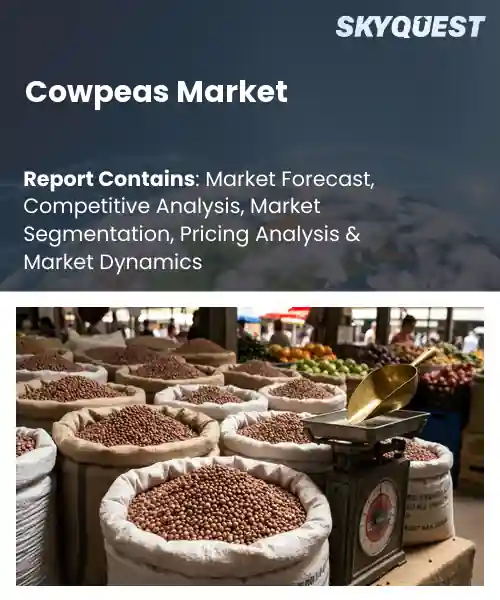
Cowpeas Market
Report ID: SQMIG20I2906
Report ID: SQMIG20I2906
[email protected]
USA +1 351-333-4748
Report ID:
SQMIG20I2906 |
Region:
Global |
Published Date: April, 2026
Pages:
157
|Tables:
88
|Figures:
76


Global Cowpeas Market size was valued at USD 6.42 Billion in 2024 and is poised to grow from USD 6.77 Billion in 2025 to USD 6.4 Billion by 2033, growing at a CAGR of 5.4% during the forecast period (2026-2033).
The cowpeas market centers on production, trade, and consumption of Vigna unguiculata, an adaptable legume grown across Africa, Asia, and parts of the Americas. It matters because cowpeas supply protein and dietary fiber to resource-limited populations while improving soil fertility through nitrogen fixation, which reduces fertilizer costs for smallholders. Historically, local subsistence markets expanded into regional trade networks as improved varieties, seed distribution programs, and processing techniques emerged during the late twentieth century. For example, Nigeria became a major producer driving regional exports, and development projects introduced drought-tolerant cultivars that stabilized yields, collectively shaping market resilience and farmer incomes today.Building on that resilience, rising demand for plant-based protein and climate-smart agriculture constitutes a key growth factor driving investment across the global cowpeas market. As consumers seek nutritious, low-carbon foods, processors and retailers scale value-added products such as ready-to-cook flours and canned cowpeas, which increases farmgate prices and incentivizes acreage expansion. Simultaneously, public and private breeding programs produce drought and pest-resistant varieties, causing yield gains that enable export opportunities to Europe and the Middle East. In practice, cooperative-led processing plants in West Africa illustrate how improved supply chains reduce postharvest losses and create steady incomes for households and expand livelihoods.
How can AI improve yield forecasting in the cowpeas market?
AI can improve cowpea yield forecasting by combining diverse data streams such as satellite imagery weather records soil sensors and field surveys to produce hyperlocal seasonal estimates. Key aspects include extracting spectral and temporal features detecting crop stress mapping growth stages and using transfer learning to adapt models where cowpea ground truth is scarce. Many existing forecasts use broad proxies so AI adds value by fusing observations with agronomic knowledge. In markets with variable rainfed conditions and pest pressure this approach makes forecasts more actionable for farmers traders and breeders by highlighting likely supply shifts and opportunities for targeted intervention.Planet Labs February 2026, the company expanded its hyperspectral and AI analytics offering which improves crop specific stress detection and enables richer pulse yield models for crops such as cowpea. This innovation supports market efficiency by giving buyers and farmers clearer production signals and faster more reliable forecasts.
Market snapshot - (2026-2033)
Global Market Size
USD 6.42 Billion
Largest Segment
Platforms & Software Frameworks
Fastest Growth
Platforms & Software Frameworks
Growth Rate
5.4% CAGR
To get more insights on this market click here to Request a Free Sample Report
Global cowpeas market is segmented by solution component, deployment mode, end-use vertical (strategic drivers) and region. Based on solution component, the market is segmented into Platforms & Software Frameworks and Professional Services (Consulting/Integration). Based on deployment mode, the market is segmented into Cloud-based Causal AI (SaaS) and On-premise/Edge Implementation. Based on end-use vertical (strategic drivers), the market is segmented into BFSI (Fraud Detection/Risk Modeling), Healthcare & Life Sciences (Drug Discovery/Clinical Trials) and Others (Marketing/Supply Chain Optimization). Based on region, the market is segmented into North America, Europe, Asia Pacific, Latin America and Middle East & Africa.
Platforms & Software Frameworks segment dominates because integrated tools tailored to cowpeas consolidate breeding analytics, quality control, traceability and farm management into a single operational layer that reduces fragmentation across the value chain. By enforcing common data models and enabling interoperability with sensors, labs and trading systems, these frameworks speed decision cycles, improve post-harvest handling and attract commercial buyers through predictable quality outcomes, thereby driving broader technology adoption.
However, Professional Services (Consulting/Integration) is emerging as the most rapidly expanding sub-segment in the cowpeas market because customized implementation, farmer training and regulatory advisory convert technology capability into usable field outcomes. This advisory-led growth accelerates deployment across diverse value chain actors, creates recurring service models and broadens market access for new solutions.
Cloud-based Causal AI (SaaS) segment leads because it delivers scalable causal modeling tuned to cowpeas agronomy, demand cycles and processing variability while lowering infrastructure barriers for producers and processors. Centralized data governance, continuous model updating and API access allow rapid scenario testing for yield drivers and price shocks, enabling stakeholders to make faster decisions, reduce post-harvest risk and adopt precision inputs that stabilize supply and market signals.
Meanwhile, On-premise/Edge Implementation is emerging as the most rapidly expanding sub-segment in the cowpeas market because buyers need analytics at remote aggregation points and strict data control from seed companies. Edge analytics lower latency, support intermittent connectivity, enable local decision rules for harvest and storage, and open demand for integrated hardware and software offerings.
To get detailed segments analysis, Request a Free Sample Report
Asia Pacific dominance in the global cowpeas market reflects a convergence of dietary tradition, agronomic suitability, and supportive value chains. Regional diets incorporate cowpeas across multiple cuisines, sustaining steady consumer demand and incentivizing production across varied agroecological zones. Public and private stakeholders have prioritized legume breeding, post-harvest handling, and processing capacity, creating supply reliability and product diversity. Well-developed trade corridors and processing hubs facilitate distribution within region and to overseas markets, while agricultural extension and farmer adoption of resilient practices strengthen on-farm productivity. Retail and foodservice channels have expanded product visibility, and interest in plant-based protein reinforces cowpeas role in both traditional and modern food systems. Combined institutional support and market infrastructure sustain Asia Pacific position as a primary source and innovator for cowpeas.
Cowpeas Market in Japan combines traditional culinary appreciation with modern food trends, supporting demand for high-quality and specialty varieties. Processing capabilities and food technology applications enable incorporation into convenience foods and plant-based formulations, while research institutions and industry partnerships advance varietal improvement and value addition. Retail focus on product traceability and premium positioning elevates market appeal, and collaborations between processors and culinary channels promote wider consumer acceptance beyond legacy uses.
Cowpeas Market in South Korea blends culinary tradition with industrial innovation, enabling applications from classic dishes to processed protein ingredients. Food manufacturers use advanced processing to supply convenience and ready-to-eat offerings, while retail channels emphasize quality and packaging innovation. Research networks and supply chain partners support varietal adaptation and steady availability. Marketing highlights nutritional benefits and convenience, broadening appeal among traditional consumers and younger urban groups and national distribution channels.
Rapid expansion of the cowpeas market in North America is driven by evolving consumer preferences, food industry innovation, and expanding distribution capabilities. Consumers in the United States and Canada show growing interest in plant-based proteins and nutrient-dense legumes, prompting manufacturers to develop diverse formats such as snacks, ingredient concentrates, and ready-to-eat meals. Foodservice experimentation and retail shelf space support wider exposure, while investment in processing and supply chain infrastructure enhances consistency and scalability. Agricultural stakeholders are exploring suitable production practices and contract arrangements to integrate cowpeas into existing rotations, aided by research collaboration and extension services. Sustainability messaging and clean-label positioning further bolster acceptance among environmentally and health-conscious purchasers, creating a robust platform for new product development and cross-channel growth.
Cowpeas Market in the United States benefits from strong ingredient innovation and extensive retail and foodservice channels that boost visibility and adoption. Processors and ingredient suppliers develop versatile formats and clean-label solutions for varied applications, while research institutions advance formulation and quality. Supply chain partnerships and contract production arrangements support consistent sourcing, and nutrition and sustainability positioning appeal to diverse consumer segments and commercial food developers and domestic small-scale manufacturers.
Cowpeas Market in Canada is shaped by interest in diversified cropping, ingredient development, and retail support for plant-based options. Processors and specialty producers emphasize value-added formulations and traceability to meet consumer expectations, while collaboration between research institutions and farming communities promotes suitable varieties and agronomic practices. Distribution networks link regional supply with national retail and foodservice channels, and sustainability narratives and nutritional messaging strengthen acceptance across conventional and emerging segments.
Europe is strengthening its role in the cowpeas market through a combination of supply chain refinement, product innovation, and targeted market positioning. Industry actors in Germany, United Kingdom, and France are investing in processing capabilities and product development to translate traditional legume uses into contemporary applications, including convenient formats and ingredient solutions for food manufacturers. Agricultural research and cooperative models support varietal suitability and sustainable cultivation practices in diverse European environments. Retailers and foodservice operators are integrating cowpeas into private-label offerings and menu innovation, while certification and traceability initiatives enhance consumer confidence. Cross-border trade links and collaboration among researchers, processors, and growers drive standardization and quality improvements that elevate Europe profile in both domestic and international cowpeas markets. This coordinated approach positions Europe to respond to shifting consumer preferences and to develop specialized value chains that emphasize sustainability and culinary diversity.
Cowpeas Market in Germany is supported by advanced processing and ingredient suppliers that facilitate diverse product development for retail and foodservice customers. Research institutions and industry collaborations focus on varietal suitability and processing optimization, while certification frameworks reinforce quality and traceability. Retail chains and distributors emphasize private-label innovation and clear sourcing narratives, encouraging processors to offer standardized value-added formats that integrate into culinary applications and ingredient portfolios and export channels.
Cowpeas Market in United Kingdom has gained traction through consumer interest in plant-based options and active product innovation among manufacturers. Foodservice and retail channels experiment with novel formats, while ingredient companies tailor functional concentrates and textured preparations for diverse applications. Research and testing facilities collaborate with growers to identify adaptable varieties, and traceability measures support premium positioning. Marketing that emphasizes nutrition and sustainability fosters acceptance across mainstream shoppers and specialist segment buyers.
Cowpeas Market in France draws on culinary heritage and growing innovation among processors and artisan producers to create both traditional and contemporary offerings. Chefs and food brands experiment with value-added preparations, while cooperative networks and research centers support varietal testing and agronomic adaptation for varied terroirs. Retailers and specialty distributors emphasize provenance and quality labeling, and storytelling around sustainable production and gastronomic versatility enhances consumer interest in both everyday and premium segments.
To know more about the market opportunities by region and country, click here to
Buy The Complete Report
Rising Demand For Plant Based Protein
Expansion Of Processing Infrastructure
Vulnerability To Climate Variability
Limited Access To Finance
Request Free Customization of this report to help us to meet your business objectives.
The competitive landscape in the global cowpeas market is shaped by technology-led differentiation, strategic partnerships, and ingredient innovation that shift purchasing and sourcing patterns; recent activity shows companies pursuing gene editing and novel ingredient routes to displace traditional legumes and dairy proteins. Examples include CRISPR-enabled trait work and pilot ingredient launches, research center partnerships to commercialize pest‑resistant cowpea varieties, and corporate ingredient investments targeting food manufacturers.
Top Player’s Company Profile
Recent Developments
SkyQuest’s ABIRAW (Advanced Business Intelligence, Research & Analysis Wing) is our Business Information Services team that Collects, Collates, Correlates, and Analyses the Data collected by means of Primary Exploratory Research backed by robust Secondary Desk research. As per SkyQuest analysis, the global cowpeas market is poised for steady growth driven by consumer shifts and supply-side upgrades. One key driver is rising demand for plant-based protein, and a second driver is expansion of processing infrastructure that enables value-added products. One restraint is vulnerability to climate variability which threatens yield reliability and supply consistency. The dominating region is Asia Pacific, supported by strong consumption, breeding programs, and processing hubs, while the dominating segment is Platforms & Software Frameworks, which streamline breeding, traceability, and farm management. Together these dynamics favor investment in resilient varieties and tech-enabled supply chains that can scale exports and retail-ready products.
| Report Metric | Details |
|---|---|
| Market size value in 2024 | USD 6.42 Billion |
| Market size value in 2033 | USD 6.4 Billion |
| Growth Rate | 5.4% |
| Base year | 2024 |
| Forecast period | (2026-2033) |
| Forecast Unit (Value) | USD Billion |
| Segments covered |
|
| Regions covered | North America (US, Canada), Europe (Germany, France, United Kingdom, Italy, Spain, Rest of Europe), Asia Pacific (China, India, Japan, Rest of Asia-Pacific), Latin America (Brazil, Rest of Latin America), Middle East & Africa (South Africa, GCC Countries, Rest of MEA) |
| Companies covered |
|
| Customization scope | Free report customization with purchase. Customization includes:-
|
To get a free trial access to our platform which is a one stop solution for all your data requirements for quicker decision making. This platform allows you to compare markets, competitors who are prominent in the market, and mega trends that are influencing the dynamics in the market. Also, get access to detailed SkyQuest exclusive matrix.
Table Of Content
Executive Summary
Market overview
Parent Market Analysis
Market overview
Market size
KEY MARKET INSIGHTS
COVID IMPACT
MARKET DYNAMICS & OUTLOOK
Market Size by Region
KEY COMPANY PROFILES
Methodology
For the Cowpeas Market, our research methodology involved a mixture of primary and secondary data sources. Key steps involved in the research process are listed below:
1. Information Procurement: This stage involved the procurement of Market data or related information via primary and secondary sources. The various secondary sources used included various company websites, annual reports, trade databases, and paid databases such as Hoover's, Bloomberg Business, Factiva, and Avention. Our team did 45 primary interactions Globally which included several stakeholders such as manufacturers, customers, key opinion leaders, etc. Overall, information procurement was one of the most extensive stages in our research process.
2. Information Analysis: This step involved triangulation of data through bottom-up and top-down approaches to estimate and validate the total size and future estimate of the Cowpeas Market.
3. Report Formulation: The final step entailed the placement of data points in appropriate Market spaces in an attempt to deduce viable conclusions.
4. Validation & Publishing: Validation is the most important step in the process. Validation & re-validation via an intricately designed process helped us finalize data points to be used for final calculations. The final Market estimates and forecasts were then aligned and sent to our panel of industry experts for validation of data. Once the validation was done the report was sent to our Quality Assurance team to ensure adherence to style guides, consistency & design.
Analyst Support
Customization Options
With the given market data, our dedicated team of analysts can offer you the following customization options are available for the Cowpeas Market:
Product Analysis: Product matrix, which offers a detailed comparison of the product portfolio of companies.
Regional Analysis: Further analysis of the Cowpeas Market for additional countries.
Competitive Analysis: Detailed analysis and profiling of additional Market players & comparative analysis of competitive products.
Go to Market Strategy: Find the high-growth channels to invest your marketing efforts and increase your customer base.
Innovation Mapping: Identify racial solutions and innovation, connected to deep ecosystems of innovators, start-ups, academics, and strategic partners.
Category Intelligence: Customized intelligence that is relevant to their supply Markets will enable them to make smarter sourcing decisions and improve their category management.
Public Company Transcript Analysis: To improve the investment performance by generating new alpha and making better-informed decisions.
Social Media Listening: To analyze the conversations and trends happening not just around your brand, but around your industry as a whole, and use those insights to make better Marketing decisions.
REQUEST FOR SAMPLE
 REQUEST FREE CUSTOMIZATION


Want to customize this report? This report can be personalized according to your needs. Our analysts and industry experts will work directly with you to understand your requirements and provide you with customized data in a short amount of time. We offer $1000 worth of FREE customization at the time of purchase.
Feedback From Our Clients


 USA (+1) 351-333-4748

