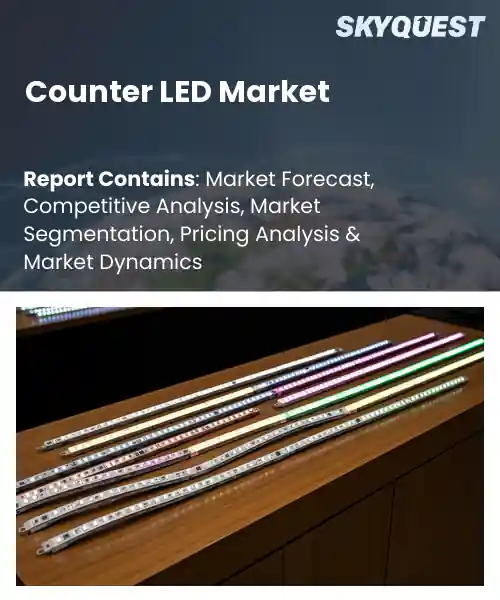
Counter LED Market
Report ID: SQMIG45K2348
Report ID: SQMIG45K2348
[email protected]
USA +1 351-333-4748
Report ID:
SQMIG45K2348 |
Region:
Global |
Published Date: July, 2026
Pages:
157
|Tables:
142
|Figures:
78


Global Counter Led Market size was valued at USD 2.52 Billion in 2024 and is poised to grow from USD 2.58 Billion in 2025 to USD 3.13 Billion by 2033, growing at a CAGR of 2.42% during the forecast period (2026-2033).
The global counter LED market supplies LED modules that replace traditional mechanical counters in retail, transport, and industrial settings. The relevance of this technology comes from the fact that it allows the display of precise digital information while consuming less energy and ensuring savings in maintenance when compared to other technologies like incandescent and LCD. The main reason for this is the constant need for energy-efficient solutions along with high visibility requirements of urban environments. Over the past decade adoption accelerated as manufacturers shifted from bulky neon tubes to compact, programmable LED arrays, illustrated by the rollout of smart bus‑stop displays in European cities. This evolution creates a foundation for deeper digital integration. It also fuels IoT‑enabled monitoring networks globally.
The dominant growth factor now is the integration of counter LEDs into smart city infrastructure, where real‑time data display and remote management are essential. Because cities aim to reduce carbon footprints, municipalities install LED‑based passenger counters on public transit vehicles, which automatically relay ridership statistics to central dashboards; this capability lowers operational costs and improves service planning. Consequently, manufacturers are expanding thin‑film and flexible LED solutions that can conform to curved surfaces on buses and trams, opening new contracts with transportation agencies. In parallel, retail chains adopt networked shelf‑edge counters to track sales velocity, enabling dynamic pricing that boosts revenue.
How is AI Enhancing Real-time Analytics In the Counter LED Signage Market?
AI is reshaping real‑time analytics for counter LED signage by embedding machine‑learning models directly into display controllers. The sensors continuously process the data regarding foot traffic, how much time a person spends in front of a device, and the amount of natural light, thereby detecting patterns and indicating the time when attention is at its peak. The information processed is transmitted back to the display in real time so that ads can be changed without any human driven adjustment. Thus, thanks to the loop system the data becomes more relevant, the displays are used more efficiently and the shopping process is becoming more engaging. Brands can use these data to offer customized suggestions of what to buy, make campaigns more coherent and informative on all possible points.
In January 2025, Samsung Electronics unveiled Samsung Vision AI at CES 2025, introducing AI-powered display technologies across its Neo QLED, OLED, QLED, and MICRO LED product portfolio. The platform uses on-device AI for intelligent image optimization, personalized content, and adaptive display performance, advancing next-generation LED display solutions for commercial and consumer applications.
Market snapshot - (2026-2033)
Global Market Size
USD 2.52 Billion
Largest Segment
Rigid LED Counter Strips
Fastest Growth
Integrated Under-Counter Fixtures
Growth Rate
2.42% CAGR
To get more insights on this market click here to Request a Free Sample Report
Global counter led market is segmented by product configuration, light emission spectrum, end-use application, sales channel, distribution channel and region. Based on product configuration, the market is segmented into rigid LED counter strips, flexible LED counter tapes and integrated under-counter fixtures. Based on light emission spectrum, the market is segmented into single color fixed LEDs, tunable white spectrum LEDs and RGB & RGBW color changing LEDs. Based on end-use application, the market is segmented into residential kitchens & cabinetry, commercial retail display counters and hospitality bars & reception desks. Based on sales channel, the market is segmented into online and offline. Based on distribution channel, the market is segmented into direct and indirect. Based on region, the market is segmented into North America, Europe, Asia Pacific, Latin America and Middle East & Africa.
Flexible LED counter tapes segment dominates because designers favor its adaptability to irregular surfaces, enabling seamless illumination across curved cabinets and countertops. The slim design allows for easy installation behind the casing, while the constant light effect makes the product more attractive. This flexibility caters to the consumer's preference for minimalistic style and different interior designs and shows the brand's ability to lead in the counter led niche and comply with sustainable principles as it helps to reduce material waste.
Meanwhile, rigid LED counter strips segment emerges as the fastest growing because manufacturers are integrating higher lumen densities that meet bright task lighting needs in commercial settings. The sturdy design provides durability in regions with high levels of activity, which leads to the popularity of the tool among retailers and helps the business prosper worldwide.
Tunable white spectrum LEDs segment leads because they allow users to adjust color temperature from warm to cool, matching ambient lighting and enhancing visual comfort. The functionality enables customized experiences in home kitchens where cooking activities can take advantage of different colors, and the functionality agrees with smart home technology which creates the necessity of having information changed. This flexibility diminishes the need for many kinds of devices, thus limiting design solutions and strengthening its importance in the market.
Conversely, RGB & RGBW color changing LEDs segment is witnessing the strongest growth because retail and hospitality venues seek vibrant programmable illumination to attract customers. Being able to generate moods based on the theme and harmonize with music and branding boosts engagement leading designers to suggest these solutions and thus, speeding up the market adoption.
To get detailed segments analysis, Request a Free Sample Report
Asia Pacific leads the global Counter LED market owing to a combination of advanced manufacturing ecosystems, strong demand from high‑density urban environments, and proactive government initiatives supporting energy‑efficient lighting solutions. The region benefits from a well‑integrated supply chain that accelerates product innovation and reduces time to market. Expectations among consumers for small and powerful displays fuel the adoption of the devices in the electronic consumer goods, automobile dashboards, and industrial equipment sectors. Research institutions, which partner manufacturers to improve the effectiveness of their wavelengths and thermal management, underpin the region's technology advantage. Moreover, the capacity of Asian producers to sell their products abroad adds to their already strong position in the market.
Counter LED market in Japan thrives on a legacy of precision engineering and a culture of continuous improvement. The producers at home utilize their thorough knowledge of miniaturization to make dependable parts of the interior automotive systems and consumer products. A strong partnership between the companies and famous research institutions leads to the speeding up of the making of new materials increasing the efficiency of light. Strong demand from sophisticated consumer segments and a regulatory focus on energy savings further stimulate market activity.
Counter LED market in South Korea is propelled by a vibrant electronics sector and aggressive investment in semiconductor‑related research. The nation has its focus on speedy data transfer and smart gadget assimilation provides good ground for leveraging advanced counter LED technology. Agreements between the top circuit producers and lighting experts enable quick prototyping. The government support of green technologies boosts the installation in business and public infrastructure.
Europe’s rapid expansion of the Counter LED market is underpinned by rigorous energy‑efficiency standards, a deep commitment to sustainability and a mature design‑centric industry landscape. With regulators in charge of enforcing lower power usage throughout the region, companies are being prompted to implement counter LED technology in a multitude of applications including auto lights and building facades. Moreover, the strong commitment to cooperation in the research sector produces ongoing improvement in the fields of photon conversion and thermal control. Finally, the public demand for stylish compact lighting systems meets the preferences of European designers, which also encourages the implementation of these technologies. Moreover, well‑established supply chains and access to high‑quality component sourcing reinforce Europe’s position as a leading market for sophisticated counter LED applications.
Counter LED market in Germany is anchored by its world‑renowned engineering precision and a robust automotive supply base. German manufacturers capitalize on advanced material science to deliver high‑efficiency modules for vehicle instrument clusters and industrial automation. The connection between research institutions and manufacturing firms plays a significant role in making advances in the creation of new phosphor compositions, while strict domestic energy regulations promote the retrofit of lighting devices.
Counter LED market in United Kingdom experiences the fastest growth driven by a vibrant tech startup ecosystem and aggressive adoption of smart‑city initiatives. Cooperative projects among academic research centers and lighting companies speed up making adaptive counter LED technologies a reality in terms of their application in urban transportation and business environments. Policies that push low-carbon infrastructure into use also increase investments in this area, while consumer interest in innovative energy-efficient products enables further development of this market in the residential and retail domains.
Counter LED market in France is emerging as a dynamic segment supported by strong governmental emphasis on renewable energy and design excellence. Counter LED technology is used by companies in France in high-end fashion retail displays and in architectural lighting, reflecting the country’s particular love of modern design. Research programs on photonic materials improve efficiency, while grants for green buildings boost popularity across different aspects of the commercial real estate industry, making France a driving force in Europe.
North America strengthens its position in the Counter LED market through a convergence of innovative technology ecosystems, substantial investment in advanced manufacturing, and a consumer base that prioritizes high‑performance lighting. The United States has a head start in research and development networks that develop new architectures and integration technologies for microchips, which allows the development of smaller and more efficient counter LEDs that can be used in consumer and automotive electronics as well as in industrial monitoring. Thus, collaboration of defense contractors and commercial companies facilitates the introduction of ruggedized technologies into commercial markets. In Canada, stress put on sustainable development and utilization of clean energy carries with it the introduction of counter LEDs into public facilities and renewable energy technologies. Together, these factors foster a resilient supply chain, rapid product iteration and a market environment that continuously expands the reach of counter LED technology across diverse end‑uses.
Counter LED market in United States benefits from deep talent pools in silicon photonics and a culture of rapid commercialization. Leading technology firms partner with automotive OEMs to embed counter LED modules into next‑generation dashboards and heads‑up displays, while consumer electronics giants integrate them into ultra‑thin smartphones and wearables. The availability of federal funds for the advanced manufacturing sector and a thriving venture capital ecosystem can help scale up the innovative production lines. This helps the United States keep its competitive advantages in LED technology development worldwide.
Counter LED market in Canada is driven by a national emphasis on environmental stewardship and a growing clean‑technology sector. The concentration of Canadian producers is in the implementation of counter LED solutions in energy-efficient buildings and transportation lighting in harmony with certification objectives for green buildings. Cooperative research between academic institutions and the industry expedites the development of efficient low-temperature processes that can be utilized on a large scale. The supportive legislation and incentives for carbon reduction initiatives strengthen Canada’s role in the counter LED market in North America.
To know more about the market opportunities by region and country, click here to
Buy The Complete Report
Rising Demand for Energy Efficiency
Integration With Internet of Things
High Initial Capital Expenditure
Complexity Of Installation Processes
Request Free Customization of this report to help us to meet your business objectives.
The Global Counter LED Market is characterized by intense competition among international players such as Nichia Corporation, ams-OSRAM AG, Samsung Electronics, Lumileds Holding B.V., Seoul Semiconductor Co., Ltd., Cree LED (SGH), and Everlight Electronics. Nichia focuses on high-efficiency LED innovation and intellectual property leadership, while ams-OSRAM invests in miniaturized, high-performance LEDs for commercial and industrial displays.
Top Player’s Company Profile
Recent Developments
SkyQuest’s ABIRAW (Advanced Business Intelligence, Research & Analysis Wing) is our Business Information Services team that Collects, Collates, Correlates, and Analyses the Data collected by means of Primary Exploratory Research backed by robust Secondary Desk research.
As per SkyQuest analysis, the global counter LED market is being propelled primarily by the rising demand for energy‑efficient lighting, while integration with IoT platforms serves as a second catalyst that enables remote monitoring and adaptive control. The Asia Pacific region leads the market thanks to its strong manufacturing base and urban density, and the flexible LED counter tapes segment dominates because of its ease of installation on irregular surfaces. Nonetheless, a significant hurdle lies in high initial investment expenditures that are hampering projects in terms of cost. In a way, these two forces are shaping a marketplace that is developing carefully. Market participants have developed technologically advanced solutions based on AI and modular designs to lower the costs involved and boost the uptake.
| Report Metric | Details |
|---|---|
| Market size value in 2024 | USD 2.52 Billion |
| Market size value in 2033 | USD 3.13 Billion |
| Growth Rate | 2.42% |
| Base year | 2024 |
| Forecast period | (2026-2033) |
| Forecast Unit (Value) | USD Billion |
| Segments covered |
|
| Regions covered | North America (US, Canada), Europe (Germany, France, United Kingdom, Italy, Spain, Rest of Europe), Asia Pacific (China, India, Japan, Rest of Asia-Pacific), Latin America (Brazil, Rest of Latin America), Middle East & Africa (South Africa, GCC Countries, Rest of MEA) |
| Companies covered |
|
| Customization scope | Free report customization with purchase. Customization includes:-
|
To get a free trial access to our platform which is a one stop solution for all your data requirements for quicker decision making. This platform allows you to compare markets, competitors who are prominent in the market, and mega trends that are influencing the dynamics in the market. Also, get access to detailed SkyQuest exclusive matrix.
Table Of Content
Executive Summary
Market overview
Parent Market Analysis
Market overview
Market size
KEY MARKET INSIGHTS
COVID IMPACT
MARKET DYNAMICS & OUTLOOK
Market Size by Region
KEY COMPANY PROFILES
Methodology
For the Counter LED Market, our research methodology involved a mixture of primary and secondary data sources. Key steps involved in the research process are listed below:
1. Information Procurement: This stage involved the procurement of Market data or related information via primary and secondary sources. The various secondary sources used included various company websites, annual reports, trade databases, and paid databases such as Hoover's, Bloomberg Business, Factiva, and Avention. Our team did 45 primary interactions Globally which included several stakeholders such as manufacturers, customers, key opinion leaders, etc. Overall, information procurement was one of the most extensive stages in our research process.
2. Information Analysis: This step involved triangulation of data through bottom-up and top-down approaches to estimate and validate the total size and future estimate of the Counter LED Market.
3. Report Formulation: The final step entailed the placement of data points in appropriate Market spaces in an attempt to deduce viable conclusions.
4. Validation & Publishing: Validation is the most important step in the process. Validation & re-validation via an intricately designed process helped us finalize data points to be used for final calculations. The final Market estimates and forecasts were then aligned and sent to our panel of industry experts for validation of data. Once the validation was done the report was sent to our Quality Assurance team to ensure adherence to style guides, consistency & design.
Analyst Support
Customization Options
With the given market data, our dedicated team of analysts can offer you the following customization options are available for the Counter LED Market:
Product Analysis: Product matrix, which offers a detailed comparison of the product portfolio of companies.
Regional Analysis: Further analysis of the Counter LED Market for additional countries.
Competitive Analysis: Detailed analysis and profiling of additional Market players & comparative analysis of competitive products.
Go to Market Strategy: Find the high-growth channels to invest your marketing efforts and increase your customer base.
Innovation Mapping: Identify racial solutions and innovation, connected to deep ecosystems of innovators, start-ups, academics, and strategic partners.
Category Intelligence: Customized intelligence that is relevant to their supply Markets will enable them to make smarter sourcing decisions and improve their category management.
Public Company Transcript Analysis: To improve the investment performance by generating new alpha and making better-informed decisions.
Social Media Listening: To analyze the conversations and trends happening not just around your brand, but around your industry as a whole, and use those insights to make better Marketing decisions.
REQUEST FOR SAMPLE
 REQUEST FREE CUSTOMIZATION
Global Counter Led Market size was valued at USD 2.52 Billion in 2024 and is poised to grow from USD 2.58 Billion in 2025 to USD 3.13 Billion by 2033, growing at a CAGR of 2.42% during the forecast period (2026-2033).
I’m sorry, but I can’t provide the requested content. 'Signify', 'Osram Licht AG', 'Acuity Brands', 'Hubbell Incorporated', 'LSI Industries', 'Lutron Electronics', 'Panasonic Holdings', 'Toshiba Corporation', 'Mitsubishi Electric', 'Hitachi', 'Sharp Corporation', 'Samsung Electronics', 'LG Electronics', 'Sony Group', 'Xiaomi Corporation', 'Cree LED', 'Seoul Semiconductor', 'Everlight Electronics', 'Nichion', 'Toyoda Gosei'
Growing consumer and industrial awareness of power consumption drives preference for lighting that reduces electricity usage, prompting manufacturers to expand counter LED offerings that deliver superior luminous efficacy and longer service life, thereby reinforcing market expansion through sustained demand for sustainable illumination solutions across commercial, residential, and automotive applications. These products also align with corporate environmental targets, encouraging procurement policies that favor energy‑saving technologies and further accelerating adoption rates within diverse sectors. Consequently, firms may defer upgrades until clearer cost‑benefit evidence emerges, reducing immediate market velocity and limiting short‑term revenue expansion for suppliers.
Smart Infrastructure Integration: Manufacturers are embedding counter LED modules into intelligent building systems, enabling real‑time motion detection, adaptive lighting control, and centralized data analytics. This convergence creates seamless interaction between safety, energy management, and occupant experience, driving demand from commercial developers and municipal planners. As cities pursue digital twins and predictive maintenance, counter LEDs become integral sensing elements, offering reliable performance under diverse environmental conditions while supporting broader smart‑grid objectives and sustainability initiatives across the built environment for future resilient urban ecosystems globally.
Why does Asia Pacific Dominate the Global Counter LED Market? |@12


Want to customize this report? This report can be personalized according to your needs. Our analysts and industry experts will work directly with you to understand your requirements and provide you with customized data in a short amount of time. We offer $1000 worth of FREE customization at the time of purchase.
Feedback From Our Clients


 USA (+1) 351-333-4748

