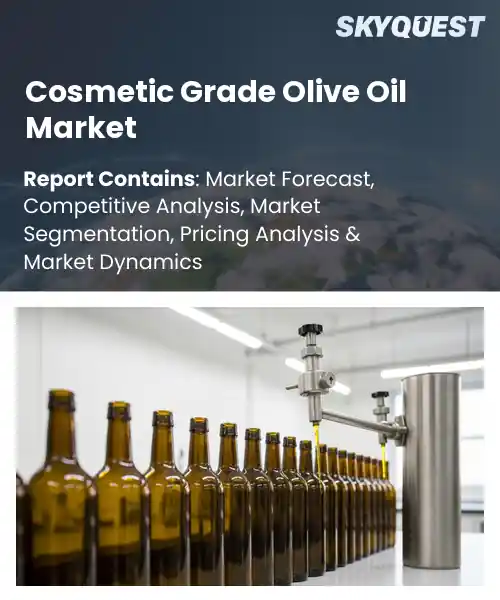
Cosmetic Grade Olive Oil Market
Report ID: SQMIG10C2080
Report ID: SQMIG10C2080
[email protected]
USA +1 351-333-4748
Report ID:
SQMIG10C2080 |
Region:
Global |
Published Date: April, 2026
Pages:
157
|Tables:
88
|Figures:
76


Global Cosmetic Grade Olive Oil Market size was valued at USD 15.8 Billion in 2024 and is poised to grow from USD 16.49 Billion in 2025 to USD 15.8 Billion by 2033, growing at a CAGR of 4.37% during the forecast period (2026-2033).
The primary driver of the cosmetic grade olive oil market is the consumer shift toward natural and sustainable ingredients, which has elevated olive oil from a culinary staple to a valued cosmetic raw material. Cosmetic grade olive oil denotes oil processed and tested to meet purity, peroxide and microbial thresholds suitable for personal care, and it matters because formulators depend on consistent antioxidant and emollient performance for efficacy and safety. Over two decades demand increased as studies on oleic acid, tocopherols and squalene validated benefits, Mediterranean producers expanded refining capacity, and niche brands marketed cold-pressed variants in creams and soaps.Because consumer preference for natural, traceable ingredients drives product differentiation, manufacturers have increased procurement of certified cosmetic grade olive oil, generating demand for certified supply chains and testing services, which incentivizes upstream investment: growers adopt sustainable agronomy and optical sorting, mills expand cold-press refining, and co-packers offer customized viscosity and antioxidant profiles, which allows brands to launch premium anti-aging serums, sulfate-free shampoos, and artisanal soaps that command higher retail prices. Regulatory harmonization and eco-labeling further enable market entry for Mediterranean and non-traditional suppliers, creating opportunities for contract manufacturing, private-label partnerships, and vertically integrated brands to capture greater margin and trust.
How is blockchain improving traceability in the cosmetic grade olive oil market?
Blockchain improves traceability in the cosmetic grade olive oil market by creating an immutable digital record for every step from grove to extraction and bottling. Key aspects include tamper proof provenance records, sensor and lab data uploads, and consumer accessible QR verification. The current market shows producers and ingredient suppliers adopting these tools to reduce fraud and strengthen purity and cultivation claims. For cosmetic formulators and brands this means clearer supplier audits, stronger ethical sourcing narratives, and easier segregation of cosmetic grade lots. Practical examples include single orchard serialization and links to third party test reports that build trust with manufacturers and discerning consumers.Lidl March 2025, the retailer with Izertis launched a blockchain QR traceability program for a new extra virgin olive oil that demonstrates ledger backed provenance for cosmetic grade sourcing. The system lets brands verify cultivation and processing details, reducing supplier risk and accelerating ingredient qualification for beauty product manufacture.
Market snapshot - (2026-2033)
Global Market Size
USD 15.8 Billion
Largest Segment
Protective Coatings & Wall Putty
Fastest Growth
Joint Fillers & Sealants
Growth Rate
4.37% CAGR
To get more insights on this market click here to Request a Free Sample Report
Global cosmetic grade olive oil market is segmented by application focus, functional role, product form and region. Based on application focus, the market is segmented into Cement & Concrete Admixtures (Workability Enhancers), Joint Fillers & Sealants and Protective Coatings & Wall Putty. Based on functional role, the market is segmented into Thickening & Rheology Modification and Suspension & Stabilizing Agents. Based on product form, the market is segmented into Powdered Carbomers and Pre-solubilized Liquid Carbomers. Based on region, the market is segmented into North America, Europe, Asia Pacific, Latin America and Middle East & Africa.
Powdered Carbomers segment dominates because formulators favor their concentrated, stable powder form for precise dosing and long shelf life in cosmetic grade olive oil applications. Their dry handling reduces degradation risk and simplifies storage logistics, enabling manufacturers to tailor viscosity and texture during final mixing. This control translates into consistent product performance and formulation flexibility, driving procurement preference among brands focused on clean labeling and reliable production workflows.
However, pre-solubilized liquid carbomers are emerging as the fastest growing product form due to ease of incorporation, reduced processing time and minimized dust exposure for manufacturers. Their ready to use nature accelerates scale up, supports rapid innovation in texture and sensory profiles, and lowers formulation complexity, unlocking faster market introductions and expanding application opportunities.
Thickening & Rheology Modification segment dominates because control of viscosity is central to translating cosmetic grade olive oil into stable creams, serums and emulsions with desirable sensory attributes. Mastery of flow behavior enables formulators to suspend actives, achieve consistent spreadability and ensure shelf stability under varying temperatures. This functional primacy drives investment in compatible thickeners and positions rheology tuning as essential to product differentiation and consumer acceptance.
However, suspension and stabilizing agents are witnessing the strongest growth as brands seek to incorporate particulate botanicals and active droplets into olive oil based cosmetics. Innovations in natural compatible stabilizers improve visual appeal and ingredient efficacy, while regulatory favor for clean formulae fuels adoption, creating new formulation niches and broader product diversification opportunities.
To get detailed segments analysis, Request a Free Sample Report
Europe leads the global cosmetic grade olive oil market through a combination of established production heritage, stringent quality controls and integrated supply chains that prioritize ingredient traceability. Mature consumer markets cultivate sophisticated demand for natural and premium formulations, encouraging brands to source high-purity olive oil tailored to topical applications. Strong regulatory frameworks and well-developed testing infrastructure support consistent grading and certification, reinforcing trust among formulators. Close proximity between growers, processors and cosmetic manufacturers accelerates innovation and product development, while a dense network of specialty suppliers and private label producers enables rapid market responsiveness. Investment in sustainable farming and cold-press extraction methods strengthens position on quality and environmental credentials.
Cosmetic Grade Olive Oil Market benefits from a robust industrial infrastructure and a discerning consumer base that favors scientifically validated natural ingredients. Strong ties between ingredient suppliers and contract manufacturers facilitate formulation testing and upscale packaging. Emphasis on purity standards and certification pathways encourages manufacturers to integrate olive oil into premium skincare lines. Collaboration between research institutes and specialty producers supports product differentiation focused on texture, stability and sensory appeal.
Cosmetic Grade Olive Oil Market draws on a vibrant beauty industry and a culture of ingredient transparency that favors botanical actives. Retailer and indie brand experimentation with clean-label narratives elevates demand for refined olive oil fractions suitable for serums and balms. Regulatory clarity around cosmetic claims encourages responsible sourcing. Strategic partnerships with European processors enable rapid access to specialized grades, supporting premium positioning and innovation in multifunctional skincare formulations globally.
Cosmetic Grade Olive Oil Market leverages a heritage of artisanal extraction techniques alongside modern cosmetic science to deliver ingredients prized for sensory quality. Strong emphasis on provenance and authentic storytelling enhances brand narratives that incorporate olive oil as a hallmark of Mediterranean-inspired luxury. Collaboration between specialty mills and niche cosmetic houses yields bespoke oil blends tailored for anti-ageing and emollient functions, reinforcing France reputation for craftsmanship and premium skincare innovation.
Rapid expansion in Asia Pacific is driven by rising consumer interest in natural and heritage-driven beauty rituals, coupled with increasing experimentation by domestic and international brands to incorporate high-quality botanical oils into formulations. Growing urban beauty cultures value textural performance and multifunctionality, prompting formulators to adopt olive oil fractions that enhance skin feel and product stability. Strengthening distribution channels, including specialty retailers and e-commerce platforms, accelerate product discovery and niche positioning. Local research institutions and contract manufacturers collaborate to adapt olive oil grades to regional preferences, while branding that emphasizes provenance and sustainability resonates with discerning consumers. Market entrants leverage premiumization trends and cross-border ingredient sourcing to introduce novel applications, reinforcing Asia Pacific role as a dynamic arena for innovative personal care products.
Cosmetic Grade Olive Oil Market in Japan benefits from a refined skincare culture that values subtle sensory profiles and effective natural actives. Formulators tailor olive oil fractions for lightweight absorption and sustained moisturization. Partnerships between cosmetic houses and ingredient specialists produce grades optimized for emulsions and facial oils. Premium positioning highlights craftsmanship and purity, aligning olive oil integration with Japan preference for gentle, high-performance skincare rituals and scientific validation practices.
Cosmetic Grade Olive Oil Market in South Korea is driven by rapid beauty trends and strong focus on novel textures and multifunctional benefits. Manufacturers experiment with specialty olive oil fractions to achieve quick absorption, lightweight finishes and compatibility with layering routines. Collaborations between K-beauty formulators and ingredient houses yield innovative delivery systems. Marketing stresses ingredient efficacy, purity and trend alignment, supporting adoption across mass prestige segments focused on skin health.
North America is strengthening its role in the cosmetic grade olive oil market through strategic sourcing, private label development and heightened focus on clean beauty credentials. Brand innovation prioritizes ingredient transparency, leading formulators to validate olive oil traceability and extraction methods for topical use. A mix of established personal care companies and nimble indie brands explore differentiated oil fractions tailored to regional consumer preferences, while contract manufacturers adapt processing techniques for scalable, consistent supply. Distribution expansion across specialty retailers and online channels improves accessibility, and collaborative R&D between ingredient suppliers and academia fosters adaptation of olive oil functionality to advanced delivery systems. Cross-border partnerships and sustainable sourcing initiatives further underpin market credibility and long-term supplier relationships.
Cosmetic Grade Olive Oil Market in United States reflects a diverse brand landscape where large personal care companies and indie brands pursue clean, functional ingredient narratives. Formulators seek consistent high-purity olive oil fractions compatible with complex emulsions and novel delivery formats. Private-label manufacturing and strong e-commerce channels support rapid commercialization. Partnerships with regional processors and ingredient innovators produce tailored grades that align with consumer expectations for performance, traceability and sustainability.
Cosmetic Grade Olive Oil Market in Canada emphasizes natural and sustainably sourced ingredients within a cautious regulatory environment. Brands and formulators seek verified provenance and clean extraction claims when selecting olive oil grades for moisturizers and body care. Partnerships with North American processors provide access to specialized fractions suited to consumer needs. Marketing highlights ethical sourcing, gentle efficacy and compatibility with sensitive skin, enabling adoption across niche and mainstream assortments.
To know more about the market opportunities by region and country, click here to
Buy The Complete Report
Increasing Demand For Natural Ingredients
Expansion Of Natural Personal Care
Raw Material Price Volatility
Regulatory and Labeling Complexity
Request Free Customization of this report to help us to meet your business objectives.
Competitive landscape in the global cosmetic grade olive oil market is driven by ingredient supplier verticalization and supplier retailer collaborations, with competition stimulated by facility upgrades, joint development and extractive technology partnerships; incumbents are pursuing targeted investments and co development deals, for example Sovena opening dedicated cosmetic grade capacity and Deoleo expanding its Olivoil cosmetic actives while California Olive Ranch formed retailer partnerships.
Top Player’s Company Profile
Recent Developments
SkyQuest’s ABIRAW (Advanced Business Intelligence, Research & Analysis Wing) is our Business Information Services team that Collects, Collates, Correlates, and Analyses the Data collected by means of Primary Exploratory Research backed by robust Secondary Desk research. As per SkyQuest analysis, the global cosmetic grade olive oil market is being driven primarily by consumer preference for natural and sustainable ingredients, supported further by expansion of natural personal care ranges, while growth is tempered by raw material price volatility that complicates sourcing and margins. Europe remains the dominant region due to its production heritage, regulatory rigor and integrated supply chains. Powdered carbomers lead as the principal product form since their concentrated, stable powder format enables precise dosing and long shelf life for formulators. Overall, the market favors traceable, premium olive oil grades and value chain investments that bolster sustainability and formulation reliability for brands seeking clean, high-performance ingredients.
| Report Metric | Details |
|---|---|
| Market size value in 2024 | USD 15.8 Billion |
| Market size value in 2033 | USD 15.8 Billion |
| Growth Rate | 4.37% |
| Base year | 2024 |
| Forecast period | (2026-2033) |
| Forecast Unit (Value) | USD Billion |
| Segments covered |
|
| Regions covered | North America (US, Canada), Europe (Germany, France, United Kingdom, Italy, Spain, Rest of Europe), Asia Pacific (China, India, Japan, Rest of Asia-Pacific), Latin America (Brazil, Rest of Latin America), Middle East & Africa (South Africa, GCC Countries, Rest of MEA) |
| Companies covered |
|
| Customization scope | Free report customization with purchase. Customization includes:-
|
To get a free trial access to our platform which is a one stop solution for all your data requirements for quicker decision making. This platform allows you to compare markets, competitors who are prominent in the market, and mega trends that are influencing the dynamics in the market. Also, get access to detailed SkyQuest exclusive matrix.
Table Of Content
Executive Summary
Market overview
Parent Market Analysis
Market overview
Market size
KEY MARKET INSIGHTS
COVID IMPACT
MARKET DYNAMICS & OUTLOOK
Market Size by Region
KEY COMPANY PROFILES
Methodology
For the Cosmetic Grade Olive Oil Market, our research methodology involved a mixture of primary and secondary data sources. Key steps involved in the research process are listed below:
1. Information Procurement: This stage involved the procurement of Market data or related information via primary and secondary sources. The various secondary sources used included various company websites, annual reports, trade databases, and paid databases such as Hoover's, Bloomberg Business, Factiva, and Avention. Our team did 45 primary interactions Globally which included several stakeholders such as manufacturers, customers, key opinion leaders, etc. Overall, information procurement was one of the most extensive stages in our research process.
2. Information Analysis: This step involved triangulation of data through bottom-up and top-down approaches to estimate and validate the total size and future estimate of the Cosmetic Grade Olive Oil Market.
3. Report Formulation: The final step entailed the placement of data points in appropriate Market spaces in an attempt to deduce viable conclusions.
4. Validation & Publishing: Validation is the most important step in the process. Validation & re-validation via an intricately designed process helped us finalize data points to be used for final calculations. The final Market estimates and forecasts were then aligned and sent to our panel of industry experts for validation of data. Once the validation was done the report was sent to our Quality Assurance team to ensure adherence to style guides, consistency & design.
Analyst Support
Customization Options
With the given market data, our dedicated team of analysts can offer you the following customization options are available for the Cosmetic Grade Olive Oil Market:
Product Analysis: Product matrix, which offers a detailed comparison of the product portfolio of companies.
Regional Analysis: Further analysis of the Cosmetic Grade Olive Oil Market for additional countries.
Competitive Analysis: Detailed analysis and profiling of additional Market players & comparative analysis of competitive products.
Go to Market Strategy: Find the high-growth channels to invest your marketing efforts and increase your customer base.
Innovation Mapping: Identify racial solutions and innovation, connected to deep ecosystems of innovators, start-ups, academics, and strategic partners.
Category Intelligence: Customized intelligence that is relevant to their supply Markets will enable them to make smarter sourcing decisions and improve their category management.
Public Company Transcript Analysis: To improve the investment performance by generating new alpha and making better-informed decisions.
Social Media Listening: To analyze the conversations and trends happening not just around your brand, but around your industry as a whole, and use those insights to make better Marketing decisions.
REQUEST FOR SAMPLE
 REQUEST FREE CUSTOMIZATION


Want to customize this report? This report can be personalized according to your needs. Our analysts and industry experts will work directly with you to understand your requirements and provide you with customized data in a short amount of time. We offer $1000 worth of FREE customization at the time of purchase.
Feedback From Our Clients


 USA (+1) 351-333-4748

