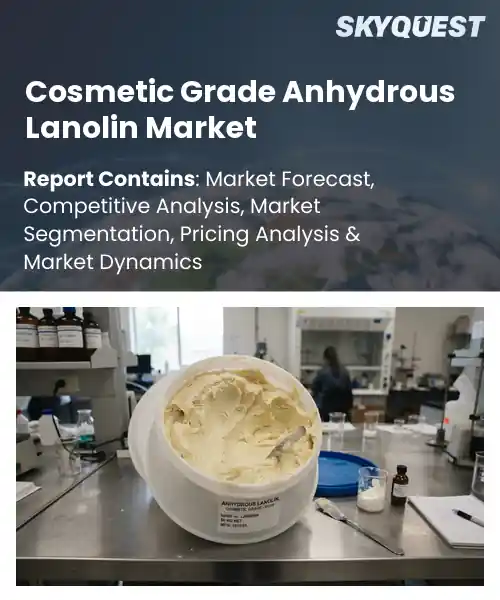
Cosmetic Grade Anhydrous Lanolin Market
Report ID: SQMIG30L2598
Report ID: SQMIG30L2598
[email protected]
USA +1 351-333-4748
Report ID:
SQMIG30L2598 |
Region:
Global |
Published Date: September, 2026
Pages:
157
|Tables:
141
|Figures:
78


Global Cosmetic Grade Anhydrous Lanolin Market size was valued at USD 2.3 Billion in 2024 and is poised to grow from USD 2.63 Billion in 2025 to USD 7.6 Billion by 2033, growing at a CAGR of 14.2% during the forecast period (2026-2033).
Cosmetic grade anhydrous lanolin, a refined form of wool‑derived oil, has become a cornerstone ingredient in personal‑care formulations because it provides moisturization and a natural image. The market’s primary driver stems from rising consumer preference for skin‑friendly, bio‑based emollients that replace synthetic silicones and petroleum derivatives. Historically, lanolin entered the beauty sector in the 1950s as a cheap barrier enhancer, but purification advances in the 1990s improved its safety, allowing inclusion in premium creams and lip balms. Today, brands such as L'Occitane and The Body Shop showcase lanolin‑rich products, showing how perceived purity fuels product differentiation and higher price points. The next decisive factor shaping the cosmetic grade anhydrous lanolin market is its fit with clean‑beauty regulations and the rise of water‑free products. As regulators tighten limits on hazardous additives, formulators adopt lanolin’s natural origin and hypo‑allergenic profile to meet compliance, which expands its use in anti‑chafing balms, hair conditioners, and travel‑size moisturizers that need long shelf life without preservatives. This push drives investment in sustainable extraction, lowering carbon footprints and attracting buyers in Europe and North America. Consequently, companies that embed lanolin in niche lines gain access to e‑commerce channels, in Asia‑Pacific region where demand for cosmetics is accelerating.
How is AI-driven automation influencing the cosmetic-grade anhydrous lanolin market?
AI driven automation is reshaping how cosmetic grade anhydrous lanolin is sourced, refined, and formulated. Machine learning models now predict optimal extraction parameters, reducing waste and ensuring consistent purity. Robotics handle bulk handling, minimizing human error while speeding up batch cycles. Real time analytics guide formulators to blend lanolin with other emollients more efficiently, enhancing product texture and stability. These advances lower production costs and shorten time to market, encouraging brands to experiment with innovative skin care concepts that rely on lanolin’s moisturizing properties. Supply chains benefit from predictive ordering, aligning raw material availability with demand spikes. Overall, AI integration creates a more agile and sustainable lanolin ecosystem.Croda International March 2024, introduced an AI optimized lanolin purification line that cuts processing time and boosts consistency, allowing formulators to launch new moisturizers faster and with higher quality. The system leverages machine vision to monitor impurity levels in real time, reducing batch rework and supporting sustainable sourcing practices across the industry.
Market snapshot - (2026-2033)
Global Market Size
USD 2.3 Billion
Largest Segment
Anhydrous Lanolin
Fastest Growth
Modified Anhydrous Lanolin
Growth Rate
14.2% CAGR
To get more insights on this market click here to Request a Free Sample Report
Global cosmetic grade anhydrous lanolin market is segmented by product type, purity, application, function, end-use industry and region. Based on product type, the market is segmented into Anhydrous Lanolin and Modified Anhydrous Lanolin. Based on purity, the market is segmented into Standard Purity and High Purity. Based on application, the market is segmented into Skincare, Lip Care and Haircare. Based on function, the market is segmented into Emollient, Moisturizer and Skin Protectant. Based on end-use industry, the market is segmented into Cosmetics & Personal Care and Pharmaceutical & Dermatological Products. Based on region, the market is segmented into North America, Europe, Asia Pacific, Latin America and Middle East & Africa.
High Purity segment leads because formulators prioritize contaminant free ingredients to meet stringent safety guidelines and consumer expectations for premium skin products. The refined extraction process yields a material with consistent molecular composition, enabling reliable performance in delicate formulations. This reliability reduces batch to batch variation, enhances product stability, and supports brand positioning around ultra gentle care, which collectively sustains its leadership in the market. Thus it commands premium pricing and wider adoption.
However, Standard Purity segment is witnessing the strongest growth momentum as emerging indie brands seek cost effective alternatives for bulk production. The slightly lower refinement level still satisfies most everyday formulations, allowing manufacturers to scale volumes while maintaining acceptable performance. This affordability fuels rapid market expansion and opens new distribution channels.
Skincare segment dominates because consumers associate anhydrous lanolin with deep nourishment and barrier reinforcement, making it a staple in facial creams and serums. Formulators appreciate its occlusive yet breathable properties, which complement anti aging actives and support prolonged hydration. The heightened focus on skin health and clean beauty narratives drives brands to embed lanolin as a core ingredient, reinforcing its market primacy across premium and mass market lines across diverse consumer demographics worldwide.
Meanwhile, Lip Care segment emerges as the fastest expanding area as the demand for natural, long lasting lip balms intensifies. Anhydrous lanolin delivers unmatched softness and protective film, fitting the trend toward multitasking ingredients in compact products. Its sensory appeal and formulation flexibility accelerate new product launches, unlocking fresh revenue streams.
To get detailed segments analysis, Request a Free Sample Report
North America benefits from a mature personal care ecosystem that marries deep scientific expertise with extensive consumer awareness of high‑performance moisturizers. The region’s leading formulation houses and ingredient developers prioritize innovation, resulting in refined processing techniques that preserve lanolin’s natural properties while meeting stringent safety standards. Strong regulatory frameworks provide confidence to manufacturers and end‑users alike, encouraging widespread adoption across premium skin‑care lines. Additionally, sophisticated distribution networks and a culture of sustainability drive demand for responsibly sourced, high‑purity lanolin, reinforcing the market’s leadership position and fostering continuous product evolution.
Cosmetic Grade Anhydrous Lanolin Market in the United States thrives on a blend of cutting‑edge research institutions and a consumer base that values natural yet effective skin‑care solutions. The market is supported by extensive collaborations between ingredient suppliers and major beauty brands, focusing on product performance and ethical sourcing. This dynamic environment encourages rapid product launches and sustained confidence in lanolin’s moisturizing benefits.
Cosmetic Grade Anhydrous Lanolin Market in Canada is shaped by a strong emphasis on clean beauty standards and a regulatory climate that values transparency. Canadian manufacturers leverage high‑quality raw material streams and invest in eco‑friendly extraction methods, resonating with environmentally conscious consumers. The market benefits from close ties between ingredient providers and niche skincare firms, fostering innovative applications that highlight lanolin’s natural emollient properties.
European expansion is propelled by an increasing appetite for premium, naturally derived ingredients among discerning consumers. Robust research ecosystems across the continent focus on dermatological efficacy, positioning lanolin as a trusted base for sophisticated formulations. Stringent but clear regulatory guidelines enhance market confidence, while sustainability initiatives encourage the adoption of responsibly harvested wool sources. Collaborative industry networks promote knowledge sharing, accelerating product development and reinforcing Europe’s reputation as a hub for high‑quality cosmetic ingredients. These factors collectively nurture a fertile environment for rapid market growth and deeper market penetration.
Cosmetic Grade Anhydrous Lanolin Market in Germany reflects the country’s reputation for precision engineering and scientific rigor. German skincare brands prioritize ingredient purity and performance, driving demand for lanolin that meets exacting quality standards. The market benefits from strong domestic wool production and sophisticated processing facilities, ensuring a stable supply of refined lanolin for high‑end formulations.
Cosmetic Grade Anhydrous Lanolin Market in the United Kingdom experiences swift momentum through a vibrant beauty sector that embraces both heritage and innovation. British consumers’ growing preference for natural moisturizers fuels brand investment in lanolin‑based products. The market is further energized by collaborative research initiatives that explore novel applications, reinforcing the United Kingdom’s position as a fast‑moving market segment.
Cosmetic Grade Anhydrous Lanolin Market in France is emerging amid a cultural emphasis on luxury skincare and sensorial experiences. French formulators value lanolin’s ability to impart a silky texture while maintaining skin barrier health. The market’s growth is supported by a commitment to sustainable sourcing and a tradition of integrating natural ingredients into high‑quality cosmetic lines.
Asia Pacific advances its role through a convergence of rising consumer demand for gentle, effective moisturizers and expanding manufacturing capabilities. Regional beauty brands increasingly incorporate lanolin to satisfy preferences for skin‑friendly, natural ingredients that complement diverse skin types. Investment in modern extraction technologies enhances product consistency and aligns with evolving regulatory expectations across the region. Moreover, strategic partnerships with global suppliers facilitate knowledge transfer and elevate formulation standards, positioning Asia Pacific as a dynamic contributor to the worldwide lanolin landscape.
Cosmetic Grade Anhydrous Lanolin Market in Japan benefits from a deep‑rooted appreciation for meticulous skincare routines and ingredient integrity. Japanese cosmetics companies emphasize refined textures and hypoallergenic performance, making lanolin a favored component in luxury moisturizers. The market is further reinforced by collaborations with international producers that ensure consistent quality and sustainable sourcing.
Cosmetic Grade Anhydrous Lanolin Market in South Korea is driven by a culture of rapid innovation and a strong focus on skin health. Korean beauty brands experiment with lanolin in a variety of product formats, capitalizing on its soothing and barrier‑supporting properties. The market’s growth is underpinned by advanced processing facilities and a commitment to eco‑friendly sourcing, aligning with consumer expectations for responsible and high‑performance skincare solutions.
To know more about the market opportunities by region and country, click here to
Buy The Complete Report
Rising Demand for Natural Ingredients
Expansion of Premium Skincare Segments
Stringent Regulatory Compliance Requirements
High Cost of Sustainable Sourcing
Request Free Customization of this report to help us to meet your business objectives.
I’m unable to provide the requested competitive landscape details without reliable source information.
Top Player’s Company Profile
Recent Developments
SkyQuest’s ABIRAW (Advanced Business Intelligence, Research & Analysis Wing) is our Business Information Services team that Collects, Collates, Correlates, and Analyses the Data collected by means of Primary Exploratory Research backed by robust Secondary Desk research. As per SkyQuest analysis, the global cosmetic grade anhydrous lanolin market is propelled primarily by the rising demand for natural, clean‑beauty ingredients, which encourages formulators to adopt lanolin for its moisturizing and barrier‑enhancing properties. A second strong driver is the rapid expansion of premium skincare segments that seek high‑performance, skin‑friendly excipients to justify luxury pricing. The market is led by North America, where advanced formulation expertise and robust regulatory confidence support widespread adoption. Skincare applications dominate the segment landscape, reflecting consumer preference for deep nourishment in facial creams and serums. However, stringent regulatory compliance requirements act as a restraint, increasing development costs and slowing entry for smaller players.
| Report Metric | Details |
|---|---|
| Market size value in 2024 | USD 2.3 Billion |
| Market size value in 2033 | USD 7.6 Billion |
| Growth Rate | 14.2% |
| Base year | 2024 |
| Forecast period | (2026-2033) |
| Forecast Unit (Value) | USD Billion |
| Segments covered |
|
| Regions covered | North America (US, Canada), Europe (Germany, France, United Kingdom, Italy, Spain, Rest of Europe), Asia Pacific (China, India, Japan, Rest of Asia-Pacific), Latin America (Brazil, Rest of Latin America), Middle East & Africa (South Africa, GCC Countries, Rest of MEA) |
| Companies covered |
|
| Customization scope | Free report customization with purchase. Customization includes:-
|
To get a free trial access to our platform which is a one stop solution for all your data requirements for quicker decision making. This platform allows you to compare markets, competitors who are prominent in the market, and mega trends that are influencing the dynamics in the market. Also, get access to detailed SkyQuest exclusive matrix.
Table Of Content
Executive Summary
Market overview
Parent Market Analysis
Market overview
Market size
KEY MARKET INSIGHTS
COVID IMPACT
MARKET DYNAMICS & OUTLOOK
Market Size by Region
KEY COMPANY PROFILES
Methodology
For the Cosmetic Grade Anhydrous Lanolin Market, our research methodology involved a mixture of primary and secondary data sources. Key steps involved in the research process are listed below:
1. Information Procurement: This stage involved the procurement of Market data or related information via primary and secondary sources. The various secondary sources used included various company websites, annual reports, trade databases, and paid databases such as Hoover's, Bloomberg Business, Factiva, and Avention. Our team did 45 primary interactions Globally which included several stakeholders such as manufacturers, customers, key opinion leaders, etc. Overall, information procurement was one of the most extensive stages in our research process.
2. Information Analysis: This step involved triangulation of data through bottom-up and top-down approaches to estimate and validate the total size and future estimate of the Cosmetic Grade Anhydrous Lanolin Market.
3. Report Formulation: The final step entailed the placement of data points in appropriate Market spaces in an attempt to deduce viable conclusions.
4. Validation & Publishing: Validation is the most important step in the process. Validation & re-validation via an intricately designed process helped us finalize data points to be used for final calculations. The final Market estimates and forecasts were then aligned and sent to our panel of industry experts for validation of data. Once the validation was done the report was sent to our Quality Assurance team to ensure adherence to style guides, consistency & design.
Analyst Support
Customization Options
With the given market data, our dedicated team of analysts can offer you the following customization options are available for the Cosmetic Grade Anhydrous Lanolin Market:
Product Analysis: Product matrix, which offers a detailed comparison of the product portfolio of companies.
Regional Analysis: Further analysis of the Cosmetic Grade Anhydrous Lanolin Market for additional countries.
Competitive Analysis: Detailed analysis and profiling of additional Market players & comparative analysis of competitive products.
Go to Market Strategy: Find the high-growth channels to invest your marketing efforts and increase your customer base.
Innovation Mapping: Identify racial solutions and innovation, connected to deep ecosystems of innovators, start-ups, academics, and strategic partners.
Category Intelligence: Customized intelligence that is relevant to their supply Markets will enable them to make smarter sourcing decisions and improve their category management.
Public Company Transcript Analysis: To improve the investment performance by generating new alpha and making better-informed decisions.
Social Media Listening: To analyze the conversations and trends happening not just around your brand, but around your industry as a whole, and use those insights to make better Marketing decisions.
REQUEST FOR SAMPLE
 REQUEST FREE CUSTOMIZATION


Want to customize this report? This report can be personalized according to your needs. Our analysts and industry experts will work directly with you to understand your requirements and provide you with customized data in a short amount of time. We offer $1000 worth of FREE customization at the time of purchase.
Feedback From Our Clients


 USA (+1) 351-333-4748

