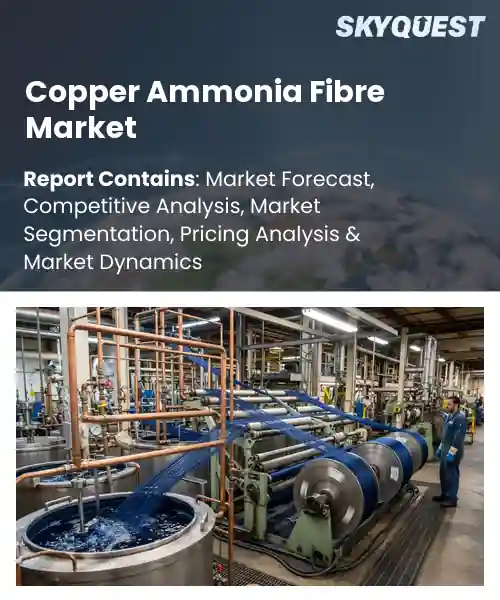
Copper Ammonia Fibre Market
Report ID: SQMIG15E4441
Report ID: SQMIG15E4441
[email protected]
USA +1 351-333-4748
Report ID:
SQMIG15E4441 |
Region:
Global |
Published Date: September, 2026
Pages:
157
|Tables:
123
|Figures:
77


Global Copper Ammonia Fibre Market size was valued at USD 1.62 Billion in 2024 and is poised to grow from USD 1.72 Billion in 2025 to USD 2.86 Billion by 2033, growing at a CAGR of 6.48% during the forecast period (2026-2033).
The copper‑ammonia fibre market revolves around conductive yarns that blend copper particles with an ammonia‑based polymer matrix, creating flexible, corrosion‑resistant conductors for wearable electronics, smart textiles, and aerospace cabling. Its significance lies in replacing rigid metal wires with lightweight, bendable strands that retain high conductivity, thereby expanding design possibilities for Internet‑of‑Things garments and lightweight aircraft interiors. Historically the sector emerged in the early 2010s when research institutions demonstrated pilot‑scale extrusion of copper‑ammonia composites, and by 2018 major textile manufacturers began pilot runs for smart jackets. These early successes sparked investor interest and set the stage for rapid commercialization globally expanding. Rising demand for energy‑efficient, lightweight interconnects acts as the principal catalyst for the global copper‑ammonia fibre market because manufacturers aiming to reduce vehicle mass are substituting traditional steel harnesses with these conductive yarns. Stricter emissions regulations compel automakers to trim weight, and the fibres enable kilogram‑level savings per vehicle while maintaining current‑carrying capacity. At the same time, 5G rollout creates a need for flexible antenna substrates, prompting telecom firms to embed copper‑ammonia yarns in rooftop fabrics. These use cases generate fresh revenue streams, justify scaling extrusion capacity, lower unit costs, and attract additional investment for sustained market expansion and profitability.
How is AI-driven automation impacting the copper ammonia fibre market's production efficiency?
AI-driven automation is reshaping the copper‑ammonia fibre production line by linking real‑time monitoring with adaptive process controls. Sensors capture temperature, pH and copper concentration, while machine‑learning models predict optimal reaction times and adjust feed rates without human intervention. This reduces cycle times and minimizes waste, allowing plants to run closer to theoretical yields. Operators now focus on oversight rather than manual adjustments, which improves safety and frees skilled labor for higher‑value tasks. The technology also enables rapid scaling of pilot batches to commercial volumes, supporting faster product launches and more responsive supply chains. Overall, the integration of AI creates a more agile and resource‑efficient manufacturing environment.In July 2023, BASF announced the deployment of an AI‑enabled control system across its copper‑ammonia fibre facility, highlighting how automated decision‑making accelerates production and strengthens market growth.
Market snapshot - (2026-2033)
Global Market Size
USD 1.62 Billion
Largest Segment
Continuous Filament
Fastest Growth
Tow
Growth Rate
6.48% CAGR
To get more insights on this market click here to Request a Free Sample Report
Global copper ammonia fibre market is segmented by fibre type, fibre grade, application, end user and region. Based on fibre type, the market is segmented into Continuous Filament, Staple Fibre, Tow and Others. Based on fibre grade, the market is segmented into Textile Grade, Industrial Grade, Medical Grade and Others. Based on application, the market is segmented into Apparel, Home Textiles, Technical Textiles, Industrial Textiles and Others. Based on end user, the market is segmented into Textile Manufacturers, Apparel Manufacturers, Home Textile Manufacturers, Industrial Textile Manufacturers and Others. Based on region, the market is segmented into North America, Europe, Asia Pacific, Latin America and Middle East & Africa.
Technical textiles segment leads because copper‑ammonia fibers provide inherent antimicrobial protection combined with durability, meeting stringent performance criteria for medical, protective and filtration products. Designers prioritize these fibers to embed long‑lasting copper ion release, reducing microbial growth in high‑risk environments. The compatibility with advanced weaving and coating techniques enhances functionality, while regulatory endorsement for health‑focused applications reinforces adoption, cementing technical textiles as the cornerstone of market activity, driving sustained industry growth.
Meanwhile, apparel segment is witnessing the strongest growth momentum because fashion brands are leveraging copper‑ammonia yarns to create antimicrobial activewear and everyday clothing that appeal to health‑conscious consumers. Rising awareness of hygiene, coupled with stylish design integration, fuels demand, prompting rapid product rollouts and opening fresh revenue streams that broaden the market’s consumer base.
Continuous filament segment dominates because its long, uniform fibers provide superior tensile strength and consistent conductivity, essential for high‑performance copper‑ammonia yarns. Manufacturers favor this type for weaving seamless fabrics that maintain copper ion distribution, enabling durable antimicrobial functionality. Its ease of integration into existing textile lines and compatibility with standard finishing processes further reinforce its market leadership, driving sustained demand across diverse product families and supporting innovation pipelines for future.
However, tow segment emerges as the most rapidly expanding area because its bundled filaments enable cost‑effective production of non‑woven mats and composite reinforcement where copper‑ammonia properties are prized. Growing interest in lightweight, antimicrobial filtration and automotive interior components drives its adoption, creating avenues for market expansion and diversified application portfolios.
To get detailed segments analysis, Request a Free Sample Report
Asia Pacific commands the lead in the copper ammonia fibre market through a blend of mature industrial ecosystems, aggressive adoption of low‑carbon technologies and deep integration with high‑value sectors such as automotive, electronics and renewable energy. The region benefits from extensive manufacturing capacity, a supply chain that readily accesses high‑purity copper and ammonia, and governments that embed climate objectives within industrial policy. Collaborative research networks between universities and corporations accelerate material innovation, while large‑scale pilot projects showcase performance benefits. Consumer demand for lightweight, high‑conductivity components further fuels the market, and the presence of export‑oriented producers positions the region as a primary source of technology and finished goods for global markets. In addition, regional trade agreements facilitate cross‑border component flow, and the strategic emphasis on energy‑efficient production reinforces the market trajectory.
Copper Ammonia Fibre Market Japan benefits from a highly coordinated industrial policy that emphasizes carbon‑neutral manufacturing and advanced materials research. Strong collaboration between leading chemical firms and automotive manufacturers accelerates the integration of copper ammonia fibres into electric vehicle wiring and electronics. The country’s extensive infrastructure for high‑purity copper production and reliable ammonia supply chains reduces material costs and supports large‑scale pilot deployments, reinforcing its position as a benchmark for technology adoption within the region.
Copper Ammonia Fibre Market South Korea leverages a strong foundation in petrochemical processing and a proactive government agenda that privileges low‑emission industrial solutions. Partnerships between major conglomerates and research institutes facilitate rapid scaling of copper ammonia fibre production for high‑speed data transmission and renewable energy infrastructure. The nation’s efficient logistics network and access to abundant ammonia feedstock enable cost‑effective manufacturing, positioning South Korea as a pivotal hub for technology diffusion across the broader Asia Pacific landscape.
Europe’s copper ammonia fibre market is expanding swiftly under the influence of rigorous environmental legislation, substantial public and private investment in clean‑technology research, and a mature industrial base that values high‑performance conductive materials. The continent’s aggressive push toward electric mobility and grid modernization creates strong demand for lightweight, low‑loss fibres. Germany deep engineering expertise and dense manufacturing clusters provide a foundation for large‑scale adoption, while the United Kingdom supportive policy framework accelerates commercialisation and attracts multinational projects. France growing focus on sustainable industrial processes adds a new layer of innovation, and cross‑border collaborations within the European Union facilitate knowledge transfer and supply‑chain integration, collectively propelling the market’s rapid expansion. Industry associations are also coordinating standards that simplify integration of copper ammonia fibres into existing manufacturing processes, further enhancing market momentum across the region.
Copper Ammonia Fibre Market Germany stands as the dominant force in Europe, propelled by a robust engineering tradition and extensive chemical manufacturing capabilities. Leading automotive and industrial firms actively incorporate copper ammonia fibres to improve efficiency and reduce weight in powertrain and renewable‑energy applications. Government incentives for low‑carbon production and strong collaboration between research universities and industry accelerate technology validation, while a well‑established supply network for high‑purity copper and ammonia ensures reliable scaling, solidifying Germany leadership position.
Copper Ammonia Fibre Market United Kingdom is identified as the fastest growing market in Europe, driven by proactive climate policies and a thriving clean‑energy sector. Strategic funding programmes encourage start‑ups and established firms to develop copper ammonia fibre solutions for smart grid and electric vehicle infrastructure. Its strong intellectual property framework and active participation in international standards bodies accelerate commercialisation, while abundant access to ammonia feedstock and a skilled engineering workforce support rapid scale‑up, positioning United Kingdom at the forefront of market acceleration.
Copper Ammonia Fibre Market France is emerging as an innovative hub, leveraging its commitment to sustainable manufacturing and strong academic research networks. French chemical producers are experimenting with copper ammonia fibre integration in renewable‑energy storage and high‑speed rail systems, guided by national green‑industrial strategies. Collaborative projects between universities and industry facilitate rapid prototyping, while policy incentives promote low‑emission material adoption. This emerging ecosystem enhances France capacity to contribute differentiated solutions to the broader European market.
North America is reinforcing its role in the copper ammonia fibre market through a confluence of advanced research ecosystems, sizable private capital allocation and a clear alignment with national decarbonization agendas. The United States leverages its world‑class university programs and a dynamic venture capital landscape to accelerate material breakthroughs and drive pilot installations across energy‑intensive sectors. Canada contributes a stable supply of high‑purity copper and abundant ammonia derived from renewable sources, while its supportive policy framework encourages sustainable manufacturing practices. Cross‑border collaborations facilitate technology transfer, and the region’s emphasis on grid resilience and electrified transportation creates a robust demand pipeline, collectively solidifying North America’s strategic position in the evolving market. Industrial alliances are also standardizing integration processes, ensuring that copper ammonia fibres can be seamlessly embedded into existing manufacturing lines across both countries, further accelerating market penetration.
Copper Ammonia Fibre Market United States benefits from a vibrant innovation landscape where leading energy firms, automotive manufacturers and technology startups converge to develop high‑performance fibre applications. Federal research initiatives and tax incentives promote large‑scale testing in smart‑grid and electric‑vehicle platforms, while a mature supply chain for copper and ammonia ensures material availability. Strong intellectual‑property protection and a culture of rapid commercialization enable U.S. companies to bring solutions to market swiftly, reinforcing the nation’s leadership in advanced conductive materials.
Copper Ammonia Fibre Market Canada leverages abundant natural resources and a strong commitment to clean‑technology adoption to nurture market growth. The country’s access to renewable‑derived ammonia and high‑grade copper feedstock provides a low‑carbon foundation for fibre production. Federal and provincial programs support research collaborations between mining enterprises and material scientists, fostering innovation in energy‑storage and grid‑modernization applications. An emphasis on sustainable manufacturing practices and a skilled technical workforce further enhances Canada capacity to scale copper ammonia fibre solutions for both domestic and export markets.
To know more about the market opportunities by region and country, click here to
Buy The Complete Report
Increasing Demand For Lightweight Materials
Advancements In Manufacturing Techniques
High Production Cost Challenges
Limited Recycling Infrastructure
Request Free Customization of this report to help us to meet your business objectives.
The copper‑ammonia fibre market is shaped by intense rivalry among established manufacturers and emerging innovators, with competition driving accelerated adoption of high‑conductivity, lightweight composites for aerospace and renewable‑energy applications. Recent strategic moves include a merger between two European producers to consolidate supply chains, a joint venture between a North‑American cable maker and an Asian chemical firm to co‑develop next‑generation fibre coatings, and a technology partnership where a leading materials group integrates AI‑driven process controls to boost production efficiency.
Top Player’s Company Profile
Recent Developments
SkyQuest’s ABIRAW (Advanced Business Intelligence, Research & Analysis Wing) is our Business Information Services team that Collects, Collates, Correlates, and Analyses the Data collected by means of Primary Exploratory Research backed by robust Secondary Desk research. As per SkyQuest analysis, the copper‑ammonia fibre market is propelled primarily by the rising demand for lightweight materials that help automotive and aerospace manufacturers cut weight and emissions, while breakthroughs in manufacturing techniques that streamline extrusion and coating processes further accelerate adoption. The continuous filament segment leads the market because its uniform fibers deliver superior tensile strength and consistent conductivity, and Asia Pacific dominates globally thanks to its extensive supply chains and strong policy support for low‑carbon technologies. However, high production cost challenges remain a significant restraint, as specialized equipment and premium raw materials keep prices above those of traditional metal conductors, tempering broader penetration.
| Report Metric | Details |
|---|---|
| Market size value in 2024 | USD 1.62 Billion |
| Market size value in 2033 | USD 2.86 Billion |
| Growth Rate | 6.48% |
| Base year | 2024 |
| Forecast period | (2026-2033) |
| Forecast Unit (Value) | USD Billion |
| Segments covered |
|
| Regions covered | North America (US, Canada), Europe (Germany, France, United Kingdom, Italy, Spain, Rest of Europe), Asia Pacific (China, India, Japan, Rest of Asia-Pacific), Latin America (Brazil, Rest of Latin America), Middle East & Africa (South Africa, GCC Countries, Rest of MEA) |
| Companies covered |
|
| Customization scope | Free report customization with purchase. Customization includes:-
|
To get a free trial access to our platform which is a one stop solution for all your data requirements for quicker decision making. This platform allows you to compare markets, competitors who are prominent in the market, and mega trends that are influencing the dynamics in the market. Also, get access to detailed SkyQuest exclusive matrix.
Table Of Content
Executive Summary
Market overview
Parent Market Analysis
Market overview
Market size
KEY MARKET INSIGHTS
COVID IMPACT
MARKET DYNAMICS & OUTLOOK
Market Size by Region
KEY COMPANY PROFILES
Methodology
For the Copper Ammonia Fibre Market, our research methodology involved a mixture of primary and secondary data sources. Key steps involved in the research process are listed below:
1. Information Procurement: This stage involved the procurement of Market data or related information via primary and secondary sources. The various secondary sources used included various company websites, annual reports, trade databases, and paid databases such as Hoover's, Bloomberg Business, Factiva, and Avention. Our team did 45 primary interactions Globally which included several stakeholders such as manufacturers, customers, key opinion leaders, etc. Overall, information procurement was one of the most extensive stages in our research process.
2. Information Analysis: This step involved triangulation of data through bottom-up and top-down approaches to estimate and validate the total size and future estimate of the Copper Ammonia Fibre Market.
3. Report Formulation: The final step entailed the placement of data points in appropriate Market spaces in an attempt to deduce viable conclusions.
4. Validation & Publishing: Validation is the most important step in the process. Validation & re-validation via an intricately designed process helped us finalize data points to be used for final calculations. The final Market estimates and forecasts were then aligned and sent to our panel of industry experts for validation of data. Once the validation was done the report was sent to our Quality Assurance team to ensure adherence to style guides, consistency & design.
Analyst Support
Customization Options
With the given market data, our dedicated team of analysts can offer you the following customization options are available for the Copper Ammonia Fibre Market:
Product Analysis: Product matrix, which offers a detailed comparison of the product portfolio of companies.
Regional Analysis: Further analysis of the Copper Ammonia Fibre Market for additional countries.
Competitive Analysis: Detailed analysis and profiling of additional Market players & comparative analysis of competitive products.
Go to Market Strategy: Find the high-growth channels to invest your marketing efforts and increase your customer base.
Innovation Mapping: Identify racial solutions and innovation, connected to deep ecosystems of innovators, start-ups, academics, and strategic partners.
Category Intelligence: Customized intelligence that is relevant to their supply Markets will enable them to make smarter sourcing decisions and improve their category management.
Public Company Transcript Analysis: To improve the investment performance by generating new alpha and making better-informed decisions.
Social Media Listening: To analyze the conversations and trends happening not just around your brand, but around your industry as a whole, and use those insights to make better Marketing decisions.
REQUEST FOR SAMPLE
 REQUEST FREE CUSTOMIZATION


Want to customize this report? This report can be personalized according to your needs. Our analysts and industry experts will work directly with you to understand your requirements and provide you with customized data in a short amount of time. We offer $1000 worth of FREE customization at the time of purchase.
Feedback From Our Clients


 USA (+1) 351-333-4748

