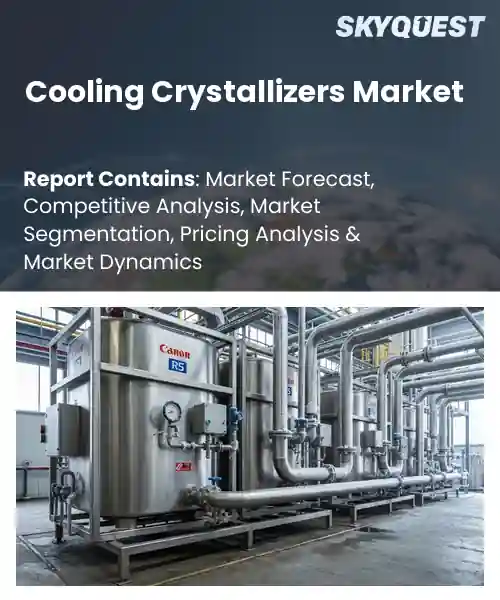
Cooling Crystallizers Market
Report ID: SQMIG20I3414
Report ID: SQMIG20I3414
[email protected]
USA +1 351-333-4748
Report ID:
SQMIG20I3414 |
Region:
Global |
Published Date: July, 2026
Pages:
157
|Tables:
145
|Figures:
78


Global Cooling Crystallizers Market size was valued at USD 512.7 Million in 2024 and is poised to grow from USD 541.41 Million in 2025 to USD 837.22 Million by 2033, growing at a CAGR of 5.6% during the forecast period (2026-2033).
The global cooling crystallizers market consists of equipment that induces solid formation by removing heat from supersaturated solutions, which is essential in the production of chemicals, pharmaceuticals, and polymers. This is important because it allows to obtain a precise crystal size distribution which has a direct impact on product performance and downstream processing efficiency. The market has historically evolved from simple batch chillers in the 1970’s to sophisticated continuous crystallizers with temperature control and automation in the 2010’s. The evolution was driven by a growing demand for quality in some sectors such as chemicals, where the production of ibuprofen and polymers is a good example of the technology’s critical role.
The growth of the cooling crystallizers market is primarily driven by the increasing trend of continuous manufacturing in the pharmaceutical and chemical industries on the basis of demand for crystals. Continuous processes enhance plant throughput by minimizing variation between batches, lowering energy usage, and providing a more seamless connection with downstream filtration. Companies such as Lonza and GEA have developed modular crystallizer lines that can be retrofitted into existing facilities, showing how technology adoption translates to capacity expansion. This trend creates openings for ancillary services, like software and maintenance, which in turn drive the market growth as manufacturers strive for optimized yields and standards.
How is AI Enhancing Efficiency In The Cooling Crystallizers Market?
AI is transforming cooling crystallizers by embedding predictive analytics into temperature and flow control loops. Sensor data is fed to machine learning algorithms so that operators can adjust cooling rates on the fly to predict patterns of crystal growth. This reduces cycle times and reduces batch-to-batch variability, while maintaining product purity. Digital twins are used to simulate process scenarios, meaning engineers can evaluate design changes without having to perform costly trial runs. The integration with enterprise systems streamlines the flow of data, turning raw measurement data into useful insights that drive continuous improvement across pharma, chemical and food production lines. That leads to a more responsive, resource-efficient operation that satisfies tighter regulatory and sustainability expectations.
Market snapshot - (2026-2033)
Global Market Size
USD 512.7 Million
Largest Segment
Batch Cooling Crystallizers
Fastest Growth
Scraped Surface Crystallizers
Growth Rate
5.6% CAGR
To get more insights on this market click here to Request a Free Sample Report
Global cooling crystallizers market is segmented by crystallizer type, cooling method, application, end user, operation mode and region. Based on crystallizer type, the market is segmented into Batch Cooling Crystallizers, Continuous Cooling Crystallizers and Scraped Surface Crystallizers. Based on cooling method, the market is segmented into Air Cooling, Water Cooling and Refrigeration Cooling. Based on application, the market is segmented into Chemicals, Pharmaceuticals, Food & Beverage and Mining & Minerals. Based on end user, the market is segmented into Chemical Manufacturers, Pharmaceutical Companies, Food Processors and Mining Companies. Based on operation mode, the market is segmented into Automatic and Semi-Automatic. Based on region, the market is segmented into North America, Europe, Asia Pacific, Latin America and Middle East & Africa.
Batch cooling crystallizers segment dominates because manufacturers prioritize flexibility and product quality for diverse chemical outputs, allowing precise temperature control and easy adaptation to batch-to-batch variations. This flexibility aligns with traditional production philosophies, reducing capital expenditure and simplifying operational training. The proven reliability of batch processes also mitigates risk in high‑value pharmaceutical and specialty chemical streams, reinforcing its preferential status across the market today globally for producers seeking consistent yields.
Meanwhile, continuous cooling crystallizers emerge as the most rapidly expanding area in the Cooling Crystallizers Market because their ability to operate uninterruptedly aligns with industry drives toward higher throughput and lower labor intensity. Ongoing innovations in process control and energy‑efficient designs accelerate adoption, positioning this technology as a catalyst for future capacity growth.
Water cooling segment dominates because it offers reliable heat removal at scale while maintaining cost‑effectiveness for large‑volume production lines. The high heat capacity of water enables stable temperature gradients, essential for consistent crystal growth, and the existing infrastructure in chemical plants simplifies integration. Operators also value its straightforward maintenance and proven safety record, which together reinforce water‑based systems as the preferred choice across diverse industrial settings throughout modern manufacturing today.
Conversely, refrigeration cooling emerges as the most rapidly expanding area in the Cooling Crystallizers Market because its precise temperature control enables high‑purity crystal production for sensitive pharmaceutical and specialty chemical uses. Eco‑friendly refrigerants and compact designs lower environmental impact and footprint, prompting innovators to adopt the technology for tighter process windows and compliance, accelerating growth.
To get detailed segments analysis, Request a Free Sample Report
North America leads the cooling crystallizers market thanks to a combination of mature industrial infrastructure, strong research and development ecosystems, and deep integration of advanced process engineering within chemical and pharmaceutical sectors. The region benefits from a highly skilled engineering workforce that drives continuous innovation in crystallization technology, emphasizing energy efficiency and product quality. Close collaboration between equipment manufacturers, end‑user industries, and academic institutions accelerates adoption of sophisticated cooling systems. Supportive regulatory frameworks and a focus on sustainable manufacturing further reinforce market leadership, while the presence of global chemical hubs ensures consistent demand for high‑performance crystallizers across a broad range of applications. In addition, the region’s investment in digitalization and advanced monitoring solutions enables real‑time process control, reducing downtime and enhancing overall plant reliability. Moreover, strong intellectual property protection encourages firms to commercialize novel cooling designs, sustaining the competitive edge of North American suppliers.
Cooling Crystallizers Market in the United States benefits from extensive chemical manufacturing clusters and a proactive approach to technology adoption. Industry leaders collaborate closely with research universities to refine cooling designs that align with stringent quality standards. Demand is reinforced by a focus on high‑value specialty chemicals and pharmaceuticals, where precise crystal size distribution drives product performance. Ongoing investments in automation and energy‑saving features further solidify the United States position as a hub for cutting‑edge crystallization solutions.
Cooling Crystallizers Market in Canada is shaped by strong petrochemical activity and a growing emphasis on sustainable processing. Collaborative networks between equipment suppliers and research institutes promote the development of low‑energy cooling technologies suited to the country’s focus on environmental stewardship. The pharmaceutical sector drives demand for precise temperature control, while government incentives encourage adoption of advanced crystallization equipment. This supportive ecosystem positions Canada as an emerging leader in efficient cooling crystallizer solutions.
Europe’s cooling crystallizers market is energized by a confluence of stringent quality regulations, strong emphasis on green manufacturing, and a tradition of engineering excellence. Companies across the region are investing heavily in process intensification to meet demanding product specifications while reducing energy consumption. Collaboration between leading equipment manufacturers and research clusters in Germany, the United Kingdom, and France accelerates the rollout of innovative cooling designs that integrate digital monitoring and advanced materials. Policy frameworks that promote circular economy principles further incentivize adoption of efficient crystallization systems, positioning Europe as a hub for high‑performance, environmentally conscious cooling solutions. The region’s focus on modular plant layouts enables rapid scale‑up, while strong supply chain networks ensure timely availability of critical components. Additionally, a skilled workforce adept at combining simulation tools with experimental expertise drives continuous improvement in crystal quality and process robustness.
Cooling Crystallizers Market in Germany reflects the country’s leadership in precision engineering and chemical production. Major chemical clusters collaborate closely with equipment designers to develop highly efficient cooling systems tailored for pharmaceuticals and fine chemicals. Emphasis on energy recovery and process integration drives the adoption of next‑generation crystallizers. Robust academic‑industry partnerships also foster innovation in cryogenic and low‑temperature technologies, reinforcing Germany’s position as a benchmark for high‑quality cooling crystallizer solutions.
Cooling Crystallizers Market in the United Kingdom is driven by a vibrant life‑science sector and a strong focus on digital transformation. Companies are integrating sensor networks and data analytics to refine temperature control and crystal size distribution. Government initiatives supporting advanced manufacturing encourage investment in scalable cooling technologies. The collaborative ecosystem among universities, start‑ups and established equipment suppliers accelerates the rollout of agile crystallizer designs, positioning the United Kingdom as a rapidly expanding hub for innovative cooling solutions.
Cooling Crystallizers Market in France is emerging through focused investment in specialty chemical production and a growing biotech landscape. French firms prioritize energy‑efficient cooling solutions to meet environmental targets while ensuring high product purity. Partnerships between national research institutes and equipment manufacturers foster development of modular crystallizers that can be quickly adapted to diverse processes. This blend of sustainability goals and technological collaboration positions France as an increasingly important player in the European cooling crystallizer arena.
Asia Pacific is rapidly strengthening its position in the cooling crystallizers market through a combination of expanding chemical manufacturing capacities, heightened focus on process efficiency, and strategic investments in research and development. Nations in the region are embracing advanced cooling technologies to support growing demand for high‑value pharmaceuticals and specialty chemicals, while also seeking to lower operational costs and environmental impact. Collaborative platforms linking equipment producers with local end‑users accelerate technology transfer and customization for diverse production scales. Government incentives aimed at modernizing industrial infrastructure further propel adoption of energy‑saving crystallization equipment, enabling the region to emerge as a key source of innovative and cost‑effective cooling solutions on the global stage. The expertise in cryogenic processing also enhances the ability to handle temperature‑sensitive compounds, reinforcing the region’s competitive advantage. As supply chains become more localized, manufacturers gain greater control over component quality and delivery timelines, further solidifying Asia Pacific’s leadership.
Cooling Crystallizers Market in Japan is anchored by a strong tradition of precision manufacturing and a leading position in high‑technology sectors. Japanese firms prioritize ultra‑reliable cooling systems for semiconductor and pharmaceutical production, where temperature stability is critical. Collaborative research between industry and technical universities drives innovations in compact, energy‑efficient designs. Government support for advanced materials and process automation further strengthens Japan’s capability to deliver sophisticated cooling crystallizer solutions worldwide.
Cooling Crystallizers Market in South Korea is propelled by rapid growth in specialty chemicals and a focus on eco‑friendly manufacturing practices. Korean manufacturers emphasize integration of intelligent control systems that enhance process reliability while minimizing energy consumption. Partnerships with research institutes facilitate development of novel cooling media and modular equipment suited for flexible production lines. This blend of technological agility and sustainability commitment positions South Korea as a rising contributor to the global cooling crystallizer landscape.
To know more about the market opportunities by region and country, click here to
Buy The Complete Report
Rising Demand in Food Processing
Energy Efficiency Incentives
High Capital Expenditure
Complex Process Integration
Request Free Customization of this report to help us to meet your business objectives.
Recent M&A activity has consolidated key equipment suppliers, while joint ventures with specialty chemical firms have expanded application‑specific cooling crystallizer lines. Technology innovation focuses on modular designs and AI‑driven temperature control, accelerating adoption in pharmaceutical and fine‑chemical production. Competitive pressure drives firms to enhance energy efficiency, integrate digital monitoring, and broaden service offerings to capture emerging market demand.
SkyQuest’s ABIRAW (Advanced Business Intelligence, Research & Analysis Wing) is our Business Information Services team that Collects, Collates, Correlates, and Analyses the Data collected by means of Primary Exploratory Research backed by robust Secondary Desk research.
As per SkyQuest analysis, the global cooling crystallizers market is propelled primarily by the accelerating shift toward continuous manufacturing in pharmaceuticals and chemicals, which demands higher throughput and tighter crystal‑size control, while a second strong driver is the push for energy‑efficiency incentives that lower utility costs and meet sustainability targets. The market’s growth is tempered by the high capital expenditure required for advanced crystallizer equipment, which can deter smaller players. North America remains the dominant region due to its mature industrial base, skilled workforce and rapid digital adoption, and batch cooling crystallizers continue to lead the segment landscape because they offer unmatched production flexibility and reliable performance across diverse applications.
| Report Metric | Details |
|---|---|
| Market size value in 2024 | USD 512.7 Million |
| Market size value in 2033 | USD 837.22 Million |
| Growth Rate | 5.6% |
| Base year | 2024 |
| Forecast period | (2026-2033) |
| Forecast Unit (Value) | USD Million |
| Segments covered |
|
| Regions covered | North America (US, Canada), Europe (Germany, France, United Kingdom, Italy, Spain, Rest of Europe), Asia Pacific (China, India, Japan, Rest of Asia-Pacific), Latin America (Brazil, Rest of Latin America), Middle East & Africa (South Africa, GCC Countries, Rest of MEA) |
| Companies covered |
|
| Customization scope | Free report customization with purchase. Customization includes:-
|
To get a free trial access to our platform which is a one stop solution for all your data requirements for quicker decision making. This platform allows you to compare markets, competitors who are prominent in the market, and mega trends that are influencing the dynamics in the market. Also, get access to detailed SkyQuest exclusive matrix.
Table Of Content
Executive Summary
Market overview
Parent Market Analysis
Market overview
Market size
KEY MARKET INSIGHTS
COVID IMPACT
MARKET DYNAMICS & OUTLOOK
Market Size by Region
KEY COMPANY PROFILES
Methodology
For the Cooling Crystallizers Market, our research methodology involved a mixture of primary and secondary data sources. Key steps involved in the research process are listed below:
1. Information Procurement: This stage involved the procurement of Market data or related information via primary and secondary sources. The various secondary sources used included various company websites, annual reports, trade databases, and paid databases such as Hoover's, Bloomberg Business, Factiva, and Avention. Our team did 45 primary interactions Globally which included several stakeholders such as manufacturers, customers, key opinion leaders, etc. Overall, information procurement was one of the most extensive stages in our research process.
2. Information Analysis: This step involved triangulation of data through bottom-up and top-down approaches to estimate and validate the total size and future estimate of the Cooling Crystallizers Market.
3. Report Formulation: The final step entailed the placement of data points in appropriate Market spaces in an attempt to deduce viable conclusions.
4. Validation & Publishing: Validation is the most important step in the process. Validation & re-validation via an intricately designed process helped us finalize data points to be used for final calculations. The final Market estimates and forecasts were then aligned and sent to our panel of industry experts for validation of data. Once the validation was done the report was sent to our Quality Assurance team to ensure adherence to style guides, consistency & design.
Analyst Support
Customization Options
With the given market data, our dedicated team of analysts can offer you the following customization options are available for the Cooling Crystallizers Market:
Product Analysis: Product matrix, which offers a detailed comparison of the product portfolio of companies.
Regional Analysis: Further analysis of the Cooling Crystallizers Market for additional countries.
Competitive Analysis: Detailed analysis and profiling of additional Market players & comparative analysis of competitive products.
Go to Market Strategy: Find the high-growth channels to invest your marketing efforts and increase your customer base.
Innovation Mapping: Identify racial solutions and innovation, connected to deep ecosystems of innovators, start-ups, academics, and strategic partners.
Category Intelligence: Customized intelligence that is relevant to their supply Markets will enable them to make smarter sourcing decisions and improve their category management.
Public Company Transcript Analysis: To improve the investment performance by generating new alpha and making better-informed decisions.
Social Media Listening: To analyze the conversations and trends happening not just around your brand, but around your industry as a whole, and use those insights to make better Marketing decisions.
REQUEST FOR SAMPLE
 REQUEST FREE CUSTOMIZATION
Global Cooling Crystallizers Market size was valued at USD 512.7 Million in 2024 and is poised to grow from USD 541.41 Million in 2025 to USD 837.22 Million by 2033, growing at a CAGR of 5.6% during the forecast period (2026-2033).
Recent M&A activity has consolidated key equipment suppliers, while joint ventures with specialty chemical firms have expanded application‑specific cooling crystallizer lines. Technology innovation focuses on modular designs and AI‑driven temperature control, accelerating adoption in pharmaceutical and fine‑chemical production. Competitive pressure drives firms to enhance energy efficiency, integrate digital monitoring, and broaden service offerings to capture emerging market demand. 'GEA Group AG', 'SPX FLOW, Inc.', 'Bucher Unipektin AG', 'Andritz AG', 'Sulzer Ltd.', 'Buss-SMS-Canzler GmbH', 'Hosokawa Micron Group', 'Hebeler Process Solutions, LLC', 'Swenson Technology, Inc.', 'Veolia Water Technologies', 'Tsukishima Holdings Co., Ltd.', 'SUEZ Water Technologies & Solutions', 'Technobis Crystallization Systems', 'De Dietrich Process Systems', 'Praj Industries Limited', '3V Tech S.p.A.', 'Comessa S.A.', 'BHS-Sonthofen GmbH', 'Amar Equipments Pvt. Ltd.', 'Aqua-Chem, Inc.'
The increasing requirement for high‑purity products in the food and beverage sector drives adoption of cooling crystallizers, as these units enable precise temperature control and consistent crystal size distribution, which are essential for product quality and regulatory compliance. Manufacturers are investing in advanced crystallization technologies to meet consumer expectations for safety and freshness, thereby expanding the market as they seek efficient, scalable solutions that reduce energy consumption while maintaining stringent quality standards. The shift towards continuous processing and lower footprints further reinforces cooling crystallizer relevance.
Advanced Modular Designs: Manufacturers are increasingly adopting modular cooling crystallizer architectures that enable rapid reconfiguration and scaling across diverse process streams. This flexibility reduces engineering lead times, supports product line diversification, and allows end‑users to adapt equipment to fluctuating demand without extensive redesign. The plug‑and‑play nature of modular units also simplifies maintenance, lowers inventory of spare parts, and enhances overall equipment reliability, positioning modular designs as a strategic response to evolving market dynamics and delivering improved operational cost efficiency for clients worldwide today.
Why does North America Dominate the Global Cooling Crystallizers Market? |@12


Want to customize this report? This report can be personalized according to your needs. Our analysts and industry experts will work directly with you to understand your requirements and provide you with customized data in a short amount of time. We offer $1000 worth of FREE customization at the time of purchase.
Feedback From Our Clients


 USA (+1) 351-333-4748

