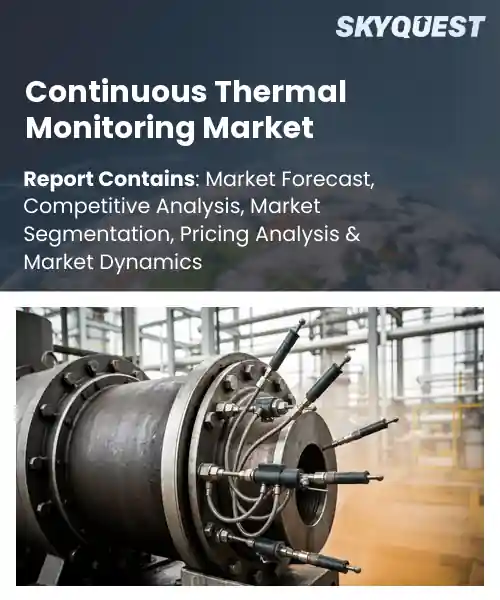
Continuous Thermal Monitoring Market
Report ID: SQMIG20D2541
Report ID: SQMIG20D2541
[email protected]
USA +1 351-333-4748
Report ID:
SQMIG20D2541 |
Region:
Global |
Published Date: February, 2026
Pages:
157
|Tables:
95
|Figures:
76


Global Continuous Thermal Monitoring Market size was valued at USD 1.2 Billion in 2024 and is poised to grow from USD 1.25 Billion in 2025 to USD 1.68 Billion by 2033, growing at a CAGR of 3.8% during the forecast period (2026-2033).
Growing need for real-time temperature monitoring, increasing adoption of predictive maintenance systems, rising deployment of sensor networks across industrial infrastructure, advancements in thermal sensing technologies, and growing emphasis on equipment safety and operational efficiency are driving demand for continuous thermal monitoring solutions.
Falling sensor costs combined with the rise of edge computing and machine learning are accelerating adoption of continuous thermal monitoring solutions. As organizations deploy dense sensor arrays that analyze data locally and transmit insights to cloud platforms for predictive maintenance they also boost continuous thermal monitoring adoption. This ability enables faster repair processes while decreasing spare parts requirement and increasing applications for electric vehicle battery monitoring and renewable energy facilities and pharmaceutical temperature-controlled storage and data center cooling systems. Growing need to detect and prevent thermal anomalies across critical infrastructure coupled with rising emphasis on operational safety and asset reliability are expected to primarily drive continuous thermal monitoring market growth. Increasing need to identify temperature fluctuations and mitigate thermal risks in real time as electronics become more compact and safety regulations become stricter is also prompting investments in continuous thermal monitoring systems.
On the contrary, high initial installation costs of monitoring infrastructure, integration challenges with legacy industrial systems, cybersecurity risks associated with connected monitoring platforms, and limited technical expertise in emerging markets are predicted to hamper continuous thermal monitoring market penetration through 2033.
Continuous thermal monitoring uses IoT temperature sensors and thermal cameras combined with edge and cloud analytics to track temperature patterns across equipment such as motors, switchgear, and bearings in real time. The trend is towards bundling solutions that include thermal sensors, edge computing devices, and monitoring software. Such solutions can help operators shift from reactive maintenance to condition-based maintenance. Continuous thermal imaging is being used by utilities and industrial facilities to identify hotspots and address potential issues in equipment.
In June 2025, Teledyne FLIR updated its product offerings and support resources for its OEM products. The update is aimed at helping system integrators integrate thermal modules into IoT and edge solutions. The development allows for faster deployment of continuous thermal monitoring solutions and enhanced predictive maintenance capabilities.
Market snapshot - (2026-2033)
Global Market Size
USD 1.2 Billion
Largest Segment
Hardware
Fastest Growth
Software
Growth Rate
3.8% CAGR
To get more insights on this market click here to Request a Free Sample Report
Global continuous thermal monitoring market is segmented by offering, application, end use, and region. Based on offering, the market is segmented into hardware, software, and services. Based on application, the market is segmented into power equipment monitoring and other applications. Based on end use, the market is segmented into data centers, oil & gas, logistics, utilities, manufacturing, healthcare, retail, telecommunications, and other end users. Based on region, the market is segmented into North America, Europe, Asia Pacific, Latin America, and Middle East & Africa.
The hardware segment is predicted to account for the largest global continuous thermal monitoring market share in the future. Indispensable nature of physical sensor arrays, ruggedized thermal cameras, and edge-capable instrumentation in continuous thermal monitoring is helping this segment hold sway over others. Reliable on-site data capture allows for the detection of anomalies on the spot. This encourages the use of reliable data capture tools. The need for robust data capture tools like sensors with low power requirements and direct data exchange with control systems further emphasizes the position of hardware.
However, software is emerging as the most rapidly expanding segment as per this continuous thermal monitoring industry analysis. Growing popularity of advanced analytics and AI-driven thermal modeling that turn sensor streams into actionable insights is creating new business scope via this segment. Demand for predictive algorithms and cloud-based management platforms is accelerating adoption and enabling new service models and recurring revenue opportunities for solution providers.
The data centers segment is estimated to lead the global continuous thermal monitoring market revenue generation in the long run. Concentrated heat loads, high equipment density, and strict uptime requirements make continuous thermal monitoring operationally essential for all data centers. The continuous thermal visibility also supports the optimization of dynamic cooling, fast fault isolation, and life cycle planning for critical infrastructure. The need for such an integrated thermal system has prompted many facility managers to invest in such a system. The investments by the vendors in rack-level sensing and compatibility with building management systems have increased the adoption rate for such a system by reducing waste and protecting IT equipment.
Meanwhile, manufacturing is being identified as the major high-growth segment as factories are increasingly using continuous thermal monitoring to avoid machine failures. This is creating a demand for predictive maintenance and thermal process quality assurance, thus increasing the addressable market size for vendors to develop industry-specific solutions.
To get detailed segments analysis, Request a Free Sample Report
Advanced infrastructure, mature technology ecosystems and strong demand from healthcare, data center, energy and industrial sectors help cement high continuous thermal monitoring adoption in the region. The focus of the regulators on safety and quality aspects of the product drives the adoption of continuous monitoring solutions. The presence of research groups and industry collaborations ensures that the product can innovate rapidly to accommodate IoT and cloud platforms. The awareness of the importance of predictive maintenance and resilience within the enterprises drives the adoption of a comprehensive monitoring strategy. The established procurement routes, skilled resources, and integrated supply chains create a healthy market for both established players and innovative newcomers to address the wide range of end use cases.
Widespread adoption of continuous thermal monitoring across healthcare, data center, and industrial environments is primarily shaping market development in the United States. There is a strong ecosystem of technology providers that support the deployment services as well as analytics services. The market is influenced by the need for integration with existing systems in the enterprise space, the focus on predictive maintenance, as well as the general attitude of early adopters.
A balance of public procurement and private modernization across utilities, transportation and healthcare infrastructure is governing continuous thermal monitoring demand in Canada. The dispersed nature of the country creates a need for remote and robust monitoring and management services that can simplify maintenance activities. Local system integrators assist multinational firms in tailoring solutions for the diverse climatic and regulatory environments. The focus on energy and asset life can drive adoption rates for cloud-enabled solutions in dispersed environments.
Regulatory emphasis on safety, energy efficiency and sustainability, a well developed industrial base pursuing digital transformation are helping drive steady adoption of continuous thermal monitoring going forward. Health facilities and operators of critical infrastructure are putting an emphasis on predictive maintenance and operational resilience resulting in broad demand. A large number of system integrators, research centres, and specialty product companies create a large base for advancing sensor technologies, edge analytics, and secure connectivity. Public/private partnerships and retrofit projects provide the ability of older systems to upgrade and demonstrate their operational value. Overall, Europe is a dynamic environment where policy frameworks, modernization of industry, and a culture of energy conscientiousness uniquely create synergy thereby encouraging each organization to adopt new technologies and differentiated compete among solution providers.
A robust manufacturing base and strong emphasis on industrial automation and quality control are supporting continuous thermal monitoring demand in the country. The demand comes from factory floors, utilities, and even research labs, creating opportunities for sophisticated sensor networks and analytics. German system integrators and engineering consultancies drive retrofit and installation projects, focusing on robustness, conformance, and integration into industrial control systems. The market prefers solutions that have already proven their reliability and efficiency in operation.
Strong uptake of cloud analytics, managed services, and flexible procurement preferences are boosting the demand for continuous thermal monitoring solutions in the United Kingdom. A strong startup and services ecosystem helps to drive the adoption of new sensor platform solutions as well as predictive maintenance solutions. Healthcare organizations, commercial real estate groups, and data center operators are early adopters of these solutions to drive agility in operations. Government initiatives in energy efficiency and support for technology trials add to the market drivers.
Retrofit efforts and rising interest from healthcare, manufacturing and municipal sectors are shaping continuous thermal monitoring adoption across France. The need for energy transition and reducing operational costs are major drivers for trial deployments. The market is favorable for vendors that offer localized service delivery, strong analytics, and regulatory compliant solution designs. The local integrators focus on solution customization based on language, regulatory, and operational requirements, whereas partnerships with international vendors enable access to advanced analytics capabilities.
Growing industrial expansion, technology-driven infrastructure projects, and proactive collaboration between local and global firms create a lucrative setting for continuous thermal monitoring providers in the region. There is an increase in manufacturing centers and data center activity, which provides demand for solutions that are capable of providing reliable monitoring across the wide variety of environmental conditions present in both locations. Both governments and commercial companies support the deployment of these solutions through various standard-setting bodies, financial assistance, and pilot program support that drives the localization of technology. High demand for custom-designed solutions that leverage edge computing, AI-enabled analytics, and connectivity also expands innovation scope in the Asia Pacific region.
High emphasis on precision, quality assurance and integration with advanced automation in manufacturing sectors is augmenting continuous thermal monitoring solution sales in Japan. The demand comes from industries where temperature control and fault prevention are issues. This is where high fidelity sensors are being used. The local engineering firms are more focused on the solution being reliable and integrated with the existing control systems. The market values those companies that can provide high-quality products.
Presence of advanced semiconductor fabrication and dense data center clusters requiring precise temperature control and process stability are promoting continuous thermal monitoring demand in South Korea. Domestic technology companies and system integrators offer high-performance sensor arrays that are optimized for factory environments and data centers. The industry, academia, and equipment vendors working together are helping drive technology advancements and deployments. The industry demands compact sensor hardware, fast data processing, and integration into production control systems.
To know more about the market opportunities by region and country, click here to
Buy The Complete Report
Rising Healthcare And Data Center Demand
For healthcare institutions and data centers, constant monitoring of temperature helps in the early detection of unusual temperature patterns, thus safeguarding critical equipment or patient environments. The value of constant monitoring in preventing downtime or ensuring regulatory compliance encourages facility managers to invest in monitoring systems, thus creating a demand for monitoring systems, making them willing to incorporate monitoring into their infrastructure, and even influencing vendors to invest in scalable and specialized monitoring systems development.
Advances In Sensor And Connectivity Technology
With improvements in the accuracy and miniaturization of sensors, as well as advances in wireless connectivity and communication protocols, continuous thermal monitoring solutions can be more easily deployed and integrated into existing infrastructures. The aforementioned improvements in technology can be said to alleviate the complexity for end users, provide more contextual information for facility teams, and make remote management easier. Consequently, organizations can be more willing to adopt continuous solutions over periodic ones, vendors can offer more interoperable solutions, and the market can benefit from a broader range of applications.
High Initial Implementation Costs
The high initial cost involved in acquiring sensors, network infrastructure, and integration services may discourage organizations from investing in facilities management if they have limited capital or competing needs. In facilities where immediate needs must be addressed, thermal monitoring may be delayed in favor of less costly or ad hoc solutions. In addition, the perceived complexity of retrofitting existing systems may be a concern for facilities management if it means disrupting operations or allocating resources. These concerns limit the global continuous thermal monitoring market outlook through 2033 and beyond.
Regulatory Uncertainty And Compliance Challenges
The presence of heterogeneous regulatory structures and data privacy needs also contributes to uncertainty among vendors and users, thereby creating complexities in deploying continuous thermal monitoring solutions. In addition, when data privacy needs are not clear or are different for various regions, it creates legal and procedural risks that deter users from adopting these solutions, thereby creating a barrier against faster adoption of these technologies despite their technical viability.
Request Free Customization of this report to help us to meet your business objectives.
Competition in the global continuous thermal monitoring market is driven by hands on competition for clinical integrations, demonstrated by recent M&A and asset sales that accelerate scale, platform partnerships that embed sensors into RPM stacks, and rapid product development such as hospital grade module launches. Examples include the asset sale of Blue Spark Technologies, greenTEG’s integration with MedM RPM, and Aulisa Medical’s second generation temperature module release.
SkyQuest’s ABIRAW (Advanced Business Intelligence, Research & Analysis Wing) is our Business Information Services team that Collects, Collates, Correlates, and Analyses the Data collected by means of Primary Exploratory Research backed by robust Secondary Desk research.
As per SkyQuest analysis, growing need for real-time detection of thermal anomalies and increasing adoption of predictive maintenance systems are anticipated to drive the demand for continuous thermal monitoring going forward. However, high initial deployment costs and integration challenges with legacy industrial infrastructure are slated to slow down the adoption of continuous thermal monitoring in the future. North America is slated to spearhead the demand for continuous thermal monitoring owing to strong presence of advanced industrial automation systems, high investments in data centers and energy infrastructure, and the presence of developed technology ecosystems. Integration of IoT-enabled sensors, edge analytics platforms, and AI-driven predictive maintenance tools are anticipated to be key trends driving the continuous thermal monitoring industry across the study period.
| Report Metric | Details |
|---|---|
| Market size value in 2024 | USD 1.2 Billion |
| Market size value in 2033 | USD 1.68 Billion |
| Growth Rate | 3.8% |
| Base year | 2024 |
| Forecast period | (2026-2033) |
| Forecast Unit (Value) | USD Billion |
| Segments covered |
|
| Regions covered | North America (US, Canada), Europe (Germany, France, United Kingdom, Italy, Spain, Rest of Europe), Asia Pacific (China, India, Japan, Rest of Asia-Pacific), Latin America (Brazil, Rest of Latin America), Middle East & Africa (South Africa, GCC Countries, Rest of MEA) |
| Companies covered |
|
| Customization scope | Free report customization with purchase. Customization includes:-
|
To get a free trial access to our platform which is a one stop solution for all your data requirements for quicker decision making. This platform allows you to compare markets, competitors who are prominent in the market, and mega trends that are influencing the dynamics in the market. Also, get access to detailed SkyQuest exclusive matrix.
Table Of Content
Executive Summary
Market overview
Parent Market Analysis
Market overview
Market size
KEY MARKET INSIGHTS
COVID IMPACT
MARKET DYNAMICS & OUTLOOK
Market Size by Region
KEY COMPANY PROFILES
Methodology
For the Continuous Thermal Monitoring Market, our research methodology involved a mixture of primary and secondary data sources. Key steps involved in the research process are listed below:
1. Information Procurement: This stage involved the procurement of Market data or related information via primary and secondary sources. The various secondary sources used included various company websites, annual reports, trade databases, and paid databases such as Hoover's, Bloomberg Business, Factiva, and Avention. Our team did 45 primary interactions Globally which included several stakeholders such as manufacturers, customers, key opinion leaders, etc. Overall, information procurement was one of the most extensive stages in our research process.
2. Information Analysis: This step involved triangulation of data through bottom-up and top-down approaches to estimate and validate the total size and future estimate of the Continuous Thermal Monitoring Market.
3. Report Formulation: The final step entailed the placement of data points in appropriate Market spaces in an attempt to deduce viable conclusions.
4. Validation & Publishing: Validation is the most important step in the process. Validation & re-validation via an intricately designed process helped us finalize data points to be used for final calculations. The final Market estimates and forecasts were then aligned and sent to our panel of industry experts for validation of data. Once the validation was done the report was sent to our Quality Assurance team to ensure adherence to style guides, consistency & design.
Analyst Support
Customization Options
With the given market data, our dedicated team of analysts can offer you the following customization options are available for the Continuous Thermal Monitoring Market:
Product Analysis: Product matrix, which offers a detailed comparison of the product portfolio of companies.
Regional Analysis: Further analysis of the Continuous Thermal Monitoring Market for additional countries.
Competitive Analysis: Detailed analysis and profiling of additional Market players & comparative analysis of competitive products.
Go to Market Strategy: Find the high-growth channels to invest your marketing efforts and increase your customer base.
Innovation Mapping: Identify racial solutions and innovation, connected to deep ecosystems of innovators, start-ups, academics, and strategic partners.
Category Intelligence: Customized intelligence that is relevant to their supply Markets will enable them to make smarter sourcing decisions and improve their category management.
Public Company Transcript Analysis: To improve the investment performance by generating new alpha and making better-informed decisions.
Social Media Listening: To analyze the conversations and trends happening not just around your brand, but around your industry as a whole, and use those insights to make better Marketing decisions.
REQUEST FOR SAMPLE
 REQUEST FREE CUSTOMIZATION
Global Continuous Thermal Monitoring Market size was valued at USD 1.2 Billion in 2024 and is poised to grow from USD 1.25 Billion in 2025 to USD 1.68 Billion by 2033, growing at a CAGR of 3.8% during the forecast period (2026-2033).
Competition in the global continuous thermal monitoring market is driven by hands on competition for clinical integrations, demonstrated by recent M&A and asset sales that accelerate scale, platform partnerships that embed sensors into RPM stacks, and rapid product development such as hospital grade module launches. Examples include the asset sale of Blue Spark Technologies, greenTEG’s integration with MedM RPM, and Aulisa Medical’s second generation temperature module release. 'ABB', 'SIEMENS', 'HONEYWELL INTERNATIONAL INC.', 'SCHNEIDER ELECTRIC', 'ADVANCED ENERGY', 'MICROCHIP TECHNOLOGY INC.', 'TELEDYNE TECHNOLOGIES INCORPORATED', 'OMRON CORPORATION', 'WIKA ALEXANDER WIEGAND SE & CO. KG', 'DOBLE ENGINEERING COMPANY', 'FLIR SYSTEMS', 'INFICON', 'EXTECH INSTRUMENTS', 'AMETEK', 'CHROMA ATE INC.', 'FLUKE CORPORATION', 'ZEDDICK', 'EMERSON ELECTRIC', 'NATIONAL INSTRUMENTS', 'PACE SCIENTIFIC'
In healthcare facilities and large data centers, continuous thermal monitoring enables proactive detection of abnormal temperature patterns, protecting sensitive equipment and patient environments. By providing persistent surveillance and early alerting capabilities, these systems reduce the risk of asset failure and operational disruption, encouraging facility managers to adopt monitoring solutions. The perceived value in preventing downtime and ensuring regulatory compliance drives procurement decisions, increases willingness to integrate monitoring into infrastructure plans, and supports vendor investment in more scalable, specialized offerings development.
Edge Analytics Integration: Edge analytics integration is enabling continuous thermal monitoring systems to process sensor data locally, reducing latency and improving responsiveness in critical environments. By embedding analytics near the data source, organizations can trigger real-time alerts, optimize cooling and heating operations, and preserve bandwidth for central systems. This shift supports scalable deployments across distributed sites, enhances resilience against network disruptions, and permits tailored analytics models per location. Vendors and integrators are emphasizing modular, interoperable solutions that simplify on-site deployment and model updates.
Why does North America Dominate the Global Continuous Thermal Monitoring Market? |@12


Want to customize this report? This report can be personalized according to your needs. Our analysts and industry experts will work directly with you to understand your requirements and provide you with customized data in a short amount of time. We offer $1000 worth of FREE customization at the time of purchase.
Feedback From Our Clients


 USA (+1) 351-333-4748

