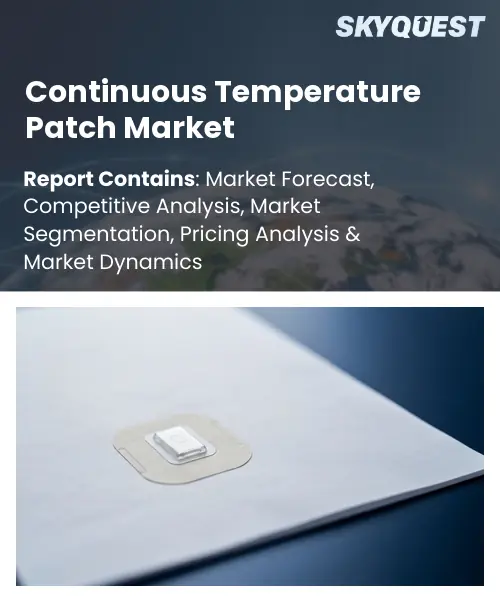
Continuous Temperature Patch Market
Report ID: SQMIG35B2456
Report ID: SQMIG35B2456
[email protected]
USA +1 351-333-4748
Report ID:
SQMIG35B2456 |
Region:
Global |
Published Date: August, 2026
Pages:
157
|Tables:
117
|Figures:
77


Global Continuous Temperature Patch Market size was valued at USD 428.6 Million in 2024 and is poised to grow from USD 468.03 Million in 2025 to USD 946.36 Million by 2033, growing at a CAGR of 9.2% during the forecast period (2026-2033).
Integration of artificial‑intelligence analytics that convert temperature streams into health insights stands as a key growth driver for the continuous temperature patch market. When patches send data to cloud platforms, models can detect trend shifts that precede illness, triggering automated alerts to clinicians or coaches. This reduces response times, lowering treatment costs and improving outcomes, as shown by cycling teams that use alerts to adjust pacing and hydration, thus avoiding heat‑stroke. Consequently demand spreads across hospitals, remote‑patient monitoring and workplace safety programs, creating revenue opportunities for both hardware makers and software providers globally across diverse sectors throughout the world today.
How are AI and IoT enhancing accuracy in the continuous temperature patch market?
AI and IoT are reshaping the continuous temperature patch market by linking real time data with predictive analytics. Sensors embedded in thin adhesive patches capture body heat every few minutes and transmit readings to cloud platforms via low power Bluetooth. IoT connectivity ensures clinicians receive uninterrupted streams while AI algorithms filter noise, correct drift and flag abnormal trends before fever escalates. The current landscape sees hospitals adopting these patches for pediatric and post operative care because they reduce manual checks and improve patient comfort. Companies such as TempTraq and VivaLNK illustrate how integrated hardware and software create a seamless monitoring loop that boosts accuracy and response speed.
TempTraq announced an AI enhanced temperature patch platform in March 2024, the solution uses edge computing to validate readings on the device and streams calibrated data to hospital dashboards, cutting false alerts and supporting faster clinical decisions. This shows how AI and IoT improve precision and reduce nurse workload, encouraging wider adoption.
Market snapshot - (2026-2033)
Global Market Size
USD 428.6 Million
Largest Segment
Disposable Patches
Fastest Growth
Reusable Patches
Growth Rate
9.2% CAGR
To get more insights on this market click here to Request a Free Sample Report
Global continuous temperature patch market is segmented by product type, connectivity, application, end user and region. Based on product type, the market is segmented into Disposable Patches and Reusable Patches. Based on connectivity, the market is segmented into Bluetooth, Wi-Fi and NFC. Based on application, the market is segmented into Patient Monitoring, Neonatal Care, Sports & Fitness and Home Healthcare. Based on end user, the market is segmented into Hospitals, Clinics and Home Care. Based on region, the market is segmented into North America, Europe, Asia Pacific, Latin America and Middle East & Africa.
Disposable patches segment dominates with large continuous temperature patch market share because they offer a ready to use solution that removes the need for cleaning or sterilization, fitting tightly with the high throughput environments of hospitals and clinics. Their ease of application reduces training time for staff, and the single use nature mitigates cross contamination risk, which is a critical concern in continuous temperature monitoring. Consequently, clinicians prefer them for reliable, hygienic data capture across diverse patient groups.
As per continuous temperature patch market outlook, reusable patches segment emerges as the fastest growing area because advancements in flexible electronics enable multiple wear cycles without performance loss. Healthcare providers are adopting them to lower long term consumable costs and to support sustainable practices, driving broader implementation in outpatient and home based monitoring programs.
As per continuous temperature patch market forecast, bluetooth segment leads because it provides low power consumption and seamless pairing with smartphones, which are widely used by clinicians and patients for real‑time temperature data. The technology’s mature ecosystem ensures reliable data transfer in crowded hospital wireless environments, and its integration with existing health apps simplifies deployment. These attributes make Bluetooth the preferred choice for continuous temperature patches across diverse care settings.
On the other hand, Wi Fi segment is witnessing the strongest growth momentum because it enables high bandwidth transmission, supporting advanced analytics and multi parameter monitoring within the same patch. Institutions are upgrading network infrastructure, and the ability to integrate with hospital information systems accelerates adoption, unlocking new use cases in remote and intensive care environments.
To get detailed segments analysis, Request a Free Sample Report
North America leads the continuous temperature patch market because it combines a mature biomedical ecosystem with extensive investment in wearable sensor innovation. The United States hosts a concentration of research universities and venture capital that accelerates product development, while regulatory pathways encourage swift market entry. Canada contributes a strong health‑technology cluster and public‑private collaborations that expand clinical adoption. Both countries benefit from integrated supply chains, advanced manufacturing capabilities, and a health‑care environment that values real‑time temperature monitoring for patient safety. The region’s focus on digital health platforms further embeds temperature patches within telemedicine services, reinforcing its dominance. Reimbursement frameworks in both nations support wide deployment across hospital networks, encouraging clinicians to integrate patches into routine vital‑sign assessments. Moreover, collaborative initiatives between American and Canadian firms foster standardization of data protocols, enhancing interoperability with electronic health records. This confluence of innovation, regulatory support, and market readiness secures North America’s leading position.
As per continuous temperature patch market regional outlook, United States is propelled by a vibrant ecosystem of technology startups and established medical device firms that prioritize rapid prototyping and scalable production. Strong collaboration between academic research centers and industry accelerates clinical validation, while health‑care providers adopt patches to enhance patient monitoring in both acute and outpatient settings. Reimbursement mechanisms and telehealth integration further embed the technology into routine practice across the nation.
As per continuous temperature patch market regional forecast, Canada benefits from strong governmental support for digital health innovation and a collaborative network of research institutes focused on sensor accuracy. Health‑care systems emphasize preventive monitoring, leading to early adoption of temperature patches in long‑term care facilities and remote communities. Partnerships with U.S. manufacturers ensure access to advanced designs, while provincial reimbursement programs facilitate integration into standard patient care pathways nationwide across the nation.
Europe experiences rapid expansion of the market driven by a combination of strong regulatory harmonization, high clinical research activity, and a growing emphasis on patient‑centred digital health solutions. The European Union framework facilitates cross‑border product approvals, enabling manufacturers to reach multiple markets efficiently. Nations such as Germany, the United Kingdom and France invest heavily in wearable sensor development and integrate patches within telemedicine platforms to support remote monitoring. Health‑care providers across the continent adopt patches to improve early detection of temperature‑related complications, while public health initiatives promote their use in community settings. This collaborative environment, coupled with advanced manufacturing clusters and a skilled engineering workforce, propels the market’s swift growth throughout Europe. Stakeholder commitment to data security and interoperability further strengthens market confidence across member states.
Germany is anchored by engineering firms and a robust network of clinical trial centers that prioritize precision and reliability. The country’s focus on Industrie 4.0 enables seamless integration of patches with hospital information systems, while insurance frameworks support reimbursement for advanced monitoring solutions. Collaborative projects between manufacturers and research universities accelerate innovation, positioning Germany as a leading hub for temperature sensing technologies across Europe today.
United Kingdom is experiencing the fastest growth due to strong public‑private partnerships that validate and deploy devices. National health services prioritize remote monitoring to alleviate pressure on acute care facilities, encouraging widespread adoption of temperature patches in both hospitals and home‑care programs. A fintech ecosystem supports health solutions, while regulatory pathways streamline market entry, making the United Kingdom a centre for temperature monitoring applications.
France is emerging thanks to incentives for digital health and a culture of biotech startups. French hospitals integrate temperature patches to enhance patient safety in postoperative and chronic disease management, while regional health agencies promote their use in community health initiatives. Partnerships with research consortia advance sensor miniaturization, and reimbursement schemes encourage clinicians to adopt patches as part of routine monitoring protocols across the nation.
Asia Pacific is strengthening its position in the market through a combination of rapid technology adoption, expanding healthcare infrastructure, and focused government initiatives that encourage wearable medical devices. The region’s manufacturing expertise, particularly in semiconductor and flexible electronics, provides cost‑effective production capabilities that attract global players. Countries such as Japan and South Korea invest heavily in sensor research, integrating temperature patches with advanced health‑data platforms and telemedicine services. Rising consumer awareness of preventive health drives demand for continuous monitoring in both clinical and home environments. Collaborative networks linking universities, startups and established manufacturers accelerate innovation cycles, while regulatory reforms streamline approval pathways, enabling faster market entry and broader patient access throughout Asia Pacific. The region also benefits from a skilled engineering talent pool and emerging standards bodies that foster interoperability across devices.
Japan is driven by engineering and a healthcare system that values detection of temperature changes. Japanese manufacturers use expertise in miniature electronics to create patches for hospital and elderly‑care settings. Government health programmes encourage integration of monitoring into routine care, while collaborations between universities and device firms accelerate clinical validation. This focus on quality and integration positions Japan as a leader in temperature monitoring solutions.
South Korea benefits from a society and government support for health technologies. Korean firms excel in flexible circuit design, producing thin comfortable patches that integrate with mobile health applications. National health insurance schemes cover monitoring tools, prompting hospitals to adopt temperature patches for chronic care. Research between universities and industry accelerates innovations, keeping South Korea at the forefront of accessible and reliable temperature monitoring solutions.
To know more about the market opportunities by region and country, click here to
Buy The Complete Report
Rising Demand For Precision Agriculture
Integration Of IoT Sensor Networks
High Initial Capital Expenditure
Complex Data Interoperability Challenges
Request Free Customization of this report to help us to meet your business objectives.
The global continuous temperature patch industry is highly competitive, with medical technology companies focusing on wearable sensor innovation, wireless connectivity, and remote patient monitoring capabilities to strengthen their market position. Key players are investing in flexible temperature sensors, miniaturized electronics, disposable wearable patches, and cloud-connected healthcare platforms to improve accuracy, patient comfort, and real-time monitoring performance.
SkyQuest’s ABIRAW (Advanced Business Intelligence, Research & Analysis Wing) is our Business Information Services team that Collects, Collates, Correlates, and Analyses the Data collected by means of Primary Exploratory Research backed by robust Secondary Desk research.
As per SkyQuest analysis, the continuous temperature patch market growth is being propelled primarily by the integration of AI‑driven analytics that turn real‑time temperature streams into predictive health insights, while the high upfront capital required for hardware and integration infrastructure acts as a notable restraint. North America leads the market due to its mature biomedical ecosystem and strong reimbursement frameworks, and disposable patches dominate the product landscape owing to their convenience and infection‑control benefits. A second growth catalyst comes from expanding IoT sensor networks that enable seamless data transmission and support advanced analytics, further widening adoption across hospitals, home‑care and sports applications. The global continuous temperature patch market trend is experiencing significant growth as healthcare providers increasingly adopt wearable monitoring solutions for real-time and remote patient temperature tracking.
| Report Metric | Details |
|---|---|
| Market size value in 2024 | USD 428.6 Million |
| Market size value in 2033 | USD 946.36 Million |
| Growth Rate | 9.2% |
| Base year | 2024 |
| Forecast period | (2026-2033) |
| Forecast Unit (Value) | USD Million |
| Segments covered |
|
| Regions covered | North America (US, Canada), Europe (Germany, France, United Kingdom, Italy, Spain, Rest of Europe), Asia Pacific (China, India, Japan, Rest of Asia-Pacific), Latin America (Brazil, Rest of Latin America), Middle East & Africa (South Africa, GCC Countries, Rest of MEA) |
| Companies covered |
|
| Customization scope | Free report customization with purchase. Customization includes:-
|
To get a free trial access to our platform which is a one stop solution for all your data requirements for quicker decision making. This platform allows you to compare markets, competitors who are prominent in the market, and mega trends that are influencing the dynamics in the market. Also, get access to detailed SkyQuest exclusive matrix.
Table Of Content
Executive Summary
Market overview
Parent Market Analysis
Market overview
Market size
KEY MARKET INSIGHTS
COVID IMPACT
MARKET DYNAMICS & OUTLOOK
Market Size by Region
KEY COMPANY PROFILES
Methodology
For the Continuous Temperature Patch Market, our research methodology involved a mixture of primary and secondary data sources. Key steps involved in the research process are listed below:
1. Information Procurement: This stage involved the procurement of Market data or related information via primary and secondary sources. The various secondary sources used included various company websites, annual reports, trade databases, and paid databases such as Hoover's, Bloomberg Business, Factiva, and Avention. Our team did 45 primary interactions Globally which included several stakeholders such as manufacturers, customers, key opinion leaders, etc. Overall, information procurement was one of the most extensive stages in our research process.
2. Information Analysis: This step involved triangulation of data through bottom-up and top-down approaches to estimate and validate the total size and future estimate of the Continuous Temperature Patch Market.
3. Report Formulation: The final step entailed the placement of data points in appropriate Market spaces in an attempt to deduce viable conclusions.
4. Validation & Publishing: Validation is the most important step in the process. Validation & re-validation via an intricately designed process helped us finalize data points to be used for final calculations. The final Market estimates and forecasts were then aligned and sent to our panel of industry experts for validation of data. Once the validation was done the report was sent to our Quality Assurance team to ensure adherence to style guides, consistency & design.
Analyst Support
Customization Options
With the given market data, our dedicated team of analysts can offer you the following customization options are available for the Continuous Temperature Patch Market:
Product Analysis: Product matrix, which offers a detailed comparison of the product portfolio of companies.
Regional Analysis: Further analysis of the Continuous Temperature Patch Market for additional countries.
Competitive Analysis: Detailed analysis and profiling of additional Market players & comparative analysis of competitive products.
Go to Market Strategy: Find the high-growth channels to invest your marketing efforts and increase your customer base.
Innovation Mapping: Identify racial solutions and innovation, connected to deep ecosystems of innovators, start-ups, academics, and strategic partners.
Category Intelligence: Customized intelligence that is relevant to their supply Markets will enable them to make smarter sourcing decisions and improve their category management.
Public Company Transcript Analysis: To improve the investment performance by generating new alpha and making better-informed decisions.
Social Media Listening: To analyze the conversations and trends happening not just around your brand, but around your industry as a whole, and use those insights to make better Marketing decisions.
REQUEST FOR SAMPLE
 REQUEST FREE CUSTOMIZATION
Global Continuous Temperature Patch Market size was valued at USD 428.6 Million in 2024 and is poised to grow from USD 468.03 Million in 2025 to USD 946.36 Million by 2033, growing at a CAGR of 9.2% during the forecast period (2026-2033).
Insufficient information to generate the requested section. 'Vivalink, Inc.', 'Blue Spark Technologies, Inc.', 'Nihon Kohden Corporation', 'Philips Healthcare', 'GE HealthCare Technologies Inc.', 'Medtronic plc', 'Abbott Laboratories', 'Dexcom, Inc.', 'Sibel Health', 'VitalConnect, Inc.', 'LifeSignals Group', 'Bioserenity', 'BioIntelliSense, Inc.', 'Cosinuss GmbH', 'Epicore Biosystems, Inc.', 'Kenzen, Inc.', 'Xsensio SA', 'Nemaura Medical Inc.', 'Leaf Healthcare, Inc.', 'Fever Smart'
Manufacturers are introducing continuous temperature patch solutions that enable monitoring of crop microclimates, allowing growers to adjust irrigation and protective measures precisely. This capability reduces waste, improves yield quality, and aligns with sustainability goals, prompting broader adoption across agricultural operations. As climate variability intensifies, the need for seamless temperature data becomes critical, encouraging investment in these technologies and fostering market expansion. Stakeholders also recognize that such patches support compliance with emerging regulatory standards on produce safety, further reinforcing the strategic importance of continuous temperature monitoring within the agricultural value chain.
Ai-Driven Predictive Maintenance: The integration of advanced AI algorithms enables continuous temperature patches to forecast degradation patterns before failures occur. By analyzing real‑time thermal data combined with historical performance, manufacturers can schedule maintenance windows that minimize downtime and extend equipment lifespan. This proactive approach enhances reliability across sectors such as aerospace, energy, and semiconductor fabrication, while reducing spare‑part inventories and labor costs. As confidence in machine‑learning reliability grows, firms increasingly view intelligent temperature monitoring as a strategic asset rather than a peripheral tool.
Why does North America Dominate the Global Continuous Temperature Patch Market? |@12


Want to customize this report? This report can be personalized according to your needs. Our analysts and industry experts will work directly with you to understand your requirements and provide you with customized data in a short amount of time. We offer $1000 worth of FREE customization at the time of purchase.
Feedback From Our Clients


 USA (+1) 351-333-4748

