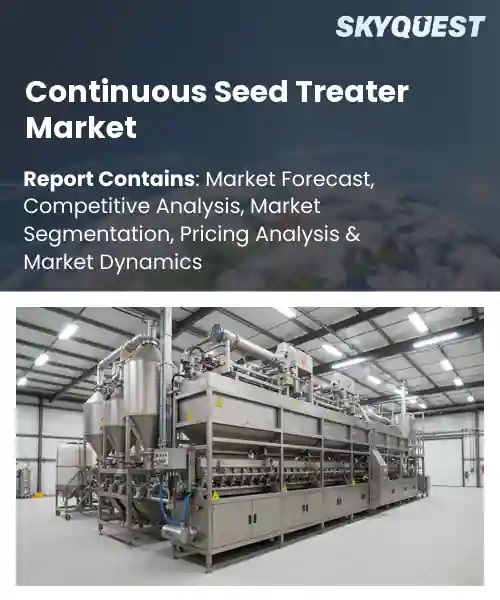
Continuous Seed Treater Market
Report ID: SQMIG20H2087
Report ID: SQMIG20H2087
[email protected]
USA +1 351-333-4748
Report ID:
SQMIG20H2087 |
Region:
Global |
Published Date: February, 2026
Pages:
157
|Tables:
142
|Figures:
78


Global Continuous Seed Treater Market size was valued at USD 4.3 Billion in 2024 and is poised to grow from USD 4.74 Billion in 2025 to USD 10.31 Billion by 2033, growing at a CAGR of 10.2% during the forecast period (2026-2033).
The global continuous seed treater industry focuses on machines that deliver chemical and biological seed treatment processes through ongoing operations instead of using batch processing methods. The requirement exists because both seed companies and planters need their seeds to undergo uniform treatment with precise dosage measurements at high processing speeds to fulfill current agricultural needs and pest control methods.
Moreover, the global continuous seed treater market outlook evolved through three stages which started with manual drum-style coaters and progressed to automated continuous conveyors with rotary applicators because customers needed better labor efficiency and compliance with regulations and they required new formulation methods. Continuous treaters function as seed treatment machines which seed companies use to achieve standard germination results while using their active ingredients efficiently for corn and soybean seeds.
In addition, the global market base experiences growth through biologicals and formulations which need delicate consistent application that companies achieve through their continuous treater technologies which researchers develop using low-shear applicators with controlled dosing systems to maintain biological viability. The commercial seed industry and contract treating facilities require expanded operations because they need to achieve both throughput efficiency and trackable traceability solutions which lead to successful case studies that demonstrate better crop emergence through biostimulant-treated corn seed and stress-ready rice seed treatment for Asian regions. The market offers possibilities for retrofitting and IoT monitoring development while equipment producers team up with biotech formulators to gain global continuous seed treater market share.
How is IoT Improving Operational Efficiency in the Continuous Seed Treater Market?
The current setup of continuous seed treaters now combines sensor systems with networked control units and cloud-based analytics software to improve process reliability while decreasing the need for human monitoring. The system uses three main parts which include real-time application rate monitoring and automated recipe management and remote diagnostic functions to maintain coating application and seed quality. The market is shifting from selling single machines to providing complete production systems because businesses need better product visibility and system uptime than ever before. The new machine capabilities enable operators to troubleshoot remotely while they improve the speed of adjusting recipes and they shift their maintenance approach from dealing with problems to scheduled repairs. Continuous treating operations become better through these functionalities which enable businesses to operate their system at greater reliability while using their capacity for expansion.
Westrup A/S in April 2025 expanded its engineering and product development through an acquisition, which enables better IoT monitoring and predictive maintenance for continuous treaters while decreasing unplanned downtime and enhancing field support to improve productivity.
Market snapshot - 2026-2033
Global Market Size
USD 4.3 Billion
Largest Segment
Integrated Systems
Fastest Growth
Continuous Flow Seed Treaters
Growth Rate
10.2% CAGR
To get more insights on this market click here to Request a Free Sample Report
The global continuous seed treater market is segmented by product type, mode of operation, application type, technology type, end user, and region. Based on product type, the market is segmented into Standalone Treaters, Integrated Systems, Drum Seed Treaters, Batch Seed Treaters, and Continuous Flow Seed Treaters. Based on mode of operation, the market is segmented into Manual Operation and Automatic Operation. Based on application type, the market is segmented into Crop Treatment and Non-Crop Treatment. Based on technology type, the market is segmented into Chemical Treatment and Biological Treatment. Based on end user, the market is segmented into Agricultural Farms and Commercial Growers. Based on region, the market is segmented into North America, Europe, Asia Pacific, Latin America, and Middle East & Africa.
According to the global continuous seed treater market analysis, the segment of Continuous Flow Seed Treaters controls the market because its design based on continuous operation provides constant output while delivering even seed coverage which decreases the need for handling processes and decreases inconsistencies in seed treatment results. Large-scale operations and commercial growers find the system operational profile to be beneficial because it operates well with automatic feeding systems and quality control systems which function throughout the production process. The combination of efficient and reliable results with modern crop science solutions drives organizations to adopt new procurement methods which include continuous operational upgrades.
However, the operational application of Batch Seed Treaters continues to grow fastest because their flexible capability helps both small and mid-sized businesses complete specific coating projects and testing operations. The application of biological treatments and specialized chemical products emerges as a precise application operation through modular upgrades and their user-friendly process controls which enable new business opportunities in specialty crop production and custom service design.
According to the global continuous seed treater market forecast, the Automatic Operation segment leads the market because its automated systems provide accurate material handling while decreasing the need for manual work. The integrated sensors with feedback loop systems enable direct observation which allows users to make adjustments that decrease operational inconsistencies while ensuring adherence to application standards. The systems provide predictable operation patterns which require less manual work, making them popular among commercial farming operations and service providers who need reliable systems for ongoing seed treatment processes.
Whereas, manual operations shows the strongest growth pattern because its inexpensive systems require little upkeep making them attractive to both small-scale farms and specialized service providers. The use of ergonomic equipment together with operator assistance tools enables workers to achieve reliable results which non-complex automation systems to work with operators who have limited financial resources create demand for portable retrofit equipment.
To get detailed segments analysis, Request a Free Sample Report
As per the continuous seed treater market regional forecast, Asia Pacific dominance is founded on three main factors which include its concentrated industrial production power together with its extensive agricultural business networks and its early adoption of ongoing process technology. The region's main markets showcase equipment manufacturers who create advanced machines together with their specialized service providers, who fulfill local and international customer needs. Key agricultural systems in main countries focus on maintaining high seed quality together with uniform seed characteristics, which results in improved performance of continuous treating systems that deliver steady application rates and processing capacity. The combination of integrated supply chains and research institutions working together with business partners, together with a strong manufacturing sector, enables fast equipment customization and production scaling. The agricultural sector invests in continuous treating infrastructure because of regulatory requirements which demand visible crop protection results and complete traceability, which are provided by advanced seed treatment systems.
The Japanese continuous seed treater sector features products which combine precision engineering with compact design and strong quality control together with traceability. Domestic manufacturers prioritize reliability and integration with automated seed handling systems to serve specialized crop sectors. Research institutes collaborate with private firms to drive incremental innovation which develops continuous treating lines that meet domestic quality standards while working in areas with limited space. The market provides customized solutions which export oriented seed producers and premium seed segments need because they offer high value to customers.
The continuous seed treater industry in South Korea focuses on developing advanced technologies, including automated control systems and agrochemical formulation platforms. Local demand favors compact, high-efficiency equipment suited to intensive production models and contract treating service providers. The industry establishes digital monitoring systems together with traceability platforms, which industry players use for quality assurance purposes. Fast industrial supply chains enable companies to create prototype products to meet requirements for specific seed types and coating technologies, which they use in both domestic and regional markets.
North America experiences rapid expansion because seed production and distribution operations require different companies to increase operational efficiency and maintain product quality and regulatory compliance. The large seed companies require continuous systems which independent contract treaters have developed to achieve their high throughput requirements while maintaining correct application and documentation for stewardship programs. The combination of farm management platform integration and financing availability together with service networks, which people use to replace batch methods creates a strong replacement trend. The market requires manufacturers to create scalable systems which provide dosing accuracy and dust control together with clean-in-place capabilities. Strong aftermarket support together with existing logistics and equipment suppliers who work with crop protection companies create an environment which drives equipment adoption across multiple farming systems.
The continuous seed treater market in the United States functions through three main elements which include market size together with the various cropping methods used and the extensive network of contract treatment services available. The buyers need equipment which provides high throughput capacity and effective dust control together with products which meet stewardship requirements. The equipment suppliers develop design products, which they create as modular products, which they craft to enable field service and digital monitoring system integration. The market enables businesses to customize their products for different seed sizes and treatment chemistries, while the market requires reliable equipment, which operates with constant uptime and yet works as part of existing seed processing systems and distribution frameworks.
The continuous seed treater market in Canada specializes in developing equipment which can withstand cold climates and create long-lasting solutions, which serve oilseed and pulse industries. Systems that deliver uniform coverage while reducing seed loss during different handling situations receive priority for selection. Production locations need service providers and cooperatives to use compact energy efficient units, which operators can operate and maintain throughout all production sites. Equipment selection and process controls throughout the value chain use export quality standards and traceability requirements as guiding principles.
European markets experience growth through three main factors which include mandatory quality standards, environmentally friendly practices, and advances in engineering technology. Stakeholders prioritize systems that follow integrated pest management principles while reducing off target exposure and providing reliable seed performance data through complete documentation. The advanced automation systems together with their modular design and retrofit functions enable regional manufacturers to meet the requirements of various seed companies and small to medium sized agricultural producers. The combination of collaborative research activities together with strong OEM networks and sustainable design requirements for low energy and low emission systems creates a competitive edge in the market. The market development process benefits from service provider mergers which enable companies to create traceable treatment solutions that meet their customized needs while achieving supply chain sustainability targets.
The continuous seed treater market in Germany demonstrates engineering excellence through its strict quality assurance procedures and dedication to automated systems. Buyers expect systems with precise dosing, robust construction, and seamless integration into larger industrial processes. Local suppliers focus on creating modular products which help customers maintain their systems while expanding them to support various seed types. The collaboration between machine builders and research organizations establishes seed treatment operations which meet process control standards, energy efficiency benchmarks, and occupational safety requirements.
The United Kingdom continuous seed treater market grows as seed merchants and independent treating services together with flexible treating systems create a strong market presence. The demand focuses on mobile and modular continuous units which serve both regional needs and contract treating models. The market values solutions that deliver consistent coating quality while enabling traceability and compliance with stewardship frameworks. Equipment suppliers who work closely with advisory services create conditions which lead to local farmers adopting systems designed specifically for their agricultural needs.
France experiences a strong continuous seed treater market because of its extensive arable land, active seed breeding programs, and cooperative distribution methods. Equipment choices focus on gentle handling of all types of cereal and specialty seeds while providing specific application techniques to safeguard seed health. The providers develop systems which enable cooperative facilities to boost their operational capacity while maintaining traceable export records. Agribusinesses and technology providers work together to create customized solutions which solve specific regional agronomic challenges and processing footprint issues.
To know more about the market opportunities by region and country, click here to
Buy The Complete Report
Increasing Seed Treatment Adoption
The continuous seed treaters create market growth because they enable agricultural operations to maintain consistent and equal coating procedures which enhance seed protection and handling efficiency during large scale operations. The system enables automated planting and seed production workflows to operate with decreased manual variability which allows commercial growers and seed processors to expand their operations. The agricultural sector experiences increased demand for continuous systems because these systems maintain constant operational capacity while preventing waste from uneven dosing and simplifying quality control processes used in modern farming operations.
Technological Advancements In Equipment
The continuous seed treater market expands through current technological improvements which enhance precision and safety while providing users with greater operational flexibility. The system increases user confidence in consistent application while decreasing operator need for manual work through its advanced dosing mechanisms and improved liquid and powder delivery controls and modular design system which enables fast equipment changes and monitoring system integration. The upgrades make continuous treaters suitable for different seed processors and commercial growers who want to replace their outdated systems and adopt new technology which provides dependable low-risk solutions to satisfy their changing agronomic needs.
High Initial Capital Requirements
The continuous seed treater market experiences restricted growth because initial capital costs prevent adoption by small seed producers and growers with limited resources. Organizations face financial obstacles because they must spend large amounts on equipment and installation and operator training, which leads to procurement delays when funding options are limited. The higher upfront costs create an investment risk which leads stakeholders to postpone system upgrades or continue using batch and manual methods, which results in slower market growth despite the potential operational benefits of latest systems.
Regulatory And Environmental Compliance
Manufacturers and continuous seed treater users face operational challenges because upcoming environmental and regulatory standards require them to comply with strict requirements, which leads to increased complexity and operational risks. The regional treatment standards which define chemical and emissions and waste disposal protocols force businesses to change their systems, which results in increased compliance expenses and new systems taking longer to reach the market. The investment restriction which results from regulatory requirements for continuous systems leads to market caution among buyers who need additional training and documentation to implement systems and achieve complete market presence.
Request Free Customization of this report to help us to meet your business objectives.
The competitive situation of the continuous seed treater market develops through three main factors which include market consolidation, product-platform partnerships that create new manufacturing processes, and service delivery systems which include new technology implementations. The companies use M&A activities to expand their seed treatment product range while forming partnerships to introduce advanced powder and biological delivery systems into retail distribution networks and developing new products which enhance their ability to process seeds and deliver precise amounts of material, as seen in Indigo Ag's CLIPS powder delivery device and recent seed portfolio deals by major seed firms.
SkyQuest’s ABIRAW (Advanced Business Intelligence, Research & Analysis Wing) is our Business Information Services team that Collects, Collates, Correlates, and Analyses the Data collected by means of Primary Exploratory Research backed by robust Secondary Desk research.
As per SkyQuest analysis, the global continuous seed treater market is driven by increased adoption of biological and advanced formulation technologies which require gentle continuous application and by advancements in technology which allow IoT-enabled monitoring to boost throughput and tracking capabilities. High initial capital requirements prevent smaller operators from transitioning to continuous systems which slows market growth. The Asia Pacific region maintains its market leadership position because of its extensive agribusiness network and manufacturing capabilities and its commitment to producing high-quality seeds, while continuous flow seed treaters lead the market because they deliver steady throughput, uniform coating and seamless integration with automated seed lines. The primary growth sectors include retrofitting and digitalization and collaborative efforts between equipment manufacturers and bioproduct developers.
| Report Metric | Details |
|---|---|
| Market size value in 2024 | USD 4.3 Billion |
| Market size value in 2033 | USD 10.31 Billion |
| Growth Rate | 10.2% |
| Base year | 2024 |
| Forecast period | 2026-2033 |
| Forecast Unit (Value) | USD Billion |
| Segments covered |
|
| Regions covered | North America (US, Canada), Europe (Germany, France, United Kingdom, Italy, Spain, Rest of Europe), Asia Pacific (China, India, Japan, Rest of Asia-Pacific), Latin America (Brazil, Rest of Latin America), Middle East & Africa (South Africa, GCC Countries, Rest of MEA) |
| Companies covered |
|
| Customization scope | Free report customization with purchase. Customization includes:-
|
To get a free trial access to our platform which is a one stop solution for all your data requirements for quicker decision making. This platform allows you to compare markets, competitors who are prominent in the market, and mega trends that are influencing the dynamics in the market. Also, get access to detailed SkyQuest exclusive matrix.
Table Of Content
Executive Summary
Market overview
Parent Market Analysis
Market overview
Market size
KEY MARKET INSIGHTS
COVID IMPACT
MARKET DYNAMICS & OUTLOOK
Market Size by Region
KEY COMPANY PROFILES
Methodology
For the Continuous Seed Treater Market, our research methodology involved a mixture of primary and secondary data sources. Key steps involved in the research process are listed below:
1. Information Procurement: This stage involved the procurement of Market data or related information via primary and secondary sources. The various secondary sources used included various company websites, annual reports, trade databases, and paid databases such as Hoover's, Bloomberg Business, Factiva, and Avention. Our team did 45 primary interactions Globally which included several stakeholders such as manufacturers, customers, key opinion leaders, etc. Overall, information procurement was one of the most extensive stages in our research process.
2. Information Analysis: This step involved triangulation of data through bottom-up and top-down approaches to estimate and validate the total size and future estimate of the Continuous Seed Treater Market.
3. Report Formulation: The final step entailed the placement of data points in appropriate Market spaces in an attempt to deduce viable conclusions.
4. Validation & Publishing: Validation is the most important step in the process. Validation & re-validation via an intricately designed process helped us finalize data points to be used for final calculations. The final Market estimates and forecasts were then aligned and sent to our panel of industry experts for validation of data. Once the validation was done the report was sent to our Quality Assurance team to ensure adherence to style guides, consistency & design.
Analyst Support
Customization Options
With the given market data, our dedicated team of analysts can offer you the following customization options are available for the Continuous Seed Treater Market:
Product Analysis: Product matrix, which offers a detailed comparison of the product portfolio of companies.
Regional Analysis: Further analysis of the Continuous Seed Treater Market for additional countries.
Competitive Analysis: Detailed analysis and profiling of additional Market players & comparative analysis of competitive products.
Go to Market Strategy: Find the high-growth channels to invest your marketing efforts and increase your customer base.
Innovation Mapping: Identify racial solutions and innovation, connected to deep ecosystems of innovators, start-ups, academics, and strategic partners.
Category Intelligence: Customized intelligence that is relevant to their supply Markets will enable them to make smarter sourcing decisions and improve their category management.
Public Company Transcript Analysis: To improve the investment performance by generating new alpha and making better-informed decisions.
Social Media Listening: To analyze the conversations and trends happening not just around your brand, but around your industry as a whole, and use those insights to make better Marketing decisions.
REQUEST FOR SAMPLE
 REQUEST FREE CUSTOMIZATION
Global Continuous Seed Treater Market size was valued at USD 4.3 Billion in 2024 and is poised to grow from USD 4.74 Billion in 2025 to USD 10.31 Billion by 2033, growing at a CAGR of 10.2% during the forecast period (2026-2033).
The competitive landscape for continuous seed treater market is driven by consolidation, product-platform partnerships, and applied technology rollouts that reshape in-plant workflows and service models. Companies pursue M&A to broaden seed treatment portfolios, partnerships to embed new powder and biological delivery systems into retail channels, and product innovation to improve throughput and dosing accuracy, for example Indigo Ag’s CLIPS powder delivery device and recent seed portfolio deals by major seed firms. 'Agri-Inject', 'Seed Treating Solutions', 'Kincaid Equipment Manufacturing', 'BASF', 'UPL Limited', 'Precision Planting', 'Vortex Engineering', 'Kincaid Enterprises', 'Seed Dynamics', 'U.S. Borax', 'Mzuri Agricultural Services', 'H.J. Baker & Bro.', 'Sisco Seed Treaters', 'Accelerated Genetics', 'All States Ag Parts', 'Cherney Microbiological Services', 'Advanced Farm Technologies', 'Westrup A/S', 'Vital Earth Resources', 'AgroLiquid'
Continuous seed treaters contribute to market growth by enabling consistent, uniform coating processes that improve seed protection and handling efficiency across large operations. Their ability to integrate into automated planting and seed production workflows reduces manual variability and supports scalability for commercial growers and seed processors. As growers and seed companies prioritize uniformity, reliability, and operational throughput, demand for continuous systems rises because these machines sustain steady processing rates, reduce waste from uneven dosing, and simplify quality control workflows, making them attractive investments for modern agricultural enterprises.
Precision Agriculture Integration: Adoption of precision agriculture practices is driving demand for continuous seed treaters that deliver consistent coatings and variable-rate application compatibility. Manufacturers are adapting equipment to integrate with farm management systems, sensor feedback and seed-specific treatment profiles, enabling improved seed performance and reduced chemical overlap. This trend supports tailored disease and pest management strategies while enhancing operational efficiency and traceability, prompting investment in modular, adaptable machines that can respond to diverse crop systems and evolving grower expectations and regulatory acceptance accelerating.
As per the continuous seed treater market regional forecast, Asia Pacific dominance is founded on three main factors which include its concentrated industrial production power together with its extensive agricultural business networks and its early adoption of ongoing process technology.


Want to customize this report? This report can be personalized according to your needs. Our analysts and industry experts will work directly with you to understand your requirements and provide you with customized data in a short amount of time. We offer $1000 worth of FREE customization at the time of purchase.
Feedback From Our Clients


 USA (+1) 351-333-4748

