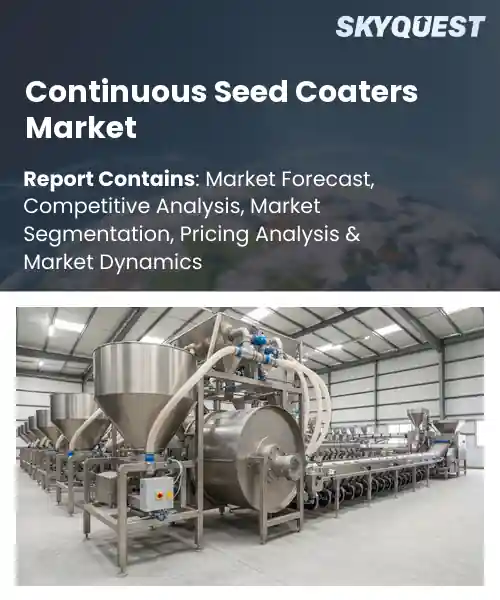
Continuous Seed Coaters Market
Report ID: SQMIG20H2086
Report ID: SQMIG20H2086
[email protected]
USA +1 351-333-4748
Report ID:
SQMIG20H2086 |
Region:
Global |
Published Date: February, 2026
Pages:
157
|Tables:
172
|Figures:
79


Global Continuous Seed Coaters Market size was valued at USD 1.40 Billion in 2024 and is poised to grow from USD 1.50 Billion in 2025 to USD 2.55 Billion by 2033, growing at a CAGR of 6.9% during the forecast period (2026-2033).
The global need for improved crop production and successful seed establishment drives the global continuous seed coaters market growth through its requirement for seeds that have complete coating which improves germination rates while providing chemical protection. Continuous seed coaters represent industrial systems which apply polymer film or nutrient layers to cereals, pulses, and vegetables through continuous delivery methods.
In addition, the global continuous seed coaters market outlook transitioned from batch processing to continuous processing during the last twenty years because North American and European and Brazilian seed companies chose to invest in operational expansion. The primary element which drives industrial growth emerges from technological advancements which enable enhanced coating process development, while innovations in automated metering and atomization and in-line drying systems increase production capacity and decrease product defects and material wastage. Seed processors develop revenue streams through their ability to deliver exact pesticide applications and inoculant encapsulation services, which enables them to cover their equipment costs.
How is Automation Improving Throughput in the Continuous Seed Coaters Market?
The continuous seed coaters industry achieves higher production rates through automation, which combines accurate product measurement with steady product movement and its system for maintaining product quality throughout the entire operational cycle. The system uses automatic metering and spraying systems which deliver uniform coverage and drying sensor technology which accelerates curing while decreasing rework needs and recipe-based controls which enable faster equipment switching. The system uses gentle material handling methods together with adaptive control technology to decrease seed damage while increasing operational time. The process allows producers to trace their production output with better accuracy together with consistent operational results.
The company Key Technology and PPM Technologies introduced their complete processing system, which controls all operations from a single point while using recipe-controlled systems to decrease manual production interruptions, which results in higher production time for the entire line. The system achieves increased production at its plant through the automated control of metering and conveyor systems and product monitoring systems, which enables more effective operations of continuous seed coating processes.
Market snapshot - (2026-2033)
Global Market Size
USD 1.4 Billion
Largest Segment
Fully Automatic
Fastest Growth
Fully Automatic
Growth Rate
6.9% CAGR
To get more insights on this market click here to Request a Free Sample Report
The global continuous seed coaters market is segmented into operation mode, throughput capacity, coating material, coating process, crop type, end-use application, and region. By operation mode, the market is divided into fully automatic and semi-automatic. Based on throughput capacity, the market is segmented into low capacity (<5 tons/hour) and medium to high capacity (>20 tons/hour). By coating material, the market includes polymers, colorants, binders, minerals, and others. Based on coating process, the market is categorized into film coating, encrusting, and pelleting. By crop type, the market is segmented into cereals & grains, oilseeds & pulses, vegetables, and flowers & ornamentals. Based on end-use application, the market is divided into industrial/factory, farm-level, and research & laboratory. Regionally, the market is segmented into North America, Europe, Asia Pacific, Latin America, and the Middle East & Africa.
As per the global continuous seed coaters market analysis, the fully automatic segment dominated the market because manufacturers and large agricultural operators prefer systems that require no manual work while delivering dependable performance and maximum operating time. The system controls all three processes of dosing and spray patterns and airflow to create uniform coatings that achieve expected seed quality standards while reducing production errors and waste. The system enables manufacturers to create rapid recipe changes through its combined sensor and PLC control functions which they use to meet industrial performance needs while satisfying strict seed treatment regulations.
However, the semi-automatic system has become the fastest increasing option because continuous coating becomes possible for small and mid-sized businesses through its reduced equipment costs and user-friendly control system. Equipment suppliers and agribusinesses who need to increase their treated seed capacity without complete automation systems will find themselves adopting new equipment because it offers easy retrofitting capabilities and operational flexibility.
According to the global continuous seed coaters market forecast, the film coating segment shows its strong market position because its ability to create thin and evenly distributed protective layers meets essential quality needs which all seed types require for perfect handling. The method enables the use of multiple coating chemistries through which seed protectors can be precisely distributed while seed integrity remains intact. The process creates reliable film formation which reduces dust and flow issues that affect sowing machines, leading manufacturers and end users to choose film capable coaters for their ability to deliver precise applications and compatibility with future processes.
Whereas the pelleting category is anticipated to have the highest continuous seed coaters market share because equipment and formulation advances now make it possible to use small and irregular seeds as precision plantable units. The rising demand from vegetable and ornamental production for seeds to grow into uniform plants drives the need for pelleting systems which create new agricultural opportunities through mechanized sowing operations.
To get detailed segments analysis, Request a Free Sample Report
As per the continuous seed coaters market regional forecast, Asia Pacific becomes a market leader because it possesses advanced manufacturing capabilities which drive agricultural modernization and creates a regional need for advanced seed technologies. The region contains equipment producing companies and seed companies which develop precise products that can be customized to create full digital farming systems. The system maintains its research capabilities through public and private collaborations, which create strong research networks to develop new coating materials and process automation systems. The system delivers operational solutions through its component supply infrastructure and its service network for components and aftermarket services.
The Japanese continuous seed coaters industry shows a preference for precision engineering together with high operational quality control procedures. Domestic manufacturers concentrate on creating portable reliable systems that handle particular seed types and special coating additives. The system connects with inspection and automation systems to provide traceable data while helping users meet their regulatory compliance needs. The system creates new material innovations through its active industry partnerships which collaborate with research institutions for process development. The system allows seed processors to maintain their performance through seed processing after sales support together with customizable solutions.
The South Korean continuous seed coaters market shows two main trends which include fast-paced technology adoption and close connections between electronics expertise and agricultural machinery design. Equipment systems require automation characteristics which include compact designs that work with smart agriculture. Local seed companies and processors prefer systems which provide multiple uses for their various crop types. Industry academic partnerships support the development of new coating formulas and precise application methods. The system protects regional markets through service networks which work with export-focused suppliers to create competitive advantages in equipment and solutions.
North America experiences growth because farmers adopt precision agriculture; seed processing services become consolidated, and there is high market demand for efficient seed treatment methods which operate at high processing rates. The distribution networks together with the technology adoption patterns of large agricultural producers and seed companies create conditions which drive market expansion. The need for seed quality control and reliable treatment processes together with operational performance improvements creates a need for businesses to invest in continuous coating technology. The mature market for aftermarket services together with the established service network system improves operational efficiency together with its entire product lifespan.
The United States market for continuous seed coaters exists because seed processing facilities require high operational efficiency which depends on system integration. Providers prioritize designing modular systems which connect coating application systems with drying and quality inspection systems. Diverse cropping systems and contract seed processors who require repeatable results and product tracing drive customer demand. The design of the product shows a balance between serviceability needs and availability of replacement parts, which makes it suitable for operation in multiple outdoor locations. Collaboration with agronomy experts and technology providers helps businesses create solutions which fit existing farm management systems while meeting supply chain needs.
The Canadian continuous seed coaters market operates through powerful field operations which need special equipment to handle regional crop variations and cold climate challenges. Customers who choose equipment need to select products which maintain durability while providing maintenance access in multiple locations that operate as processing centers. Local manufacturers and distributors work together with seed firms to create systems which meet the distinct needs of pulse seeds and cereal seeds. After sales service and regional support networks play a vital role in sustaining business operations through faultless service. The partnership between equipment suppliers and research institutes creates new technologies which enhance performance according to the specific needs of local agricultural conditions.
Europe gains competitive strength through its two main strategies which include quality control based on regulatory requirements and development of sustainable coating technologies and advanced manufacturing capabilities which produce precision engineering. Technology providers and research centers together with seed companies establish cross border partnerships to create new application systems which reduce environmental damage while improving seed health. Specialized supplier clusters provide complete system solutions which unite automated processes, product tracking capabilities, and energy-efficient product design. European companies use their service excellence together with high-quality product standards to develop premium market segments which support multiple crop production systems throughout the European market.
Germany continuous seed coaters market operates through its extensive manufacturing base which has a deep heritage of mechanical precision. The market provides equipment which features strong construction materials, automated functions, and the ability to connect with industrial management systems. German suppliers focus their operations on developing energy-efficient methods which meet both regulatory standards and customer quality requirements. The company establishes close relationships with engineering firms and component manufacturers which enables them to adopt new technologies without delay. The organization has developed its service and maintenance capabilities to deliver support for both industrial processing operations and extended service life.
The United Kingdom continuous seed coaters market receives its support from advanced agri tech business ecosystem and strong research institutions. The company provides systems which are both modular and adaptable to process different seed types and various processing capacities. The company adds digital integration and advisory services to their equipment, which helps customers find the best parameters for machine operation and product tracking. The partnership between startups and established manufacturers and academic institutions drives coating innovation and application method development. The use of service-oriented business systems improve user education and equipment availability throughout local seed business operations.
The continuous seed coaters market in France operates close to major seed companies because it emphasizes the development of new treatment chemistries and environmentally friendly treatment methods. Equipment manufacturers provide specialized solutions which protect different crop types during the coating process through their controlled distribution system. The development of biodegradable products and highly effective products comes from industry partners who established strong connections with research institutions. The regional network of clusters enables businesses to rapidly implement optimized systems which perform well in both industrial processing environments and specialized seed production.
To know more about the market opportunities by region and country, click here to
Buy The Complete Report
Increasing Demand for Seed Efficiency
Adoption Of Advanced Coating Technologies
High Capital Investment Requirements
Regulatory and Environmental Compliance
Request Free Customization of this report to help us to meet your business objectives.
Companies compete in the global continuous seed coaters market through price and capacity competition, yet they need to fulfill formulation supply and regulatory compliance requirements, particularly because demand for biodegradable coatings has increased due to microplastic prohibition laws. Companies establish partnerships through co-development agreements and product approvals, which helps them achieve supply chain control and product differentiation, as demonstrated by BIOWEG through its collaboration with Bayer and Ginkgo and Ashland which obtained eco-coat approval from regulatory authorities.
SkyQuest’s ABIRAW (Advanced Business Intelligence, Research & Analysis Wing) is our Business Information Services team that Collects, Collates, Correlates, and Analyses the Data collected by means of Primary Exploratory Research backed by robust Secondary Desk research.
As per SkyQuest analysis, the global continuous seed coaters market trends are being driven primarily by rising demand for higher crop yields and consistent stand establishment that favor uniformly coated seeds. While continuous technological advancements in coating formulations and automation systems make it easier to operate. Industry growth faces challenges from high capital investment requirements, which create financial obstacles for small processors to operate their facilities. The market exists in Asia Pacific because of manufacturing hubs which support agricultural modernization and export activities while large processors use automatic systems to maintain their operational standards. Manufacturers who specialize in precision film and pelleting products together with their enhanced service and aftermarket business strategies will experience ongoing market growth.
| Report Metric | Details |
|---|---|
| Market size value in 2024 | USD 1.4 Billion |
| Market size value in 2033 | USD 2.55 Billion |
| Growth Rate | 6.9% |
| Base year | 2024 |
| Forecast period | (2026-2033) |
| Forecast Unit (Value) | USD Billion |
| Segments covered |
|
| Regions covered | North America (US, Canada), Europe (Germany, France, United Kingdom, Italy, Spain, Rest of Europe), Asia Pacific (China, India, Japan, Rest of Asia-Pacific), Latin America (Brazil, Rest of Latin America), Middle East & Africa (South Africa, GCC Countries, Rest of MEA) |
| Companies covered |
|
| Customization scope | Free report customization with purchase. Customization includes:-
|
To get a free trial access to our platform which is a one stop solution for all your data requirements for quicker decision making. This platform allows you to compare markets, competitors who are prominent in the market, and mega trends that are influencing the dynamics in the market. Also, get access to detailed SkyQuest exclusive matrix.
Table Of Content
Executive Summary
Market overview
Parent Market Analysis
Market overview
Market size
KEY MARKET INSIGHTS
COVID IMPACT
MARKET DYNAMICS & OUTLOOK
Market Size by Region
KEY COMPANY PROFILES
Methodology
For the Continuous Seed Coaters Market, our research methodology involved a mixture of primary and secondary data sources. Key steps involved in the research process are listed below:
1. Information Procurement: This stage involved the procurement of Market data or related information via primary and secondary sources. The various secondary sources used included various company websites, annual reports, trade databases, and paid databases such as Hoover's, Bloomberg Business, Factiva, and Avention. Our team did 45 primary interactions Globally which included several stakeholders such as manufacturers, customers, key opinion leaders, etc. Overall, information procurement was one of the most extensive stages in our research process.
2. Information Analysis: This step involved triangulation of data through bottom-up and top-down approaches to estimate and validate the total size and future estimate of the Continuous Seed Coaters Market.
3. Report Formulation: The final step entailed the placement of data points in appropriate Market spaces in an attempt to deduce viable conclusions.
4. Validation & Publishing: Validation is the most important step in the process. Validation & re-validation via an intricately designed process helped us finalize data points to be used for final calculations. The final Market estimates and forecasts were then aligned and sent to our panel of industry experts for validation of data. Once the validation was done the report was sent to our Quality Assurance team to ensure adherence to style guides, consistency & design.
Analyst Support
Customization Options
With the given market data, our dedicated team of analysts can offer you the following customization options are available for the Continuous Seed Coaters Market:
Product Analysis: Product matrix, which offers a detailed comparison of the product portfolio of companies.
Regional Analysis: Further analysis of the Continuous Seed Coaters Market for additional countries.
Competitive Analysis: Detailed analysis and profiling of additional Market players & comparative analysis of competitive products.
Go to Market Strategy: Find the high-growth channels to invest your marketing efforts and increase your customer base.
Innovation Mapping: Identify racial solutions and innovation, connected to deep ecosystems of innovators, start-ups, academics, and strategic partners.
Category Intelligence: Customized intelligence that is relevant to their supply Markets will enable them to make smarter sourcing decisions and improve their category management.
Public Company Transcript Analysis: To improve the investment performance by generating new alpha and making better-informed decisions.
Social Media Listening: To analyze the conversations and trends happening not just around your brand, but around your industry as a whole, and use those insights to make better Marketing decisions.
REQUEST FOR SAMPLE
 REQUEST FREE CUSTOMIZATION
Global Continuous Seed Coaters Market size was valued at USD 1.4 Billion in 2024 and is poised to grow from USD 1.5 Billion in 2025 to USD 2.55 Billion by 2033, growing at a CAGR of 6.9% during the forecast period (2026-2033).
Competitive pressure in the global continuous seed coaters market is shifting competition from price and capacity to formulation supply and regulatory compliance, with microplastic bans accelerating demand for biodegradable coatings. Firms pursue partnerships, co-development and product approvals to secure differentiation and supply chains, for example BIOWEG’s collaborations with Bayer and Ginkgo and Ashland’s recent eco-coat regulatory approval. 'AG Leader Technology', 'SeedTreat', 'Saint-Gobain', 'Uniscope', 'Buehler', 'Templanova', 'Harsco Infrastructure', 'RIECO Industries', 'GATX Corporation', 'Primetals Technologies', 'Spirex Corporation', 'Glatt Group', 'Schenck Process', 'Netafim', 'Yara International', 'ACG Worldwide', 'Allgaier Process Technology', 'Thomas A. Caserta', 'Astec Industries', 'Huber Engineered Materials'
Continuous seed coaters enable uniform application of protectants and coatings, which improves seed handling, sowing consistency and post-treatment performance, encouraging adoption by seed processors. By providing precise metering and consistent layer formation, these systems reduce seed damage and variability, support integration with modern seed treatment chemistries, and simplify downstream logistics. The resulting operational efficiencies and enhanced seed quality make investment in continuous coating technology attractive to large-scale and specialized seed producers, thereby reinforcing demand for continuous seed coating equipment across production environments.
Precision Coating Adoption: Continuous seed coater manufacturers are focusing on precision application technologies that deliver uniform coating thickness and composition across heterogeneous seed batches. This trend is driven by seed companies seeking consistent germination performance, reduced ingredient waste, and tailored protection for specific crop varieties. Adoption encourages collaboration with agritech firms for sensor based process control, enables bespoke coating formulations, and supports value propositions centered on improved planting outcomes and sustainability without relying on blanket chemical treatments and facilitating traceability throughout supply chains.
Asia Pacific Dominate the Global Continuous Seed Coaters Market?


Want to customize this report? This report can be personalized according to your needs. Our analysts and industry experts will work directly with you to understand your requirements and provide you with customized data in a short amount of time. We offer $1000 worth of FREE customization at the time of purchase.
Feedback From Our Clients


 USA (+1) 351-333-4748

