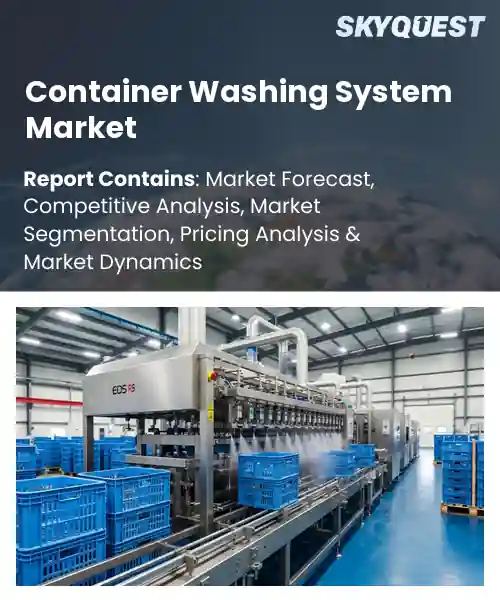
Container Washing System Market
Report ID: SQMIG20I3259
Report ID: SQMIG20I3259
[email protected]
USA +1 351-333-4748
Report ID:
SQMIG20I3259 |
Region:
Global |
Published Date: July, 2026
Pages:
157
|Tables:
154
|Figures:
78


Global Container Washing System Market size was valued at USD 415.80 Million in 2024 and is poised to grow from USD 437.01 Million in 2025 to USD 650.59 Million by 2033, growing at a CAGR of 5.1% during the forecast period (2026-2033).
The container washing system market trends consists of equipment and services that are used to wash shipping containers, railcars, and containers before they re-enter the supply chain. Its importance is given by the strict sanitation regulations, especially for food, pharmaceutical and chemical cargoes, for which a sterile environment for transport is required. The market began to take shape in the early 2000s with increased trading volumes and recall events such as Salmonella pathogen outbreaks. Ports were forced to install wash stations during one European outbreak in 2009. In recent years, automation, water-recycling technology and monitoring have made adoption easier and quicker, turning what was once an optional service into an operational necessity for logistics hubs around the world.
Now, the container washing system market share is being driven by the increasing sustainability pressure that is pushing ports and carriers to use water-recycling and energy-efficient wash systems. Closed-loop units can reduce freshwater use by up to 80 percent, lowering operating costs and meeting standards such as ISO 14001, with the savings serving as an example for other ports to follow. At the same time, the growth of e-commerce and the transportation of temperature sensitive pharmaceuticals is creating a need for fast and high throughput washers that can certify containers in minutes, reducing dwell time and improving berth productivity. This convergence is driving manufacturers to roll out modular, IoT-enabled devices that deliver real-time analytics, creating fresh and significant long-term service-contract and data-subscription revenue opportunities.
How is AI-driven Automation Reshaping the Container Washing System Market?
AI-powered automation is transforming container washing system market growth with the integration of smart sensors, computer vision and machine-learning algorithms into cleaning machinery. Such technologies can monitor water usage, detergent levels and brush wear in real time, allowing the system to adjust cycles on the fly for optimal sanitation. Predictive maintenance alerts reduce downtime and data integration with port management platforms helps with scheduling and improves throughput. Operators now benefit from faster turnarounds, lower operating costs and improved compliance with food‑safety and hazmat regulations. The transition will also speed up across ports of varying sizes as the shift to data-rich autonomous machines further spurs investment in modular designs that can be retrofitted to existing lines.
In March 2024, a leading provider of container washing systems introduced an AI-powered cleaning robot that autonomously maps container interiors, adjusts pressure settings and reports metrics for performance, improving efficiency and supporting the growth trajectory of the market.
Market snapshot - (2026-2033)
Global Market Size
USD 415.8 Million
Largest Segment
Automatic Container Washing Systems
Fastest Growth
Semi-Automatic Container Washing Systems
Growth Rate
5.1% CAGR
To get more insights on this market click here to Request a Free Sample Report
Global container washing system market is segmented by automation technology, equipment configuration, target vessel classification, process application chemical base, end-use industry and region. Based on automation technology, the market is segmented into automatic container washing systems, semi-automatic container washing systems and manual container washing systems. Based on equipment configuration, the market is segmented into continuous tunnel washers, batch rotating cabinets and mobile container washers. Based on target vessel classification, the market is segmented into drum cleaning systems, intermediate bulk container cleaning systems, roller cleaning systems, mixing container cleaning systems, tote washers and pallet cleaners. Based on process application chemical base, the market is segmented into aqueous wash systems, caustic wash cycles, solvent wash cycles and steam sterilization units. Based on end-use industry, the market is segmented into food production, beverage processing, chemical manufacturing, healthcare facilities, petroleum refineries, gas extraction plants, logistics hubs, distribution centers and others. Based on region, the market is segmented into North America, Europe, Asia Pacific, Latin America and Middle East & Africa.
The automatic container washing aystems segment is dominant due to its full-cycle cleaning, real-time monitoring, and remote diagnostics to maintain consistent hygiene standards required by high-throughput industries. It addresses cost efficiency targets and stringent regulatory compliance by limiting labor involvement with repeatable performance. Thus, the emphasis is laid on full automation by manufacturers to lower the risk of contamination, improve throughput and reduce operational costs and this is contributing to its leadership position in the global container washing market segment in general today.
Of these, the semi‑automatic container washing systems segment is exhibiting the strongest growth momentum, as it represents a flexible compromise between capital expenditure and labor efficiency, and is attractive to midsize producers expanding capacity. The modular design allows for easy retrofitting, and new digital add-ons enhance adoption, accelerating market growth and creating new opportunities for equipment suppliers.
Continuous tunnel washers prefer segment leads because it offers continuous high volume cleaning, which matches the throughput demands of large scale logistics and beverage plants. The linear flow removes bottlenecks and advanced sensor networks optimize wash cycles for consistent results in all container sizes. The integrated water recirculation cuts utility costs to meet sustainability mandates. This combination of efficiency, scalability and environmental compliance is why operators seeking maximum productivity prefer continuous tunnels.
In contrast, the mobile container washers segment is the fastest growing segment as it offers on-site flexibility for decentralized operations and temporary facilities. Its compact size and ease of deployment meets the increasing demand for flexible cleaning solutions on construction sites and emergency response situations, driving uptake and generating new sources of income for manufacturers.
To get detailed segments analysis, Request a Free Sample Report
Asia Pacific region has a strong manufacturing base and large maritime logistics networks, which makes it fertile ground for the adoption of container washing solutions. Progressing environmental regulations that support sustainable cargo handling are driving strategic investments in advanced cleaning technologies. Regional major ports were quick to adopt automation and integrated services, resulting in greater efficiency and reduced turn-around times for exporters and importers. A strong engineering workforce enables continuous improvements in system design, and regular collaboration between equipment manufacturers and logistics providers accelerates adoption. All these factors together create a competitive advantage that makes Asia Pacific the primary arena for the deployment and innovation of container washing systems.
Container washing system market outlook in Japan benefits from a long‑standing emphasis on precision engineering and high environmental standards. Port authorities prioritize advanced cleaning protocols to protect coastal ecosystems, fostering demand for reliable, low‑impact equipment. Collaboration between domestic technology firms and global suppliers enables rapid integration of cutting‑edge features, while strong supply chain coordination ensures consistent service levels for containerized trade.
Container washing system market forecast in South Korea is propelled by a dynamic export sector that values rapid container turnaround and stringent hygiene requirements. Government incentives for eco‑friendly industrial practices encourage adoption of water‑efficient cleaning solutions. Leading shipyards and logistics hubs partner with system providers to tailor technologies that meet high throughput demands, reinforcing the nation’s reputation for operational excellence in maritime trade.
In Europe, growth is fueled by stringent environmental regulations mandating ports to embrace sustainable cleaning methods, providing a robust boost for sophisticated container washing technologies. The dense network of multimodal transport hubs in the region requires high levels of operational efficiency, and this is driving investment in automated solutions to reduce labor intensity and improve reliability of turnarounds. Co-operations in research across the continent create innovation leading to designs that are environmentally conscious and in line with the goals of the circular economy. This in turn is fuelling demand for uniform standards of sanitation, further increasing momentum across the European market.
Container washing system market regional outlook in Germany is characterized by a decisive focus on engineering excellence and regulatory compliance. Major ports integrate sophisticated automation to meet stringent environmental standards, while manufacturers concentrate on modular designs that enhance adaptability across diverse cargo types. Close partnerships between industrial associations and technology firms stimulate continuous refinement of cleaning efficiency, reinforcing Germany’s leadership in the European market.
Container washing system market regional forecast in United Kingdom experiences rapid growth driven by ambitious sustainability targets and a thriving logistics sector. Port operators prioritize innovative water‑recycling technologies to align with national environmental goals, while the demand for swift cargo processing encourages adoption of high‑capacity cleaning stations. Collaborative ventures between academic institutions and equipment suppliers accelerate the development of tailored solutions for evolving trade patterns.
Container washing system market analysis in France is emerging as a focal point for eco‑focused initiatives within the maritime community. Governmental incentives support the deployment of low‑impact cleaning systems, and emerging port hubs seek technologies that balance operational speed with environmental stewardship. Growing awareness of hygiene standards in supply chains further stimulates interest in advanced washing solutions.
The presence of vast port infrastructure and proactive regulatory framework in North America can be attributed to the region’s rising share in the container washing market. The need for operational resilience is leading to the use of automated, high-throughput cleaning equipment that can cope with a variety of cargo streams. Sustainability is a key focus for industry stakeholders, leading to the adoption of water-saving features and energy-efficient designs. Robust research and development ecosystems promote cooperation between technology providers and logistics operators, speeding up the deployment of next-gen solutions. The strategic combination of efficiency, environmental responsibility and innovation strengthens the region’s competitive position in the global market.
Container washing system market penetration in United States benefits from a vast coastline dotted with major container terminals that require reliable, high‑capacity cleaning operations. Regulatory bodies encourage adoption of environmentally sound practices, prompting investment in water reclamation and low‑chemical cleaning technologies. Partnerships between leading equipment manufacturers and port authorities enable rapid deployment of scalable solutions that address the high volume of trade traversing the nation.
Container washing system industry in Canada reflects a growing commitment to sustainable maritime practices across its key gateway ports. Cold climate considerations drive the development of robust cleaning systems that maintain performance in challenging conditions. Collaborative initiatives between government agencies and technology firms emphasize water efficiency and reduced environmental impact, supporting the country’s broader goals for greener trade operations.
To know more about the market opportunities by region and country, click here to
Buy The Complete Report
Increasing Demand for Sustainable Logistics
Adoption of Automated Washing Systems
High Initial Capital Investment
Stringent Environmental Compliance Regulations
Request Free Customization of this report to help us to meet your business objectives.
The container washing systems market is characterized by competition among established equipment manufacturers that continue expanding their product portfolios through automation, water recycling technologies, and customized cleaning solutions for food & beverage, chemicals, pharmaceuticals, and industrial packaging applications. Companies are investing in digital monitoring, energy-efficient cleaning technologies, and closed-loop water treatment systems to improve operational efficiency and help customers comply with increasingly stringent hygiene and environmental regulations. Strategic collaborations with industrial packaging companies and process equipment integrators are also enabling manufacturers to deliver turnkey container cleaning solutions while strengthening long-term aftermarket service and maintenance businesses.
Top Player’s Company Profile
Recent Developments in the Container Washing System Market
SkyQuest’s ABIRAW (Advanced Business Intelligence, Research & Analysis Wing) is our Business Information Services team that Collects, Collates, Correlates, and Analyses the Data collected by means of Primary Exploratory Research backed by robust Secondary Desk research. As per SkyQuest analysis, the market’s primary engine is the rising demand for sustainable logistics, which pushes ports to adopt water‑recycling and low‑chemical washers, while the parallel surge in automated washing systems adds a second catalyst by cutting labor costs and boosting throughput. The leading region is Asia Pacific, where dense manufacturing and progressive environmental rules accelerate deployment. Automatic Container Washing Systems remain the dominant segment, delivering full‑cycle cleaning, real‑time monitoring and remote diagnostics that meet stringent hygiene standards. However, high initial capital investment acts as a restraint, limiting uptake among smaller operators and slowing near‑term penetration and encouraging further innovation in IoT‑enabled solutions.
| Report Metric | Details |
|---|---|
| Market size value in 2024 | USD 415.8 Million |
| Market size value in 2033 | USD 650.59 Million |
| Growth Rate | 5.1% |
| Base year | 2024 |
| Forecast period | (2026-2033) |
| Forecast Unit (Value) | USD Million |
| Segments covered |
|
| Regions covered | North America (US, Canada), Europe (Germany, France, United Kingdom, Italy, Spain, Rest of Europe), Asia Pacific (China, India, Japan, Rest of Asia-Pacific), Latin America (Brazil, Rest of Latin America), Middle East & Africa (South Africa, GCC Countries, Rest of MEA) |
| Companies covered |
|
| Customization scope | Free report customization with purchase. Customization includes:-
|
To get a free trial access to our platform which is a one stop solution for all your data requirements for quicker decision making. This platform allows you to compare markets, competitors who are prominent in the market, and mega trends that are influencing the dynamics in the market. Also, get access to detailed SkyQuest exclusive matrix.
Table Of Content
Executive Summary
Market overview
Parent Market Analysis
Market overview
Market size
KEY MARKET INSIGHTS
COVID IMPACT
MARKET DYNAMICS & OUTLOOK
Market Size by Region
KEY COMPANY PROFILES
Methodology
For the Container Washing System Market, our research methodology involved a mixture of primary and secondary data sources. Key steps involved in the research process are listed below:
1. Information Procurement: This stage involved the procurement of Market data or related information via primary and secondary sources. The various secondary sources used included various company websites, annual reports, trade databases, and paid databases such as Hoover's, Bloomberg Business, Factiva, and Avention. Our team did 45 primary interactions Globally which included several stakeholders such as manufacturers, customers, key opinion leaders, etc. Overall, information procurement was one of the most extensive stages in our research process.
2. Information Analysis: This step involved triangulation of data through bottom-up and top-down approaches to estimate and validate the total size and future estimate of the Container Washing System Market.
3. Report Formulation: The final step entailed the placement of data points in appropriate Market spaces in an attempt to deduce viable conclusions.
4. Validation & Publishing: Validation is the most important step in the process. Validation & re-validation via an intricately designed process helped us finalize data points to be used for final calculations. The final Market estimates and forecasts were then aligned and sent to our panel of industry experts for validation of data. Once the validation was done the report was sent to our Quality Assurance team to ensure adherence to style guides, consistency & design.
Analyst Support
Customization Options
With the given market data, our dedicated team of analysts can offer you the following customization options are available for the Container Washing System Market:
Product Analysis: Product matrix, which offers a detailed comparison of the product portfolio of companies.
Regional Analysis: Further analysis of the Container Washing System Market for additional countries.
Competitive Analysis: Detailed analysis and profiling of additional Market players & comparative analysis of competitive products.
Go to Market Strategy: Find the high-growth channels to invest your marketing efforts and increase your customer base.
Innovation Mapping: Identify racial solutions and innovation, connected to deep ecosystems of innovators, start-ups, academics, and strategic partners.
Category Intelligence: Customized intelligence that is relevant to their supply Markets will enable them to make smarter sourcing decisions and improve their category management.
Public Company Transcript Analysis: To improve the investment performance by generating new alpha and making better-informed decisions.
Social Media Listening: To analyze the conversations and trends happening not just around your brand, but around your industry as a whole, and use those insights to make better Marketing decisions.
REQUEST FOR SAMPLE
 REQUEST FREE CUSTOMIZATION
Global Container Washing System Market size was valued at USD 415.8 Million in 2024 and is poised to grow from USD 437.01 Million in 2025 to USD 650.59 Million by 2033, growing at a CAGR of 5.1% during the forecast period (2026-2033).
The competitive landscape is shaped by intense rivalry among equipment manufacturers that are accelerating M&A to broaden product portfolios, forging strategic partnerships with major port operators to embed automated washing solutions, and investing in IoT‑enabled technology to deliver real‑time monitoring and water‑recycling capabilities, thereby differentiating their offerings and locking in long‑term service contracts. 'Kärcher SE & Co. KG', 'Douglas Machines Corp.', 'Rotajet Systems Ltd', 'Numafa Chemical Washing Systems', 'SRS Engineering Corporation', 'OFRU Recycling GmbH & Co. KG', 'Unitech Washing Systems Ltd', 'Mauser Packaging Solutions', 'Schütz GmbH & Co. KGaA', 'Krones AG', 'GEA Group AG', 'NiMCO Corporation', 'JEROS A/S', 'Elpress B.V.', 'Newsmith Stainless Ltd', 'Inox Meccanica S.r.l.', 'Colussi Ermes S.r.l.', 'Smeg S.p.A.', 'Hobart GmbH', 'Meiko Maschinenbau GmbH & Co. KG'
The growing emphasis on sustainable logistics drives operators to seek container washing solutions that reduce environmental impact. By integrating efficient cleaning processes, shipping companies can lower water consumption, minimize chemical usage, and extend container lifespan. This alignment with corporate sustainability goals enhances brand reputation and meets stakeholder expectations, encouraging broader adoption of washing systems across ports and terminals. Consequently, demand for advanced, eco‑friendly washing technologies accelerates market expansion. Furthermore, such practices support compliance with emerging green port initiatives, reinforcing the strategic value of washing systems for long‑term operational efficiency.
Digital Twin Integration: Manufacturers are embedding digital twin technology into container washing systems to simulate operational performance, predict maintenance needs, and optimize resource consumption. By creating real‑time virtual replicas of equipment, users can experiment with cycle parameters, detect inefficiencies, and implement corrective actions without interrupting production. This proactive approach reduces downtime, extends asset life, and aligns with Industry 4.0 strategies, fostering greater transparency and data‑driven decision‑making across the logistics and shipping sectors while simultaneously improving compliance with emerging environmental standards and client sustainability expectations.
Why does Asia Pacific Dominate the Global Container Washing System Market? |@12


Want to customize this report? This report can be personalized according to your needs. Our analysts and industry experts will work directly with you to understand your requirements and provide you with customized data in a short amount of time. We offer $1000 worth of FREE customization at the time of purchase.
Feedback From Our Clients


 USA (+1) 351-333-4748

