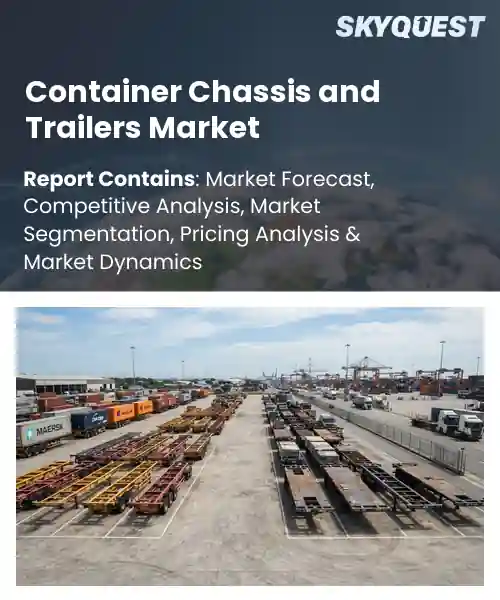
Container Chassis and Trailers Market
Report ID: SQMIG20V2031
Report ID: SQMIG20V2031
[email protected]
USA +1 351-333-4748
Report ID:
SQMIG20V2031 |
Region:
Global |
Published Date: August, 2026
Pages:
157
|Tables:
153
|Figures:
78


Global Container Chassis And Trailers Market size was valued at USD 6.42 Billion in 2024 and is poised to grow from USD 6.82 Billion in 2025 to USD 11.04 Billion by 2033, growing at a CAGR of 6.2% during the forecast period (2026-2033).
Container chassis and trailers form the backbone of intermodal freight, providing the reusable platform that connects sea‑borne containers to trucks and rail wagons. The market has grown as global trade expanded, fuel prices fell, and logistics providers pursued cost‑efficient, carbon‑light solutions. Early 2000s deregulation of inland ports in Europe and the United States unlocked new haulage routes, prompting operators to invest in standardized chassis pools. Today, the sector supports over one million container moves daily, underpinning supply‑chain resilience during disruptions such as the 2021 Suez Canal blockage. This evolution demonstrates how tighter integration of modes fuels demand for global chassis assets. Rising e‑commerce volumes and the consequent pressure on last‑mile delivery speed represent the next pivotal catalyst for the chassis market, because carriers must minimise empty‑haul miles while preserving container turnaround. Companies such as Maersk have launched chassis‑sharing platforms that allocate underutilised units to regional shippers, converting idle capacity into revenue and reducing congestion at inland terminals. This model encourages investment in telematics, which in turn enhances asset visibility and enables pricing aligned with demand spikes during peak seasons. As a result, manufacturers of lightweight aluminium chassis gain market share, while logistics firms exploit the improved efficiency to expand trade corridors.
How is IoT-driven automation reshaping the container chassis and trailers market?
IoT driven automation is turning container chassis and trailers into connected assets that can report location, status and maintenance needs in real time. Sensors on wheels, brakes and locking mechanisms feed data to cloud platforms, enabling operators to schedule repairs before failures occur. This visibility reduces idle time and improves asset utilization across intermodal hubs. Fleet managers can balance demand by reallocating chassis based on predictive analytics rather than manual logs. The technology also supports compliance with safety standards by alerting crews to overload or unsecured loads. As shippers seek faster turnaround, the digital layer adds reliability and flexibility to the supply chain.Great Dane Trailers November 2025 introduced a telematics suite that links each chassis to a central dashboard, allowing operators to view temperature, door status and battery health instantly. The system cuts dispatch delays and helps carriers keep equipment in optimal condition, driving efficiency across the market.
Market snapshot - (2026-2033)
Global Market Size
USD 6.42 Billion
Largest Segment
Container Chassis
Fastest Growth
Extendable Container Chassis
Growth Rate
6.2% CAGR
To get more insights on this market click here to Request a Free Sample Report
Global container chassis and trailers market is segmented by product type, chassis type, container size, application, end user and region. Based on product type, the market is segmented into Container Chassis, Container Trailers, Chassis-Trailer Combinations, Extendable Container Chassis and Other Types. Based on chassis type, the market is segmented into Gooseneck Chassis, Straight Chassis, Sliding Chassis, Extendable Chassis and Other Chassis Types. Based on container size, the market is segmented into 20-Foot, 40-Foot, 45-Foot and Other Sizes. Based on application, the market is segmented into Dry Containers, Refrigerated Containers, Tank Containers, Specialized Containers and Others. Based on end user, the market is segmented into Shipping & Logistics Companies, Freight Transportation Companies, Port & Terminal Operators, Container Leasing Companies and Others. Based on region, the market is segmented into North America, Europe, Asia Pacific, Latin America and Middle East & Africa.
Container chassis segment dominates because it provides the fundamental structural platform that links containers to trucks, ensuring secure transport across diverse supply‑chain routes. Its simplicity, durability, and compatibility with standard container dimensions make it the preferred choice for most shippers and terminal operators. The widespread reliance on conventional intermodal operations, coupled with cost‑effective maintenance and proven performance, reinforces its central position in the market and continues to drive equipment standardization across global freight networks.
Meanwhile, extendable container chassis emerges as the most rapidly expanding area because its adjustable length accommodates oversized loads and evolving cargo profiles, attracting logistics providers seeking flexibility. Innovative telescopic mechanisms and modular designs are unlocking new route possibilities, prompting manufacturers to invest heavily and accelerating market diversification for future growth.
Gooseneck chassis segment leads because its elevated front axle design distributes weight more evenly, allowing higher payloads and smoother maneuverability in congested terminal yards. This configuration reduces tire wear and improves braking stability, which appeals to freight carriers handling heavy or high‑center‑of‑gravity loads. The operational advantages translate into lower total cost of ownership and enhanced turnaround times, cementing its popularity among high‑volume shippers and reinforcing its status as a preferred choice for demanding logistics networks worldwide.
Conversely, sliding chassis is witnessing the strongest growth momentum because its adjustable platform slides laterally, simplifying container loading in tight dock spaces and reducing reliance on external handling equipment. This innovation enhances operational flexibility, prompting terminal operators to adopt it for space‑constrained facilities and driving rapid market expansion globally now.
To get detailed segments analysis, Request a Free Sample Report
Asia Pacific dominates the global container chassis and trailers market because the region combines deep manufacturing expertise, extensive port infrastructure, and a strong logistics network that supports high volume intermodal activity. Leading economies invest heavily in technology integration and automation, enhancing chassis utilization and reducing turnaround time. The presence of major original equipment manufacturers drives continual product innovation, while trade corridors linking East Asia with emerging markets create persistent demand. Moreover, supportive regulatory frameworks and collaborative partnerships among carriers, terminal operators, and chassis providers reinforce supply chain efficiency, positioning Asia Pacific as the pivotal hub for container movement worldwide. In addition, regional emphasis on green logistics encourages the adoption of low‑emission chassis and alternative fuel solutions, further differentiating Asia Pacific offerings. Digital platforms that enable real‑time tracking and predictive maintenance also enhance asset reliability, allowing carriers to optimize fleet deployment across congested ports.
Container Chassis and Trailers Market in Japan benefits from a mature intermodal ecosystem that integrates advanced manufacturing techniques with highly automated port operations. Domestic manufacturers prioritize precision engineering and durability, while logistics firms adopt sophisticated scheduling software to maximize chassis circulation. Strong collaborations between rail operators and seaport authorities streamline handoff processes, reducing dwell time and supporting high turnover rates essential for the nation’s export‑driven trade flows and reliability overall.
Container Chassis and Trailers Market in South Korea is propelled by a coordinated supply chain that leverages advanced engineering and incentives for efficiency. Local manufacturers focus on lightweight yet robust designs, enabling quicker loading cycles and lower fuel consumption. Integrated digital hubs connect carriers, terminal operators, and customs agencies, facilitating seamless information flow and reducing bottlenecks. The emphasis on export‑oriented logistics sustains demand for reliable chassis solutions across gateway ports.
Europe experiences rapid expansion in the container chassis and trailers market driven by integrated transport policies, high environmental standards, and substantial investments in port modernization. The region’s emphasis on multimodal connectivity encourages collaboration between rail networks, inland waterways, and seaports, fostering efficient chassis turnover. Leading manufacturers adopt modular designs that comply with stringent emissions regulations, while logistics providers leverage advanced analytics to optimize fleet deployment. Growing consumer demand for sustainable freight solutions further accelerates adoption of low‑carbon chassis technologies. Digital platforms that provide visibility into chassis location are integrated into European supply chains, allowing operators to respond to disruptions. Collaborative initiatives among ports, carriers, and equipment providers also foster standardization of chassis interfaces, simplifying cross‑border operations and enhancing efficiency.
Container Chassis and Trailers Market in Germany is anchored by an engineering base and a network of inland terminals that link major ports to the continental hinterland. German manufacturers emphasize precision and compliance with rigorous safety standards, delivering chassis that suit both heavy‑duty freight and environmentally conscious operations. Frameworks between rail operators and maritime hubs streamline chassis handover, while digital scheduling tools improve asset utilization across the country’s logistics corridors.
Container Chassis and Trailers Market in the United Kingdom is growing driven by sustainability targets and rising import volumes at ports. Domestic manufacturers are developing lightweight chassis with alternative fuel capability to meet emissions standards. Digital freight platforms link shippers, carriers, and terminal operators, providing chassis tracking and dynamic allocation. Policy incentives for modal shift promote rail and inland waterway use, expanding demand for versatile chassis across the island’s trade network.
Container Chassis and Trailers Market in France is emerging as logistics firms adopt strategies to support trade through Mediterranean gateways. French manufacturers emphasize modular chassis designs that can be adapted for electric propulsion, aligning with national carbon‑reduction goals. Pilots between port authorities and rail operators test automated chassis handling systems to cut dwell time. Growing awareness of freight sustainability among shippers drives interest in low‑emission chassis, positioning France as a hub for transport.
North America strengthens its position in the container chassis and trailers market through a combination of expansive inland transportation networks, robust port capacities, and innovation in chassis design. The United States benefits from a vast rail corridor system that connects major coastal gateways to inland distribution hubs, enabling efficient chassis repositioning. Investment in smart technologies such as IoT‑enabled tracking and automated management platforms improves asset visibility and utilization rates. Canada focuses on harmonizing standards across provinces and aligning with cross‑border protocols, facilitating seamless chassis flow between the two nations. Both countries prioritize sustainability, encouraging the development of alternative‑fuel chassis and supporting policies that reward greener freight solutions. Collaborative initiatives among carriers, terminal operators, and equipment manufacturers further drive standardization and operational excellence across the continent.
Container Chassis and Trailers Market in the United States is shaped by a network of ports on Atlantic and Pacific coasts that handle volumes of container traffic. Domestic manufacturers focus on chassis solutions that integrate telematics for monitoring. Collaboration between rail freight operators and maritime terminals streamlines chassis exchanges, while logistics firms adopt algorithms to optimize asset deployment. Ongoing policy support for low‑emission equipment encourages transition toward greener chassis options nationwide.
Container Chassis and Trailers Market in Canada is evolving as the country aligns its logistics framework with trade dynamics and connectivity. Manufacturers prioritize durable designs suited for colder climates and longer haul distances, incorporating modular components for easy maintenance. Partnerships between Canadian ports and U.S. rail networks facilitate chassis movement, reducing time at borders. Sustainability incentives encourage adoption of electric and hybrid chassis, supporting goals for reduced emissions in freight transportation.
To know more about the market opportunities by region and country, click here to
Buy The Complete Report
Rising Demand For Intermodal Transport
Adoption Of Lightweight Materials
Fluctuating Fuel Prices Impact
Stringent Emission Regulations
Request Free Customization of this report to help us to meet your business objectives.
The container chassis and trailers market is shaped by intense rivalry as incumbents pursue M&A, strategic alliances and tech upgrades to secure freight‑liner contracts; CIMC Vehicles Group’s recent acquisition of a regional trailer builder, Hyundai Translead’s partnership with a major logistics carrier, and CIE Manufacturing’s rollout of IoT‑enabled durable chassis illustrate how competition drives innovation, cost efficiency and service differentiation.
Top Player’s Company Profile
Recent Developments
SkyQuest’s ABIRAW (Advanced Business Intelligence, Research & Analysis Wing) is our Business Information Services team that Collects, Collates, Correlates, and Analyses the Data collected by means of Primary Exploratory Research backed by robust Secondary Desk research. As per SkyQuest analysis, the global container chassis and trailers market is being propelled primarily by the rising demand for intermodal transport, which fuels investment in versatile chassis to support faster freight turnaround. A second strong catalyst is the growing adoption of lightweight materials that improve fuel efficiency and payload capacity while meeting sustainability goals. However, fluctuating fuel prices pose a restraint by prompting carriers to delay new equipment purchases, tempering growth. Asia Pacific dominates the market thanks to its extensive port infrastructure, manufacturing base and digital adoption, and within this region the container chassis segment remains the clear leader, driven by its fundamental role in linking containers to trucks.
| Report Metric | Details |
|---|---|
| Market size value in 2024 | USD 6.42 Billion |
| Market size value in 2033 | USD 11.04 Billion |
| Growth Rate | 6.2% |
| Base year | 2024 |
| Forecast period | (2026-2033) |
| Forecast Unit (Value) | USD Billion |
| Segments covered |
|
| Regions covered | North America (US, Canada), Europe (Germany, France, United Kingdom, Italy, Spain, Rest of Europe), Asia Pacific (China, India, Japan, Rest of Asia-Pacific), Latin America (Brazil, Rest of Latin America), Middle East & Africa (South Africa, GCC Countries, Rest of MEA) |
| Companies covered |
|
| Customization scope | Free report customization with purchase. Customization includes:-
|
To get a free trial access to our platform which is a one stop solution for all your data requirements for quicker decision making. This platform allows you to compare markets, competitors who are prominent in the market, and mega trends that are influencing the dynamics in the market. Also, get access to detailed SkyQuest exclusive matrix.
Table Of Content
Executive Summary
Market overview
Parent Market Analysis
Market overview
Market size
KEY MARKET INSIGHTS
COVID IMPACT
MARKET DYNAMICS & OUTLOOK
Market Size by Region
KEY COMPANY PROFILES
Methodology
For the Container Chassis and Trailers Market, our research methodology involved a mixture of primary and secondary data sources. Key steps involved in the research process are listed below:
1. Information Procurement: This stage involved the procurement of Market data or related information via primary and secondary sources. The various secondary sources used included various company websites, annual reports, trade databases, and paid databases such as Hoover's, Bloomberg Business, Factiva, and Avention. Our team did 45 primary interactions Globally which included several stakeholders such as manufacturers, customers, key opinion leaders, etc. Overall, information procurement was one of the most extensive stages in our research process.
2. Information Analysis: This step involved triangulation of data through bottom-up and top-down approaches to estimate and validate the total size and future estimate of the Container Chassis and Trailers Market.
3. Report Formulation: The final step entailed the placement of data points in appropriate Market spaces in an attempt to deduce viable conclusions.
4. Validation & Publishing: Validation is the most important step in the process. Validation & re-validation via an intricately designed process helped us finalize data points to be used for final calculations. The final Market estimates and forecasts were then aligned and sent to our panel of industry experts for validation of data. Once the validation was done the report was sent to our Quality Assurance team to ensure adherence to style guides, consistency & design.
Analyst Support
Customization Options
With the given market data, our dedicated team of analysts can offer you the following customization options are available for the Container Chassis and Trailers Market:
Product Analysis: Product matrix, which offers a detailed comparison of the product portfolio of companies.
Regional Analysis: Further analysis of the Container Chassis and Trailers Market for additional countries.
Competitive Analysis: Detailed analysis and profiling of additional Market players & comparative analysis of competitive products.
Go to Market Strategy: Find the high-growth channels to invest your marketing efforts and increase your customer base.
Innovation Mapping: Identify racial solutions and innovation, connected to deep ecosystems of innovators, start-ups, academics, and strategic partners.
Category Intelligence: Customized intelligence that is relevant to their supply Markets will enable them to make smarter sourcing decisions and improve their category management.
Public Company Transcript Analysis: To improve the investment performance by generating new alpha and making better-informed decisions.
Social Media Listening: To analyze the conversations and trends happening not just around your brand, but around your industry as a whole, and use those insights to make better Marketing decisions.
REQUEST FOR SAMPLE
 REQUEST FREE CUSTOMIZATION


Want to customize this report? This report can be personalized according to your needs. Our analysts and industry experts will work directly with you to understand your requirements and provide you with customized data in a short amount of time. We offer $1000 worth of FREE customization at the time of purchase.
Feedback From Our Clients


 USA (+1) 351-333-4748

