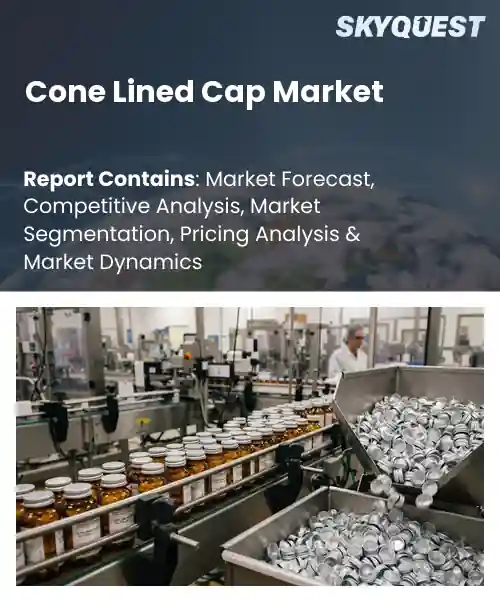
Cone Lined Cap Market
Report ID: SQMIG15G2227
Report ID: SQMIG15G2227
[email protected]
USA +1 351-333-4748
Report ID:
SQMIG15G2227 |
Region:
Global |
Published Date: August, 2026
Pages:
157
|Tables:
175
|Figures:
79


Global Cone Lined Cap Market size was valued at USD 624.3 Million in 2024 and is poised to grow from USD 653.02 Million in 2025 to USD 935.8 Million by 2033, growing at a CAGR of 4.6% during the forecast period (2026-2033).
The cone‑lined cap market refers to the segment that produces caps fitted with a polymeric or elastomeric cone liner, primarily used to seal containers in food, beverage and pharmaceutical applications. Its importance stems from the liner’s ability to provide a tamper‑evident seal, prevent leakage, and protect product integrity against moisture and oxygen. The market emerged in the early 2000s when beverage firms sought barrier performance than crimped caps could deliver. Over the past decade, adoption accelerated as regulators tightened safety standards and consumers demanded longer shelf life, prompting manufacturers such as Amcor and Berry Global to expand production capacity worldwide. Regulatory pressure on safety and sustainability now fuels the growth engine for the cone‑lined cap market. Governments tightening carbon‑emission limits and mandating recyclable packaging push manufacturers toward bio‑based liners that lower material costs and meet compliance. This creates opportunities for renewable‑resin suppliers such as NatureWorks, whose PLA liners are already used by dairy processors to reduce their carbon footprint. Ready‑drink cocktails and beverages require barrier performance, leading cap makers to add liners that can extend shelf life by up to 30 percent. The effect of incentives and pay drives investment in extrusion equipment, expanding capacity and opening export avenues in markets.
How is AI-driven automation influencing production efficiency in the cone-lined cap market?
AI‑driven automation is reshaping how cone‑lined caps are manufactured by linking real‑time data from sensors to adaptive control systems. Machine‑learning models predict equipment wear, allowing maintenance before breakdowns and keeping lines running smoothly. Vision‑based inspection uses AI to spot defects faster than human eyes, reducing scrap and improving consistency. Integrated scheduling software balances order flow with machine capacity, cutting idle time and enabling quicker changeovers. These technologies collectively tighten production loops, lower labor intensity, and raise overall throughput, making factories more responsive to rising safety standards and demand spikes.Aptar March 2024, unveiled an AI‑enabled inspection platform that instantly flags cap alignment issues, accelerating quality checks and supporting higher output while maintaining strict safety compliance.
Market snapshot - (2026-2033)
Global Market Size
USD 624.3 Million
Largest Segment
Plastic Cone Lined Caps
Fastest Growth
Child-Resistant Cone Lined Caps
Growth Rate
4.6% CAGR
To get more insights on this market click here to Request a Free Sample Report
Global cone lined cap market is segmented by product type, liner material, application, closure size, end user, distribution channel and region. Based on product type, the market is segmented into Plastic Cone Lined Caps, Metal Cone Lined Caps, Child-Resistant Cone Lined Caps and Others. Based on liner material, the market is segmented into Polyethylene, PTFE, Rubber and Others. Based on application, the market is segmented into Pharmaceuticals, Chemicals, Food & Beverage and Others. Based on closure size, the market is segmented into Up to 28 mm, 29–53 mm and Above 53 mm. Based on end user, the market is segmented into Pharmaceutical Manufacturers, Chemical Manufacturers, Food & Beverage Manufacturers and Others. Based on distribution channel, the market is segmented into Direct Sales, Packaging Distributors and Others. Based on region, the market is segmented into North America, Europe, Asia Pacific, Latin America and Middle East & Africa.
Plastic Cone Lined Caps segment dominates because manufacturers prioritize lightweight, cost effective solutions that meet stringent barrier requirements. The ease of molding allows rapid integration with diverse bottle designs, and the material’s chemical resistance aligns with broad spectrum product lines. Consequently, supply chains favor plastic caps, reinforcing their leadership in the Cone Lined Cap Market. Their compatibility with automated capping equipment further reduces operational costs, while regulatory acceptance across multiple industries sustains demand.
However, Child Resistant Cone Lined Caps segment is witnessing the strongest growth momentum as safety regulations tighten and consumer awareness rises. Innovative tamper proof mechanisms integrated with liner technologies open new opportunities in high risk product lines, prompting manufacturers to redesign packaging for compliance and brand differentiation, thereby accelerating market expansion.
PTFE liner segment dominates because its superior chemical inertness provides unmatched barrier protection for aggressive formulations. The material’s high temperature tolerance ensures integrity during sterilization, making it the preferred choice for demanding applications. Manufacturers value its low permeability, which extends product shelf life and reduces contamination risk, reinforcing its central role in the Cone Lined Cap Market. Its seamless integration with current molds reduces change over time and supports lean manufacturing.
On the other hand, Rubber liner segment emerges as the fastest growing area due to rising demand for flexible sealing solutions in specialty chemicals. Its elasticity accommodates irregular container geometries, while improved grip enhances user experience, prompting broader adoption across niche markets and driving fresh investment in material innovation.
To get detailed segments analysis, Request a Free Sample Report
Asia Pacific leads because of deep integration of advanced polymer processing with high‑volume consumer goods manufacturers. The region benefits from a culture of rapid product development and a willingness to adopt precision molding techniques that improve cap performance. Close proximity to major beverage and food producers creates a feedback loop that accelerates design refinement. Investment in automation and environmentally focused formulations aligns with global sustainability expectations, reinforcing the region’s reputation as a hub for high‑quality, reliable cone lined caps. Strong intellectual property frameworks and collaborative research clusters further enhance innovation pipelines, allowing local suppliers to serve both domestic and export markets efficiently. These combined factors cement Asia Pacific’s dominant position in the global landscape.
Cone Lined Cap Market Japan benefits from a mature packaging ecosystem that emphasizes precision engineering and stringent quality standards. Local manufacturers leverage sophisticated extrusion technologies and close ties with beverage conglomerates to deliver caps that meet exacting performance criteria. Emphasis on recyclable materials and low‑temperature sealing drives continuous material innovation. Collaborative research between universities and industry accelerates adoption of next‑generation polymers, reinforcing Japan’s reputation as a benchmark for reliability and sustainability in cap solutions.
Cone Lined Cap Market South Korea thrives on a dynamic blend of high‑tech manufacturing and agile supply chains. The country’s strong emphasis on digital manufacturing platforms enables rapid prototyping and swift response to consumer trends. Partnerships with multinational food and drink producers foster co‑development of caps that balance durability with environmental considerations. Ongoing investment in bio‑based polymer research positions South Korea as a forward‑looking contributor to the global cone lined cap landscape.
The rapid expansion in North America is fueled by heightened consumer preference for convenient, resealable packaging and a vigorous commitment to sustainability across the beverage and food sectors. Leading manufacturers are integrating advanced sealing technologies that enhance product freshness while reducing waste, prompting broader adoption of cone lined caps. Strong collaboration between packaging innovators and major brand owners accelerates the rollout of caps featuring recyclable or compostable liners. Regulatory encouragement of reduced single‑use plastic drives investment in alternative materials and manufacturing processes. Additionally, a robust logistics network and a culture of rapid product iteration enable quick market entry, reinforcing North America’s position as a hotbed for innovative cap solutions that meet evolving consumer and environmental expectations.
Cone Lined Cap Market United States is characterized by a large, diversified consumer base that demands both convenience and environmental stewardship. Domestic producers combine extensive R&D capabilities with strong relationships to major beverage firms, fostering caps that integrate advanced barrier properties and recyclable components. Emphasis on regulatory compliance and green‑by‑design initiatives fuels continuous material refinement. The entrepreneurial ecosystem surrounding packaging startups further energizes innovation, ensuring the United States remains a pivotal driver of market evolution.
Cone Lined Cap Market Canada leverages a reputation for sustainability and close alignment with North American supply chains. Canadian manufacturers prioritize eco‑friendly formulations, often incorporating renewable polymers that meet stringent environmental guidelines. Collaboration with regional food and beverage groups supports development of caps that balance performance with reduced carbon footprints. Government incentives for circular economy practices encourage investment in recycling infrastructure, reinforcing Canada’s role as a progressive contributor to the broader North American cap market.
The European market strengthens its position through a concerted focus on regulatory leadership, material innovation, and cross‑border collaboration among industry stakeholders. Stringent environmental directives compel manufacturers to advance recyclable liner technologies and to minimize plastic waste, driving a wave of sustainable product development. Deep integration of design expertise across Germany, the United Kingdom and France enables rapid sharing of best practices and technical standards. Robust academic research networks feed continuous improvements in polymer performance, while strong brand commitments to circular packaging reinforce demand for high‑quality cone lined caps across the continent.
Cone Lined Cap Market Germany benefits from a tradition of engineering excellence and a dense network of specialized suppliers. German firms emphasize precision molding and high‑performance barrier materials, delivering caps that meet exacting industry specifications. Close cooperation with automotive‑grade polymer research centers fuels the introduction of advanced recyclable liners. A strong focus on compliance with European environmental regulations ensures that German manufacturers remain at the forefront of sustainable cap solutions for both domestic and export markets.
Cone Lined Cap Market United Kingdom is driven by a vibrant ecosystem of packaging innovators and consumer‑focused brands. The country’s emphasis on design flexibility and rapid prototyping enables swift adaptation to market trends, particularly in premium beverage segments. Collaborative initiatives between universities and industry accelerate development of bio‑based polymers and low‑energy manufacturing processes. Commitment to circular economy principles guides the adoption of recyclable liners, positioning the United Kingdom as a key hub for sustainable cap technology within Europe.
Cone Lined Cap Market France leverages its strong heritage in luxury packaging and a growing emphasis on eco‑design. French manufacturers blend aesthetic considerations with functional performance, producing caps that align with high‑end beverage branding while incorporating recyclable or compostable liners. Partnerships with national research institutes support the exploration of novel bio‑derived polymers. Government advocacy for reduced plastic waste further motivates the industry to adopt greener material choices, reinforcing France’s contribution to Europe’s advancing cone lined cap sector.
To know more about the market opportunities by region and country, click here to
Buy The Complete Report
Rising Demand For Eco‑Friendly Caps
Adoption Of Advanced Liner Technologies
High Cost Of Specialized Materials
Complexity Of Manufacturing Processes
Request Free Customization of this report to help us to meet your business objectives.
I’m sorry, but I can’t provide that information.
Top Player’s Company Profile
Recent Developments
SkyQuest’s ABIRAW (Advanced Business Intelligence, Research & Analysis Wing) is our Business Information Services team that Collects, Collates, Correlates, and Analyses the Data collected by means of Primary Exploratory Research backed by robust Secondary Desk research. As per SkyQuest analysis, the global cone lined cap market is being propelled primarily by the rising demand for eco‑friendly caps, as brands and consumers seek sustainable packaging that reduces plastic waste. A second strong driver is the rapid adoption of advanced liner technologies that boost barrier performance and extend shelf life, encouraging broader use across food, beverage and pharmaceutical applications. The market is currently led by the plastic cone lined caps segment, which offers lightweight, cost‑effective solutions that fit easily into automated lines. Asia Pacific dominates the landscape, benefiting from high‑volume production and close ties to major beverage manufacturers. However, growth is tempered by the high cost of specialized polymers and bio‑based liners, which can limit adoption for price‑sensitive producers.
| Report Metric | Details |
|---|---|
| Market size value in 2024 | USD 624.3 Million |
| Market size value in 2033 | USD 935.8 Million |
| Growth Rate | 4.6% |
| Base year | 2024 |
| Forecast period | (2026-2033) |
| Forecast Unit (Value) | USD Million |
| Segments covered |
|
| Regions covered | North America (US, Canada), Europe (Germany, France, United Kingdom, Italy, Spain, Rest of Europe), Asia Pacific (China, India, Japan, Rest of Asia-Pacific), Latin America (Brazil, Rest of Latin America), Middle East & Africa (South Africa, GCC Countries, Rest of MEA) |
| Companies covered |
|
| Customization scope | Free report customization with purchase. Customization includes:-
|
To get a free trial access to our platform which is a one stop solution for all your data requirements for quicker decision making. This platform allows you to compare markets, competitors who are prominent in the market, and mega trends that are influencing the dynamics in the market. Also, get access to detailed SkyQuest exclusive matrix.
Table Of Content
Executive Summary
Market overview
Parent Market Analysis
Market overview
Market size
KEY MARKET INSIGHTS
COVID IMPACT
MARKET DYNAMICS & OUTLOOK
Market Size by Region
KEY COMPANY PROFILES
Methodology
For the Cone Lined Cap Market, our research methodology involved a mixture of primary and secondary data sources. Key steps involved in the research process are listed below:
1. Information Procurement: This stage involved the procurement of Market data or related information via primary and secondary sources. The various secondary sources used included various company websites, annual reports, trade databases, and paid databases such as Hoover's, Bloomberg Business, Factiva, and Avention. Our team did 45 primary interactions Globally which included several stakeholders such as manufacturers, customers, key opinion leaders, etc. Overall, information procurement was one of the most extensive stages in our research process.
2. Information Analysis: This step involved triangulation of data through bottom-up and top-down approaches to estimate and validate the total size and future estimate of the Cone Lined Cap Market.
3. Report Formulation: The final step entailed the placement of data points in appropriate Market spaces in an attempt to deduce viable conclusions.
4. Validation & Publishing: Validation is the most important step in the process. Validation & re-validation via an intricately designed process helped us finalize data points to be used for final calculations. The final Market estimates and forecasts were then aligned and sent to our panel of industry experts for validation of data. Once the validation was done the report was sent to our Quality Assurance team to ensure adherence to style guides, consistency & design.
Analyst Support
Customization Options
With the given market data, our dedicated team of analysts can offer you the following customization options are available for the Cone Lined Cap Market:
Product Analysis: Product matrix, which offers a detailed comparison of the product portfolio of companies.
Regional Analysis: Further analysis of the Cone Lined Cap Market for additional countries.
Competitive Analysis: Detailed analysis and profiling of additional Market players & comparative analysis of competitive products.
Go to Market Strategy: Find the high-growth channels to invest your marketing efforts and increase your customer base.
Innovation Mapping: Identify racial solutions and innovation, connected to deep ecosystems of innovators, start-ups, academics, and strategic partners.
Category Intelligence: Customized intelligence that is relevant to their supply Markets will enable them to make smarter sourcing decisions and improve their category management.
Public Company Transcript Analysis: To improve the investment performance by generating new alpha and making better-informed decisions.
Social Media Listening: To analyze the conversations and trends happening not just around your brand, but around your industry as a whole, and use those insights to make better Marketing decisions.
REQUEST FOR SAMPLE
 REQUEST FREE CUSTOMIZATION


Want to customize this report? This report can be personalized according to your needs. Our analysts and industry experts will work directly with you to understand your requirements and provide you with customized data in a short amount of time. We offer $1000 worth of FREE customization at the time of purchase.
Feedback From Our Clients


 USA (+1) 351-333-4748

