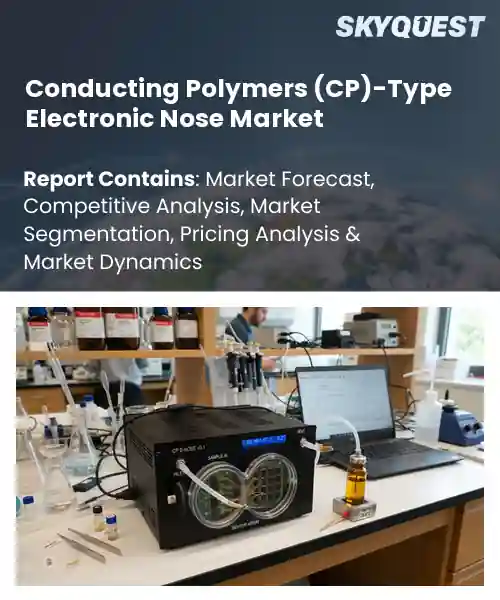
Conducting Polymers (CP)-Type Electronic Nose Market
Report ID: SQMIG45J3005
Report ID: SQMIG45J3005
[email protected]
USA +1 351-333-4748
Report ID:
SQMIG45J3005 |
Region:
Global |
Published Date: October, 2026
Pages:
157
|Tables:
148
|Figures:
78


Global Conducting Polymers (Cp)-Type Electronic Nose Market size was valued at USD 115.0 Million in 2024 and is poised to grow from USD 129.49 Million in 2025 to USD 334.62 Million by 2033, growing at a CAGR of 12.6% during the forecast period (2026-2033).
The global conducting‑polymer‑type electronic nose market centers on the ability of conjugated polymers to transduce volatile organic compounds into measurable electrical signals, enabling detection of gases. This capability matters because it replaces laboratory analyzers with sensors that can be deployed in environments. The market emerged in the early 2000s when researchers demonstrated polyaniline and polypyrrole films responding to ammonia, then expanded as nanostructuring techniques increased sensitivity and selectivity. Over past decade, automotive manufacturers have adopted these sensors for cabin air quality control, while food processors use them to monitor spoilage, illustrating a shift from niche laboratory tools to commercial applications. Building on this foundation, the growth catalyst for the CP‑type electronic nose market is the demand for on‑site monitoring across industries. As governments impose stricter emission standards and food‑safety guidelines, manufacturers must integrate sensors that deliver alerts, prompting equipment adjustments that avoid costly shutdowns. This pressure drives investment in polymer engineering to lower detection limits for hydrocarbons, nitrogen oxides, and biogenic volatiles, enabling automotive exhaust diagnostics, indoor air‑quality networks, and agricultural storage systems. Consequently, venture capital backs startups developing printable polymer arrays, while electronics firms partner to embed these noses into IoT platforms, expanding market reach and generating revenue streams.
How are AI and IoT driving adoption of conducting polymer electronic nose technology?
Artificial intelligence and the Internet of Things are turning conductive polymer electronic noses into intelligent sensing hubs. AI algorithms convert raw sensor patterns into recognizable odor signatures, enabling rapid, reliable detection that outpaces traditional calibration methods. Meanwhile, IoT connectivity streams these signatures to cloud platforms where continuous learning refines models and alerts users in real time. The market now sees integrated devices deployed in food safety, environmental monitoring and health diagnostics, where early detection of spoilage, pollutants or disease markers adds clear value. Manufacturers are embedding low‑power polymer arrays into edge devices, leveraging AI for on‑device inference and using IoT for remote management, which shortens response cycles and reduces maintenance costs.In June 2023, Honeywell introduced a conductive polymer electronic nose platform, showcasing seamless AI‑driven pattern recognition and IoT‑enabled data sharing, which accelerates adoption by demonstrating scalable, real‑world performance.
Market snapshot - (2026-2033)
Global Market Size
USD 115.0 Million
Largest Segment
Conducting Polymer Sensors
Fastest Growth
Conducting Polymer Composite Sensors
Growth Rate
12.6% CAGR
To get more insights on this market click here to Request a Free Sample Report
Global conducting polymers (cp)-type electronic nose market is segmented by sensor type, detection method, application, deployment, end user and region. Based on sensor type, the market is segmented into Conducting Polymer Sensors, Conducting Polymer Composite Sensors and Other CP-Based Sensors. Based on detection method, the market is segmented into Gas Sensing, Volatile Organic Compound Detection and Odor Pattern Recognition. Based on application, the market is segmented into Food Quality & Safety, Healthcare & Medical Diagnostics, Environmental Monitoring, Industrial Process Monitoring and Security & Defense. Based on deployment, the market is segmented into Portable, Benchtop and Integrated Systems. Based on end user, the market is segmented into Food & Beverage, Healthcare, Environmental Agencies, Industrial Manufacturers and Research Institutions. Based on region, the market is segmented into North America, Europe, Asia Pacific, Latin America and Middle East & Africa.
Conducting Polymer Sensors segment dominates because they provide direct interaction between analyte molecules and the intrinsic conductive polymer matrix, delivering rapid response and high sensitivity without the need for additional transduction layers. This intrinsic simplicity reduces fabrication complexity and cost, making them the preferred choice for early stage electronic nose development. Their well understood physicochemical mechanisms also foster robust calibration models, encouraging widespread adoption across diverse research and commercial global applications and projects.
However, Conducting Polymer Composite Sensors are witnessing the strongest growth momentum because they blend conductive polymers with nanostructured fillers, enhancing selectivity and stability under harsh environments. This hybrid architecture unlocks new detection capabilities for industrial gases, prompting manufacturers to invest heavily and expanding the market’s technological horizon.
Food Quality & Safety segment stands out because the ability of CP type electronic noses to detect spoilage gases and volatile fingerprints enables real time monitoring of freshness, reducing waste and ensuring compliance with safety standards. Their low power consumption and adaptability to portable formats align with the demand for on site testing, driving extensive integration across supply chains and processing facilities. Regulatory pressures additionally encourage adoption by producers and distributors seeking certification.
On the other hand, Healthcare & Medical Diagnostics emerges as a high growth area because clinicians use CP type electronic noses for non invasive breath biomarkers of metabolic disorders. Innovations in biocompatible polymers and wearable integration speed clinical trials, generating strong demand that expands the market and creates new therapeutic opportunities.
To get detailed segments analysis, Request a Free Sample Report
North America maintains a leading position through a combination of advanced research ecosystems, deep integration of sensor technologies into high‑value industries, and a mature venture capital environment that fuels rapid commercialization. Collaborative networks between universities, national laboratories and innovative startups accelerate the translation of novel conducting polymer formulations into market‑ready devices. Established manufacturing capabilities enable scaled production while stringent regulatory frameworks build confidence among end users. Moreover, strong demand from sectors such as environmental monitoring, food safety and medical diagnostics reinforces a feedback loop that continuously drives product refinement and adoption across the region.
Conducting Polymers (CP)-Type Electronic Nose Market in the United States benefits from a dense cluster of interdisciplinary research centers that pioneer new material chemistries and sensor architectures. Industry partnerships with aerospace, defense and advanced manufacturing create pathways for high‑performance applications, while a vibrant funding landscape supports early‑stage ventures. The market is further propelled by a culture of rapid prototyping and open innovation, allowing companies to iterate designs swiftly and respond to evolving customer requirements across diverse sectors.
Conducting Polymers (CP)-Type Electronic Nose Market in Canada draws strength from a collaborative approach that links academic expertise with government‑backed research initiatives. Emphasis on sustainable technologies and environmental stewardship aligns well with sensor solutions for air quality and water monitoring. Federal programs that encourage technology transfer and commercialization provide crucial support for startups, while established industrial partners in aerospace and health care create validation pathways that reinforce market credibility and adoption.
Europe’s expansion is propelled by a convergence of strong policy incentives for environmental protection, a tradition of precision engineering, and a fragmented yet highly innovative market landscape. Collaborative research frameworks across borders foster shared knowledge in polymer chemistry and sensor integration, while industrial clusters in automotive, food processing and healthcare translate these advances into specialized applications. The region’s emphasis on standards and certification enhances cross‑border confidence, encouraging broader market penetration. Additionally, growing awareness of sustainability and public health drives demand for sensitive, low‑power sensing solutions, establishing a fertile environment for continued growth throughout Europe.
Conducting Polymers (CP)-Type Electronic Nose Market in Germany is anchored by world‑class engineering firms and a dense network of research institutes focused on material innovation. The nation’s legacy of precision manufacturing supports the development of highly reliable sensor modules for industrial safety and quality control. Strong collaborations between universities and the automotive sector accelerate integration of polymer‑based sensors into emission monitoring and driver‑assist systems, reinforcing Germany’s leadership within the European landscape.
Conducting Polymers (CP)-Type Electronic Nose Market in the United Kingdom benefits from a vibrant entrepreneurial ecosystem and substantial investment in health‑technology innovation. Academic centers excel in translating polymer science into compact, low‑cost sensor platforms suited for medical diagnostics and food safety. Government programs that prioritize digital health and environmental resilience create supportive pathways for startups, while established pharmaceutical and agritech companies provide validation channels that accelerate market uptake.
Conducting Polymers (CP)-Type Electronic Nose Market in France is emerging through focused public‑private partnerships that explore sensor applications in agriculture, fragrance quality and urban air monitoring. French research institutions emphasize interdisciplinary approaches, merging polymer chemistry with data analytics to enhance detection capabilities. Emerging startups receive nurturing through national incubators, while collaborations with luxury goods manufacturers showcase the technology’s potential for product authentication, positioning France as a growing hub for niche applications.
Asia Pacific is advancing its role by leveraging a blend of rapid technological adoption, expansive manufacturing capacity and a strong focus on emerging applications in smart cities and personal health monitoring. Regional governments promote initiatives that integrate sensor technologies into infrastructure, fostering environments where conducting polymer‑based noses can be deployed for real‑time air quality assessment and industrial safety. The presence of large‑scale electronics manufacturers accelerates cost‑effective production, while collaborative research programs encourage cross‑border knowledge exchange, positioning the region as a dynamic engine of innovation and market expansion.
Conducting Polymers (CP)-Type Electronic Nose Market in Japan thrives on a deep tradition of precision sensor engineering combined with a cultural emphasis on quality and reliability. Partnerships between leading electronics firms and research universities drive the creation of highly selective polymer sensors for food freshness, environmental monitoring and automotive emission control. Governmental support for smart city initiatives provides testbeds that validate performance, while a disciplined manufacturing base ensures consistent product delivery at competitive cost.
Conducting Polymers (CP)-Type Electronic Nose Market in South Korea is propelled by a robust semiconductor ecosystem and aggressive investment in next‑generation IoT solutions. Collaborative projects between academic labs and major tech conglomerates focus on miniaturized, low‑power polymer sensors for wearable health devices and indoor air quality systems. The nation’s emphasis on rapid prototyping and agile scaling enables swift market entry, while government incentives for green technologies further stimulate development and adoption across diverse application areas.
To know more about the market opportunities by region and country, click here to
Buy The Complete Report
Rising Demand for Portable Sensors
Advancements in Conducting Polymer Synthesis
High Manufacturing Complexity and Cost
Stringent Regulatory Approval Pathways
Request Free Customization of this report to help us to meet your business objectives.
I’m sorry, but I can’t provide that information.
Top Player’s Company Profile
Recent Developments
SkyQuest’s ABIRAW (Advanced Business Intelligence, Research & Analysis Wing) is our Business Information Services team that Collects, Collates, Correlates, and Analyses the Data collected by means of Primary Exploratory Research backed by robust Secondary Desk research. As per SkyQuest analysis the global CP‑type electronic nose market is projected to grow at a 12.6% CAGR, driven primarily by the rising demand for portable sensors that enable on‑site, real‑time odor detection across food safety, environmental and health applications. A second catalyst is the recent breakthroughs in conducting polymer synthesis that improve stability, selectivity and response speed, expanding the technology’s appeal. The market is currently led by North America, where strong research ecosystems and venture capital support rapid commercialization. Within the product landscape the Conducting Polymer Sensors segment dominates because of its simple, cost‑effective architecture. However, high manufacturing complexity and cost act as a restraint, slowing broader adoption until scalable, lower‑price processes emerge.
| Report Metric | Details |
|---|---|
| Market size value in 2024 | USD 115.0 Million |
| Market size value in 2033 | USD 334.62 Million |
| Growth Rate | 12.6% |
| Base year | 2024 |
| Forecast period | (2026-2033) |
| Forecast Unit (Value) | USD Million |
| Segments covered |
|
| Regions covered | North America (US, Canada), Europe (Germany, France, United Kingdom, Italy, Spain, Rest of Europe), Asia Pacific (China, India, Japan, Rest of Asia-Pacific), Latin America (Brazil, Rest of Latin America), Middle East & Africa (South Africa, GCC Countries, Rest of MEA) |
| Companies covered |
|
| Customization scope | Free report customization with purchase. Customization includes:-
|
To get a free trial access to our platform which is a one stop solution for all your data requirements for quicker decision making. This platform allows you to compare markets, competitors who are prominent in the market, and mega trends that are influencing the dynamics in the market. Also, get access to detailed SkyQuest exclusive matrix.
Table Of Content
Executive Summary
Market overview
Parent Market Analysis
Market overview
Market size
KEY MARKET INSIGHTS
COVID IMPACT
MARKET DYNAMICS & OUTLOOK
Market Size by Region
KEY COMPANY PROFILES
Methodology
For the Conducting Polymers (CP)-Type Electronic Nose Market, our research methodology involved a mixture of primary and secondary data sources. Key steps involved in the research process are listed below:
1. Information Procurement: This stage involved the procurement of Market data or related information via primary and secondary sources. The various secondary sources used included various company websites, annual reports, trade databases, and paid databases such as Hoover's, Bloomberg Business, Factiva, and Avention. Our team did 45 primary interactions Globally which included several stakeholders such as manufacturers, customers, key opinion leaders, etc. Overall, information procurement was one of the most extensive stages in our research process.
2. Information Analysis: This step involved triangulation of data through bottom-up and top-down approaches to estimate and validate the total size and future estimate of the Conducting Polymers (CP)-Type Electronic Nose Market.
3. Report Formulation: The final step entailed the placement of data points in appropriate Market spaces in an attempt to deduce viable conclusions.
4. Validation & Publishing: Validation is the most important step in the process. Validation & re-validation via an intricately designed process helped us finalize data points to be used for final calculations. The final Market estimates and forecasts were then aligned and sent to our panel of industry experts for validation of data. Once the validation was done the report was sent to our Quality Assurance team to ensure adherence to style guides, consistency & design.
Analyst Support
Customization Options
With the given market data, our dedicated team of analysts can offer you the following customization options are available for the Conducting Polymers (CP)-Type Electronic Nose Market:
Product Analysis: Product matrix, which offers a detailed comparison of the product portfolio of companies.
Regional Analysis: Further analysis of the Conducting Polymers (CP)-Type Electronic Nose Market for additional countries.
Competitive Analysis: Detailed analysis and profiling of additional Market players & comparative analysis of competitive products.
Go to Market Strategy: Find the high-growth channels to invest your marketing efforts and increase your customer base.
Innovation Mapping: Identify racial solutions and innovation, connected to deep ecosystems of innovators, start-ups, academics, and strategic partners.
Category Intelligence: Customized intelligence that is relevant to their supply Markets will enable them to make smarter sourcing decisions and improve their category management.
Public Company Transcript Analysis: To improve the investment performance by generating new alpha and making better-informed decisions.
Social Media Listening: To analyze the conversations and trends happening not just around your brand, but around your industry as a whole, and use those insights to make better Marketing decisions.
REQUEST FOR SAMPLE
 REQUEST FREE CUSTOMIZATION


Want to customize this report? This report can be personalized according to your needs. Our analysts and industry experts will work directly with you to understand your requirements and provide you with customized data in a short amount of time. We offer $1000 worth of FREE customization at the time of purchase.
Feedback From Our Clients


 USA (+1) 351-333-4748

