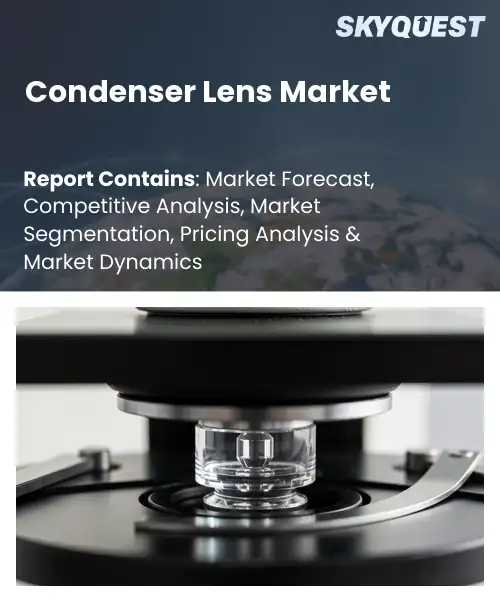
Condenser Lens Market
Report ID: SQMIG20D2577
Report ID: SQMIG20D2577
[email protected]
USA +1 351-333-4748
Report ID:
SQMIG20D2577 |
Region:
Global |
Published Date: April, 2026
Pages:
157
|Tables:
143
|Figures:
78


Global Condenser Lens Market size was valued at USD 1.5 Billion in 2024 and is poised to grow from USD 1.61 Billion in 2025 to USD 2.88 Billion by 2033, growing at a CAGR of 7.5% during the forecast period (2026-2033).
The primary driver of the condenser lens market is accelerating demand for precision optics in imaging, projection and lithography systems, which has transformed a niche component industry into part of photonics value chains. Condenser lenses gather and shape light to improve illumination uniformity, resolution and throughput, and functionality underpins applications from semiconductor photolithography to projection and microscopes. Historically the market evolved from simple glass optics toward aspheric molded plastics and glass polymer designs as manufacturing capabilities improved; for example, projectors shifted to molded aspheric lenses to reduce cost while semiconductor fabs adopted high purity fused silica condensers for ultraviolet exposure.Building on that evolution, the key factor shaping global condenser lens growth is scalable fabrication that lowers unit costs and expands end markets. As manufacturers adopt precision injection molding, nanoimprint lithography and improved coating processes, optical performance rises and prices drop, prompting projector makers to deliver brighter, more uniform illumination and enabling semiconductor fabs to deploy ultraviolet condensers for smaller nodes. The resulting cost-performance shift opens opportunities in automotive sensing and augmented reality where compact, high-efficiency condensers are required, and it drives suppliers to scale automation and quality control so they can meet the tight tolerances those real-world applications demand.
How is AI transforming demand forecasting in the condenser lens market?
AI is reshaping demand forecasting in the condenser lens market by combining machine learning with diverse data sources to deliver more context aware and adaptive predictions. Key aspects include learning patterns from historical orders, ingesting signals from sales channels and adjacent markets, and detecting anomalies caused by supply disruptions or product launches. The current state shows manufacturers and distributors adopting event aware planning to reduce reactive rush builds and improve supplier coordination. In practice this means tighter alignment between quoted lead times and production runs, faster response to shifts in scientific instrument demand, and more resilient inventory positioning across regional channels.Edmund Optics December 2025, the company received recognition for manufacturing excellence which reinforces its ability to scale AI enabled demand forecasting alongside precision production and inventory planning. This supports faster response to order changes and more efficient alignment of output with market signals.
Market snapshot - (2026-2033)
Global Market Size
USD 1.5 Billion
Largest Segment
Spherical Lenses
Fastest Growth
Aspheric Lenses
Growth Rate
7.5% CAGR
To get more insights on this market click here to Request a Free Sample Report
Global condenser lens market is segmented by product type, application, material type, end user, distribution channel and region. Based on product type, the market is segmented into Aspheric Lenses, Spherical Lenses and Custom Lenses. Based on application, the market is segmented into Medical Devices, Industrial Equipment and Consumer Electronics. Based on material type, the market is segmented into Glass, Plastic and Polymer. Based on end user, the market is segmented into Research Institutions and Manufacturers. Based on distribution channel, the market is segmented into Online Retail, Offline Retail and Direct Sales. Based on region, the market is segmented into North America, Europe, Asia Pacific, Latin America and Middle East & Africa.
Aspheric Lenses segment dominates because their surface profiles correct spherical aberration and concentrate light more efficiently, enabling superior illumination uniformity and tighter focal control in condenser systems. This optical advantage drives preference in precision imaging and high-intensity illumination applications, which in turn incentivizes optics manufacturers to prioritize aspheric production, invest in precision molding and coating technologies, and integrate these lenses into advanced optical assemblies to meet evolving performance demands.
However, Custom Lenses are experiencing the fastest growth as OEMs demand tailored optical solutions for niche applications, driving investments in rapid prototyping, bespoke coatings and tight tolerance manufacturing. This customization trend expands opportunities by unlocking specialized use cases, shortening development cycles, and enabling higher-value contracts between optics suppliers and equipment makers.
Medical Devices segment dominates because diagnostic and therapeutic tools demand exceptionally high imaging clarity, consistent illumination, and robust material compatibility, positioning condenser lenses as critical components. Strict safety and reliability expectations drive suppliers to adopt tighter quality controls and specialized coatings, which prompts design refinement and long-term supplier partnerships, reinforcing the prominence of medical-focused optics in product roadmaps and capital allocation within the condenser lens industry.
Meanwhile, Consumer Electronics is the most rapidly expanding area as demand for compact projection, AR optics, and enhanced imaging drives adoption of miniature condenser lenses. Advances in thin-film coatings, mass-production techniques, and integration into compact modules accelerate design cycles and open new consumer applications, creating avenues for suppliers to scale and diversify product portfolios.
To get detailed segments analysis, Request a Free Sample Report
Asia Pacific dominance in the condenser lens market stems from a confluence of manufacturing strength, concentrated demand from advanced optics industries, and integrated supply chain ecosystems. The region benefits from deep technical expertise in precision glass fabrication, investments in automation, and clusters of component suppliers and OEMs that foster rapid innovation. Close collaboration between research institutions and industry accelerates adaptation of novel lens coatings and high-precision shaping techniques. Strong export orientation and established global distribution networks amplify market reach. Market players leverage cost efficiencies alongside high-volume production capabilities to serve diverse end users, including imaging, semiconductor inspection, and medical instrumentation, reinforcing the region role as a central hub for both advanced development and large scale supply. Supportive industrial policies and a vibrant aftermarket service ecosystem further strengthen competitive positioning across product life cycles.
Condenser Lens Market in Japan is characterized by advanced optical engineering, precision manufacturing, and close ties between universities and specialized OEMs. Domestic firms focus on high quality glass processing, sophisticated coating methods, and stringent quality control to meet demanding applications in scientific instrumentation and high-end imaging. A mature supplier base and emphasis on continuous innovation support niche product differentiation while service capabilities enable companies to maintain leadership across value chains.
Condenser Lens Market in South Korea benefits from strong electronics manufacturing integration, precision component suppliers, and a focus on rapid process optimization. Local manufacturers align lens development with advanced imaging sensor trends and semiconductor inspection needs, emphasizing compactness and performance. Collaboration between industrial firms and applied research centers fosters process refinement and coating technologies. Robust domestic demand from consumer electronics sectors supports product enhancement and positioning within regional supply networks.
North America rapid expansion in the condenser lens market is driven by a combination of innovation in optical design, strong end market demand, and close collaboration between technology companies and research institutions. The region emphasizes customization for specialized applications, such as advanced imaging, life sciences, and semiconductor inspection, encouraging suppliers to invest in precision fabrication and advanced coating techniques. A competitive landscape featuring both established optical manufacturers and agile startups promotes rapid prototyping and adoption of tailored solutions. Additionally, integrated supply chains, proximity to major OEMs, and a service focus on application support and quality assurance enable market participants to respond quickly to evolving customer requirements and capture high-value opportunities across diverse sectors. Supportive procurement practices among key end users and investment in automated manufacturing processes reinforce scalability, while aftermarket services and technical support strengthen customer retention and enable sustained market momentum.
Condenser Lens Market in United States is driven by proximity to major technology OEMs, strong research institutions, and a diversified end user base spanning healthcare, semiconductor, and aerospace. Suppliers prioritize bespoke optical solutions, rapid prototyping, and stringent quality processes to meet demanding application requirements. A competitive ecosystem of established manufacturers and innovative startups supports technological advancement, while robust technical support and services help translate complex optical designs into deployable systems.
Condenser Lens Market in Canada is shaped by a collaboration between research institutions, specialty manufacturers, and niche OEMs focusing on imaging and scientific instruments. Emphasis on customization and rigorous testing supports development of lenses tailored for laboratory equipment and industrial inspection. The local market values service, application support, and close supplier relationships, enabling iterative design improvements. Partnerships with international distributors extend reach while maintaining focus on quality and technical competence.
Europe is strengthening its position in the condenser lens market through a combination of advanced materials research, precision optics heritage, and a focus on regulatory compliance and quality standards. Regional manufacturers emphasize high performance differentiation, specialized coatings, and bespoke optical assemblies tailored to scientific and industrial applications. Collaboration across international research networks and cross-border supply partnerships accelerates technology transfer and process standardization. Strong capabilities in manufacturing automation and surface treatment techniques support production of complex lens geometries. Collectively, these factors enable European firms to compete on technical depth and reliability, serving demanding customers that prioritize long term performance and rigorous qualification. Investment in optical innovation clusters and partnerships with OEMs supports development of tailored lens subsystems, while robust aftermarket capabilities and certification expertise enhance customer confidence. Emphasis on sustainability in material selection and process optimization further differentiates regional offerings and supports longer product lifecycles.
Condenser Lens Market in Germany leverages a strong precision engineering tradition, advanced manufacturing capabilities, and close integration with industrial automation suppliers. Local firms focus on robust, high tolerance lenses for industrial inspection, machine vision, and automotive applications, emphasizing reliability and performance. Collaboration with equipment manufacturers enables tailored optical modules, while rigorous testing and certification practices support deployment in demanding industrial environments. This engineering driven approach underpins a strong technical reputation.
Condenser Lens Market in United Kingdom combines academic research strengths with a dynamic manufacturing base that services scientific instrumentation and microscopy sectors. Firms prioritize optical innovation, custom assembly, and advanced coating techniques to meet specialized application requirements. Collaborative programs link universities and industry to accelerate prototype validation and performance testing. Emphasis on quality assurance and aftersales services supports strong customer relationships and enhances regional competitiveness in advanced precision optical components.
Condenser Lens Market in France is anchored by research institutions, optics workshops, and firms focusing on scientific and medical imaging applications. Emphasis on precision polishing, bespoke lens assemblies, and innovative coating supports niche product offerings. Collaboration with hospitals and centers facilitates rigorous performance evaluation and application driven design. A culture of artisanal expertise combined with modern production methods enables French manufacturers to deliver differentiated optical components tailored to demanding markets.
To know more about the market opportunities by region and country, click here to
Buy The Complete Report
Rising Demand For Imaging Precision
Expansion Of Photonics And Lasers
High Manufacturing Complexity And Costs
Stringent Quality And Certification Requirements
Request Free Customization of this report to help us to meet your business objectives.
Competitive dynamics in the global condenser lens market are shaped by technology substitution and supply chain consolidation, with incumbents executing targeted acquisitions for precision manufacturing and coatings while specialist startups push metaoptics and freeform micro lens array solutions to displace traditional condensers. Examples include Jenoptik’s acquisition activity to broaden precision optics capabilities, Myrias Optics’ wafer-level metaoptics partnerships, and ANAX Optics’ release of freeform design tools.
Top Player’s Company Profile
Recent Developments
SkyQuest’s ABIRAW (Advanced Business Intelligence, Research & Analysis Wing) is our Business Information Services team that Collects, Collates, Correlates, and Analyses the Data collected by means of Primary Exploratory Research backed by robust Secondary Desk research. As per SkyQuest analysis, the global condenser lens market is being driven by accelerating demand for precision optics in imaging, projection and lithography systems and further bolstered by expansion of photonics and lasers that require specialized beam shaping and coatings. Growth is anchored by aspheric lenses as the dominating segment due to superior aberration correction and illumination control, while Asia Pacific is the dominating region supported by deep manufacturing ecosystems and integrated supply chains. A key restraint remains high manufacturing complexity and costs, which raise barriers to scale and prolong qualification cycles. Suppliers focusing on scalable fabrication and advanced coatings are best positioned to capture rising demand.
| Report Metric | Details |
|---|---|
| Market size value in 2024 | USD 1.5 Billion |
| Market size value in 2033 | USD 2.88 Billion |
| Growth Rate | 7.5% |
| Base year | 2024 |
| Forecast period | (2026-2033) |
| Forecast Unit (Value) | USD Billion |
| Segments covered |
|
| Regions covered | North America (US, Canada), Europe (Germany, France, United Kingdom, Italy, Spain, Rest of Europe), Asia Pacific (China, India, Japan, Rest of Asia-Pacific), Latin America (Brazil, Rest of Latin America), Middle East & Africa (South Africa, GCC Countries, Rest of MEA) |
| Companies covered |
|
| Customization scope | Free report customization with purchase. Customization includes:-
|
To get a free trial access to our platform which is a one stop solution for all your data requirements for quicker decision making. This platform allows you to compare markets, competitors who are prominent in the market, and mega trends that are influencing the dynamics in the market. Also, get access to detailed SkyQuest exclusive matrix.
Table Of Content
Executive Summary
Market overview
Parent Market Analysis
Market overview
Market size
KEY MARKET INSIGHTS
COVID IMPACT
MARKET DYNAMICS & OUTLOOK
Market Size by Region
KEY COMPANY PROFILES
Methodology
For the Condenser Lens Market, our research methodology involved a mixture of primary and secondary data sources. Key steps involved in the research process are listed below:
1. Information Procurement: This stage involved the procurement of Market data or related information via primary and secondary sources. The various secondary sources used included various company websites, annual reports, trade databases, and paid databases such as Hoover's, Bloomberg Business, Factiva, and Avention. Our team did 45 primary interactions Globally which included several stakeholders such as manufacturers, customers, key opinion leaders, etc. Overall, information procurement was one of the most extensive stages in our research process.
2. Information Analysis: This step involved triangulation of data through bottom-up and top-down approaches to estimate and validate the total size and future estimate of the Condenser Lens Market.
3. Report Formulation: The final step entailed the placement of data points in appropriate Market spaces in an attempt to deduce viable conclusions.
4. Validation & Publishing: Validation is the most important step in the process. Validation & re-validation via an intricately designed process helped us finalize data points to be used for final calculations. The final Market estimates and forecasts were then aligned and sent to our panel of industry experts for validation of data. Once the validation was done the report was sent to our Quality Assurance team to ensure adherence to style guides, consistency & design.
Analyst Support
Customization Options
With the given market data, our dedicated team of analysts can offer you the following customization options are available for the Condenser Lens Market:
Product Analysis: Product matrix, which offers a detailed comparison of the product portfolio of companies.
Regional Analysis: Further analysis of the Condenser Lens Market for additional countries.
Competitive Analysis: Detailed analysis and profiling of additional Market players & comparative analysis of competitive products.
Go to Market Strategy: Find the high-growth channels to invest your marketing efforts and increase your customer base.
Innovation Mapping: Identify racial solutions and innovation, connected to deep ecosystems of innovators, start-ups, academics, and strategic partners.
Category Intelligence: Customized intelligence that is relevant to their supply Markets will enable them to make smarter sourcing decisions and improve their category management.
Public Company Transcript Analysis: To improve the investment performance by generating new alpha and making better-informed decisions.
Social Media Listening: To analyze the conversations and trends happening not just around your brand, but around your industry as a whole, and use those insights to make better Marketing decisions.
REQUEST FOR SAMPLE
 REQUEST FREE CUSTOMIZATION


Want to customize this report? This report can be personalized according to your needs. Our analysts and industry experts will work directly with you to understand your requirements and provide you with customized data in a short amount of time. We offer $1000 worth of FREE customization at the time of purchase.
Feedback From Our Clients


 USA (+1) 351-333-4748

