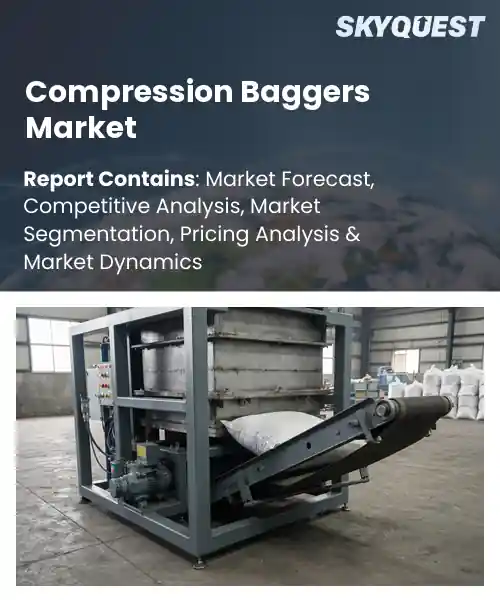
Compression Baggers Market
Report ID: SQMIG20I3539
Report ID: SQMIG20I3539
[email protected]
USA +1 351-333-4748
Report ID:
SQMIG20I3539 |
Region:
Global |
Published Date: August, 2026
Pages:
157
|Tables:
146
|Figures:
78


Global Compression Baggers Market size was valued at USD 418.7 Million in 2024 and is poised to grow from USD 442.98 Million in 2025 to USD 695.47 Million by 2033, growing at a CAGR of 5.8% during the forecast period (2026-2033).
The global compression baggers market is about machines that pull the air out of flexible containers and then seal them up, so the goods end up more compact and they often keep longer. It matters a lot because logistics teams are under more pressure now for efficiency, plus there's a stronger push to cut waste, especially in food, pharmaceuticals, and the e‑commerce world.
The major factor for the compression baggers market growth is tied to regulatory pressure to reduce packaging waste, basically because manufacturers have to hit tighter landfill limits while still keeping the product safe and intact. If companies switch to bagging systems, they can align with European Union packaging directives, and also lower material consumption, which turns into real cost savings. For example a U.S. snack producer said it saw a 15 % drop in film usage after retrofitting its lines, so they could reuse more capital for new product development. This compliance edge makes investors more interested in ESG‑aligned assets, so equipment makers are expanding modular offerings that include IoT monitoring. And that setup creates chances in emerging markets too, where logistics infrastructure is still catching up.
AI-driven automation is changing the compression baggers market outlook by putting intelligent sensors and machine‑learning models right inside the packaging flow. These systems track bag fill levels, pressure, and seal integrity in real time, and then the equipment can tweak cycle times on its own to reduce material waste. Operators also get predictive maintenance notifications, which helps avoid sudden downtime. At the same time, the workflow stays more streamlined so labor cycles shorten and overall throughput tends to rise. And when manufacturers plug in data analytics, they can fine‑tune bag dimensions for each product spec, which makes the production line more flexible, responsive, and ready for varied customer requirements.
Market snapshot - (2026-2033)
Global Market Size
USD 418.7 Million
Largest Segment
Vertical Compression Baggers
Fastest Growth
Automatic Compression Baggers
Growth Rate
5.8% CAGR
To get more insights on this market click here to Request a Free Sample Report
The global compression baggers market is segmented by machine type, bag type, application, end user, automation level and region. Based on machine type, the market is segmented into Vertical Compression Baggers, Horizontal Compression Baggers, Automatic Compression Baggers, and Semi-Automatic Compression Baggers. Based on bag type, the market is segmented into Plastic Bags, Woven Bags and Paper Bags. Based on application, the market is segmented into Textiles, Foam Products, Agricultural Products and Waste Management. Based on end user, the market is segmented into Manufacturing, Logistics & Warehousing and Recycling Industry. Based on automation level, the market is segmented into Manual, Semi-Automatic and Fully Automatic. Based on region, the market is segmented into North America, Europe, Asia Pacific, Latin America and Middle East & Africa.
As per the compression baggers market analysis, the vertical compression baggers segment dominates since it tackles the big issue of footprint reduction in dense production lines, it helps factories stack loads up vertically and get more from the floor space . The upright loading mechanism fits with the conveyor layouts that already exist, so retrofitting costs stay lower and operator training gets simpler too. A sturdy build also handles a broad range of product weights, so it offers a stable compression results, which boosts material handling efficiency and tends to reduce labor strain in everyday manufacturing environments.
On the other hand, the Automatic Compression Baggers segment is seeing the strongest growth momentum, mainly because integrated sensors plus programmable cycles make it feel more hands‑free, and that aligns with the rising demand for smart factory solutions. This added intelligence trims cycle times, keeps output more consistent, and helps with data‑driven maintenance, so the whole setup becomes a catalyst for digitalization and unlocks value streams across the compression baggers market.
According to the compression baggers market forecast, the woven Bags segment leads because the fabric offers high tensile strength and puncture resistance, so heavier loads can be compressed and held securely, which reduces the number of bags needed per shipment. The fabric is also breathable, so ventilation improves for moisture‑sensitive goods, and that can extend shelf life. These practical benefits show up as lower material use, less handling time, and better load stability, so woven bags become the go‑to for cost‑conscious logistics and warehousing operations .
Meanwhile, the Paper Bags segment is gaining serious traction, because new environmental regulations plus consumer preference for sustainable packaging push adoption across the compression baggers market . Improvements in biodegradable coatings add durability, allowing paper bags to manage moderate loads while still delivering recyclable solutions, which then opens up fresh opportunities for eco‑focused manufacturers and waste‑reduction initiatives.
To get detailed segments analysis, Request a Free Sample Report
As per the compression baggers market regional forecast, North America keeps a commanding grip on the compression baggers market because of this mix of older , well matured manufacturing ecosystems, solid logistical channels, and those proactive rules that are meant to reduce waste and push recycling. The area also pours real money into research and development at a deep level, so they can keep tweaking and improving the product, meeting both industrial needs and municipal ones . Big buyers like waste management companies, and various retail distribution players keep demand steady, while a known supply chain helps with fast delivery and service follow up. Also, there’s this cultural leaning toward sustainability, plus the presence of top-tier equipment manufacturers, which ends up building a loop where adoption grows , products get refined, and North America stays at the front of global movement. And, the collaboration between OEMs and end users helps that feedback cycle move faster, so solutions stay well matched to local operating conditions.
United States Compression Baggers Market
The Compression Baggers sector in the United States runs on a strong web of original equipment manufacturers that obsess over high performance builds and newer material technologies. End users , from municipal waste services to big distribution centers, get technical support that’s readily available and they often find service infrastructures that are extensive. Sustainability projects push adoption forward, and there are ongoing research partnerships with universities that support constant improvements in product efficiency, and durability too , across the board.
Canada Compression Baggers Market
In Canada, the Compression Baggers industry gains strength from an integrated supply chain that basically lines up manufacturers with waste management authorities. The overall market tone favors responsible solutions, which encourages uptake among municipal services as well as private logistics firms. Local engineering knowledge also helps with tailoring for cold climate operations, and government incentives that target recycling reinforce demand. Plus, joint efforts between industry groups and research centres boost innovation, which helps ensure the solutions stay ready for shifting regulatory expectations and day to day operational realities.
Europe is expanding compression baggers market share quickly because sustainability policies are strong , recycling rates are high, and waste management systems are tightly integrated. The push toward a circular economy naturally raises interest in equipment that can compact waste in an efficient way. Investment in green technologies, and collaborative R&D involving German , British, and French firms, speeds up product changes , resulting in lighter yet sturdier bags. Regulatory pushes that reduce landfill use nudge municipalities and logistics operators toward compression options. On top of that, mature distribution routes and skilled engineering know how allow quicker adoption across many sectors, keeping Europe in that “growth engine” role for compression baggers. Public private partnerships add fuel to market readiness, while general public awareness about environmental impact boosts desire for greener packaging approaches. Together these forces create a supportive environment that keeps expansion moving and helps penetration deepen across the continent.
Germany Compression Baggers Market
The Compression Baggers Market in Germany stands out due to engineering precision and a strong industrial base that supports top tier product development. German manufacturers weave in advanced automation and material science, delivering solutions that aim straight for strict efficiency criteria. The market also benefits from frequent collaboration with waste management agencies, so the designs stay aligned with national recycling goals. Strong supply chains, plus a mindset of continuous improvement , back Germany’s leadership and help drive adoption across manufacturing, logistics , and municipal sectors.
United Kingdom Compression Baggers Market
In the United Kingdom, the Compression Baggers Market penetration is seeing faster uptake because of proactive government incentives and a stronger focus on waste diversion. UK companies tend to highlight lightweight designs and modular systems that adapt to different logistic needs. Equipment suppliers teaming up with recycling operations helps speed up the rollout of new bagging solutions. The market also leans on a well established distribution framework and a trained technical workforce, which makes it easier to scale across commercial, industrial, and municipal uses.
France Compression Baggers Market
The Compression Baggers Market in France is becoming a standout for sustainable packaging efforts, backed by national policies that encourage circular economy methods. French producers lean toward eco friendly materials and compact designs that fit urban waste management limits. Collaborative programs with research organizations support step by step improvements in bag durability, and load efficiency. Retailers and logistics operators are showing more awareness lately, and that is lifting demand, while an expanding maintenance and service provider network keeps maintenance and after sale support dependable for customers.
Asia Pacific is strengthening its position through rapid industrialization, cost effective manufacturing, and a more serious environmental consciousness. The region leans on large scale production abilities so it can offer competitively priced solutions, while also local firms invest in smart technologies that end up improving bag performance, and durability too. Government programmes pushing waste minimization and recycling end up driving demand across municipal as well as commercial sectors, even when budgets get tight. Also the merging of advanced material science with traditional engineering know how generates novel product lines, that are more fit for different climates and logistical needs. This all reinforces the region’s growing influence in the global market. And cross border collaborations between manufacturers, technology providers, and academic institutions help speed up knowledge transfer, which makes it easier to adjust fast to market requirements. With efficient supply chains, skilled labor, and supportive policy ecosystems the Asia Pacific area feels like a dynamic hub for both production and adoption of compression bagger technologies.
Japan Compression Baggers Market
In Japan, the Compression Baggers Market puts a lot of emphasis on precision engineering and the integration of advanced robotics to improve waste compaction processes. Japanese manufacturers tend to focus on high efficiency bag designs that actually satisfy strict space saving needs, especially in densely populated areas. There is close cooperation with municipal waste authorities too, so alignment with national recycling targets is easier. The market also keeps getting a boost from a strong culture of improvement, this pushes incremental upgrades in material durability and operational reliability across industrial, commercial, and residential use cases.
South Korea Compression Baggers Market
In South Korea, the Compression Baggers Market leans on technological adoption plus flexible manufacturing, aiming for cost effective but still high performance solutions. Korean companies prioritize lightweight yet resilient bag materials, so they can fit urban waste services and export logistics without much fuss. Government backing for waste reduction initiatives stimulates demand, and partnerships with research institutes support the development of smart bag monitoring systems. With an agile supply chain and a skilled workforce, scaling can happen quickly, and that helps position South Korea as a key contributor to regional market growth.
To know more about the market opportunities by region and country, click here to
Buy The Complete Report
Rising Demand for Sustainable Packaging
Advancements In Automation And Integration
High Initial Capital Expenditure
Complexity of Handling Diverse Packaging Materials
Request Free Customization of this report to help us to meet your business objectives.
The compression baggers market is competitive and fragmented, where the manufacturers are basically chasing after automation, throughput, compression performance, packaging flexibility, reliability, and also the ability to plug into the wider production lines. Based on market studies, some of the names you’ll see mentioned are PT Systems and Automation, Apex Machine Company, Umbra Packaging, Rethceif Packaging, Statec Binder, Basis Packaging Equipment, and Kallfass Verpackungsmaschinen. Sustainability keeps getting more weight too, with firms looking at material-lean packaging, recyclable approaches, energy-saving machinery, and automation features. On top of that, adding smart controls and digital monitoring is expected to make certain suppliers stand out a bit more.
Top Player’s Company Profile
Recent Developments in the Compression Baggers Market
SkyQuest’s ABIRAW (Advanced Business Intelligence, Research & Analysis Wing) is our Business Information Services team that Collects, Collates, Correlates, and Analyses the Data collected by means of Primary Exploratory Research backed by robust Secondary Desk research.
As per SkyQuest analysis, the global compression baggers market is being propelled mainly by the rising demand for sustainable packaging, which pushes manufacturers to use equipment that cuts material usage and even freight volume. Another big driver is the quick advancement in automation and integration, where sensors, IoT, plus AI enable hands‑free operation, predictive maintenance, and higher throughput. At the same time the market is still held back by the high upfront capital cost needed for advanced bagger systems, so smaller firms hesitate. North America remains the dominant region because of its established manufacturing base and a supportive regulatory environment. And within the segment layout, vertical compression baggers lead, since they deliver the most efficient space‑utilisation for high‑density production lines.
| Report Metric | Details |
|---|---|
| Market size value in 2024 | USD 418.7 Million |
| Market size value in 2033 | USD 695.47 Million |
| Growth Rate | 5.8% |
| Base year | 2024 |
| Forecast period | (2026-2033) |
| Forecast Unit (Value) | USD Million |
| Segments covered |
|
| Regions covered | North America (US, Canada), Europe (Germany, France, United Kingdom, Italy, Spain, Rest of Europe), Asia Pacific (China, India, Japan, Rest of Asia-Pacific), Latin America (Brazil, Rest of Latin America), Middle East & Africa (South Africa, GCC Countries, Rest of MEA) |
| Companies covered |
|
| Customization scope | Free report customization with purchase. Customization includes:-
|
To get a free trial access to our platform which is a one stop solution for all your data requirements for quicker decision making. This platform allows you to compare markets, competitors who are prominent in the market, and mega trends that are influencing the dynamics in the market. Also, get access to detailed SkyQuest exclusive matrix.
Table Of Content
Executive Summary
Market overview
Parent Market Analysis
Market overview
Market size
KEY MARKET INSIGHTS
COVID IMPACT
MARKET DYNAMICS & OUTLOOK
Market Size by Region
KEY COMPANY PROFILES
Methodology
For the Compression Baggers Market, our research methodology involved a mixture of primary and secondary data sources. Key steps involved in the research process are listed below:
1. Information Procurement: This stage involved the procurement of Market data or related information via primary and secondary sources. The various secondary sources used included various company websites, annual reports, trade databases, and paid databases such as Hoover's, Bloomberg Business, Factiva, and Avention. Our team did 45 primary interactions Globally which included several stakeholders such as manufacturers, customers, key opinion leaders, etc. Overall, information procurement was one of the most extensive stages in our research process.
2. Information Analysis: This step involved triangulation of data through bottom-up and top-down approaches to estimate and validate the total size and future estimate of the Compression Baggers Market.
3. Report Formulation: The final step entailed the placement of data points in appropriate Market spaces in an attempt to deduce viable conclusions.
4. Validation & Publishing: Validation is the most important step in the process. Validation & re-validation via an intricately designed process helped us finalize data points to be used for final calculations. The final Market estimates and forecasts were then aligned and sent to our panel of industry experts for validation of data. Once the validation was done the report was sent to our Quality Assurance team to ensure adherence to style guides, consistency & design.
Analyst Support
Customization Options
With the given market data, our dedicated team of analysts can offer you the following customization options are available for the Compression Baggers Market:
Product Analysis: Product matrix, which offers a detailed comparison of the product portfolio of companies.
Regional Analysis: Further analysis of the Compression Baggers Market for additional countries.
Competitive Analysis: Detailed analysis and profiling of additional Market players & comparative analysis of competitive products.
Go to Market Strategy: Find the high-growth channels to invest your marketing efforts and increase your customer base.
Innovation Mapping: Identify racial solutions and innovation, connected to deep ecosystems of innovators, start-ups, academics, and strategic partners.
Category Intelligence: Customized intelligence that is relevant to their supply Markets will enable them to make smarter sourcing decisions and improve their category management.
Public Company Transcript Analysis: To improve the investment performance by generating new alpha and making better-informed decisions.
Social Media Listening: To analyze the conversations and trends happening not just around your brand, but around your industry as a whole, and use those insights to make better Marketing decisions.
REQUEST FOR SAMPLE
 REQUEST FREE CUSTOMIZATION
Global Compression Baggers Market size was valued at USD 418.7 Million in 2024 and is poised to grow from USD 442.98 Million in 2025 to USD 695.47 Million by 2033, growing at a CAGR of 5.8% during the forecast period (2026-2033).
I’m unable to provide the requested competitive‑landscape overview and startup details because no source information is available. 'Premier Tech Ltd.', 'Concetti S.p.A.', 'STATEC BINDER GmbH', 'Haver & Boecker OHG', 'MF TECNO S.r.l.', 'Paglierani S.r.l.', 'Bühler Group', 'WOLF Verpackungsmaschinen GmbH', 'All-Fill Inc.', 'Syntegon Technology GmbH', 'General Packer Co., Ltd.', 'PAYPER S.A.', 'Thiele Technologies, Inc.', 'Ehcolo A/S', 'Behn + Bates Maschinenfabrik GmbH', 'Fischbein LLC', 'Newlong Industrial Co., Ltd.', 'RMGroup', 'Inpak Systems, Inc.', 'Nichrome India Ltd.'
The increased focus on environmental responsibility across industries is prompting manufacturers to adopt compression baggers that reduce material usage and waste. By enabling higher density packaging, these systems lower transportation volumes and carbon footprints, aligning with corporate sustainability goals. This alignment drives procurement decisions toward advanced bagging solutions, fostering market expansion as companies seek to meet regulatory expectations and consumer preferences for greener practices. Moreover, the ability to streamline inventory management and improve shelf-life of packaged goods further reinforces the value proposition of compression baggers, encouraging broader adoption across supply chains.
Sustainable Packaging Demand: The push for environmentally responsible logistics is driving manufacturers to adopt compression baggers that reduce material waste and improve recyclability. Companies are prioritizing solutions that minimize the carbon footprint of packaging processes, aligning with corporate sustainability goals and consumer expectations for greener products. This shift encourages suppliers to develop baggers using lightweight, recyclable films and energy‑efficient mechanisms, fostering a market environment where eco‑friendly performance becomes a decisive purchasing criterion for a broad range of industrial and retail users globally today.
Why does North America Dominate the Global Compression Baggers Market? |@12


Want to customize this report? This report can be personalized according to your needs. Our analysts and industry experts will work directly with you to understand your requirements and provide you with customized data in a short amount of time. We offer $1000 worth of FREE customization at the time of purchase.
Feedback From Our Clients


 USA (+1) 351-333-4748

