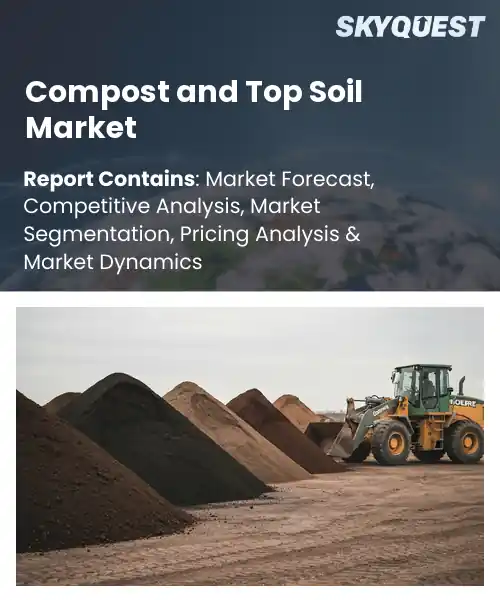
Compost and Top Soil Market
Report ID: SQMIG15C2226
Report ID: SQMIG15C2226
[email protected]
USA +1 351-333-4748
Report ID:
SQMIG15C2226 |
Region:
Global |
Published Date: July, 2026
Pages:
157
|Tables:
146
|Figures:
78


Global Compost And Top Soil Market size was valued at USD 8.43 Billion in 2024 and is poised to grow from USD 8.94 Billion in 2025 to USD 14.36 Billion by 2033, growing at a CAGR of 6.1% during the forecast period (2026-2033).
The global compost and top soil market encompasses production of organic amendments that improve soil fertility, water retention, and carbon sequestration. Its significance has risen as agricultural producers and municipalities seek alternatives to synthetic fertilizers and landfill waste. The primary driver of market expansion is accelerating demand for land‑management practices, a trend that began in the early 2000s when EU directives incentivized organic waste recycling. Since then, North America has seen a surge in community composting facilities, while China has launched programs converting food waste into compost, marking the sector’s shift from niche activity to an element of the circular economy.
The rise of regulatory pressure on greenhouse‑gas emissions fuels a factor: the monetization of carbon sequestration through compost and top‑soil applications. When compost is incorporated into agricultural fields, it captures carbon that would otherwise be released, allowing farmers to earn credits in carbon‑market schemes. This incentive accelerates adoption, as seen in California’s Healthy Soils Program, where participants receive payments proportional to measured soil‑carbon gains. Demand from landscaping firms seeking substrates expands market size, while advancements in anaerobic digestion create compost from biogas residues. Consequently, investment in processing infrastructure intensifies, reinforcing the market’s growth trajectory and diversifying supply chains across regions.
How are AI and IoT Technologies Optimizing Compost And Topsoil Market Supply Chains?
AI and IoT are reshaping the compost and topsoil supply chain by linking farms, processing facilities and distributors with continuous data flow. Sensors monitor moisture, temperature and nutrient levels in raw organic feedstock, allowing operators to adjust aeration and turning schedules in real time. Machine learning models predict optimal blend ratios and forecast demand, reducing waste and inventory pressure. Connected logistics platforms route trucks based on load weight and traffic, cutting travel time and emissions. The result is a more transparent chain where growers receive consistent product quality and buyers benefit from faster, reliable deliveries.
RenX Enterprises Corp., in February 2026, launched an AI driven platform that integrates IoT sensor data from its engineered soil production lines with automated inventory management. The system balances feedstock intake with order schedules, shortening lead times and boosting consistency, which directly supports market expansion and operational efficiency.
Market snapshot - (2026-2033)
Global Market Size
USD 8.43 Billion
Largest Segment
Compost
Fastest Growth
Topsoil
Growth Rate
6.1% CAGR
To get more insights on this market click here to Request a Free Sample Report
Global compost and top soil market is segmented by product type, source, application, end user, distribution channel and region. Based on product type, the market is segmented into Compost and Topsoil. Based on source, the market is segmented into Green Waste, Animal Manure, Municipal Organic Waste and Others. Based on application, the market is segmented into Landscaping, Agriculture, Gardening and Land Reclamation. Based on end user, the market is segmented into Residential, Commercial, Agricultural and Government & Municipal. Based on distribution channel, the market is segmented into Garden Centers, Direct Sales and Online Retail. Based on region, the market is segmented into North America, Europe, Asia Pacific, Latin America and Middle East & Africa.
Garden Centers segment dominates because it offers immediate tactile experience, allowing customers to assess texture, aroma, and nutrient feel directly. Retail staff provide expert guidance, fostering trust and repeat purchases. Physical proximity to gardening projects encourages impulse buying, especially during seasonal planting periods. The entrenched presence of dedicated garden hubs also aligns with traditional DIY culture and environmentally conscious consumer mindset, reinforcing their market leadership.
Meanwhile, Online Retail segment emerges as the key high growth area in the compost and top soil market. Digital platforms broaden reach, offering convenience and home delivery that appeal to time pressed consumers. Interactive tools and curated recommendations accelerate adoption, while data driven personalization fuels repeat orders and expands market penetration.
Landscaping segment dominates because it drives large volume purchases for aesthetic soil enhancement and erosion control in public parks, commercial plazas, and residential gardens. Design professionals rely on consistent quality to meet visual standards, prompting bulk orders and repeat contracts. The visual impact of healthy plant beds directly influences client satisfaction, reinforcing ongoing demand and securing the segment’s leading position through long term maintenance agreements and seasonal refurbishment projects.
On the other hand, Land Reclamation segment is witnessing the strongest growth momentum in the compost and top soil market. Increasing remediation of degraded sites creates demand for soil amendment products that restore fertility and stabilize substrates. Government incentives and corporate sustainability pledges accelerate adoption, positioning this segment as a catalyst for future market expansion.
To get detailed segments analysis, Request a Free Sample Report
North America leads the market through a convergence of mature agricultural practices, sophisticated waste‑to‑resource systems, and proactive policy environments that prioritize soil health and circular economy principles. The region benefits from deep research infrastructure that fuels continuous product innovation, while large‑scale commercial farming adopts organic amendments to sustain productivity. Strong consumer demand for sustainable landscaping and gardening solutions adds further momentum, supported by well‑established distribution channels and expertise in large‑volume logistics. Collaborative initiatives between government agencies, industry associations, and research institutions reinforce standards and promote responsible sourcing, ensuring that North America maintains a competitive edge in quality, reliability, and market responsiveness.
Compost and Top Soil Market in United States is shaped by extensive farmland that embraces organic inputs to improve resilience and yield. Innovation hubs across the country develop microbial‑enhanced blends that cater to diverse climatic zones, while regulatory frameworks encourage the use of certified compost in public projects. Retail networks, from big‑box home centers to specialized garden centers, provide broad access, and a strong culture of environmental stewardship drives household adoption for residential landscaping and backyard gardening.
Compost and Top Soil Market in Canada reflects a strong emphasis on sustainable land management across its vast agricultural and forested landscapes. Government incentives promote the diversion of organic waste into high‑quality compost, fostering a circular approach that supports both crop production and reclamation of degraded sites. Collaborative research programs focus on cold‑climate formulations, and a growing awareness among urban planners leads to increased utilization in municipal green spaces and community gardens.
Europe’s expansion is propelled by stringent environmental regulations that mandate organic matter recycling, alongside a cultural shift toward greener urban development. The region’s mature horticultural sector actively seeks premium compost solutions to meet high standards for soil fertility and biodiversity. Strong public‑private partnerships accelerate research into bio‑based amendments, while consumer preferences for organic produce and sustainable landscaping fuel demand across residential and commercial settings. Integrated waste management infrastructures ensure reliable feedstock supplies, and cross‑border trade within the European market enhances accessibility, reinforcing Europe’s position as an innovative and environmentally conscious hub for compost and top soil.
Compost and Top Soil Market in Germany is characterized by rigorous certification systems that guarantee product quality and traceability. Recycling initiatives convert municipal organic waste into nutrient‑rich compost, supporting intensive horticulture and extensive public green spaces. Industry collaborations focus on precision application technologies, aligning with the country’s emphasis on efficiency and environmental stewardship. Strong consumer demand for organic gardening products further drives market depth and product diversity.
Compost and Top Soil Market in United Kingdom experiences rapid growth fueled by government incentives for sustainable agriculture and urban greening projects. A vibrant network of community composting schemes supplies locally sourced material, enhancing regional resilience. Retailers expand premium product lines to meet rising homeowner interest in environmentally responsible landscaping. Research institutions develop tailored formulations for the varied British climate, reinforcing the market’s reputation for innovation and sustainability.
Compost and Top Soil Market in France is emerging as municipalities prioritize green infrastructure and reduce landfill dependence. National policies encourage organic waste collection, creating a steady stream of high‑quality feedstock for compost production. Agricultural cooperatives adopt compost to improve soil structure and reduce chemical inputs, while boutique garden centers introduce consumer‑friendly blends for home use. Educational campaigns raise awareness of soil health benefits, supporting a gradual but steady market expansion.
Asia Pacific advances its role through accelerating urbanization, expanding horticultural activities, and heightened awareness of waste reduction practices. Nations within the region invest in modern composting facilities that transform agricultural residues and municipal waste into valuable soil amendments, aligning with broader sustainability goals. Growing middle‑class consumers seek healthier home gardens and eco‑friendly landscaping, prompting retailers to diversify product offerings. Cross‑regional collaborations and technology transfer accelerate the development of climate‑adapted compost solutions, while supportive policy frameworks encourage circular resource use, positioning Asia Pacific as an emerging leader in the global compost and top soil landscape.
Compost and Top Soil Market in Japan integrates advanced processing techniques to maximize nutrient recovery from limited land resources. Urban initiatives promote community composting, turning kitchen waste into premium blends for residential gardens and city parks. Agricultural sectors adopt compost to enhance soil fertility and reduce reliance on chemical inputs, supported by research institutions that tailor formulations to the country’s varied microclimates. Consumer interest in home gardening fuels retail expansion of ready‑to‑use products.
Compost and Top Soil Market in South Korea benefits from coordinated waste management policies that channel organic waste into high‑quality compost for both urban greening and intensive farming. Collaborative efforts between industry and academia drive innovation in bio‑fertilizer blends that improve crop resilience. Growing public enthusiasm for sustainable living spurs demand for garden‑center products, while government programs incentivize the use of compost in public landscaping projects, reinforcing the market’s upward trajectory.
To know more about the market opportunities by region and country, click here to
Buy The Complete Report
Rising Consumer Preference for Organic
Government Incentives Supporting Soil Management
High Initial Capital Expenditure
Regulatory Complexity Across Regions
Request Free Customization of this report to help us to meet your business objectives.
The compost and top‑soil market is shaped by a handful of agile innovators that compete through technology‑driven product launches and strategic capital raises. Biome Makers accelerates soil health monitoring with AI‑based DNA analytics, leveraging a $35 million Series A to forge agribusiness partnerships, while Sway differentiates by commercializing seaweed‑derived compostable films, supported by a $2.5 million seed round that funds scale‑up and distribution agreements. These moves intensify competition for sustainable material adoption.
SkyQuest’s ABIRAW (Advanced Business Intelligence, Research & Analysis Wing) is our Business Information Services team that Collects, Collates, Correlates, and Analyses the Data collected by means of Primary Exploratory Research backed by robust Secondary Desk research.
As per SkyQuest analysis, the global compost and top soil market is being propelled primarily by rising consumer preference for organic inputs, which pushes growers and landscapers toward certified compost and premium topsoil blends. A second driver comes from expanding government incentives that subsidize sustainable soil‑management practices and lower adoption costs. The market is led by North America where mature waste‑to‑resource systems and strong distribution networks give it a clear edge. Within the region the garden‑centers channel dominates because shoppers can touch and test products, fostering repeat purchases. However, high initial capital expenditure for processing facilities remains a significant restraint that could slow entry for smaller players.
| Report Metric | Details |
|---|---|
| Market size value in 2024 | USD 8.43 Billion |
| Market size value in 2033 | USD 14.36 Billion |
| Growth Rate | 6.1% |
| Base year | 2024 |
| Forecast period | (2026-2033) |
| Forecast Unit (Value) | USD Billion |
| Segments covered |
|
| Regions covered | North America (US, Canada), Europe (Germany, France, United Kingdom, Italy, Spain, Rest of Europe), Asia Pacific (China, India, Japan, Rest of Asia-Pacific), Latin America (Brazil, Rest of Latin America), Middle East & Africa (South Africa, GCC Countries, Rest of MEA) |
| Companies covered |
|
| Customization scope | Free report customization with purchase. Customization includes:-
|
To get a free trial access to our platform which is a one stop solution for all your data requirements for quicker decision making. This platform allows you to compare markets, competitors who are prominent in the market, and mega trends that are influencing the dynamics in the market. Also, get access to detailed SkyQuest exclusive matrix.
Table Of Content
Executive Summary
Market overview
Parent Market Analysis
Market overview
Market size
KEY MARKET INSIGHTS
COVID IMPACT
MARKET DYNAMICS & OUTLOOK
Market Size by Region
KEY COMPANY PROFILES
Methodology
For the Compost and Top Soil Market, our research methodology involved a mixture of primary and secondary data sources. Key steps involved in the research process are listed below:
1. Information Procurement: This stage involved the procurement of Market data or related information via primary and secondary sources. The various secondary sources used included various company websites, annual reports, trade databases, and paid databases such as Hoover's, Bloomberg Business, Factiva, and Avention. Our team did 45 primary interactions Globally which included several stakeholders such as manufacturers, customers, key opinion leaders, etc. Overall, information procurement was one of the most extensive stages in our research process.
2. Information Analysis: This step involved triangulation of data through bottom-up and top-down approaches to estimate and validate the total size and future estimate of the Compost and Top Soil Market.
3. Report Formulation: The final step entailed the placement of data points in appropriate Market spaces in an attempt to deduce viable conclusions.
4. Validation & Publishing: Validation is the most important step in the process. Validation & re-validation via an intricately designed process helped us finalize data points to be used for final calculations. The final Market estimates and forecasts were then aligned and sent to our panel of industry experts for validation of data. Once the validation was done the report was sent to our Quality Assurance team to ensure adherence to style guides, consistency & design.
Analyst Support
Customization Options
With the given market data, our dedicated team of analysts can offer you the following customization options are available for the Compost and Top Soil Market:
Product Analysis: Product matrix, which offers a detailed comparison of the product portfolio of companies.
Regional Analysis: Further analysis of the Compost and Top Soil Market for additional countries.
Competitive Analysis: Detailed analysis and profiling of additional Market players & comparative analysis of competitive products.
Go to Market Strategy: Find the high-growth channels to invest your marketing efforts and increase your customer base.
Innovation Mapping: Identify racial solutions and innovation, connected to deep ecosystems of innovators, start-ups, academics, and strategic partners.
Category Intelligence: Customized intelligence that is relevant to their supply Markets will enable them to make smarter sourcing decisions and improve their category management.
Public Company Transcript Analysis: To improve the investment performance by generating new alpha and making better-informed decisions.
Social Media Listening: To analyze the conversations and trends happening not just around your brand, but around your industry as a whole, and use those insights to make better Marketing decisions.
REQUEST FOR SAMPLE
 REQUEST FREE CUSTOMIZATION
Global Compost And Top Soil Market size was valued at USD 8.43 Billion in 2024 and is poised to grow from USD 8.94 Billion in 2025 to USD 14.36 Billion by 2033, growing at a CAGR of 6.1% during the forecast period (2026-2033).
The compost and top‑soil market is shaped by a handful of agile innovators that compete through technology‑driven product launches and strategic capital raises. Biome Makers accelerates soil health monitoring with AI‑based DNA analytics, leveraging a $35 million Series A to forge agribusiness partnerships, while Sway differentiates by commercializing seaweed‑derived compostable films, supported by a $2.5 million seed round that funds scale‑up and distribution agreements. These moves intensify competition for sustainable material adoption. 'ScottsMiracle-Gro Company', 'Oldcastle APG, Inc.', 'The Espoma Company', 'Sun Gro Horticulture Canada Ltd.', 'Klasmann-Deilmann GmbH', 'Westland Horticulture Ltd.', 'Premier Tech Ltd.', 'Bord na Móna plc', 'Lambert Peat Moss Inc.', 'Good Earth Horticulture, Inc.', 'Michigan Peat Company', 'Timberline Soil Products, LLC', 'Garick LLC', 'A1 Organics', 'Casella Waste Systems, Inc.', 'Denali Water Solutions LLC', 'Veolia Environnement S.A.', 'Ragno Enterprises, Inc.', 'Komptech GmbH', 'TerraCycle, Inc.'
Consumers increasingly demand organic and sustainably produced agricultural inputs, prompting growers to adopt compost and topsoil solutions that enhance soil health while reducing reliance on synthetic fertilizers, thereby aligning production practices with market expectations for environmentally responsible products. This shift is reinforced by retailer commitments to source from certified organic farms, and by educational campaigns highlighting the long‑term benefits of soil enrichment for crop yield stability and ecosystem resilience, creating a virtuous cycle that fuels demand for high‑quality compost and premium topsoil blends across diverse farming sectors.
Circular Economy Integration: The compost and topsoil sector is increasingly being positioned as a cornerstone of circular economy initiatives, where organic waste streams from agriculture, municipalities, and food processing are redirected into value‑added soil products. Companies are forging collaborations across waste management, agronomy, and retail channels to close loops, reduce landfill dependence, and enhance brand sustainability narratives. This shift drives demand for high‑quality, contaminant‑free compost, encourages innovative feedstock sourcing, and expands market reach into eco‑conscious consumer segments and strengthens corporate ESG credentials globally.
Why does North America Dominate the Global Compost and Top Soil Market? |@12


Want to customize this report? This report can be personalized according to your needs. Our analysts and industry experts will work directly with you to understand your requirements and provide you with customized data in a short amount of time. We offer $1000 worth of FREE customization at the time of purchase.
Feedback From Our Clients


 USA (+1) 351-333-4748

