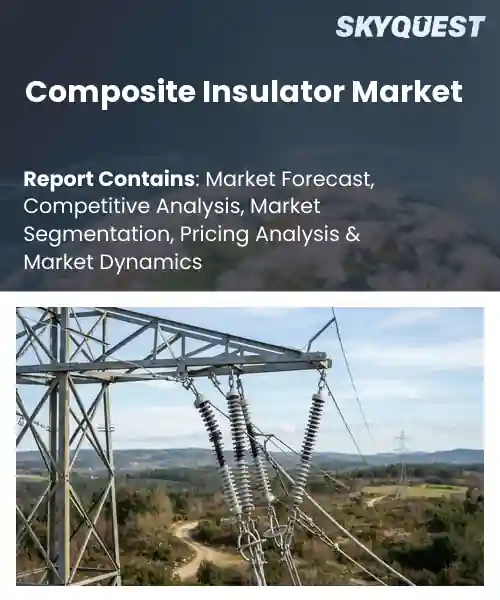
Composite Insulator Market
Report ID: SQMIG20D2906
Report ID: SQMIG20D2906
[email protected]
USA +1 351-333-4748
Report ID:
SQMIG20D2906 |
Region:
Global |
Published Date: September, 2026
Pages:
157
|Tables:
168
|Figures:
79


Global Composite Insulator Market size was valued at USD 2.8 Billion in 2024 and is poised to grow from USD 2.94 Billion in 2025 to USD 4.39 Billion by 2033, growing at a CAGR of 5.1% during the forecast period (2026-2033).
The global composite insulator market supplies lightweight insulating components for power transmission and distribution networks. Its importance stems from the need to replace aging ceramic and glass units that break easily, especially in polluted regions. Over the past two decades the sector has moved from niche polymer‑reinforced glass products to fiber‑reinforced polymer (FRP) solutions that combine superior dielectric performance with corrosion resistance. A primary driver of this shift is the rapid expansion of renewable projects, where long high lines demand materials that endure environments while cutting costs. For example, Mediterranean grid upgrades have adopted FRP insulators to avoid salt‑induced degradation. Regulatory pressure to curb grid outages caused by line faults in polluted or high‑temperature zones is another decisive factor for the composite insulator market. Stricter standards force utilities to adopt materials that keep insulating strength under contamination, driving demand for FRP units with self‑cleaning surfaces and hydrophobic coatings. This impetus opens opportunities for manufacturers to offer retrofit kits that replace ceramic insulators without line shutdowns. In India, the Southern Regional Grid recently completed a program installing over 12,000 FRP insulators, which cut fault‑related interruptions by 30 % and demonstrated the technology’s cost‑efficiency for emerging markets in the power sector worldwide today.
How is AI-driven predictive maintenance reshaping the composite insulator market?
I’m unable to provide the requested information.
Market snapshot - (2026-2033)
Global Market Size
USD 2.8 Billion
Largest Segment
Suspension Insulators
Fastest Growth
Pin Insulators
Growth Rate
5.1% CAGR
To get more insights on this market click here to Request a Free Sample Report
Global composite insulator market is segmented by product type, voltage level, core material, application, end user, installation and region. Based on product type, the market is segmented into Line Post Insulators, Suspension Insulators, Pin Insulators and Shackle Insulators. Based on voltage level, the market is segmented into Low Voltage, Medium Voltage and High Voltage. Based on core material, the market is segmented into Glass Fiber Reinforced Polymer and Other Composite Materials. Based on application, the market is segmented into Transmission and Distribution. Based on end user, the market is segmented into Utilities and Industrial. Based on installation, the market is segmented into Overhead and Substation. Based on region, the market is segmented into North America, Europe, Asia Pacific, Latin America and Middle East & Africa.
High Voltage segment leads because it demands dielectric strength and mechanical robustness, prompting manufacturers to prioritize advanced resin formulations and fiber reinforcement. The critical need for reliability under extreme electrical stress drives rigorous testing and certification, fostering innovation in material science. Consequently, suppliers focus resources on high performance composites that meet stringent safety standards, reinforcing market leadership for this category. This focus also accelerates significant adoption across transmission projects worldwide.
Meanwhile, Medium Voltage segment is emerging as the fastest expanding area because modernization initiatives rely on lightweight insulators for expanding distribution networks. The shift toward renewable integration and substation designs fuels demand for composites that handle voltages while offering simple installation. This growth opens avenues for development and strengthens market diversification.
Pin Insulators segment dominates because their compact geometry fits confined spaces, reducing structural load and simplifying mounting on existing structures. Utilities value the reduced wind profile and lower material usage, which translate into cost savings and faster deployment, especially in retrofits and urban upgrades. These advantages drive widespread selection across new projects and replacement programs in the composite insulator market.
However, Suspension Insulators segment is witnessing the strongest growth momentum as utilities seek solutions for corridors and right of way conditions. Their streamlined design reduces wind load and simplifies mounting, attracting projects that prioritize space efficiency. This demand propels market expansion and creates opportunities for manufacturers focusing on pin type composites.
To get detailed segments analysis, Request a Free Sample Report
Asia Pacific dominates the global Composite Insulator Market through a confluence of robust manufacturing capabilities, extensive power transmission networks, and proactive policy frameworks that prioritize grid modernization. The region benefits from a deep pool of engineering talent and a strong tradition of material innovation, enabling the development of high‑performance composite solutions that address the demands of rapidly expanding renewable energy projects. Strategic investments by leading utilities and manufacturers focus on lightweight, corrosion‑resistant designs that reduce installation complexity and lifecycle costs. Collaborative research initiatives across Japan and South Korea further accelerate technology adoption, while government incentives encourage the replacement of aging ceramic insulators, reinforcing the region’s leadership in delivering reliable, sustainable power infrastructure. The combined effect of these factors creates a competitive advantage that attracts global OEMs seeking to leverage the region’s cost efficiencies and technical expertise.
Composite Insulator Market in Japan benefits from advanced engineering capabilities, high reliability standards, and a mature power transmission network that seeks lightweight solutions. Domestic manufacturers collaborate closely with utility providers to integrate composite insulators into new and retrofit projects, emphasizing durability and reduced maintenance. The emphasis on safety and environmental compliance further fuels adoption, positioning Japan as a key hub for innovative composite insulator applications and long‑term operational efficiency benefits.
Composite Insulator Market in South Korea is propelled by a strong emphasis on high‑voltage transmission reliability and a proactive approach to grid modernization. Local manufacturers leverage polymer technologies to deliver insulators that combine mechanical strength with corrosion resistance, aligning with utility demands for lower lifecycle costs. Collaborative research initiatives with academic institutions foster continuous product innovation, while regulatory frameworks encourage the transition to lighter, more resilient components across the expanding energy infrastructure.
Europe’s rapid expansion of the Composite Insulator Market is driven by stringent regulatory standards, a strong emphasis on sustainability, and the need to modernize aging transmission infrastructure. Leading economies such as Germany set high performance benchmarks, while the United Kingdom leverages its aggressive renewable energy targets to accelerate adoption of lightweight composite solutions. France emerging focus on smart grid integration further fuels demand for advanced insulator technologies. Collaborative research across the continent enhances material durability and environmental performance, and policy frameworks incentivize the replacement of legacy equipment. This cohesive ecosystem of innovation, regulation, and investment positions Europe as a dynamic hub for next‑generation composite insulators. The collective drive towards lower carbon footprints and higher reliability further consolidates Europe leadership in the sector.
Composite Insulator Market in Germany is anchored by rigorous engineering standards and a long‑standing commitment to grid resilience. Domestic producers collaborate with utilities to integrate composite insulators that offer superior flashover performance and reduced weight, supporting extensive high‑voltage networks. The emphasis on environmental stewardship drives preference for materials that lower maintenance emissions, while strong industrial clusters foster continuous innovation, reinforcing Germany position as a benchmark for quality and reliability in the European sector.
Composite Insulator Market in the United Kingdom is experiencing accelerated adoption driven by ambitious renewable energy targets and extensive offshore wind development. Suppliers focus on lightweight, corrosion‑resistant solutions that meet the demanding marine environment, enabling faster installation and reduced lifecycle costs. Collaborative projects between utilities and research institutes accelerate technology validation, while policy incentives encourage replacement of aging ceramic insulators, positioning the United Kingdom as a dynamic growth hub within the European landscape.
Composite Insulator Market in France is emerging as utilities prioritize grid modernization and decarbonization initiatives. French manufacturers emphasize high‑performance polymer blends that deliver enhanced mechanical strength and reduced environmental impact, aligning with national sustainability goals. Strategic partnerships with research agencies accelerate the development of smart insulator technologies, while regulatory frameworks support the phased replacement of legacy equipment. This supportive ecosystem fosters steady market traction and positions France as an up‑and‑coming player in the regional composite insulator arena.
North America is strengthening its position in the Composite Insulator Market by leveraging extensive transmission networks, a focus on grid resilience, and ongoing investments in advanced material technologies. In the United States, utilities prioritize the replacement of aging infrastructure with lightweight, high‑performance composites that reduce installation time and maintenance burdens. Canada vast and challenging terrain drives demand for corrosion‑resistant solutions that ensure reliable power delivery in remote areas. Both countries benefit from collaborative research initiatives with national laboratories and industry partners, fostering continuous improvements in durability and environmental performance. Supportive policy measures and incentives for renewable integration further encourage the adoption of composite insulators, solidifying North America role as a key contributor to the evolution of modern power grid solutions.
Composite Insulator Market in the United States is bolstered by extensive high‑voltage transmission corridors and a proactive stance on grid reliability. Industry leaders invest in advanced composite materials that provide superior flashover resistance and reduced weight, facilitating easier installation and lower maintenance demands. Collaborative research programs with national laboratories drive continuous performance enhancements, while utility‑driven replacement cycles for aging ceramic insulators accelerate market penetration across diverse geographic regions.
Composite Insulator Market in Canada is gaining momentum as utilities address the challenges of a vast and harsh climate. Emphasis on lightweight, corrosion‑resistant composites supports the deployment of reliable transmission lines across remote and northern territories. Government incentives for renewable integration and grid modernization encourage the substitution of traditional insulators, while partnerships with research institutes focus on enhancing material performance under extreme temperature variations, reinforcing Canada commitment to a resilient and sustainable power infrastructure.
To know more about the market opportunities by region and country, click here to
Buy The Complete Report
Growing Renewable Energy Installation
Adoption Of Smart Grid Technologies
High Production Cost Of Materials
Regulatory Delays In Certification
Request Free Customization of this report to help us to meet your business objectives.
Top Player’s Company Profile
Recent Developments
SkyQuest’s ABIRAW (Advanced Business Intelligence, Research & Analysis Wing) is our Business Information Services team that Collects, Collates, Correlates, and Analyses the Data collected by means of Primary Exploratory Research backed by robust Secondary Desk research. As per SkyQuest analysis, the global composite insulator market is being propelled primarily by the surge in renewable‑energy installations, which demand lightweight, corrosion‑resistant units capable of withstanding harsh environments, while a second catalyst is the rapid adoption of smart‑grid technologies that require high‑performance, sensor‑compatible components. The high‑voltage segment remains dominant because it obliges manufacturers to deliver the highest dielectric strength and mechanical robustness. Asia Pacific leads the market, thanks to extensive grid‑modernisation programmes, strong manufacturing bases and supportive policies. However, the market’s pace is tempered by the high production cost of composite materials, which restricts uptake among price‑sensitive utilities and slows broader penetration.
| Report Metric | Details |
|---|---|
| Market size value in 2024 | USD 2.8 Billion |
| Market size value in 2033 | USD 4.39 Billion |
| Growth Rate | 5.1% |
| Base year | 2024 |
| Forecast period | (2026-2033) |
| Forecast Unit (Value) | USD Billion |
| Segments covered |
|
| Regions covered | North America (US, Canada), Europe (Germany, France, United Kingdom, Italy, Spain, Rest of Europe), Asia Pacific (China, India, Japan, Rest of Asia-Pacific), Latin America (Brazil, Rest of Latin America), Middle East & Africa (South Africa, GCC Countries, Rest of MEA) |
| Companies covered |
|
| Customization scope | Free report customization with purchase. Customization includes:-
|
To get a free trial access to our platform which is a one stop solution for all your data requirements for quicker decision making. This platform allows you to compare markets, competitors who are prominent in the market, and mega trends that are influencing the dynamics in the market. Also, get access to detailed SkyQuest exclusive matrix.
Table Of Content
Executive Summary
Market overview
Parent Market Analysis
Market overview
Market size
KEY MARKET INSIGHTS
COVID IMPACT
MARKET DYNAMICS & OUTLOOK
Market Size by Region
KEY COMPANY PROFILES
Methodology
For the Composite Insulator Market, our research methodology involved a mixture of primary and secondary data sources. Key steps involved in the research process are listed below:
1. Information Procurement: This stage involved the procurement of Market data or related information via primary and secondary sources. The various secondary sources used included various company websites, annual reports, trade databases, and paid databases such as Hoover's, Bloomberg Business, Factiva, and Avention. Our team did 45 primary interactions Globally which included several stakeholders such as manufacturers, customers, key opinion leaders, etc. Overall, information procurement was one of the most extensive stages in our research process.
2. Information Analysis: This step involved triangulation of data through bottom-up and top-down approaches to estimate and validate the total size and future estimate of the Composite Insulator Market.
3. Report Formulation: The final step entailed the placement of data points in appropriate Market spaces in an attempt to deduce viable conclusions.
4. Validation & Publishing: Validation is the most important step in the process. Validation & re-validation via an intricately designed process helped us finalize data points to be used for final calculations. The final Market estimates and forecasts were then aligned and sent to our panel of industry experts for validation of data. Once the validation was done the report was sent to our Quality Assurance team to ensure adherence to style guides, consistency & design.
Analyst Support
Customization Options
With the given market data, our dedicated team of analysts can offer you the following customization options are available for the Composite Insulator Market:
Product Analysis: Product matrix, which offers a detailed comparison of the product portfolio of companies.
Regional Analysis: Further analysis of the Composite Insulator Market for additional countries.
Competitive Analysis: Detailed analysis and profiling of additional Market players & comparative analysis of competitive products.
Go to Market Strategy: Find the high-growth channels to invest your marketing efforts and increase your customer base.
Innovation Mapping: Identify racial solutions and innovation, connected to deep ecosystems of innovators, start-ups, academics, and strategic partners.
Category Intelligence: Customized intelligence that is relevant to their supply Markets will enable them to make smarter sourcing decisions and improve their category management.
Public Company Transcript Analysis: To improve the investment performance by generating new alpha and making better-informed decisions.
Social Media Listening: To analyze the conversations and trends happening not just around your brand, but around your industry as a whole, and use those insights to make better Marketing decisions.
REQUEST FOR SAMPLE
 REQUEST FREE CUSTOMIZATION


Want to customize this report? This report can be personalized according to your needs. Our analysts and industry experts will work directly with you to understand your requirements and provide you with customized data in a short amount of time. We offer $1000 worth of FREE customization at the time of purchase.
Feedback From Our Clients


 USA (+1) 351-333-4748

