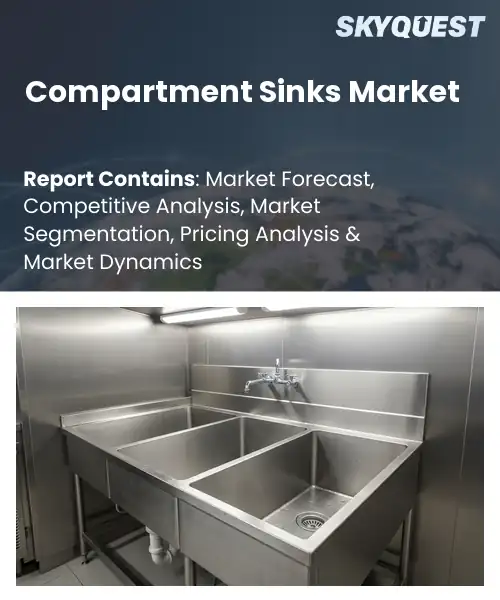
Compartment Sinks Market
Report ID: SQMIG15F2375
Report ID: SQMIG15F2375
[email protected]
USA +1 351-333-4748
Report ID:
SQMIG15F2375 |
Region:
Global |
Published Date: June, 2026
Pages:
157
|Tables:
179
|Figures:
79


Global Compartment Sinks Market size was valued at USD 1.19 Billion in 2024 and is poised to grow from USD 1.25 Billion in 2025 to USD 1.87 Billion by 2033, growing at a CAGR of 5.1% during the forecast period (2026-2033).
The global compartment sinks industry refers to the segment of sanitary fixtures that integrate multiple functional basins into a single unit, commonly used in hospitals, laboratories, and high‑traffic public facilities. Its importance drives from the ability to separate contaminated water from clean runoff, thereby enhancing hygiene and reducing cross‑infection risks.
An emerging growth factor reshaping the compartment sinks market is the rising emphasis on sustainable design, which prompts manufacturers to adopt eco‑friendly materials and water‑saving technologies. As building codes tighten to require lower water consumption, suppliers introduce low‑flow compartments equipped with sensor‑activated faucets, reducing utility costs for institutions while meeting environmental benchmarks. This causes facility managers to favor such solutions, creating a feedback loop that spurs R&D investment. Real‑world adoption can be seen in European university labs where efficient sinks have cut water usage by 30 percent, opening opportunities for retrofits and export to emerging markets hungry for green infrastructure.
How is IoT integration influencing the compartment sinks market?
IoT integration is reshaping compartment sinks by embedding sensors that monitor water flow, temperature and usage patterns, enabling predictive maintenance and real‑time alerts for leaks or blockages. Manufacturers are pairing these smart sinks with cloud platforms that aggregate data across commercial kitchens, allowing operators to optimize cleaning schedules and reduce downtime. The added connectivity also supports remote firmware updates, ensuring compliance with hygiene standards without manual intervention. As facilities seek greater efficiency, the ability to track performance metrics and automate reporting makes IoT‑enabled sinks an attractive upgrade, driving broader adoption across hospitality and food‑service venues.
In May 2026, a leading compartment‑sink producer launched an IoT‑connected model that streams usage data to a centralized dashboard, improving operational efficiency and supporting the market’s growth.
Market snapshot - (2026-2033)
Global Market Size
USD 1.19 Billion
Largest Segment
Single Compartment Sinks
Fastest Growth
Single Compartment Sinks
Growth Rate
5.1% CAGR
To get more insights on this market click here to Request a Free Sample Report
Global compartment sinks market is segmented by product type, material type, installation type, application, end user, distribution channel and region. Based on product type, the market is segmented into Single Compartment Sinks, Two Compartment Sinks, Three Compartment Sinks, Four Compartment Sinks and Others. Based on material type, the market is segmented into Stainless Steel, Galvanized Steel, Composite Materials and Others. Based on installation type, the market is segmented into Freestanding Sinks, Wall-Mounted Sinks and Drop-In Sinks. Based on application, the market is segmented into Restaurants & Foodservice, Hotels & Hospitality, Healthcare Facilities, Educational Institutions, Food Processing Facilities and Others. Based on end user, the market is segmented into Commercial Kitchens, Institutional Facilities, Food Processing Companies and Others. Based on distribution channel, the market is segmented into Direct Sales, Foodservice Equipment Dealers, E-Commerce and Others. Based on region, the market is segmented into North America, Europe, Asia Pacific, Latin America and Middle East & Africa.
Single compartment sinks segment dominates with large compartment sinks market share because it meets the fundamental workflow requirements of most foodservice operations, offering simplicity, easy cleaning, and straightforward maintenance. Its compact footprint fits within limited kitchen spaces, reducing installation complexity and cost. Kitchen designers favor this configuration for its adaptability across diverse menu styles, while operators appreciate the lower risk of cross contamination, reinforcing its pervasive adoption across the market. Additionally, the straightforward supply chain for single basin units ensures quick replacements, further cementing its market leadership.
However, three compartment sinks are witnessing the strongest growth momentum in the Compartment Sinks Market as culinary concepts evolve toward multi stage preparation and segregation of raw, cooked, and waste streams. Innovative designs that integrate hygiene features and flexible configurations attract high end establishments seeking compliance with strict safety standards, driving rapid adoption and expanding market opportunities for manufacturers.
As per compartment sinks market outlook, stainless steel segment leads because its corrosion resistance and hygienic surface finish align with stringent sanitation protocols in foodservice environments. The material’s longevity reduces lifecycle costs, encouraging chefs and facility managers to prefer it over alternatives. Its aesthetic appeal also supports brand consistency in visible kitchen areas, reinforcing its prominence across commercial installations. Furthermore, the material’s compatibility with modern cleaning agents ensures consistent performance under intense usage, solidifying its market leadership.
Meanwhile, composite materials are emerging as the key high growth segment as manufacturers prioritize lightweight solutions that lower transportation costs and simplify installation. Advances in polymer reinforcement provide comparable durability while offering design flexibility, attracting eco conscious operators seeking sustainable alternatives, thereby accelerating market expansion and creating new revenue streams for innovative suppliers.
To get detailed segments analysis, Request a Free Sample Report
North America maintains a leading position through a combination of mature building practices, high consumer expectations for premium bathroom solutions, and a strong network of design professionals who champion integrated fixtures. The region benefits from extensive research and development capabilities that foster innovative compartment configurations, aligning with trends toward space efficiency and aesthetic cohesion. Robust supply chains and a culture of early adoption enable rapid market penetration for new product introductions. Additionally, stringent building standards and a focus on sustainability incentivize manufacturers to incorporate water‑saving technologies, reinforcing the appeal of compartment sinks among environmentally conscious buyers. Collectively, these factors create a resilient ecosystem that sustains North America’s dominance in the global landscape.
As per compartment sinks market regional outlook, United States is driven by a sophisticated residential renovation sector that seeks seamless integration of functionality and style. Design firms and architects prioritize modular solutions that maximize limited bathroom footprints, fostering strong demand for compartment sinks. Consumer preference for high‑quality materials and advanced water‑conservation features further fuels market activity. Distribution channels ranging from specialty retailers to large home improvement chains ensure broad accessibility, while ongoing collaborations between manufacturers and design schools nurture continuous innovation.
As per compartment sinks market regional forecast, Canada reflects a balanced focus on durability and eco‑efficiency, resonating with the country’s emphasis on sustainable building practices. Builders and homeowners alike value the space‑saving benefits of compartment designs, especially in multi‑unit dwellings and retrofit projects. The market benefits from close proximity to United States supply networks, enabling timely adoption of cutting‑edge product lines. Industry stakeholders also leverage government incentives for water‑saving fixtures, reinforcing the growth trajectory of compartment sinks across Canadian residential and commercial sectors.
European market experiences rapid expansion due to heightened emphasis on environmental stewardship, evolving interior design aesthetics, and stringent regulatory frameworks that promote water efficiency. Consumers are increasingly attracted to sleek, space‑optimizing solutions that complement contemporary minimalist trends prevalent in urban housing. A strong tradition of architectural innovation encourages the integration of multifunctional bathroom fixtures, positioning compartment sinks as a preferred choice for new construction and renovation alike. Collaborative ecosystems among manufacturers, design institutes, and standards bodies accelerate the diffusion of novel materials and ergonomic designs. Together, these dynamics underpin the swift growth of the compartment sinks segment across Europe.
As per compartment sinks industry analysis, Germany is characterized by a robust engineering culture that prizes precision and high performance. Manufacturers leverage advanced production techniques to deliver compartment sinks with superior durability and refined finishes, catering to discerning homeowners and commercial developers. The market is further propelled by strict building codes that prioritize water conservation, prompting widespread adoption of efficient fixtures. Design collaborations between architects and product developers foster customized solutions that align with Germany’s reputation for functional yet aesthetically appealing interiors.
United Kingdom is experiencing accelerated uptake as urban dwelling sizes shrink and renovation projects seek space‑saving innovations. Consumers place a premium on contemporary designs that blend seamlessly with modern bathroom layouts, driving demand for sleek compartment solutions. The market benefits from active participation of specialist retailers and design consultancies that champion integrated fixtures. Regulatory encouragement of sustainable water use reinforces the appeal of compartment sinks, positioning them as a key component in the United Kingdom’s push toward greener residential environments.
France is emerging as designers embrace versatile bathroom concepts that balance elegance with practicality. The market is nourished by a growing appetite for refurbishment of historic residences, where compartment sinks provide a discreet yet functional upgrade. French manufacturers focus on high‑end finishes and artisanal craftsmanship, appealing to consumers seeking both style and efficiency. Growing awareness of environmental impact and supportive policies for water‑saving technologies further stimulate market momentum across residential and hospitality sectors.
Asia Pacific strengthens its position through rapid urbanization, rising middle‑income populations, and a cultural shift toward modern living spaces that prioritize functional design. Manufacturers in the region are investing heavily in research and development to create compact, water‑efficient compartment sinks tailored to densely populated apartments and hospitality projects. Growing awareness of sustainability drives adoption of eco‑friendly materials and low‑flow technologies. The region’s agile supply chains and competitive manufacturing capabilities enable swift scaling of innovative product lines, while collaborations with international design firms bring global aesthetic standards to local markets. These combined forces elevate Asia Pacific’s role as a pivotal growth engine for compartment sinks.
Japan is defined by a meticulous focus on space optimization and refined craftsmanship. Limited residential footprints and a strong tradition of minimalist design encourage the integration of compartment sinks that deliver both functionality and visual harmony. Japanese manufacturers emphasize high‑quality materials and precision engineering, resulting in products that meet demanding consumer expectations. Environmental consciousness is reinforced through government incentives for water‑saving fixtures, further propelling demand within residential and hospitality sectors.
South Korea is propelled by a vibrant real estate development scene that prioritizes contemporary, compact bathroom solutions. Consumers are attracted to sleek designs that complement high‑rise living and smart home concepts, fostering strong market growth. Local manufacturers leverage advanced production technologies to offer innovative compartment configurations with integrated water‑efficiency features. Collaboration between design studios and technology firms enhances the appeal of smart‑enabled sinks, positioning South Korea as a forward‑looking hub for next‑generation bathroom fixtures.
To know more about the market opportunities by region and country, click here to
Buy The Complete Report
Increasing Demand For Clean Water
Regulatory Incentives For Waste Management
High Capital Expenditure Requirements
Limited Availability Of Skilled Workforce
Request Free Customization of this report to help us to meet your business objectives.
The competitive landscape is shaped by established manufacturers expanding product portfolios through strategic acquisitions of niche sink innovators, while new entrants leverage modular design and IoT integration to differentiate. Recent M&A activity includes a leading global kitchen‑fixture brand acquiring a boutique laboratory‑sink specialist to broaden its compaction‑sink range. Partnerships between hardware suppliers and smart‑home platforms are accelerating tech‑driven features, and continuous material innovation is intensifying rivalry over premium and cost‑effective segments.
SkyQuest’s ABIRAW (Advanced Business Intelligence, Research & Analysis Wing) is our Business Information Services team that Collects, Collates, Correlates, and Analyses the Data collected by means of Primary Exploratory Research backed by robust Secondary Desk research.
As per SkyQuest analysis, the global compartment sinks market growth is being propelled primarily by the rising need for clean water in food‑service, pharmaceutical and healthcare settings, while a second important driver is the shift toward sustainable materials and water‑saving designs that meet green‑building standards. North America remains the dominant region due to mature construction practices, strong R&D and early adoption of eco‑efficient fixtures. The single compartment sink segment continues to lead the market because of its simplicity, easy maintenance and space‑saving appeal in commercial kitchens. However, the high capital outlay required for customized installations acts as a restraint, slowing adoption among budget‑constrained facilities. The global compartment sinks market trend driven primarily by expansion in commercial kitchens, stricter hygiene regulations, and modernization of foodservice infrastructure.
| Report Metric | Details |
|---|---|
| Market size value in 2024 | USD 1.19 Billion |
| Market size value in 2033 | USD 1.87 Billion |
| Growth Rate | 5.1% |
| Base year | 2024 |
| Forecast period | (2026-2033) |
| Forecast Unit (Value) | USD Billion |
| Segments covered |
|
| Regions covered | North America (US, Canada), Europe (Germany, France, United Kingdom, Italy, Spain, Rest of Europe), Asia Pacific (China, India, Japan, Rest of Asia-Pacific), Latin America (Brazil, Rest of Latin America), Middle East & Africa (South Africa, GCC Countries, Rest of MEA) |
| Companies covered |
|
| Customization scope | Free report customization with purchase. Customization includes:-
|
To get a free trial access to our platform which is a one stop solution for all your data requirements for quicker decision making. This platform allows you to compare markets, competitors who are prominent in the market, and mega trends that are influencing the dynamics in the market. Also, get access to detailed SkyQuest exclusive matrix.
Table Of Content
Executive Summary
Market overview
Parent Market Analysis
Market overview
Market size
KEY MARKET INSIGHTS
COVID IMPACT
MARKET DYNAMICS & OUTLOOK
Market Size by Region
KEY COMPANY PROFILES
Methodology
For the Compartment Sinks Market, our research methodology involved a mixture of primary and secondary data sources. Key steps involved in the research process are listed below:
1. Information Procurement: This stage involved the procurement of Market data or related information via primary and secondary sources. The various secondary sources used included various company websites, annual reports, trade databases, and paid databases such as Hoover's, Bloomberg Business, Factiva, and Avention. Our team did 45 primary interactions Globally which included several stakeholders such as manufacturers, customers, key opinion leaders, etc. Overall, information procurement was one of the most extensive stages in our research process.
2. Information Analysis: This step involved triangulation of data through bottom-up and top-down approaches to estimate and validate the total size and future estimate of the Compartment Sinks Market.
3. Report Formulation: The final step entailed the placement of data points in appropriate Market spaces in an attempt to deduce viable conclusions.
4. Validation & Publishing: Validation is the most important step in the process. Validation & re-validation via an intricately designed process helped us finalize data points to be used for final calculations. The final Market estimates and forecasts were then aligned and sent to our panel of industry experts for validation of data. Once the validation was done the report was sent to our Quality Assurance team to ensure adherence to style guides, consistency & design.
Analyst Support
Customization Options
With the given market data, our dedicated team of analysts can offer you the following customization options are available for the Compartment Sinks Market:
Product Analysis: Product matrix, which offers a detailed comparison of the product portfolio of companies.
Regional Analysis: Further analysis of the Compartment Sinks Market for additional countries.
Competitive Analysis: Detailed analysis and profiling of additional Market players & comparative analysis of competitive products.
Go to Market Strategy: Find the high-growth channels to invest your marketing efforts and increase your customer base.
Innovation Mapping: Identify racial solutions and innovation, connected to deep ecosystems of innovators, start-ups, academics, and strategic partners.
Category Intelligence: Customized intelligence that is relevant to their supply Markets will enable them to make smarter sourcing decisions and improve their category management.
Public Company Transcript Analysis: To improve the investment performance by generating new alpha and making better-informed decisions.
Social Media Listening: To analyze the conversations and trends happening not just around your brand, but around your industry as a whole, and use those insights to make better Marketing decisions.
REQUEST FOR SAMPLE
 REQUEST FREE CUSTOMIZATION
Global Compartment Sinks Market size was valued at USD 1.19 Billion in 2024 and is poised to grow from USD 1.25 Billion in 2025 to USD 1.87 Billion by 2033, growing at a CAGR of 5.1% during the forecast period (2026-2033).
The competitive landscape is shaped by established manufacturers expanding product portfolios through strategic acquisitions of niche sink innovators, while new entrants leverage modular design and IoT integration to differentiate. Recent M&A activity includes a leading global kitchen‑fixture brand acquiring a boutique laboratory‑sink specialist to broaden its compaction‑sink range. Partnerships between hardware suppliers and smart‑home platforms are accelerating tech‑driven features, and continuous material innovation is intensifying rivalry over premium and cost‑effective segments. 'The Middleby Corporation', 'Ali Group', 'Elkay Manufacturing Company', 'Advance Tabco', 'John Boos & Co.', 'Eagle Group', 'BK Resources', 'Krowne Metal Corporation', 'Regency Equipment', 'Just Manufacturing', 'IMC/Teddy', 'T&S Brass and Bronze Works', 'Advance Pierre Foods Equipment', 'MagiKitch'n', 'Steelton', 'Winholt Equipment Group', 'Acitya Group', 'Lakeside Manufacturing', 'Vollrath Company', 'Mepra S.p.A.'
The rising need for safe, pathogen‑free water in industries such as food processing, pharmaceuticals, and municipal treatment drives adoption of compartment sinks, as these units enable segregation of contaminants and simplify cleaning protocols, thereby supporting compliance with stringent hygiene standards and enhancing overall operational efficiency, which in turn encourages manufacturers to expand production capacity to meet growing customer expectations for reliable water management solutions. The market responds by investing in advanced materials and modular designs that further reduce cross‑contamination risks while facilitating rapid installation and maintenance.
Sustainable Material Adoption: Manufacturers are increasingly integrating recycled plastics, bio‑based composites, and low‑emission alloys into compartment sink designs, responding to heightened environmental expectations from architects and end‑users. This shift not only reduces the carbon footprint of each unit but also aligns product portfolios with green building certifications, making the offering more attractive in markets where sustainability drives procurement decisions. These initiatives enable clients to meet ESG targets while reducing long‑term maintenance costs, fostering stronger brand loyalty and repeat specifications across projects globally significantly.
Why does North America Dominate the Global Compartment Sinks Market? |@12


Want to customize this report? This report can be personalized according to your needs. Our analysts and industry experts will work directly with you to understand your requirements and provide you with customized data in a short amount of time. We offer $1000 worth of FREE customization at the time of purchase.
Feedback From Our Clients


 USA (+1) 351-333-4748

