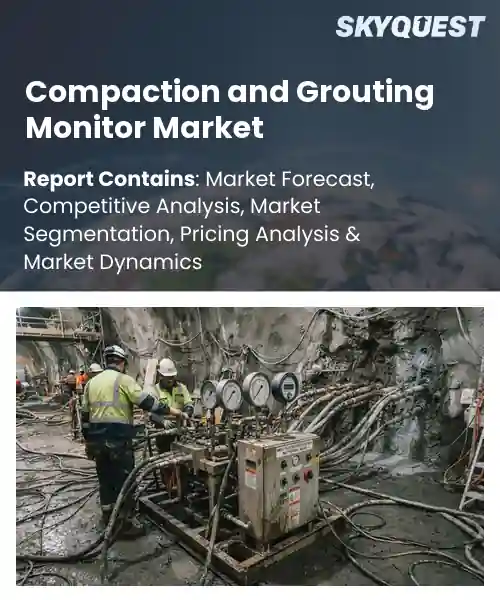
Compaction and Grouting Monitor Market
Report ID: SQMIG45J2821
Report ID: SQMIG45J2821
[email protected]
USA +1 351-333-4748
Report ID:
SQMIG45J2821 |
Region:
Global |
Published Date: August, 2026
Pages:
157
|Tables:
120
|Figures:
77


Global Compaction And Grouting Monitor Market size was valued at USD 486.0 Million in 2024 and is poised to grow from USD 526.34 Million in 2025 to USD 996.08 Million by 2033, growing at a CAGR of 8.3% during the forecast period (2026-2033).
The global compaction and grouting monitor market provides instruments that measure soil density, moisture, and grout pressure during civil‑engineering works. Its relevance lies in confirming that ground‑improvement methods meet design criteria, thereby avoiding settlement failures and expensive repairs. The market originated in the 1990s when firms replaced manual penetrometers with electronic load cells and ultrasonic sensors. In the last decade, rapid urbanization and the rise of high‑rise construction in Asia have heightened demand, as developers need real‑time data to certify foundation performance. Consequently, manufacturers now offer wireless telemetry and cloud‑based analytics that feed directly into building information models for project planning. Regulatory pressure is the main catalyst driving market expansion because governments are tightening standards for ground‑stabilization verification. When authorities require documented compaction levels before permitting load‑bearing structures, contractors must adopt monitoring solutions to demonstrate compliance, which fuels equipment sales. For example, the European Union’s geotechnical code now mandates grout pressure logging for tunnel linings, prompting firms to integrate sensor networks into construction workflows. This impetus also creates opportunities for service providers to offer data‑management platforms that turn measurements into maintenance alerts, thereby reducing downtime and premiums. As compliance becomes an advantage, investment in advanced monitoring technology is expected to accelerate.
How is AI-driven automation enhancing accuracy in the compaction and grouting monitor market?
AI‑driven automation is reshaping the compaction and grouting monitor market by embedding intelligent sensors that capture vibration, pressure and moisture in real time. Machine‑learning algorithms analyze these streams to flag deviations instantly, allowing operators to adjust mixes before defects appear. The technology also creates predictive models that anticipate settlement patterns, reducing the need for manual sampling and speeding up quality assurance. Integration with cloud platforms enables remote oversight, so project teams can compare performance across sites and apply best‑practice parameters consistently. This blend of precision data and automated decision‑making is raising confidence in outcomes and lowering the risk of costly rework, making projects more reliable and on schedule.In July 2024, a leading equipment manufacturer introduced an AI‑powered compaction monitoring system, improving precision and reducing rework, supporting market growth.
Market snapshot - (2026-2033)
Global Market Size
USD 486.0 Million
Largest Segment
Hardware
Fastest Growth
Software
Growth Rate
8.3% CAGR
To get more insights on this market click here to Request a Free Sample Report
Global compaction and grouting monitor market is segmented by component, monitoring type, application, end user and region. Based on component, the market is segmented into Hardware, Software and Services. Based on monitoring type, the market is segmented into Compaction Monitoring, Grouting Monitoring and Integrated Monitoring. Based on application, the market is segmented into Building Construction, Transportation Infrastructure, Mining, Tunneling and Dam & Foundation Construction. Based on end user, the market is segmented into Construction Companies, Geotechnical Contractors, Mining Companies and Infrastructure Developers. Based on region, the market is segmented into North America, Europe, Asia Pacific, Latin America and Middle East & Africa.
Hardware segment dominates because it provides the tangible sensors, data loggers, and rugged enclosures essential for reliable field deployment. Engineers prioritize proven physical devices that can withstand harsh construction sites, vibration, and moisture, ensuring continuous measurement integrity. The direct link between hardware reliability and safety compliance fuels procurement decisions, while manufacturers continuously refine durability and precision, reinforcing hardware’s central position in the market for ongoing project success and lifecycle efficiency.
Meanwhile, Software segment emerges as the most rapidly expanding area in the compaction and grouting monitor market. Cloud based analytics platforms and AI driven interpretation tools are unlocking time insights, attracting users seeking predictive capabilities. This shift toward intelligent processing accelerates adoption across projects, creating revenue streams and broadening the market’s growth horizon.
Compaction monitoring segment leads because it directly measures soil density and settlement, providing the core data required for quality assurance in ground improvement projects. Practitioners rely on precise compaction readings to meet stringent safety standards and to validate design assumptions, making this capability indispensable. Continuous regulatory emphasis on foundation integrity reinforces demand, while proven methodologies and vendor expertise sustain its preeminent role in the market for reliable construction outcomes worldwide.
On the other hand, Integrated monitoring segment emerges as the key high growth area in the compaction and grouting monitor market. Fusion of compaction and grouting data into unified dashboards enables holistic site oversight, attracting projects with complex sequencing. This convergence drives broader adoption, opening cross functional opportunities and expanding market potential.
To get detailed segments analysis, Request a Free Sample Report
North America retains a preeminent position due to a confluence of advanced engineering capabilities, robust research and development ecosystems, and stringent safety and quality regulations that drive early adoption of monitoring technologies. The United States houses a dense network of technology providers and large‑scale construction projects that demand precision in compaction and grouting processes. Canada complements this landscape with strong governmental support for infrastructure renewal and a growing emphasis on sustainable ground improvement methods. Collaborative partnerships between academic institutions, equipment manufacturers, and end‑users foster continuous innovation, while the presence of major oil and gas operations further reinforces demand for reliable monitoring solutions. Collectively these factors create a resilient market environment that sustains North American dominance.
Compaction and Grouting Monitor Market in United States benefits from a mature industrial base and a high concentration of specialized equipment manufacturers. Extensive infrastructure projects across transportation, energy, and civil sectors prioritize real‑time monitoring to ensure compliance and performance. Strong collaboration between research universities and private firms accelerates technology refinement, while regulatory frameworks encourage adoption of advanced monitoring practices that enhance safety and efficiency throughout project lifecycles.
Compaction and Grouting Monitor Market in Canada is driven by proactive government initiatives aimed at modernizing aging infrastructure and expanding renewable energy facilities. The market enjoys close ties with North American technology providers, enabling rapid integration of cutting‑edge monitoring systems. Emphasis on environmental stewardship promotes the use of precision grouting techniques, and a skilled engineering workforce supports widespread implementation across urban development and resource extraction projects.
Europe experiences rapid expansion of the compaction and grouting monitor market as a result of stringent environmental directives, heightened focus on sustainable construction, and substantial public investment in infrastructure modernization. Germany leads with a strong engineering tradition and a deep pool of specialized manufacturers that set high performance benchmarks. The United Kingdom benefits from a dynamic regulatory environment that encourages innovative monitoring solutions for large‑scale redevelopment and offshore projects. France’s emerging market reflects growing awareness of the value of real‑time data in reducing project risk and optimizing ground improvement methods. Cross‑border collaborations and harmonized standards further accelerate technology diffusion, positioning Europe as a hub of progressive adoption and continuous improvement.
Compaction and Grouting Monitor Market in Germany is anchored by world‑class engineering firms and a rigorous standards framework that demands precise ground improvement verification. Major construction and energy initiatives integrate monitoring devices early in design to meet performance and environmental criteria. Strong collaboration between industry associations and research institutes drives continuous innovation, while a well‑established supply chain ensures rapid availability of sophisticated solutions across both public and private sectors.
Compaction and Grouting Monitor Market in United Kingdom is propelled by an ambitious pipeline of urban regeneration and offshore infrastructure projects that require advanced monitoring for safety and compliance. Regulatory incentives favor the adoption of digital monitoring platforms, encouraging firms to embrace data‑driven decision‑making. Close partnerships with technology innovators and a vibrant consultancy landscape accelerate the rollout of state‑of‑the‑art monitoring equipment throughout the construction value chain.
Compaction and Grouting Monitor Market in France is emerging as industry stakeholders recognize the competitive advantage of real‑time monitoring in reducing rework and enhancing durability. Governmental emphasis on sustainable building practices stimulates demand for precise compaction verification, particularly in transportation and public works. Growing collaboration between academic research centres and equipment suppliers fosters the development of tailored monitoring solutions that address the specific geological and regulatory context of French projects.
Asia Pacific is strengthening its position in the compaction and grouting monitor market through a combination of rapid urbanization, ambitious infrastructure programs, and increasing awareness of the benefits of digital monitoring. Japan leverages its reputation for precision engineering and strong focus on resilience to integrate advanced monitoring technologies into large‑scale seismic retrofitting and tunneling endeavors. South Korea’s commitment to smart construction and high‑tech manufacturing supports swift adoption of sophisticated monitoring systems across new metropolitan developments and energy facilities. Regional cooperation, government support for research initiatives, and a rising pool of skilled professionals collectively accelerate technology diffusion, positioning Asia Pacific as a dynamic and increasingly influential player in the global market.
Compaction and Grouting Monitor Market in Japan is shaped by a long‑standing emphasis on precision and disaster‑resilient construction. Extensive tunneling, high‑rise, and coastal protection projects incorporate real‑time monitoring to verify compaction quality and grout performance under stringent safety standards. Collaboration between leading sensor manufacturers and academic research centres fuels continuous advancement of compact, high‑accuracy monitoring devices. Governmental programs that prioritize infrastructure resilience further encourage widespread adoption throughout the nation’s construction sector.
Compaction and Grouting Monitor Market in South Korea benefits from robust investment in smart construction initiatives and a strong domestic manufacturing base for sensing technologies. Large‑scale urban redevelopment and renewable energy infrastructure projects employ advanced monitoring solutions to optimize ground improvement processes and reduce construction risk. Close coordination between industry consortia and research institutions accelerates the integration of artificial intelligence and data analytics into monitoring platforms, enhancing predictive capabilities and operational efficiency across the country’s rapidly evolving built environment.
To know more about the market opportunities by region and country, click here to
Buy The Complete Report
Regulatory Standards are Strengthening
Growing Construction Activities Worldwide
High Equipment Cost is Deterring
Limited Skilled Workforce Hampers Adoption
Request Free Customization of this report to help us to meet your business objectives.
The competitive landscape is shaped by active consolidation and collaborative innovation, with firms pursuing strategic M&A, joint ventures, and technology upgrades to capture rising demand for real‑time compaction and grouting monitoring; Geokon’s partnership with Deep Excavation integrates monitoring hardware with service delivery, while Nova Ventures’ acquisition of a sensor specialist expands its data‑analytics capabilities, illustrating how players leverage alliances and tech breakthroughs to differentiate in a rapidly evolving market.
Top Player’s Company Profile
Recent Developments
SkyQuest’s ABIRAW (Advanced Business Intelligence, Research & Analysis Wing) is our Business Information Services team that Collects, Collates, Correlates, and Analyses the Data collected by means of Primary Exploratory Research backed by robust Secondary Desk research. As per SkyQuest analysis, the global compaction and grouting monitor market is being propelled primarily by tightening regulatory standards that require documented ground‑improvement verification, while the surge in worldwide construction activity adds a second boost by expanding demand for reliable real‑time monitoring across building, infrastructure and mining projects. High equipment cost remains a notable restraint, limiting adoption among smaller contractors who must balance upfront capital against immediate project budgets. North America continues to dominate the market thanks to its advanced engineering ecosystem, strong R&D base and strict safety regulations. Within the market, the hardware segment leads in share because durable sensors and data loggers are essential for field reliability.
| Report Metric | Details |
|---|---|
| Market size value in 2024 | USD 486.0 Million |
| Market size value in 2033 | USD 996.08 Million |
| Growth Rate | 8.3% |
| Base year | 2024 |
| Forecast period | (2026-2033) |
| Forecast Unit (Value) | USD Million |
| Segments covered |
|
| Regions covered | North America (US, Canada), Europe (Germany, France, United Kingdom, Italy, Spain, Rest of Europe), Asia Pacific (China, India, Japan, Rest of Asia-Pacific), Latin America (Brazil, Rest of Latin America), Middle East & Africa (South Africa, GCC Countries, Rest of MEA) |
| Companies covered |
|
| Customization scope | Free report customization with purchase. Customization includes:-
|
To get a free trial access to our platform which is a one stop solution for all your data requirements for quicker decision making. This platform allows you to compare markets, competitors who are prominent in the market, and mega trends that are influencing the dynamics in the market. Also, get access to detailed SkyQuest exclusive matrix.
Table Of Content
Executive Summary
Market overview
Parent Market Analysis
Market overview
Market size
KEY MARKET INSIGHTS
COVID IMPACT
MARKET DYNAMICS & OUTLOOK
Market Size by Region
KEY COMPANY PROFILES
Methodology
For the Compaction and Grouting Monitor Market, our research methodology involved a mixture of primary and secondary data sources. Key steps involved in the research process are listed below:
1. Information Procurement: This stage involved the procurement of Market data or related information via primary and secondary sources. The various secondary sources used included various company websites, annual reports, trade databases, and paid databases such as Hoover's, Bloomberg Business, Factiva, and Avention. Our team did 45 primary interactions Globally which included several stakeholders such as manufacturers, customers, key opinion leaders, etc. Overall, information procurement was one of the most extensive stages in our research process.
2. Information Analysis: This step involved triangulation of data through bottom-up and top-down approaches to estimate and validate the total size and future estimate of the Compaction and Grouting Monitor Market.
3. Report Formulation: The final step entailed the placement of data points in appropriate Market spaces in an attempt to deduce viable conclusions.
4. Validation & Publishing: Validation is the most important step in the process. Validation & re-validation via an intricately designed process helped us finalize data points to be used for final calculations. The final Market estimates and forecasts were then aligned and sent to our panel of industry experts for validation of data. Once the validation was done the report was sent to our Quality Assurance team to ensure adherence to style guides, consistency & design.
Analyst Support
Customization Options
With the given market data, our dedicated team of analysts can offer you the following customization options are available for the Compaction and Grouting Monitor Market:
Product Analysis: Product matrix, which offers a detailed comparison of the product portfolio of companies.
Regional Analysis: Further analysis of the Compaction and Grouting Monitor Market for additional countries.
Competitive Analysis: Detailed analysis and profiling of additional Market players & comparative analysis of competitive products.
Go to Market Strategy: Find the high-growth channels to invest your marketing efforts and increase your customer base.
Innovation Mapping: Identify racial solutions and innovation, connected to deep ecosystems of innovators, start-ups, academics, and strategic partners.
Category Intelligence: Customized intelligence that is relevant to their supply Markets will enable them to make smarter sourcing decisions and improve their category management.
Public Company Transcript Analysis: To improve the investment performance by generating new alpha and making better-informed decisions.
Social Media Listening: To analyze the conversations and trends happening not just around your brand, but around your industry as a whole, and use those insights to make better Marketing decisions.
REQUEST FOR SAMPLE
 REQUEST FREE CUSTOMIZATION


Want to customize this report? This report can be personalized according to your needs. Our analysts and industry experts will work directly with you to understand your requirements and provide you with customized data in a short amount of time. We offer $1000 worth of FREE customization at the time of purchase.
Feedback From Our Clients


 USA (+1) 351-333-4748

