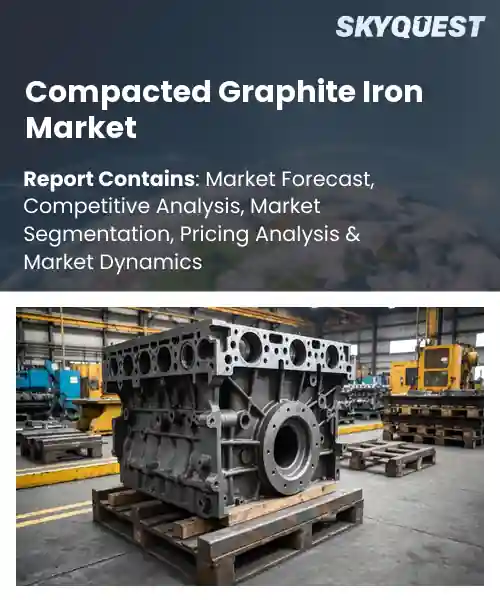
Compacted Graphite Iron Market
Report ID: SQMIG15O2050
Report ID: SQMIG15O2050
[email protected]
USA +1 351-333-4748
Report ID:
SQMIG15O2050 |
Region:
Global |
Published Date: June, 2026
Pages:
157
|Tables:
95
|Figures:
76


Global Compacted Graphite Iron Market size was valued at USD 9.25 Billion in 2024 and is poised to grow from USD 9.78 Billion in 2025 to USD 15.26 Billion by 2033, growing at a CAGR of 5.72% during the forecast period (2026-2033).
The primary driver of the compacted graphite iron industry is rising demand from automotive and heavy equipment industries for lighter, stronger castings that meet stricter emissions and efficiency targets. Compacted graphite iron is defined by a vermicular graphite microstructure that yields higher tensile strength and greater fatigue resistance than grey iron while preserving thermal performance superior to many alternative alloys. This matters because manufacturers can design thinner walls and compact engine blocks, turbo housings and machine tool bases, lowering vehicle weight and improving fuel economy. Initially a niche material, adoption widened as foundry practices and melt control matured and OEM substitution demonstrated lasting performance and cost benefits.
An essential growth factor is scalable foundry capability, because when foundries invest in controlled melt and inoculation, they reduce defect rates and cost, which in turn makes compacted graphite iron viable for broader applications. As defect related scrap falls, OEMs expand specifications to include CGI for heavy truck engine blocks, turbocharger housings and wind turbine components where high fatigue strength and damping increase service life under cyclic loads.
How is IoT enabling predictive maintenance in compacted graphite iron manufacturing?
Through connecting sensors in both mould lines and machining items marked over melt ladles to collect data this example demonstrates how IoT can provide predictive maintenance for Compact Graphite Iron (CGI) manufacturing. By then performing edge and cloud analytics on this collected data, you are able to detect signs of wear, misalined and thermal excursions, allowing teams to perform repairs prior to a complete failure.
In light of Moving towards 'Smart Foundries', OEMs want to use lighter and stronger components with improved reliability and traceability. For instance, when using process control and tracking system to record production history, you can form online models that detect anomalies in the production environment. Thus reducing scrap rates, as well as preventing unplanned shutdowns causing a more consistent production of CGI products, and in turn making the CGI more desirable to prospective buyers.
Presidio and TDK SensEI in May 2026 have partnered to introduce validated Edge analytics for Predictive Maintenance to manufacturers and foundries. EdgeRX enables real-time condition monitoring, allowing for rapid response times as well increased equipment availability, ultimately allowing manufacturers to easily scale up CGI production.
Market snapshot - (2026-2033)
Global Market Size
USD 9.25 Billion
Largest Segment
350 MPa
Fastest Growth
450 MPa
Growth Rate
5.72% CAGR
To get more insights on this market click here to Request a Free Sample Report
Global compacted graphite iron market is segmented by grade type, product type, application type and region. Based on grade type, the market is segmented into 300 MPa, 350 MPa, 400 MPa, 450 MPa, 500 MPa and Others. Based on product type, the market is segmented into Spheroid, Nodules and Others. Based on application type, the market is segmented into Automotive, Construction, Marine, Power Generation and Others. Based on region, the market is segmented into North America, Europe, Asia Pacific, Latin America and Middle East & Africa.
400 MPa segment dominates with compacted graphite iron market share because it offers an optimal balance of tensile strength and castability that aligns with core performance requirements in compacted graphite iron applications. Its mechanical reliability enables designers to reduce wall thickness while maintaining fatigue resistance and thermal stability, which supports lighter, more efficient components. These material advantages encourage OEM preference, simplify qualification processes, and foster supply chain investments that entrench its leading position in the market.
As per compacted graphite iron market outlook, 450 MPa segment is emerging as the most rapidly expanding segment because manufacturers pursue higher strength grades to support downsized, high-efficiency engines and demanding industrial applications. Advances in inoculation and heat treatment widen its applicability, prompting investments in process capability and enabling new component designs that open opportunities across performance-sensitive markets.
As per compacted graphite iron market forecast, automotive segment dominates because compacted graphite iron uniquely meets engine manufacturers’ needs for improved strength, thermal conductivity, and vibration damping in downsized, high-boost powertrains. Its capacity to allow thinner, lighter engine architectures while preserving durability drives consistent adoption by OEMs and tier suppliers. Regulatory pressure on efficiency and emissions accelerates integration into critical components, creating sustained engineering focus and predictable procurement for this material.
As per compacted graphite iron market analysis, power generation segment is witnessing the strongest growth momentum as energy equipment makers adopt compacted graphite iron for larger combustion engines and alternator housings requiring enhanced fatigue performance. Innovations in the casting and metallurgy reduce life-cycle costs, driving stationary power and renewables-related applications and unlocking aftermarket and retrofit opportunities that expand long-term market potential.
To get detailed segments analysis, Request a Free Sample Report
Asia Pacific leads the global compacted graphite iron market, leveraging industrial strength, specific production capabilities, and strategic supply chain integration. The region’s established foundries and metallurgical capabilities provide consistent production of high grade compacted graphite iron for demanding engine and industrial applications. Centrally located with key automotive and heavy equipment OEMs to facilitate collaboration on material specs and speedy adoption of innovative casting techniques. Steady intake backed by strong demand from commercial vehicle, shipbuilding and industrial machinery sectors. Competitive advantage is strengthened by ongoing investment in process improvement, research and development, and workforce skills. The region is a leading supplier of high performance compacted graphite iron to the global markets owing to efficient logistics, size of production and export orientation.
Close alignment with luxury automotive and industrial OEMs and culture of precision engineering benefit the compacted graphite iron market in Japan. Foundries focus on metallurgical refinement and strong quality control to fulfill the most stringent performance and reliability standards. Through close collaboration, material suppliers and engine designers can create tailored solutions to achieve high performance and lightweighting requirements. Japan market is distinguished by consistent innovation, value added components and strong export linkages that make local makers dependable partners for sophisticated engine and machinery applications.
South Korea is driven by advanced manufacturing clusters and integrated supply chains that serve major vehicle and heavy equipment producers. Local foundries concentrate on scalable production of high strength castings while investing in process automation and quality systems. Close cooperation with OEMs accelerates adoption of compacted graphite iron for performance intensive components. The market benefits from technology transfer and an emphasis on efficiency, enabling suppliers to compete on both domestic demand and targeted international deliveries for industrial and automotive applications.
The compacted graphite iron market in Europe is expanding rapidly driven by the needs of advanced engineering, significant OEM participation and regulatory drivers focusing on efficiency and durability in heavy duty powertrains. Foundry networks established in core markets have increased capacities to produce high integrity castings for commercial vehicles, rail and industrial machines. Co-operative innovation between metallurgists, engine makers and tier suppliers increases material qualification and application development. The rising demand for fuel efficient power solutions, recyclability and life cycle performance is further driving the adoption of compacted graphite iron. Regional clusters provide fast feedback loops between design and manufacturing, which can improve market momentum across different end use industries and make Europe a hub for high performance casting solutions.
Germany is anchored by a strong engineering ecosystem and high demand from premium automotive and industrial machinery sectors. Foundries in Germany focus on precision casting, stringent quality assurance, and material innovation to meet exacting OEM specifications. Close proximity to major engine manufacturers and equipment producers facilitates iterative product development and rapid scaling of validated components. The market emphasizes reliability, performance under demanding operating conditions, and integration with advanced powertrain technologies, reinforcing Germany as a dominant supplier of specialized compacted graphite iron castings.
United Kingdom is emerging through niche expertise in high performance applications and specialty manufacturing. The market is characterized by agile foundries that cater to motorsport, marine, and bespoke industrial equipment where tailored material solutions are valued. Collaboration between universities, research centers, and small to medium sized suppliers fosters innovation in casting techniques and alloy optimization. Growing interest from retrofit and aftermarket channels provides additional routes to commercialization, supporting a dynamic and evolving market presence in the region.
France is among the fastest growing in Europe, supported by modernization of foundry infrastructure and targeted industrial programs that prioritize durable, efficient components. Demand growth is driven by commercial vehicle manufacturers, rail equipment suppliers, and a revitalized industrial machinery sector seeking robust casting solutions. French suppliers emphasize sustainable production practices, circular material flows, and close collaboration with system integrators to accelerate adoption. The market shows strong momentum as capabilities expand and validated applications proliferate across key heavy duty segments.
North America is expanding its footprint in the compacted graphite iron industry with strategic investments in foundry modernization, onshoring of essential supply chains, and fostering greater collaboration between material suppliers and engine manufacturers. The region is using its industrial base to help heavy duty sectors that appreciate the high strength to weight and thermal attributes of compacted graphite iron. The emphasis on resilience and supplier diversification is pushing capacity improvements and technology upgrades. Encouraging integrated product development and after-market support models are cross-sector demand coming from on-road, off-road, maritime and energy applications. In addition, policy and industry activities focused on durable, efficient power systems also support market advancement and regional competitiveness to provide high performance castings.
United States benefits from extensive linkages to heavy duty truck, industrial equipment and energy sectors demanding high performance castings. Foundries are improving their processes and working more closely with original equipment manufacturers to qualify compacted graphite iron for crucial components. The market focuses on supply chain responsiveness, aftermarket support and lifetime performance for demanding applications. Investments in materials engineering and production scale-up are improving local ability to meet domestic demand and pursue targeted export prospects in rugged, high-value cast parts.
Canada market is affected by resource-based sectors and high demand for robust components in mining, rail and marine applications. Local foundries specialize in heavy castings with performance in extreme conditions and equipment with lengthy service intervals. Collaborating with equipment manufacturers to develop specialized materials and casting solutions for cold environment and heavy load applications. The market benefits from proximity to raw material sources and a focus on supply reliability, sustainable production practices and specific knowledge that complement wider North America capacity.
To know more about the market opportunities by region and country, click here to
Buy The Complete Report
Rising Demand From Automotive Sector
Advances In Casting Technologies
High Production Processing Costs
Competition From Alternative Materials
Request Free Customization of this report to help us to meet your business objectives.
Competition in the compacted graphite iron market is driven by OEM requirements for lighter, higher-strength engine components and by foundries competing on process control and automation. Key competitive strategies are licensing deals and system sales like SinterCast’s CGI system deployments, strategic partnerships that combine AM and welding technology, and venture-backed digital foundry entrants commercializing factory-scale software and manufacturing capabilities.
SkyQuest’s ABIRAW (Advanced Business Intelligence, Research & Analysis Wing) is our Business Information Services team that Collects, Collates, Correlates, and Analyses the Data collected by means of Primary Exploratory Research backed by robust Secondary Desk research.
As per SkyQuest analysis, the global compacted graphite iron market growth is being propelled primarily by rising demand from the automotive sector while advances in casting technologies further accelerate adoption; however, high production processing costs constrain wider uptake and capacity expansion. Asia Pacific dominates the market due to concentrated foundry capabilities and proximity to OEMs, and the automotive application segment remains the leading end use as engine downsizing and emissions compliance drive material substitution. Foundry scalability and IoT enabled predictive maintenance are emerging enablers that improve quality and reduce scrap, supporting more consistent supply and longer term growth prospects across heavy equipment and power generation applications. The global compacted graphite iron market trend is fueled by rising demand for lightweight and high-strength engine materials, increasing automotive production, and growing adoption of fuel-efficient diesel and commercial vehicle engines requiring superior thermal and mechanical performance.
| Report Metric | Details |
|---|---|
| Market size value in 2024 | USD 9.25 Billion |
| Market size value in 2033 | USD 15.26 Billion |
| Growth Rate | 5.72% |
| Base year | 2024 |
| Forecast period | (2026-2033) |
| Forecast Unit (Value) | USD Billion |
| Segments covered |
|
| Regions covered | North America (US, Canada), Europe (Germany, France, United Kingdom, Italy, Spain, Rest of Europe), Asia Pacific (China, India, Japan, Rest of Asia-Pacific), Latin America (Brazil, Rest of Latin America), Middle East & Africa (South Africa, GCC Countries, Rest of MEA) |
| Companies covered |
|
| Customization scope | Free report customization with purchase. Customization includes:-
|
To get a free trial access to our platform which is a one stop solution for all your data requirements for quicker decision making. This platform allows you to compare markets, competitors who are prominent in the market, and mega trends that are influencing the dynamics in the market. Also, get access to detailed SkyQuest exclusive matrix.
Table Of Content
Executive Summary
Market overview
Parent Market Analysis
Market overview
Market size
KEY MARKET INSIGHTS
COVID IMPACT
MARKET DYNAMICS & OUTLOOK
Market Size by Region
KEY COMPANY PROFILES
Methodology
For the Compacted Graphite Iron Market, our research methodology involved a mixture of primary and secondary data sources. Key steps involved in the research process are listed below:
1. Information Procurement: This stage involved the procurement of Market data or related information via primary and secondary sources. The various secondary sources used included various company websites, annual reports, trade databases, and paid databases such as Hoover's, Bloomberg Business, Factiva, and Avention. Our team did 45 primary interactions Globally which included several stakeholders such as manufacturers, customers, key opinion leaders, etc. Overall, information procurement was one of the most extensive stages in our research process.
2. Information Analysis: This step involved triangulation of data through bottom-up and top-down approaches to estimate and validate the total size and future estimate of the Compacted Graphite Iron Market.
3. Report Formulation: The final step entailed the placement of data points in appropriate Market spaces in an attempt to deduce viable conclusions.
4. Validation & Publishing: Validation is the most important step in the process. Validation & re-validation via an intricately designed process helped us finalize data points to be used for final calculations. The final Market estimates and forecasts were then aligned and sent to our panel of industry experts for validation of data. Once the validation was done the report was sent to our Quality Assurance team to ensure adherence to style guides, consistency & design.
Analyst Support
Customization Options
With the given market data, our dedicated team of analysts can offer you the following customization options are available for the Compacted Graphite Iron Market:
Product Analysis: Product matrix, which offers a detailed comparison of the product portfolio of companies.
Regional Analysis: Further analysis of the Compacted Graphite Iron Market for additional countries.
Competitive Analysis: Detailed analysis and profiling of additional Market players & comparative analysis of competitive products.
Go to Market Strategy: Find the high-growth channels to invest your marketing efforts and increase your customer base.
Innovation Mapping: Identify racial solutions and innovation, connected to deep ecosystems of innovators, start-ups, academics, and strategic partners.
Category Intelligence: Customized intelligence that is relevant to their supply Markets will enable them to make smarter sourcing decisions and improve their category management.
Public Company Transcript Analysis: To improve the investment performance by generating new alpha and making better-informed decisions.
Social Media Listening: To analyze the conversations and trends happening not just around your brand, but around your industry as a whole, and use those insights to make better Marketing decisions.
REQUEST FOR SAMPLE
 REQUEST FREE CUSTOMIZATION
Global Compacted Graphite Iron Market size was valued at USD 9.25 Billion in 2024 and is poised to grow from USD 9.78 Billion in 2025 to USD 15.26 Billion by 2033, growing at a CAGR of 5.72% during the forecast period (2026-2033).
Competition in the compacted graphite iron market is driven by OEM requirements for lighter, higher-strength engine components and by foundries competing on process control and automation. Key competitive strategies are licensing deals and system sales like SinterCast’s CGI system deployments, strategic partnerships that combine AM and welding technology, and venture-backed digital foundry entrants commercializing factory-scale software and manufacturing capabilities. 'SinterCast', 'Tupy', 'Saint-Jean Industries', 'Grainger & Worrall', 'Fritz Winter Eisengiesserei', 'Caterpillar', 'Waupaca Foundry', 'Dalian Innovation Parts Manufacturing', 'Asimco', 'Hunan Valin Iron & Steel', 'Georg Fischer', 'Rochester Armature', 'Aisan Industry', 'Ricardo', 'Teksid', 'Nemak', 'Metalurgica Madrilena', 'Sodicam', 'Mirae Industries', 'Cifunsa'
Rising demand from automotive manufacturers for components that combine strength, thermal stability, and fatigue resistance has pushed adoption of compacted graphite iron in engine blocks and structural parts. Its mechanical advantages enable more compact, durable designs that meet performance and longevity requirements, encouraging OEMs to specify CG iron over alternatives. Adoption is supported by perceived lifecycle benefits, compatibility with existing casting processes, and supplier capability to deliver consistent material quality, which collectively expand application scope and stimulate investment across the supply chain.
Oem Emissions Regulations Driving Adoption: Stricter vehicle emissions and lifecycle regulations are incentivizing original equipment manufacturers to prioritize materials that enable engine downsizing, durability and improved fuel efficiency. Compacted graphite iron offers a balance of strength, thermal stability and castability that helps designers reduce mass while maintaining structural integrity under higher pressures and temperatures. As compliance becomes core to product design strategies, automakers increasingly integrate CGI into powertrain and heavy-duty vehicle applications to meet regulatory and customer expectations for lower environmental impact without compromising performance.
Why does Asia Pacific Dominate the Global Compacted Graphite Iron Market? |@12


Want to customize this report? This report can be personalized according to your needs. Our analysts and industry experts will work directly with you to understand your requirements and provide you with customized data in a short amount of time. We offer $1000 worth of FREE customization at the time of purchase.
Feedback From Our Clients


 USA (+1) 351-333-4748

