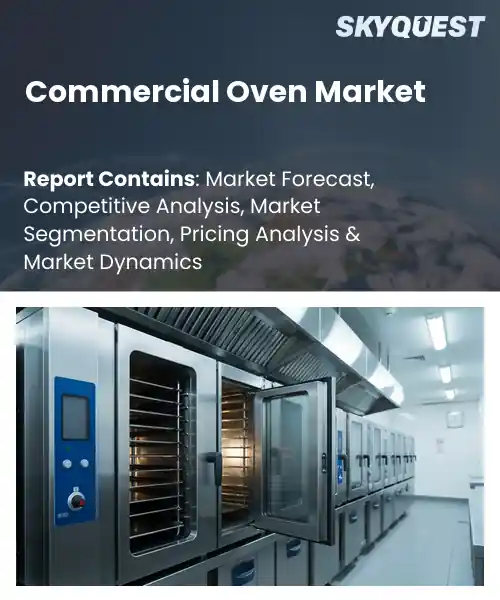
Commercial Oven Market
Report ID: SQMIG25S2081
Report ID: SQMIG25S2081
[email protected]
USA +1 351-333-4748
Report ID:
SQMIG25S2081 |
Region:
Global |
Published Date: February, 2026
Pages:
157
|Tables:
172
|Figures:
79


Global Commercial Oven Market size was valued at USD 19.4 Billion in 2024 and is poised to grow from USD 20.66 Billion in 2025 to USD 34.19 Billion by 2033, growing at a CAGR of 6.5% during the forecast period (2026-2033).
Growing urbanization, rising disposable incomes, expansion of foodservice chains, technological advancements in cooking equipment, and increasing emphasis on energy efficiency are driving sales of commercial ovens.
Expanding quick-service restaurants, cloud kitchens, and organized retail bakeries are significantly boosting demand for high-capacity and high-performance oven systems across developed and emerging economies. Simultaneously, labor shortages and the rapid growth of delivery-focused and cloud kitchen models are also bolstering commercial oven market growth. Additionally, stricter energy regulations and rising utility costs are encouraging the adoption of energy-efficient, electronically controlled ovens, improving lifecycle economics despite higher upfront investments.
On the contrary, high initial capital investment for advanced commercial ovens, significant maintenance and repair costs, fluctuating raw material prices, supply chain disruptions, and compliance challenges with evolving food safety and energy regulations are expected to hamper commercial oven market penetration in the long run.
How Can IoT in Enhance Energy Efficiency of Commercial Ovens?
Commercial ovens have improved in their ability to use less energy through IoT integration. By using sensors, connectivity and data analytics to combine cooking processes into one smarter way to prepare food. Remote monitoring of temp, run times, etc., provides real-time insight into how much energy is being consumed. Predictive maintenance alerts will help you avoid any inefficient operating condition or unexpected equipment technology failures. Automated recipes now reduce unnecessary preheating of items allowing for less overall energy use.
Market snapshot - 2026-2033
Global Market Size
USD 19.4 Billion
Largest Segment
Gas Ovens
Fastest Growth
Combination Ovens
Growth Rate
6.5% CAGR
To get more insights on this market click here to Request a Free Sample Report
The commercial oven market is segmented by product type, capacity, application, control type, end user, and region. Based on control type, the market is segmented into manual, semi-automatic, and fully automatic. Based on product type, the market is segmented into electric ovens, gas ovens, convection ovens, and combination ovens. Based on application, the market is segmented into bakery confectionery, food processing catering, restaurants, and commercial kitchen. Based on end users, the market is segmented into commercial and industrial. Based on capacity, the market is segmented into small, medium, and large. Based on the region, the market is segmented into North America, Europe, Asia Pacific, Latin America, and Middle East & Africa.
The fully automatic segment is estimated to account for the highest commercial oven market share going forward. These ovens have become quite popular in many commercial kitchens these days as they do not require manual work and save a lot of time. They minimize manual intervention and automate cooking processes that are increasingly used by faster-food restaurants and food service chains. Their capacity to handle advanced cooking features and digital controls tends to be more suited for heavy-duty use. Most of this change is due to the increasing requirement for high-tech, competitive restaurant management.
Semi-automatic ovens are the fastest-growing segment as per this commercial oven market forecast. These ovens are becoming more and more popular because they are much simpler than full-automatic alternatives, and also cheaper. Semi-automatic ovens are popular among many small and mid-size food businesses that still want to improve efficiency without spending huge amounts of money upfront. The combination of manual and automatic functionality makes them perfect for any kitchen requirements. That segment is expected to see rapid growth as businesses increasingly seek lower cost upgrades.
The small capacity segment is expected to spearhead the global commercial oven market revenue generation in the long run. This is mostly due to the fact that they are compact in size and cafes; food trucks and small restaurants prefer them. Small capacity ovens are energy efficient and cost-effective, which also means they use less energy to bake food when compared with other ovens, becoming ideal for companies with restricted kitchen solutions or operating a lower volume business. Cloud kitchens and quick-service outlets rely on these outlets, contributing to their rise.
The growth in the medium capacity segment is slated to rise rapidly as per this commercial oven industry analysis. It caters to mid-range restaurants, confectioneries, and catering businesses as it provides more productivity than small ovens but not industrial scale. This selection allows you to maintain space and outfit expanding businesses with a good mix of oven size, cost, and performance. Increased use of flexi cooking range is the primary factor resulting in rapid expansion of omnipresent cooking appliances.
To get detailed segments analysis, Request a Free Sample Report
The commercial oven market in North America is driven by an extensive number of food chains, high-tech kitchens and energy-efficient cooking demand. The region is also host to several fast-food outlets, bakeries and catering units that need robust and powerful ovens. The emphasis on strict food safety regulations and productivity is another reason why many food businesses are replacing their old appliances with newer models. The dominance of North America can be attributed to well-developed supply chains, availability of skilled labor and strong distribution networks, easy access to advanced manufacturing capabilities, etc.
United States Commercial Oven Market
Sophisticated specification practices among major foodservice operators, and broad availability of aftermarket support are helping this country lead commercial oven demand in North America. Growing consumer demand for durability, flexible cooking modes, and integration with kitchen workflow management is also helping create new opportunities in the United States. Preference for commercial ovens that balance performance with operational efficiency and lifecycle cost considerations is high.
Canada Commercial Oven Market
Growing number of independent foodservice operators and cafe culture expansion are primarily augmenting the demand for commercial ovens. Commercial buyers prioritize straightforward maintenance, energy mindful operation, and local service availability. Although smaller than the market size of the U.S., Canada is gaining momentum and creating new business scope.
High investments in technological modernization of professional kitchens and evolving culinary trends are forecasted to govern the sales of commercial ovens across Europe. Adoption of modular designs and smart control systems suited for varied culinary practices is expected to be high in commercial oven companies. Regulatory harmonization across markets and incentives for retrofitting legacy kitchens accelerate replacement cycles. Demand for compact and multifunctional commercial ovens is high in in urban landscape. Stringent energy efficiency regulations and growing emphasis on sustainability are also expected to boost investments in R&D of energy-efficient commercial ovens.
Germany Commercial Oven Market
Robust industrial manufacturing capabilities, emphasis on engineering quality, and collaboration between equipment makers are helping boost commercial oven sales in Germany. Suppliers offer robust service ecosystems and training that align with operator needs. The transformation to efficient ovens is part of the nation's broader effort to reduce energy use in commercial spaces.
United Kingdom Commercial Oven Market
High demand for flexible cooking solutions driven by changing consumer preferences and a thriving out of home dining sector are shaping commercial oven adoption. Wastage of energy in commercial kitchens is now barred, due to the new government guidelines, which has prompted more kitchen operators to switch to eco-friendly ovens. Operators prioritize versatile, compact units that support diverse menus and efficient service rhythms.
France Commercial Oven Market
Commercial oven sales in France are expected to be governed by artisan baking and boutique hospitality sectors. Preference for commercial ovens offering exact thermal control and consistent baking performance tailored to artisanal finishes is high. Vendor led training and distribution channels help build operator familiarity and support adoption of advanced commercial oven functionality.
Why Commercial Oven Vendors are Focusing on Maximizing Their Sales Potential in Asia Pacific?
Increasing demand for automated kitchens, expansion of foodservice sector, and cost-effective manufacturing help position Asia Pacific as the most opportune region for commercial oven providers. Growing number of QSRs, bakeries and cafes, across countries such as China, Japan, India, and South Korea is also expected to boost the sales of commercial ovens in the future. Culinary innovation across the region drives demand for ovens with precise temperature profiles and multifunction capabilities. Investment in localized research and development and operator training programs ensures products align with specific culinary techniques and service models.
Japan Commercial Oven Market
Precision engineering, miniaturized designs, and automation continue to be the major distinguishing elements for the commercial ovens market in Japan. Solid supplier service infrastructure and a culture of constant improvement allow for rapid updates to the products. This puts the country in a good place to be a supplier of premium quality and technological advancements in commercial ovens. Japan-based companies are currently working on improvements targeting unique cooking styles and high-capacity service solutions.
South Korea Commercial Oven Market
Integration of smart controls, digital connectivity, and compact designs remains the top priority of commercial oven manufacturers looking to make a mark in this country. Commercial ovens offering multifunctionality, fast recovery, and intuitive interfaces that lower training needs are preferred in South Korea. Strong aftersales service and customization enable operators to specify ovens that support contemporary menu innovation and high throughput service models.
To know more about the market opportunities by region and country, click here to
Buy The Complete Report
Energy Efficiency Adoption Driving Demand
Expansion Of Foodservice and Institutional Sector
High Initial Acquisition Costs
Supply Chain Reliability and Costs
Request Free Customization of this report to help us to meet your business objectives.
Leading companies are expected to invest heavily in the development of energy-efficient, compact and multi-functional ovens going forward. Integration of smart technologies and improving energy efficiency are also key trends as per this commercial oven market analysis.
Sustainable Equipment Design
Smart Kitchen Connectivity
SkyQuest’s ABIRAW (Advanced Business Intelligence, Research & Analysis Wing) is our Business Information Services team that Collects, Collates, Correlates, and Analyses the Data collected by means of Primary Exploratory Research backed by robust Secondary Desk research.
As per SkyQuest analysis, expanding global foodservice industry and rising demand for energy-efficient cooking equipment are anticipated to drive the demand for commercial ovens going forward. However, high initial capital investment and rising compliance requirements with energy and food safety regulations are slated to slow down the adoption of commercial ovens in the future. North America is slated to spearhead the demand for commercial ovens owing to the strong presence of quick-service restaurant chains and well-established foodservice infrastructure. Integration of IoT-enabled smart controls and development of modular, high-efficiency oven systems are slated to be key trends driving the commercial oven sector through 2033 and beyond.
| Report Metric | Details |
|---|---|
| Market size value in 2024 | USD 19.4 Billion |
| Market size value in 2033 | USD 34.19 Billion |
| Growth Rate | 6.5% |
| Base year | 2024 |
| Forecast period | 2026-2033 |
| Forecast Unit (Value) | USD Billion |
| Segments covered |
|
| Regions covered | North America (US, Canada), Europe (Germany, France, United Kingdom, Italy, Spain, Rest of Europe), Asia Pacific (China, India, Japan, Rest of Asia-Pacific), Latin America (Brazil, Rest of Latin America), Middle East & Africa (South Africa, GCC Countries, Rest of MEA) |
| Companies covered |
|
| Customization scope | Free report customization with purchase. Customization includes:-
|
To get a free trial access to our platform which is a one stop solution for all your data requirements for quicker decision making. This platform allows you to compare markets, competitors who are prominent in the market, and mega trends that are influencing the dynamics in the market. Also, get access to detailed SkyQuest exclusive matrix.
Table Of Content
Executive Summary
Market overview
Parent Market Analysis
Market overview
Market size
KEY MARKET INSIGHTS
COVID IMPACT
MARKET DYNAMICS & OUTLOOK
Market Size by Region
KEY COMPANY PROFILES
Methodology
For the Commercial Oven Market, our research methodology involved a mixture of primary and secondary data sources. Key steps involved in the research process are listed below:
1. Information Procurement: This stage involved the procurement of Market data or related information via primary and secondary sources. The various secondary sources used included various company websites, annual reports, trade databases, and paid databases such as Hoover's, Bloomberg Business, Factiva, and Avention. Our team did 45 primary interactions Globally which included several stakeholders such as manufacturers, customers, key opinion leaders, etc. Overall, information procurement was one of the most extensive stages in our research process.
2. Information Analysis: This step involved triangulation of data through bottom-up and top-down approaches to estimate and validate the total size and future estimate of the Commercial Oven Market.
3. Report Formulation: The final step entailed the placement of data points in appropriate Market spaces in an attempt to deduce viable conclusions.
4. Validation & Publishing: Validation is the most important step in the process. Validation & re-validation via an intricately designed process helped us finalize data points to be used for final calculations. The final Market estimates and forecasts were then aligned and sent to our panel of industry experts for validation of data. Once the validation was done the report was sent to our Quality Assurance team to ensure adherence to style guides, consistency & design.
Analyst Support
Customization Options
With the given market data, our dedicated team of analysts can offer you the following customization options are available for the Commercial Oven Market:
Product Analysis: Product matrix, which offers a detailed comparison of the product portfolio of companies.
Regional Analysis: Further analysis of the Commercial Oven Market for additional countries.
Competitive Analysis: Detailed analysis and profiling of additional Market players & comparative analysis of competitive products.
Go to Market Strategy: Find the high-growth channels to invest your marketing efforts and increase your customer base.
Innovation Mapping: Identify racial solutions and innovation, connected to deep ecosystems of innovators, start-ups, academics, and strategic partners.
Category Intelligence: Customized intelligence that is relevant to their supply Markets will enable them to make smarter sourcing decisions and improve their category management.
Public Company Transcript Analysis: To improve the investment performance by generating new alpha and making better-informed decisions.
Social Media Listening: To analyze the conversations and trends happening not just around your brand, but around your industry as a whole, and use those insights to make better Marketing decisions.
REQUEST FOR SAMPLE
 REQUEST FREE CUSTOMIZATION
Global Commercial Oven Market size was valued at USD 19.4 Billion in 2024 and is poised to grow from USD 20.66 Billion in 2025 to USD 34.19 Billion by 2033, growing at a CAGR of 6.5% during the forecast period (2026-2033).
Whirlpool Corporation, Robert Bosch GmbH, LG Electronics, Panasonic Corporation, SMEG, Alto-Shaam, Henny Penny, Vulcan, Blodgett, Garland, TurboChef, Middleby Corporation, Electrolux Professional, Fagor Industrial, Moffat, Haier Group Corporation, Baker's Pride, Sharp Corporation, Dongbu Daewoo Electronics, Cleveland Range
The key driver of the Commercial Oven Market is the rapid expansion of the foodservice industry, including restaurants, bakeries, hotels, and quick-service outlets. Growing demand for efficient, high-capacity cooking equipment and the rise of commercial kitchens and cloud kitchens are further fueling market growth.
Key trends in the Commercial Oven Market include the rapid adoption of energy-efficient and smart ovens, increasing demand for customized and multifunctional cooking equipment, growth of automated and IoT-enabled kitchen solutions, and rising preference for compact ovens in limited-space foodservice setups.
North America accounted for the largest share in the Commercial Oven Market, driven by a well-established foodservice industry, high adoption of advanced kitchen equipment, strong presence of quick-service restaurants, and continuous investments in modern commercial kitchens across the region.


Want to customize this report? This report can be personalized according to your needs. Our analysts and industry experts will work directly with you to understand your requirements and provide you with customized data in a short amount of time. We offer $1000 worth of FREE customization at the time of purchase.
Feedback From Our Clients


 USA (+1) 351-333-4748

