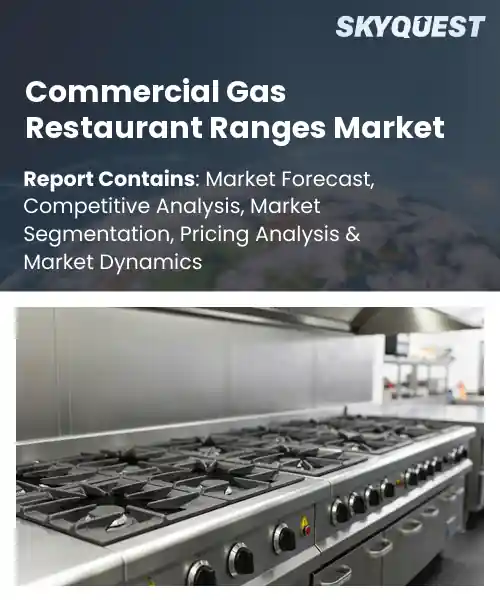
Commercial Gas Restaurant Ranges Market
Report ID: SQMIG20B2184
Report ID: SQMIG20B2184
[email protected]
USA +1 351-333-4748
Report ID:
SQMIG20B2184 |
Region:
Global |
Published Date: June, 2026
Pages:
157
|Tables:
176
|Figures:
74


Global Commercial Gas Restaurant Ranges Market size was valued at USD 2.45 Billion in 2024 and is poised to grow from USD 2.57 Billion in 2025 to USD 3.83 Billion by 2033, growing at a CAGR of 5.1% during the forecast period (2026-2033).
The global commercial gas restaurant range market is about burners and ovens that run on natural gas or propane, and they supply that intense, quick heat cooking in restaurants is needed. It matters because places want fast, accurate temperature control, so the food comes out better and energy doesn’t just disappear.
In addition, the main reason for the commercial gas restaurant ranges market growth is the push toward more efficient operations, mostly from utility costs going up and regulations tightening a bit. When electricity tariffs rise, many operators prefer gas burners because they deliver stronger BTU output per fuel unit, which lowers overall spending. That cost pressure also nudges kitchens into hybrid layouts, where gas does frying and similar jobs, while other units take care of baking. For instance, some California restaurant groups retrofitted their kitchens with gas burners, and they reported cutting fuel bills by about 15 percent, plus gaining LEED points. Manufacturers, in turn, are responding by expanding product families and also selling installation options meant to reduce downtime, so revenue becomes easier to unlock in places where gas pipelines reach out to those court-side corridors or wherever the infrastructure goes.
IoT is remaking commercial gas restaurant ranges by adding sensors that monitor flame stability, temperature uniformity, plus fuel consumption, often in real time, all at once. Those data feeds stream into kitchen management platforms, and then chefs can tune heat immediately, reducing waste instead of guessing. Remote diagnostics send alerts to service teams before a burner fails, so repairs happen earlier, and that cuts both downtime and maintenance expenses. Energy dashboards also let operators compare performance station by station, so they can copy best practices, and schedule more intelligently. On top of that, the setup supports links to inventory systems, connecting cooking cycles with ingredient usage, and it helps restaurants match prep output to actual demand. Overall, it turns a traditional equipment piece into an “intelligent asset”, and that boosts operational efficiency while also improving the guest experience, even if people don’t notice the tech directly.
Market snapshot - (2026-2033)
Global Market Size
USD 2.45 Billion
Largest Segment
Heavy-Duty Gas Ranges
Fastest Growth
Modular Gas Ranges
Growth Rate
5.1% CAGR
To get more insights on this market click here to Request a Free Sample Report
The global commercial gas restaurant ranges market is segmented by product type, burner configuration, oven type, installation type, end user, distribution channel, and region. Based on product type, the market is categorized into heavy-duty gas ranges, medium-duty gas ranges, modular gas ranges, stock pot gas ranges, and others. By burner configuration, the market is segmented into 2–4 burner ranges, 5–8 burner ranges, and above 8 burner ranges. Based on oven type, the market is divided into standard oven base, convection oven base, storage base, and cabinet base. By installation type, the market is classified into freestanding and countertop units. Based on end user, the market serves full-service restaurants, quick service restaurants (QSRs), hotels and hospitality establishments, institutional kitchens, and others. By distribution channel, the market is segmented into direct sales, foodservice equipment dealers, e-commerce channels, and others. Regionally, the market is analyzed across North America, Europe, Asia Pacific, Latin America, and the Middle East & Africa.
As per the commercial gas restaurant ranges market analysis, the Heavy duty gas ranges segment takes the lead, mainly because they are built for the brutal reality of demanding kitchens, they keep up with high output and still hold up over time. The thick construction, the way they handle continuous high temperature cycles, it all makes them a solid pick for everyday abuse. And in full-service or institutional places, chefs lean toward anything that feels dependable and fast, so it makes sense that these units get chosen more often. Plus they can manage big batches and all cooking approaches at once, so they end up being the main thing in equipment shopping plans.
At the same time, modular gas ranges are showing the strongest growth momentum, and that’s because they let operators tweak the layout as the kitchen footprint changes, or when the culinary concept shifts. These can be swapped out components and reconfigure the setup, which is a big deal for people trying to stay agile and not waste space. That flexibility helps these ranges spread across different concepts, which then speeds up market expansion, and it also creates space for designers to get creative.
According to the commercial gas restaurant ranges market forecast, the 5-8 burner ranges category is dominating because it hits a good balance between cooking capacity and day to day operational efficiency, so it fits what most full service, and many hotel kitchens, actually need. Having multiple burners means cooks can work on several menu items at the same time, so tickets move faster and the whole service flow gets smoother. That matches what many chefs want, and it’s why these are the goto selection for medium to high volume operations.
Meanwhile, ranges with more than 8 burners are becoming the fastest-growing option, especially for kitchens that push extreme volume and want specialized zones. These bigger layouts cater to setups where throughput is critical, and where staff benefit from dedicated burner real estate for different tasks. Newer burner technology and ergonomic improvements also help cut heat loss and add safety features, so upscale operations take a closer look and start investing. So basically, that’s why this tier is pulling market expansion forward.
To get detailed segments analysis, Request a Free Sample Report
As per the commercial gas restaurant ranges market regional forecast, North America leads, mostly because the dining world there already acts like it expects top tier dependability, like in the everyday routine, reliable cooking equipment and tight precision. There’s also a huge amount of infrastructure for gas supply which keeps everything running without those annoying interruptions, especially for big busy places. And the food culture in the United States and Canada tends to lean toward flame kissed methods, so demand for sturdy gas ranges stays steady, it doesn’t wobble. On the business side, makers get to lean on advanced engineering abilities, plus a distribution network that feels tightly linked, which helps them push products out fast and keep service quick. Safety rules also manage to stay in the balance with some room for innovation, so new burner concepts and smarter controls can show up without getting blocked. And the region puts a lot of focus on hospitality education, along with chef training, that part keeps reinforcing the preference for gas driven solutions, so the leadership position solidifies.
United States Commercial Gas Restaurant Ranges Market
The Commercial Gas Restaurant Ranges sector in the United States benefits from an older, well rooted love for grill centered cooking and a huge number of independent restaurants. Many operators choose gas ranges because they heat right away, and the temperature stays steady even when the menu shifts from day to day. Supplier ties are basically already mature, so getting replacement components or technical help is typically faster than in other categories. Culinary schools and chef communities push gas technology as something is needed for consistent cooking results, which keeps demand strong across both city areas and suburban zones.
Canada Commercial Gas Restaurant Ranges Market
In Canada, the Commercial Gas Restaurant Ranges industry benefits from a dependable natural gas network, plus a culinary scene that still respects more classic cooking methods. Restaurant teams like the energy efficiency, and the level of control, especially when heating demands go up and down through the day. Local producers often work closely with hospitality teams, so equipment can be adjusted to match regional cooking styles, without losing core performance. There’s also an ongoing sustainability focus, and that encourages high efficiency burner adoption, which helps gas ranges keep landing as a preferred option across the Canadian foodservice segment.
Europe’s commercial gas restaurant ranges market penetration seems to come from a bunch of things hitting at once: culinary heritage that’s hard to ignore, stricter energy efficiency requirements, and an increasing interest in food provenance. Gas ranges fit well with the European taste for precise temperature control, which matters a lot for traditional dishes where heat level has to be exact. Governments also nudge greener equipment through incentives, so manufacturers can test and scale lower emission burner technology. Culinary training centers back gas as a flexible instrument, useful for both classic technique and modern gastronomy, so adoption spreads from fine dining down to casual venues. On top of that, the supply chain remains fairly strong across key markets, allowing faster rollouts and smoother maintenance, which adds more market momentum throughout the region.
Germany Commercial Gas Restaurant Ranges Market
The German Commercial Gas Restaurant Ranges Market is supported by a long history of engineering and a strong commitment to high performance cooking solutions. Restaurants tend to value the immediate flame modulation and the durability of gas ranges, because it lines up with the country’s careful, detail focused approach to food prep. Local producers also add advanced safety mechanisms, which helps them meet strict regulatory requirements while still offering efficiency that actually performs. Equipment manufacturers often partner with culinary schools as well, so skill building keeps going, and gas tech stays treated like a core pillar of German gastronomy.
United Kingdom Commercial Gas Restaurant Ranges Market
In the United Kingdom, the Commercial Gas Restaurant Ranges Market is picking up quickly, mainly because chefs want heat sources that feel responsive across different menu styles. The ability to adjust temperature easily, plus reliable flame control, matches the fast pace of British service. Industry groups also push for gas solutions that can match changing environmental goals, so manufacturers respond with cleaner burner designs. And the restaurant startup ecosystem is vibrant, which adds extra speed to demand, positioning gas ranges as a go to choice for new eateries.
France Commercial Gas Restaurant Ranges Market
The French Commercial Gas Restaurant Ranges Market is starting to grow as chefs mix traditional techniques with more contemporary trends. Gas ranges give the precise flame needed for classic French sauces while also supporting flexibility for modern plating styles. More awareness around energy efficient appliances is lining up with the national sustainability direction, so high efficiency gas models are getting more attention. Culinary academies stress mastering gas driven cooking too, and that helps shape a new group of professionals who often prefer these ranges for their steadiness and fast response.
Asia Pacific is moving ahead fast, not just with better taste but with that whole vibe of vibrant dining cultures and, more urban foodservice corridors popping up everywhere. At the same time, investment in modern kitchen infrastructure keeps rising, in a very noticeable way. In that setting, gas ranges matter because they deliver swift heat response, which chefs want when they are building intricate Asian cuisines and they need rapid temperature shifts, sometimes literally in seconds. Regional manufacturers are also leaning toward compact, high‑output designs, mainly because many kitchens are space constrained in dense city areas. Equipment suppliers and hospitality chains are working together more often too, and that makes it easier to bring in energy‑efficient gas solutions, and it plugs into wider sustainability agendas. On top of that, culinary tourism is growing, so people pay attention to authentic cooking methods, and that’s basically where gas ranges look like essential tools for high quality dining experiences across the region.
Japan Commercial Gas Restaurant Ranges Market
The Commercial Gas Restaurant Ranges Market outlook in Japan tends to be changed due to a strong focus on precision and consistency. Chefs lean on the immediate flame control of gas ranges to handle delicate work, tempura and yakitori being the usual examples. Domestic manufacturers then add sophisticated safety features to satisfy strict standards, but they also deal with space limitations that are common in Japanese kitchens. Some partnerships with restaurant chains help with standardized equipment deployment, so gas ranges stay positioned as a trusted component in Japanese gastronomic practice.
South Korea Commercial Gas Restaurant Ranges Market
In South Korea, the Commercial Gas Restaurant Ranges Market is helped along by a lively street‑food scene and a growing fine‑dining segment. Gas ranges provide the rapid heat modulation that many operators need for Korean barbeque, plus the quicker service formats that move fast. Local producers are putting emphasis on energy‑saving technologies, and that ties into national environmental policies, which makes adoption feel easier. Culinary institutions also bring gas based cooking into their curricula, so newer chefs get trained on these versatile appliances, and that supports continued growth across the Korean market.
To know more about the market opportunities by region and country, click here to
Buy The Complete Report
Rising Restaurant Energy Efficiency
Adoption Of Smart Cooking Controls
High Initial Equipment Investment
Limited Gas Infrastructure Availability
Request Free Customization of this report to help us to meet your business objectives.
The competitive landscape is formed by established manufacturers that keep broadening their product lines via strategic acquisitions, or collaborations, while newer entrants lean on advanced burner technology and IoT connectivity to stand out. In the recent M&A wave there was this kitchen equipment group, a leading one, buying a specialty gas‑burner designer to expand its commercial range portfolio a bit further, and there’s also a partnership between a big hospitality supplier and a smart‑control startup to fold in remote monitoring, which should boost efficiency and feel more appealing to tech‑savvy restaurateurs.
Top Player’s Company Profile
Recent Developments in the Commercial Gas Restaurant Ranges Market
SkyQuest’s ABIRAW (Advanced Business Intelligence, Research & Analysis Wing) is our Business Information Services team that Collects, Collates, Correlates, and Analyses the Data collected by means of Primary Exploratory Research backed by robust Secondary Desk research.
As per SkyQuest analysis, the commercial gas restaurant ranges market is being pulled forward mostly by operators pushing restaurant energy efficiency. They want to trim fuel expenses and also qualify for green certifications, while faster adoption of smart cooking controls plus IoT connectivity gives real-time performance insights that further cut waste. Still, the upfront investment cost stays a major drag , especially for smaller diners who can’t spread out capital so easily. North America keeps leading the space, mainly because it has mature gas infrastructure and strong culinary demand, and heavy duty gas ranges take up most of the spotlight because they last longer and put out high power. In the end, efficiency upgrades plus digital smart features are what’s steering the market upward.
| Report Metric | Details |
|---|---|
| Market size value in 2024 | USD 2.45 Billion |
| Market size value in 2033 | USD 3.83 Billion |
| Growth Rate | 5.1% |
| Base year | 2024 |
| Forecast period | (2026-2033) |
| Forecast Unit (Value) | USD Billion |
| Segments covered |
|
| Regions covered | North America (US, Canada), Europe (Germany, France, United Kingdom, Italy, Spain, Rest of Europe), Asia Pacific (China, India, Japan, Rest of Asia-Pacific), Latin America (Brazil, Rest of Latin America), Middle East & Africa (South Africa, GCC Countries, Rest of MEA) |
| Companies covered |
|
| Customization scope | Free report customization with purchase. Customization includes:-
|
To get a free trial access to our platform which is a one stop solution for all your data requirements for quicker decision making. This platform allows you to compare markets, competitors who are prominent in the market, and mega trends that are influencing the dynamics in the market. Also, get access to detailed SkyQuest exclusive matrix.
Table Of Content
Executive Summary
Market overview
Parent Market Analysis
Market overview
Market size
KEY MARKET INSIGHTS
COVID IMPACT
MARKET DYNAMICS & OUTLOOK
Market Size by Region
KEY COMPANY PROFILES
Methodology
For the Commercial Gas Restaurant Ranges Market, our research methodology involved a mixture of primary and secondary data sources. Key steps involved in the research process are listed below:
1. Information Procurement: This stage involved the procurement of Market data or related information via primary and secondary sources. The various secondary sources used included various company websites, annual reports, trade databases, and paid databases such as Hoover's, Bloomberg Business, Factiva, and Avention. Our team did 45 primary interactions Globally which included several stakeholders such as manufacturers, customers, key opinion leaders, etc. Overall, information procurement was one of the most extensive stages in our research process.
2. Information Analysis: This step involved triangulation of data through bottom-up and top-down approaches to estimate and validate the total size and future estimate of the Commercial Gas Restaurant Ranges Market.
3. Report Formulation: The final step entailed the placement of data points in appropriate Market spaces in an attempt to deduce viable conclusions.
4. Validation & Publishing: Validation is the most important step in the process. Validation & re-validation via an intricately designed process helped us finalize data points to be used for final calculations. The final Market estimates and forecasts were then aligned and sent to our panel of industry experts for validation of data. Once the validation was done the report was sent to our Quality Assurance team to ensure adherence to style guides, consistency & design.
Analyst Support
Customization Options
With the given market data, our dedicated team of analysts can offer you the following customization options are available for the Commercial Gas Restaurant Ranges Market:
Product Analysis: Product matrix, which offers a detailed comparison of the product portfolio of companies.
Regional Analysis: Further analysis of the Commercial Gas Restaurant Ranges Market for additional countries.
Competitive Analysis: Detailed analysis and profiling of additional Market players & comparative analysis of competitive products.
Go to Market Strategy: Find the high-growth channels to invest your marketing efforts and increase your customer base.
Innovation Mapping: Identify racial solutions and innovation, connected to deep ecosystems of innovators, start-ups, academics, and strategic partners.
Category Intelligence: Customized intelligence that is relevant to their supply Markets will enable them to make smarter sourcing decisions and improve their category management.
Public Company Transcript Analysis: To improve the investment performance by generating new alpha and making better-informed decisions.
Social Media Listening: To analyze the conversations and trends happening not just around your brand, but around your industry as a whole, and use those insights to make better Marketing decisions.
REQUEST FOR SAMPLE
 REQUEST FREE CUSTOMIZATION
Global Commercial Gas Restaurant Ranges Market size was valued at USD 2.45 Billion in 2024 and is poised to grow from USD 2.57 Billion in 2025 to USD 3.83 Billion by 2033, growing at a CAGR of 5.1% during the forecast period (2026-2033).
The competitive landscape is shaped by established manufacturers expanding product lines through strategic acquisitions and collaborations, while new entrants leverage advanced burner technology and IoT connectivity to differentiate offerings. Recent M&A activity includes a leading kitchen equipment group acquiring a specialty gas‑burner designer to broaden its commercial range portfolio, and a partnership between a major hospitality supplier and a smart‑control startup to integrate remote monitoring, driving efficiency and appealing to tech‑savvy restaurateurs. 'The Middleby Corporation', 'Ali Group', 'ITW Food Equipment Group', 'Imperial Commercial Cooking Equipment', 'American Range', 'Atosa Catering Equipment', 'Moffat Group', 'Falcon Foodservice Equipment', 'Lincat', 'Blue Seal', 'Fagor Professional', 'Bertos', 'MBM Corporation', 'Turbo Air', 'Sammic'
Restaurants are increasingly seeking to reduce operational costs and meet sustainability targets, making energy‑efficient gas ranges attractive. These appliances deliver precise heat control, faster cooking times, and lower fuel consumption compared to older models. The perceived environmental benefits and alignment with green certifications encourage chefs and owners to prioritize modern gas ranges, thereby expanding demand across quick‑service and full‑service segments. Consequently, manufacturers experience stronger market momentum as establishments upgrade equipment to achieve both economic and ecological objectives. The shift also supports long‑term profitability for operators.
Sustainable Menu Innovation Driving Adoption: Restaurant operators are reshaping kitchens to meet consumer demand for greener dining experiences, opting for commercial gas ranges that deliver precise temperature control while reducing carbon footprints. The ability to sear, grill, and bake efficiently aligns with sustainable menu concepts, enabling chefs to showcase locally sourced, plant‑forward dishes without compromising flavor or speed. This alignment fuels procurement preferences for gas equipment that supports low‑emission cooking and reinforces brand narratives centered on environmental responsibility and strengthens long‑term market differentiation among consumers.
Why does North America Dominate the Global Commercial Gas Restaurant Ranges Market? |@12


Want to customize this report? This report can be personalized according to your needs. Our analysts and industry experts will work directly with you to understand your requirements and provide you with customized data in a short amount of time. We offer $1000 worth of FREE customization at the time of purchase.
Feedback From Our Clients


 USA (+1) 351-333-4748

