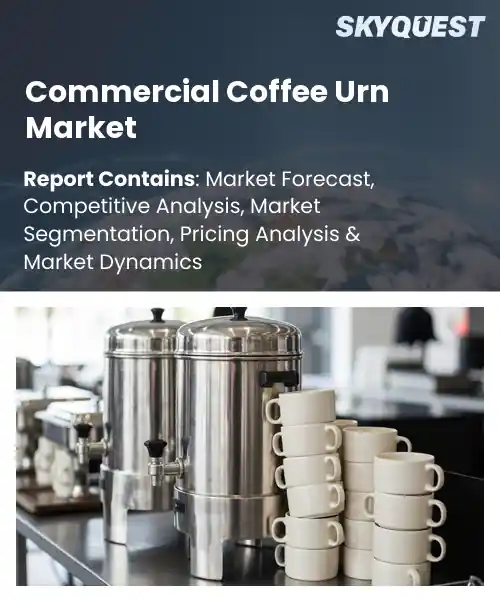
Commercial Coffee Urn Market
Report ID: SQMIG25H2113
Report ID: SQMIG25H2113
[email protected]
USA +1 351-333-4748
Report ID:
SQMIG25H2113 |
Region:
Global |
Published Date: June, 2026
Pages:
157
|Tables:
117
|Figures:
77


Global Commercial Coffee Urn Market size was valued at USD 382.50 Million in 2024 and is poised to grow from USD 400.55 Million in 2025 to USD 582.40 Million by 2033, growing at a CAGR of 4.7% during the forecast period (2026-2033).
The commercial coffee urn market trends consists of coffee machines that are used by hotels, corporate cafeterias, event locations, and caterers to serve large groups of people with hot coffee at the same time. The coffee urn market is growing in importance due to an increasing need for fast and dependable beverage service at high-traffic venues where traditional drip coffee makers cannot keep up with the demand for coffee. The emergence of this sector in the 1990’s was a result of the demand for disposable coffee cups and consumers looking for caffeine when they are on the go, which has led manufacturers to develop successfully programmed and user-controlled models for commercial use.
The last ten years have seen considerable growth in the commercial coffee urn market growth across North America and Europe due to the workplace wellness program emphasis on refreshments; and COVID has created remote learning sites that have subsequently increased the installation of commercial coffee urns. The growing hospitality industry continues to serve as the main catalyst for growth in the commercial coffee urn market, as organizations consider company culture and create ways to keep employees happy along with how to engage clients through beverage services. As organizations develop open workspace design and host meetings on location, the demand for commercial coffee equipment increases creating the need for procurement teams to upgrade from small drip coffee machines to large coffee urns that allow for brewing up to eight hours of hot coffee continuously.
The increase in use of commercial coffee urn market share has resulted in manufacturers designing more energy efficient heating systems and controls, which assists with reducing operations costs and increasing the reliability of service for vending coffee system operators. An example of coffee manufacturers installing energy efficient brew systems is campuses in Seattle modifying brew cycles based off data and analytics which travels through the system to create an endless cycle of producing product to keep up with the volume of demand for coffee.
How is IoT-driven Automation Reshaping the Commercial Coffee Urn Market?
IoT-driven automation has transformed commercial coffee urns into smart devices, allowing management of the urns through a central dashboard. Embedded heating and brewing temperature, water level and brew time sensors provide data to the urns via the cloud in real time. Operators can use this real-time data to optimize brew recipes, prevent waste and schedule preventive maintenance before an equipment failure.
In addition to optimizing the brewing process, the integration of point-of-sale systems enables venues to automatically adjust inventory levels according to demand patterns. In addition, staff is alerted via mobile notifications when there are any deviations in brewing parameters so they can respond immediately. Ultimately, these steps will lead to improved service reliability, decreased energy consumption and improved customer experience when customers demand consistent high-quality cup of coffee.
In April 2026, the National Coffee Association (NCA), with the help of NCA's Connected Coffee Urn Pilot, will demonstrate how connected coffee urns using IoT to measure brewing temperature and consistency can help grow the market and improve operational efficiency.
Market snapshot - (2026-2033)
Global Market Size
USD 382.5 Million
Largest Segment
Below 30 Cups
Fastest Growth
Above 60 Cups
Growth Rate
4.72% CAGR
To get more insights on this market click here to Request a Free Sample Report
Global commercial coffee urn market is segmented by capacity, material, end-use, distribution and region. Based on capacity, the market is segmented into below 30 cups, 30-60 cups and above 60 cups. Based on material, the market is segmented into stainless steel and aluminum. Based on end-use, the market is segmented into hotels & hospitality, restaurants & catering, offices & corporate and events & banquets. Based on distribution, the market is segmented into food service distributors, online and restaurant equipment dealers. Based on region, the market is segmented into North America, Europe, Asia Pacific, Latin America and Middle East & Africa.
Commercial coffee urns typically run for long periods with lots of coffee, so it is important that they have excellent thermal retention, durability, and resistance to rusting. Stainless steel is the best material choice for these types of coffee makers because it has all of these qualities. Also, stainless steel is a very hard material to break and will not need to be repaired or replaced often, which helps keep operating costs low. Also, since stainless steel has an appealing aesthetic, buyers are looking for coffee brewers made of stainless steel in order to make their brand image seem more premium.
However, the aluminum segment is growing rapidly right now because aluminum is lightweight, therefore it is easier to handle and costs less to ship than other types of coffee makers, which makes it attractive to businesses that want to be agile in their operations. Also, as more new designs are created that will allow coffee makers made of aluminum to distribute heat throughout the brewing process, the demand for coffee makers made of aluminum will continue to increase rapidly as well.
The hospitality sector leads in sales because large hotels and motels need a steady supply of high quality coffee to serve their customers, thus having a source for reliable urns is crucial for everyday operation. The desire for premium presentation and a continued supply of large quantities of coffee during the day drives the choice of sturdy equipment that can endure having coffee brewed continuously. Additionally, the desire to provide guests with great beverages to create an exceptional experience will result in hotels and motels investing in high quality urns; this reaffirms this segment's importance in the total hospitality ecosystem worldwide.
The office and corporate market represents the next fast-growing opportunity due to the fact that many more offices and companies are building flexible workspaces that create coffee stations for employees to congregate and socialise, thus improving employee morale. The rise in remote and hybrid work will drive an increase in demand for compact, easy to use coffee urns; it will also impact the market positively through the encouragement of energy-efficient equipment that is being driven by sustainability initiatives.
To get detailed segments analysis, Request a Free Sample Report
The North America commercial coffee urn industry trends has been able to establish its position as a leader in many ways, including its sophisticated retail infrastructure, increasing consumer demand for convenient hot beverages, and lifestyle habits that are heavily influenced by on-the-go coffee consumption. In addition, strong supply chains in the country and the widespread adoption of innovative coffee dispensing equipment continue to support the strength of this market. The hospitality segment within the North American region has become a mature industry that is focused on providing consistent quality products, which leads to a fast cycle of replenishment of products. Furthermore, the collaboration between coffee manufacturers and large-scale foodservice operators further enhances the distribution reach of manufacturers, and the loyalty of consumers to coffee brands helps ensure there is a long-term preference for premium commercial coffee urns across multiple points of interaction with consumers.
Commercial coffee urn market outlook in United States thrives on extensive coffeehouse networks and a large population accustomed to bulk brewing in offices, events, and catering venues. The market enjoys deep penetration of automated thermal brewing equipment, supported by a logistics framework that ensures rapid replenishment. Innovation focused on energy efficiency and user‑friendly designs resonates with operators intent on minimizing downtime, while a culture of customization fuels demand for varied flavor offerings across multiple service channels.
Commercial coffee urn market forecast in Canada is bolstered by a strong seasonal demand for hot coffee during colder months and a growing preference for ready‑to‑serve solutions in hospitality settings. Supply chains emphasize reliability and cold‑climate performance, prompting manufacturers to develop robust insulation and temperature control features. Collaborative relationships between distributors and local coffee roasters enhance product relevance, while sustainability initiatives attract clientele seeking environmentally responsible brewing options in communal and corporate environments.
The European market is growing rapidly because of changing lifestyles of consumers, who are beginning to value quick, quality coffee experiences, but do not want to sacrifice taste in the process. The development of a sophisticated café culture in Europe, combined with the increased demand for coffee in both corporate and event settings, has resulted in a significant increase in the use of large-scale coffee brewing equipment. Manufacturers of coffee have placed an emphasis on producing energy-efficient equipment and meeting strict environmental standards, which appeals to environmentally-conscious consumers and regulatory agencies. Cross-border trade in Europe is facilitating the ease of coffee equipment distribution throughout Europe, and the continued development of novelty coffee flavor and customized coffee solutions will support the growing coffee consumer segment, which is incredibly diverse across Europe.
Commercial coffee urn market analysis in Germany reflects a dominant position supported by a strong manufacturing base and a well‑organized distribution network. Precision engineering and reliability are hallmarks of products favored by industrial caterers and large venues. The market benefits from a focus on sustainability, with manufacturers integrating recyclable components and efficient heating systems. Partnerships with regional coffee roasters enhance flavor authenticity, while a demand for consistent temperature control drives continuous product refinement across the sector.
Commercial coffee urn market penetration in United Kingdom expands swiftly as businesses and event planners gravitate toward convenient, high‑volume coffee solutions. A dynamic on‑premise consumption trend, especially in office environments and public gatherings, propels demand for easy‑to‑operate urns. The market embraces smart technologies that allow remote monitoring and rapid temperature adjustments, aligning with the desire for operational efficiency. Collaborative efforts between suppliers and specialty coffee brands foster a diverse product portfolio that caters to evolving taste preferences.
Commercial coffee urn industry trends in France emerges as an emerging segment, buoyed by a rising enthusiasm for communal coffee experiences in hospitality and corporate domains. French consumers appreciate artisanal flavor profiles, urging manufacturers to incorporate premium bean selections into bulk brewing options. Energy‑efficient designs appeal to sustainability‑focused businesses, while flexible service models support pop‑up events and catering services. Growing awareness of convenience without compromising quality drives gradual market uptake across metropolitan and regional venues.
Increasing urbanization, a rise in coffee focused lifestyles, and growing usage of bulk brewing systems have enhanced and strengthened the position of the Asia Pacific region. The development of the middle class is now looking for convenient access to high quality or premium coffee which has prompted manufacturers to develop new technologies that are thermal based and try to meet the needs of consumers based on local preferences. There has also been an emphasis on developing supply chains (across the Asia Pacific region) that are low cost and fast, along with partnering with new coffee culture areas in order to create products that are locally based. In order to help improve the momentum of the market across a variety of economies, there continues to be a focus on energy-efficient designs that take into consideration compact designs due to population density.
Commercial coffee urn industry analysis in Japan benefits from a sophisticated hospitality sector that values precision and consistency in beverage service. Manufacturers focus on compact, high‑efficiency units that align with limited kitchen spaces typical of urban establishments. Integration of advanced temperature control and automated cleaning cycles meets the high standards of Japanese consumers. Partnerships with local coffee roasters enhance flavor authenticity, while a cultural emphasis on quality drives continual refinement of brewing technology.
Commercial coffee urn industry outlook in South Korea expands as coffee culture intertwines with fast‑paced work environments and vibrant event scenes. The market favors sleek, technology‑rich urns equipped with digital interfaces for easy operation and monitoring. Energy‑saving innovations resonate with environmentally aware businesses, and collaborations with domestic coffee brands yield nuanced taste offerings. Rapid distribution networks ensure timely product availability, supporting the growing demand for reliable, large‑scale coffee solutions across cafés, corporate cafeterias, and public gatherings.
To know more about the market opportunities by region and country, click here to
Buy The Complete Report
Increasing Demand for on Site Coffee
Adoption of Sustainable Brewing Practices
High Initial Cost of Urn Equipment
Limited Availability of Skilled Baristas
Request Free Customization of this report to help us to meet your business objectives.
Intense rivalry in the commercial coffee urn sector is driven by manufacturers seeking to differentiate through smart‑temperature controls and integrated IoT monitoring. Recent M&A activity includes a leading urn producer acquiring a small brewing‑technology firm to embed sensor analytics. Partnerships such as Diamond Brew’s distribution deal with GNC and Voyage’s $52 million Series C funding for allergen‑free coffee alternatives further sharpen competitive pressures.
Top Player’s Company Profile
Recent Developments in the Commercial Coffee Urn Market
SkyQuest’s ABIRAW (Advanced Business Intelligence, Research & Analysis Wing) is our Business Information Services team that Collects, Collates, Correlates, and Analyses the Data collected by means of Primary Exploratory Research backed by robust Secondary Desk research. As per SkyQuest analysis the global commercial coffee urn market is projected to expand at a 4.7 % CAGR driven primarily by the rising demand for on‑site coffee in hotels, offices and event venues, which pushes operators to adopt larger, reliable urns; a secondary boost comes from growing emphasis on sustainable brewing practices such as recyclable liners and energy‑saving cycles that resonate with eco‑conscious buyers. North America remains the dominant region thanks to its mature hospitality sector and robust distribution networks, while stainless‑steel urns hold the largest share because of their superior heat retention and durability. The main restraint is the high upfront cost of equipment, which can deter small‑scale adopters and slow market penetration.
| Report Metric | Details |
|---|---|
| Market size value in 2024 | USD 382.5 Million |
| Market size value in 2033 | USD 582.4 Million |
| Growth Rate | 4.72% |
| Base year | 2024 |
| Forecast period | (2026-2033) |
| Forecast Unit (Value) | USD Million |
| Segments covered |
|
| Regions covered | North America (US, Canada), Europe (Germany, France, United Kingdom, Italy, Spain, Rest of Europe), Asia Pacific (China, India, Japan, Rest of Asia-Pacific), Latin America (Brazil, Rest of Latin America), Middle East & Africa (South Africa, GCC Countries, Rest of MEA) |
| Companies covered |
|
| Customization scope | Free report customization with purchase. Customization includes:-
|
To get a free trial access to our platform which is a one stop solution for all your data requirements for quicker decision making. This platform allows you to compare markets, competitors who are prominent in the market, and mega trends that are influencing the dynamics in the market. Also, get access to detailed SkyQuest exclusive matrix.
Table Of Content
Executive Summary
Market overview
Parent Market Analysis
Market overview
Market size
KEY MARKET INSIGHTS
COVID IMPACT
MARKET DYNAMICS & OUTLOOK
Market Size by Region
KEY COMPANY PROFILES
Methodology
For the Commercial Coffee Urn Market, our research methodology involved a mixture of primary and secondary data sources. Key steps involved in the research process are listed below:
1. Information Procurement: This stage involved the procurement of Market data or related information via primary and secondary sources. The various secondary sources used included various company websites, annual reports, trade databases, and paid databases such as Hoover's, Bloomberg Business, Factiva, and Avention. Our team did 45 primary interactions Globally which included several stakeholders such as manufacturers, customers, key opinion leaders, etc. Overall, information procurement was one of the most extensive stages in our research process.
2. Information Analysis: This step involved triangulation of data through bottom-up and top-down approaches to estimate and validate the total size and future estimate of the Commercial Coffee Urn Market.
3. Report Formulation: The final step entailed the placement of data points in appropriate Market spaces in an attempt to deduce viable conclusions.
4. Validation & Publishing: Validation is the most important step in the process. Validation & re-validation via an intricately designed process helped us finalize data points to be used for final calculations. The final Market estimates and forecasts were then aligned and sent to our panel of industry experts for validation of data. Once the validation was done the report was sent to our Quality Assurance team to ensure adherence to style guides, consistency & design.
Analyst Support
Customization Options
With the given market data, our dedicated team of analysts can offer you the following customization options are available for the Commercial Coffee Urn Market:
Product Analysis: Product matrix, which offers a detailed comparison of the product portfolio of companies.
Regional Analysis: Further analysis of the Commercial Coffee Urn Market for additional countries.
Competitive Analysis: Detailed analysis and profiling of additional Market players & comparative analysis of competitive products.
Go to Market Strategy: Find the high-growth channels to invest your marketing efforts and increase your customer base.
Innovation Mapping: Identify racial solutions and innovation, connected to deep ecosystems of innovators, start-ups, academics, and strategic partners.
Category Intelligence: Customized intelligence that is relevant to their supply Markets will enable them to make smarter sourcing decisions and improve their category management.
Public Company Transcript Analysis: To improve the investment performance by generating new alpha and making better-informed decisions.
Social Media Listening: To analyze the conversations and trends happening not just around your brand, but around your industry as a whole, and use those insights to make better Marketing decisions.
REQUEST FOR SAMPLE
 REQUEST FREE CUSTOMIZATION
Global Commercial Coffee Urn Market size was valued at USD 382.5 Million in 2024 and is poised to grow from USD 400.55 Million in 2025 to USD 582.4 Million by 2033, growing at a CAGR of 4.72% during the forecast period (2026-2033).
Intense rivalry in the commercial coffee urn sector is driven by manufacturers seeking to differentiate through smart‑temperature controls and integrated IoT monitoring. Recent M&A activity includes a leading urn producer acquiring a small brewing‑technology firm to embed sensor analytics. Partnerships such as Diamond Brew’s distribution deal with GNC and Voyage’s $52 million Series C funding for allergen‑free coffee alternatives further sharpen competitive pressures. 'Bunn-O-Matic Corporation', 'Hamilton Beach Commercial', 'Wilbur Curtis Company', 'Cecilware (Food Equipment)', 'Waring Commercial', 'Newco Enterprises', 'Cafejo', 'Bloomfield (Manitowoc)', 'Fetco International', 'Service Ideas', 'Vollrath Company', 'American Metalcraft', 'Update International', 'WINCO Foodservice', 'Tablecraft Products', 'Winware', 'Admiral Craft', 'Adcraft (American Metalcraft)', 'Carlisle FoodService', 'Polar Ware Company'
Consumers and businesses increasingly prioritize convenient, high‑volume coffee solutions for meetings, events, and breakrooms, prompting hospitality venues to install commercial coffee urns. This preference drives demand for reliable, large‑capacity brewing equipment that can consistently deliver quality coffee throughout the day. Manufacturers respond by expanding product lines with advanced temperature control, energy‑efficient designs, and user‑friendly interfaces, further encouraging adoption across diverse settings. As organizations seek to enhance employee satisfaction and guest experience, the demand for commercial urns continues to rise significantly.
Eco‑Friendly Materials Adoption: Consumers increasingly demand sustainable packaging and equipment, prompting manufacturers to integrate recyclable polymers, bamboo handles, and biodegradable liners into commercial coffee urns. This shift enhances brand perception among environmentally conscious businesses, encourages loyalty, and aligns with corporate responsibility goals. Suppliers are collaborating with green material innovators to ensure durability while reducing carbon footprints, creating a competitive edge for companies that prioritize eco‑design in their product portfolios and can leverage marketing campaigns highlighting sustainability credentials to attract clients.
Why does North America Dominate the Global Commercial Coffee Urn Market? |@12


Want to customize this report? This report can be personalized according to your needs. Our analysts and industry experts will work directly with you to understand your requirements and provide you with customized data in a short amount of time. We offer $1000 worth of FREE customization at the time of purchase.
Feedback From Our Clients


 USA (+1) 351-333-4748

