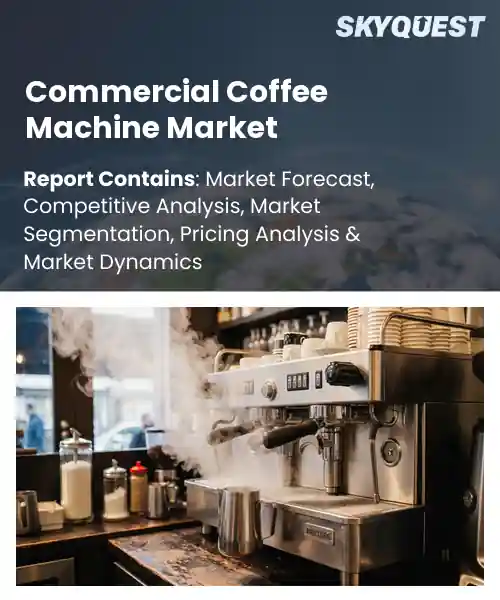
Commercial Coffee Machine Market
Report ID: SQMIG20I2697
Report ID: SQMIG20I2697
[email protected]
USA +1 351-333-4748
Report ID:
SQMIG20I2697 |
Region:
Global |
Published Date: February, 2026
Pages:
157
|Tables:
140
|Figures:
78


Global Commercial Coffee Machine Market size was valued at USD 6.1 Billion in 2024 and is poised to grow from USD 6.44 Billion in 2025 to USD 9.96 Billion by 2033, growing at a CAGR of 5.6% during the forecast period (2026-2033).
The commercial coffee machine market is seeing continued advancement because of the growth of global coffee culture due to increased urbanization and the rapid expansion of cafés, quick-service restaurants, hotels, and corporate office spaces. The increase in consumer demand for high-quality, specialty coffee beverages available in the food service and hospitality markets has pushed restaurants, cafés, and other similar outlets to invest in state-of-the-art commercial coffee machines that provide consistent, fast, and quality output.
Furthermore, the increase in espresso-based drinks, cold brew, and other specialty coffee drinks is ushering in the rapid adoption of technologically advanced commercial coffee machines with automated brewing, programmable features, and integrated milk frothing systems by cafés, quick-service restaurants, hotels, and corporate offices.
Technological innovation is an important factor driving the commercial coffee machine market growth, with manufacturers developing fully automated coffee makers with touchscreen interfaces and connected to the Internet of Things (IoT). These coffee makers are designed with energy-efficient systems that allow for remote monitoring of their performance by the end-user. With super-automatic and automated machines gaining momentum in this segment due to reduced reliance on labour while maintaining beverage quality and operational efficiency, the consumer's focus on green and robust behaviour has also had an effect on purchasing behaviours, with consumers seeking energy-efficient machines that work with eco-friendly coffee pods and/or recyclable materials.
How is IoT Improving Operational Efficiency in the Commercial Coffee Machine Market?
Connecting sensors, telecommunications, and cloud software to daily routines allows for increased efficiency in commercial coffee machines by utilizing Internet of Things (IoT) technologies. The primary functions of IoT are to allow operators to monitor their machines’ health remotely, obtain real-time data on how frequently their machines are used, and receive automated alert notifications related to maintenance or supply needs. The current environment for commercial coffee machines is heavily influenced by the fact that operators require predictably high-quality drinks with predictable downtime across a variety of locations. With IoT functionality, coffee machine operators can more efficiently schedule maintenance on multiple machines by using IoT technologies that allow technicians to send workers to complete the necessary repairs without requiring any manual inspection of the machine prior to making repairs. Throughout the entire supply chain, IoT technologies allow grinder-to-brewer interfaces, or connections between grinders and brew stations, to be adjusted in coordination with one another to keep beverage ingredients the same during times of increased demand. This functionality leads to less reliance on manual inspection of brewing procedures in a high-volume business, allowing for more efficiency and scalability of operations over time.
Market snapshot - (2026-2033)
Global Market Size
USD 6.1 Billion
Largest Segment
Traditional Machines
Fastest Growth
Specialty Coffee Machines
Growth Rate
5.6% CAGR
To get more insights on this market click here to Request a Free Sample Report
Global commercial coffee machine market is segmented into type of coffee machine, price segment, technology, usage location, end user and region. Based on type of coffee machine, the market is segmented into traditional machines and specialty coffee machines. Based on price segment, the market is segmented into low range, medium range and high range. Based on technology, the market is segmented into manual control and automatic control. Based on usage location, the market is segmented into on-premise and off-premise. Based on end user, the market is segmented into commercial and corporate offices. Based on region, the market is segmented into North America, Europe, Asia Pacific, Latin America and Middle East & Africa.
As per commercial coffee machine market analysis, the traditional machines segment currently dominates the market. Traditional espresso machines have been used reliably for many years by cafes/restaurants/hotels as well as doing big volume operations. They also give you more control over how you brew your coffee, which is why both large coffee chains and small independent cafes choose traditional espresso machines. The reason traditional machines have the highest commercial coffee machine market share is becausethey are very strong in many established foodservice locations.
As per the commercial coffee machine market outlook, the specialty coffee machines segment has the fastest growing rate. People need premium beverages (cappuccino, latte, cold brew) and have many choices to customize their espresso drinks, so more people are buying and using new advanced specialty machines. New models of super automatic and fully automatic specialty machines with built-in grinders, frothing systems, programmable settings, etc., are becoming more popular among modern cafes and corporate offices because they use less time creating coffee and have (produce) a consistent beverage. Specialty coffee culture and premiumization are fueling the growth of this segment.
As per the commercial coffee machine market forecast, the medium segment is dominant in the market. Medium-priced commercial coffee machines have the greatest combination of performance, durability, and price; this makes them an excellent choice for many small/medium size cafes, restaurants, and offices. Many businesses want a reliable machine without spending a premium on initial investment.
The high-range segment is witnessing the fastest commercial coffee machine market growth. Premium and technologically advanced machines equipped with IoT connectivity, touchscreen interfaces, energy-efficient systems, and customization features are gaining popularity among upscale cafés, hotels, and specialty coffee chains. Premium & technologically advanced machines with IoT connectivity, touchscreen display/s, energy efficiency and customization have become increasingly popular with upscale cafes, hotels, and specialty coffee chains. Heightened consumer expectation of quality coffee experience will drive increased investment in higher priced equipment.
To get detailed segments analysis, Request a Free Sample Report
The commercial coffee machine sector is Europe due to its coffee culture, highly urban areas, established hospitality industry, and the need for quality equipment and services. Established companies manufacture products in Europe with an experienced workforce in engineering and production, so companies can rapidly innovate and make customized products for the commercial user. The wide variety of café chains networks and institutional purchasers are focused on machine reliability and energy savings where there is ongoing demand for both commercial machines and maintenance contracts. There are also strict regulations governing the production of commercial coffee machines throughout European Union countries, and most of these regulations currently encourage the development of durable, easily serviceable products. Additionally, because local coffee equipment manufacturers and service providers maintain close ties, they can collaborate and strengthen their markets through aftermarket sales and training for operators; thereby establishing Europe as the leader for the design, development and acceptance of commercial coffee machines. The result of this synergistic ecosystem is to create a place to attract global partnerships and product launches.
Germany commercial coffee machine market has a strong manufacturing base, skilled engineering talent, and density of specialty coffee shops and institutional buyers. Businesses seek reliable, durable machines with local service support and spare parts. The drive for more energy efficiency and compliance with regulations is increasing the demand for advanced controls and high-durability parts.
The United Kingdom commercial coffee machine market is defined by a dynamic café culture, tourism centres, and multiple contracts catering channels requiring flexible, high-throughput machines. Business owners prefer modular machines from suppliers with strong service support and remote diagnostics. Manufacturers have focused on user experience and sustainability to create user interfaces and cleaning systems. Working with their local distributors, suppliers of commercial coffee machines have created training programs and after-market services to increase business uptime.
The France commercial coffee machine market reflects the country's long-standing appreciation of specialty cafés, and the refined tastes of consumers regarding the quality of beverages. The preference for precise control over the extraction process of beverages and the ability to modify brewing profiles are the basis for growth opportunities within this market segment. Local roasters and café operators partner with suppliers of coffee machines to develop and improve equipment settings and maintenance processes.
North America region dominates the market because of changing customer needs for specialty drinks, huge growth in out-of-home consumption channels, and a rapidly evolving food service industry seeking more efficient ways of doing business. The widespread adoption of automated, connected platforms and a greater focus on hygiene and consistency provide operators with a strong reason to move towards equipment that requires less skilled labor but still produces high-quality beverages. The strong distributor network, leasing and maintenance options and close cooperation of manufacturers and chain operators provide operators with the ability to rapidly implement new coffee machine technologies throughout cafés, workplaces and hospitality venues.
As per commercial coffee machine industry analysis, United States is driven by niche coffee chains, corporate offices, convenience stores and grocery or c-store operators looking for scalable, automated solutions to meet their demands. In addition to ease of use, repairability of machines, and having the ability to function seamlessly with digital ordering platforms, common characteristics of machines specified for use in the commercial coffee market in the U.S. will be their ability to brew beverages with consistent quality across multiple locations due to the ability to remotely monitor and measure performance of connected machines.
Commercial coffee machine market in Canada features a vibrant specialty coffee industry combined with a growing demand from institutional customers in the hospitality and workplace sectors for reliable, energy efficient machines to provide coffee services. Equipment operators prefer machines that deliver consistent, high-quality coffee while still being simple to maintain with easily accessible local service for maintenance. Relationships between equipment suppliers and regional distributors allow customized training and sales support programs for each type of operator.
As per commercial coffee machine market regional outlook, the increasing urbanization of the Asia Pacific region, growing affinity for quality coffee drinks, and continuing investment by local manufacturers into creating tailored solutions means that this area continues to enhance its position as a leader within the commercial coffee machine marketplace. Many regional suppliers are modifying their machines to accommodate many different operators requirements; for example, providing small footprints, or automated features to address the shortage of skilled workers in the urban centres. The continued expansion of café chains throughout this region, the increasing presence of coffee in convenience retail, and the growth of workplace coffee amenities all contribute to an increasing demand for scalable and connected commercial coffee machines.
As per commercial coffee machine market regional forecast, domestic manufacturers and service providers developing solutions for the commercial coffee machine marketplace in Japan stay focused on high expectations from their customers in terms of machine precision, compact design, and advanced automation capabilities that can accommodate the dense customer environments of urban cafés. Customers are looking for machines that can produce consistent extraction results, have easy-to-use cleaning routines, and can operate quietly to provide their patrons with a premium experience. Japan's strength in domestic engineering continues to fuel innovation within control and energy efficiency for commercial coffee machine technology.
The South Korean economy has a strong café culture; therefore, the commercial coffee machine market within this region is driven by both technical innovation and demand for compact performing commercial coffee machines that fit within urban cafés and kiosks. Customers (operators) want machines to produce coffee quickly, have user-friendly interfaces, and include hygienic features. Domestic and international manufacturers of commercial coffee machines are responding to operators' requirements by developing products that feature enhanced controls and modular designs. Each of these manufacturers has developed distribution channels as well as infrastructure and processes to support reliable operations; furthermore, they have established barista training programs as part of their efforts to promote expanded usage of commercial coffee machines.
To know more about the market opportunities by region and country, click here to
Buy The Complete Report
Rising Demand for Specialty Coffee
Specialty coffee has been gaining popularity among consumers, thus increasing the demand for higher-quality commercial machines by operator segments including cafés, hotels and foodservices. These machine types allow operators to produce products consistently, extract flavours efficiently, and prepare a variety of drinks meeting consumer expectations for innovative and flavorful beverages. As operators look to differentiate products and enhance customer satisfaction/guest experiences, there is a movement to machines with advanced features as well as customization; as a result, the manufacturers are broadening their product lines.
Advancements in Technology in Machine Design
Advancements in technology within machine design continue to create new levels of operational efficiencies and convenience, making new machines, on aggregate, a more attractive capital investment. The technological advancements that are driving new machines toward higher levels of automation, increased connectivity, and easier maintenance are reducing or eliminating both training time/requirements to train staff and machine downtime due to maintenance, allowing operators to produce consistent beverages with less skilled labour. The advancements associated with automation, connectivity and easy maintenance are helping to drive down the perceived operational risk, as well as the total cost of ownership from a qualitative/user perspective, thereby encouraging operators to upgrade their facilities or purchase additional replacements for machines in a variety of service environments.
High Initial Capital Investment
The scales of investing in advanced commercial-type equipment that require significant upfront capital outlay act as a deterrent for smaller independent vendors/operators who would normally purchase new equipment. Consequently, when operators focus on cash flow in the short-term and have the flexibility to operate on readily available budgets, they will likely delay upgrading their equipment, select less expensive alternatives, or keep using the equipment they currently have, slowing the pace in which old equipment is replaced with newer versions. This type of conservative purchasing behaviour has created a decline in sales volume for premium model machines and, consequently, a slower expansion of manufacturers due to only considering possible financingarrangements instead of waiting until there is enough commercial coffee machine market growth.
Complex Ongoing Service and Maintenance Requirements
Commercial coffee-making machines that require complex ongoing service and maintenance requirements have added a significant layer of complexity and associated operational barriers that will ultimately hinder the growth of the overall market by creating a higher perception of ownership responsibilities associated with those machines. Operators who have poor access to trained technicians and/or instantaneous availability of common spare parts will typically shy away from purchasing complex pieces of equipment as a means of eliminating equipment downtime and service interruptions, thus opting to purchase more basic or outdated models. The need for established aftersales support and extensive training creates an additional complexity to the manufacturers as well as the buyers of commercial coffee machines and slows down the rate of adoption of these types of machines into the market.
Request Free Customization of this report to help us to meet your business objectives.
The global commercial coffee machines market is seeing significant changes as companies like De’Longhi consolidate their premium/automatic segments, robotics startups offer more innovative products for large-volume venues, and Chinese manufacturers build and sell smart, cost-effective devices. These key factors are transforming the competitive environment through mergers/acquisitions, introducing new technologies, and creating partnerships between suppliers and roasters to drive their decision-making.
Sustainability and Circular Design: Manufacturers and operators have prioritized sustainability by providing machinery in modular forms, creating products that can be made from recyclable materials, or providing parts that are repairable to increase their lifespan and decrease waste. Likewise, focusing on energy efficiency and creating machines that are designed to work with reusable or compostable serving systems support the brand's goals for sustainability. Service providers are expanding their service models to offer take-back programs and refurbing services, which support large corporations' environmental initiatives. This is a commercial coffee machine market trend that allows suppliers to differentiate themselves from other suppliers like the manufacturers and affects the purchasing decisions of large chains as they try to establish partnerships within their respective supply chains that will help them create traceability and environmentally responsible management practices throughout the lifecycle of their products.
Integration with Digital Ecosystems: Commercial coffee makers are becoming increasingly integrated with digital technology that allows for remote monitoring, predictive maintenance as well as efficient inventory management which increases operational efficiency and decreases downtime. The ability to connect to digital technology allows for personalized beverage recipes, cashless payment systems, and loyalty reward programs, thus enhancing customer experience no matter where the establishment is located. By utilizing open-access application program interfaces (APIs) and using information gleaned from cloud-based analytics by vendors and operators to optimize work flows, menu options, and service range while maintaining consistent quality for all franchises; all while implementing and ensuring proper requirements for the protection of sensitive customer information through cyber security measures.
SkyQuest’s ABIRAW (Advanced Business Intelligence, Research & Analysis Wing) is our Business Information Services team that Collects, Collates, Correlates, and Analyses the Data collected by means of Primary Exploratory Research backed by robust Secondary Desk research.
As per SkyQuest analysis, the global commercial coffee machine industry is primarily driven by the rise in demand for specialty coffee; the expansion of automation and IoT enabled solutions supports further acceleration in the deployment of coffee machines. Improved consistency, remote diagnostics, and reduced labour requirements are benefits of using automated coffee machines. The high initial capital investment necessary for advanced commercial coffee systems remains a key barrier to entry for small operators, hindering potential upgrades. Europe dominates this market due to a strong café culture with a mature infrastructure; therefore, Europe also has extensive manufacturing and service infrastructures and has an emphasis on sustainable practices. The automatic control segment leads to widespread adoption in the market due to predictable coffee production, ease of scaling, and opportunities to create added value through multi-site implementations.
| Report Metric | Details |
|---|---|
| Market size value in 2024 | USD 6.1 Billion |
| Market size value in 2033 | USD 9.96 Billion |
| Growth Rate | 5.6% |
| Base year | 2024 |
| Forecast period | (2026-2033) |
| Forecast Unit (Value) | USD Billion |
| Segments covered |
|
| Regions covered | North America (US, Canada), Europe (Germany, France, United Kingdom, Italy, Spain, Rest of Europe), Asia Pacific (China, India, Japan, Rest of Asia-Pacific), Latin America (Brazil, Rest of Latin America), Middle East & Africa (South Africa, GCC Countries, Rest of MEA) |
| Companies covered |
|
| Customization scope | Free report customization with purchase. Customization includes:-
|
To get a free trial access to our platform which is a one stop solution for all your data requirements for quicker decision making. This platform allows you to compare markets, competitors who are prominent in the market, and mega trends that are influencing the dynamics in the market. Also, get access to detailed SkyQuest exclusive matrix.
Table Of Content
Executive Summary
Market overview
Parent Market Analysis
Market overview
Market size
KEY MARKET INSIGHTS
COVID IMPACT
MARKET DYNAMICS & OUTLOOK
Market Size by Region
KEY COMPANY PROFILES
Methodology
For the Commercial Coffee Machine Market, our research methodology involved a mixture of primary and secondary data sources. Key steps involved in the research process are listed below:
1. Information Procurement: This stage involved the procurement of Market data or related information via primary and secondary sources. The various secondary sources used included various company websites, annual reports, trade databases, and paid databases such as Hoover's, Bloomberg Business, Factiva, and Avention. Our team did 45 primary interactions Globally which included several stakeholders such as manufacturers, customers, key opinion leaders, etc. Overall, information procurement was one of the most extensive stages in our research process.
2. Information Analysis: This step involved triangulation of data through bottom-up and top-down approaches to estimate and validate the total size and future estimate of the Commercial Coffee Machine Market.
3. Report Formulation: The final step entailed the placement of data points in appropriate Market spaces in an attempt to deduce viable conclusions.
4. Validation & Publishing: Validation is the most important step in the process. Validation & re-validation via an intricately designed process helped us finalize data points to be used for final calculations. The final Market estimates and forecasts were then aligned and sent to our panel of industry experts for validation of data. Once the validation was done the report was sent to our Quality Assurance team to ensure adherence to style guides, consistency & design.
Analyst Support
Customization Options
With the given market data, our dedicated team of analysts can offer you the following customization options are available for the Commercial Coffee Machine Market:
Product Analysis: Product matrix, which offers a detailed comparison of the product portfolio of companies.
Regional Analysis: Further analysis of the Commercial Coffee Machine Market for additional countries.
Competitive Analysis: Detailed analysis and profiling of additional Market players & comparative analysis of competitive products.
Go to Market Strategy: Find the high-growth channels to invest your marketing efforts and increase your customer base.
Innovation Mapping: Identify racial solutions and innovation, connected to deep ecosystems of innovators, start-ups, academics, and strategic partners.
Category Intelligence: Customized intelligence that is relevant to their supply Markets will enable them to make smarter sourcing decisions and improve their category management.
Public Company Transcript Analysis: To improve the investment performance by generating new alpha and making better-informed decisions.
Social Media Listening: To analyze the conversations and trends happening not just around your brand, but around your industry as a whole, and use those insights to make better Marketing decisions.
REQUEST FOR SAMPLE
 REQUEST FREE CUSTOMIZATION
Global Commercial Coffee Machine Market size was valued at USD 6.1 Billion in 2024 and is poised to grow from USD 6.44 Billion in 2025 to USD 9.96 Billion by 2033, growing at a CAGR of 5.6% during the forecast period (2026-2033).
The competitive landscape in the global commercial coffee machine market is driven by consolidation among legacy OEMs, rapid innovation from robotics and IoT entrants, and supplier–roaster partnerships that shift procurement decisions. Strategic moves include De’Longhi’s business combination to consolidate premium and automatic segments, robotics startups showing product upgrades for high-traffic venues, and Chinese manufacturers pushing smart, lower-cost alternatives. 'Mastrena', 'Slayer', 'La Marzocco', 'JURA', 'Rancilio', 'Nuova Simonelli', 'Bunn', 'Keurig Dr Pepper', 'Hamilton Beach', 'Gaggia', 'Faema', 'Elekta', 'Thermoplan', 'Dalla Corte', 'Sanremo', 'Cimbali', 'Victoria Arduino', 'Franke', 'Astoria', 'Wega'
The growing consumer preference for specialty coffee encourages cafés, hotels, and foodservice operators to invest in higher-quality commercial machines because these devices enable consistent extraction and complex beverage preparation that meet customer expectations. As operators prioritize product differentiation and enhanced guest experience, demand shifts toward machines with advanced features and customizable settings, prompting manufacturers to expand offerings. This willingness to invest in equipment that supports premium beverages stimulates market expansion through product development, replacement cycles, and broader adoption across service segments.
Why does Europe Dominate the Global Commercial Coffee Machine Market? |@12


Want to customize this report? This report can be personalized according to your needs. Our analysts and industry experts will work directly with you to understand your requirements and provide you with customized data in a short amount of time. We offer $1000 worth of FREE customization at the time of purchase.
Feedback From Our Clients


 USA (+1) 351-333-4748

