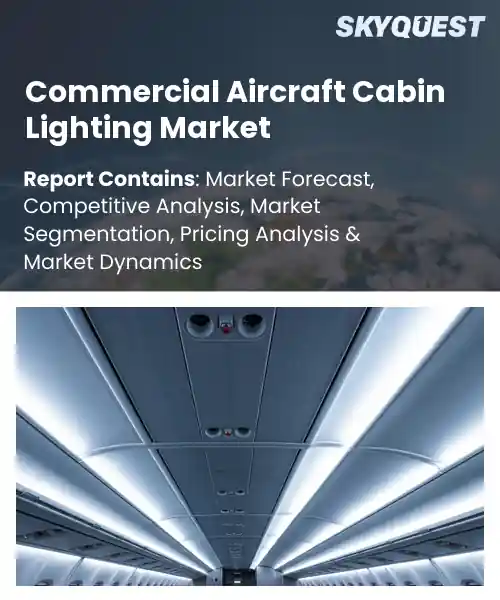
Commercial Aircraft Cabin Lighting Market
Report ID: SQMIG20A2684
Report ID: SQMIG20A2684
[email protected]
USA +1 351-333-4748
Report ID:
SQMIG20A2684 |
Region:
Global |
Published Date: June, 2026
Pages:
157
|Tables:
120
|Figures:
77


Global Commercial Aircraft Cabin Lighting Market size was valued at USD 2.17 Billion in 2024 and is poised to grow from USD 2.3 Billion in 2025 to USD 3.7 Billion by 2033, growing at a CAGR of 6.1% during the forecast period (2026-2033).
The passenger experience expectations and airline operational priorities are the key factors driving the commercial aircraft cabin lighting market. This market includes interior lighting systems that affect comfort, orientation and safety during flights and is important because lighting decisions can reduce jet lag, increase perceived spaciousness and reinforce brand identity, all of which impact revenue and loyalty. In the last 20 years solid state technologies replaced fluorescent systems and allowed for color tuning and programmable dimming profiles that allowed airlines to experiment. For example, Delta and Singapore Airlines retrofitted fleets with LED lighting, which yielded measurable gains in passenger satisfaction and energy savings.
Regulators and airlines are focused on fuel efficiency and reduction of maintenance costs, which are key growth factors for the adoption of lightweight, long-life LED modules and integrated control systems. Airlines are looking for modular fixtures that are easier to maintain, and have lower lifecycle costs, asking lighting suppliers for fixtures that minimize mean time to repair to drive real savings on large fleets. More opportunity exists with the trend of cabin personalization, where dynamic lighting is synced with service phases to increase ancillary sales and loyalty. Airlines experimenting with circadian lighting in long-haul operations have seen improvements in passenger rest measures, which in turn helps with premium cabin differentiation and justifies retrofit costs.
How is IoT enhancing passenger experience in the commercial aircraft cabin lighting market?
The Internet of Things (IoT) is changing cabin lighting by incorporating sensors, connected LED fixtures and cabin management systems into a responsive passenger centric system. Its key features include personalized mood scenes and circadian support, and seat level control that adapts in real time to the needs of passengers and flight phases. Today, we see airlines and suppliers investing in networked lighting to increase comfort and reduce manual intervention while enabling predictive maintenance and energy efficiency. Suppliers are rolling out advanced LED platforms to meet rising demand, and work in the industry on edge computing and next generation cabin wireless infrastructure is making these capabilities practical for retrofits and new builds.
Collins Aerospace May 2026, unveiled real-time cabin connectivity and personalisation connecting lighting to passenger preferences and onboard systems, showcasing how IoT driven lighting improves comfort, reduces crew workload and drives market growth by commercializing smarter cabins.
Market snapshot - (2026-2033)
Global Market Size
USD 2.17 Billion
Largest Segment
LED Lighting
Fastest Growth
LED Lighting
Growth Rate
6.1% CAGR
To get more insights on this market click here to Request a Free Sample Report
Global commercial aircraft cabin lighting market is segmented by light type, application, aircraft type, sales channel and region. Based on light type, the market is segmented into LED Lighting, Fluorescent Lighting and Others. Based on application, the market is segmented into Emergency Lighting, Reading Lights, Lavatory Lights, Signage and Indicator Lights, Ceiling and Wall Lights and Others. Based on aircraft type, the market is segmented into Narrow-body Aircraft, Wide-body Aircraft, Regional Jets and Others. Based on sales channel, the market is segmented into OEM and Aftermarket. Based on region, the market is segmented into North America, Europe, Asia Pacific, Latin America and Middle East & Africa.
The LED Lighting segment leads as airlines and manufacturers focus on the superior energy efficiency, longer operational life and flexible dimming and color tuning capabilities, that directly enhance cabin ambience and reduce operational costs and maintenance cycles. These technical advantages drive integration at the design stage and ease compliance with emerging onboard system requirements, creating a strong preference for LED across new builds and planned upgrades and enabling suppliers to scale production and innovation.
But the fastest growing area is the Others segment, with technologies such as OLED panels and fibre optic systems enabling ultra slim installations and bespoke mood lighting. Supplier innovation and airlines looking for differentiation and weight savings are driving adoption. Retrofit activity is accelerating, and new niche product and service opportunities exist within cabin modernization programs.
OEM segment leads as original equipment manufacturers incorporate cabin lighting solutions at the aircraft design and production stages allowing seamless electrical and systems integration, certified installation, and long-term supply agreements that align with airline fleet strategies. This front loaded integration simplifies retrofitting, locks in multi-year supplier contracts and encourages close co-development with airlines and Tier 1 contractors, reinforcing OEMs’ central role in specifying and scaling lighting technologies.
However, the strongest growth momentum is seen in the Aftermarket segment, as airlines are pursuing cabin refurbishments to install efficient lighting and modern controls without purchasing new airframes. Lower upfront costs and certified plug and play modules spur adoption and create upgrade and service opportunities for suppliers and MRO providers, while expanding recurring revenue streams.
To get detailed segments analysis, Request a Free Sample Report
Asia Pacific dominates the global commercial aircraft cabin lighting market due to a combination of advanced manufacturing capabilities, concentrated airline demand in the region, and strong regional supply chains. The established electronics manufacturers and specialty lighting manufacturers provide quick adaptation of LED innovations and human centric lighting solutions for a wide fleet mix. The proximity to major airframe assembly hubs enables deep collaboration between cabin system integrators and original equipment manufacturers, expediting product validation and customization. Strong retrofit activity driven by operators looking for passenger comfort and efficiency also further supports market depth. The regulatory alignment and investment in technological research create an ecosystem where design, production and aftermarket services are closely integrated, reinforcing regional leadership and exporting influence to adjacent markets. Startups also collaborate with established companies to create joint ventures. This also expands product lines and aids in reaching a wider audience.
Commercial Aircraft Cabin Lighting Market in Japan has a strong domestic aerospace supply base and close cooperation between lighting designers and airframe manufacturers. Precision engineering and user experience are keys to the adoption of tailored mood and task lighting solutions for new cabins and retrofits Responding to demand from full service carriers and operators looking for premium passenger environments, local companies are focusing on reliability, regulatory compliance and ease of integration with cabin control systems.
The South Korea Commercial Aircraft Cabin Lighting Market is marked by the quick adoption of advanced lighting controls and strong partnerships between electronics suppliers and airline cabin retrofit teams. Passenger experience is the driver for modular, scalable lighting solutions that make installation and maintenance easier, with a focus on smart cabin ecosystems. Local manufacturers focus on compact design, thermal management and digital connectivity that enables effective collaboration with global avionics integrators and meets a variety of operator needs across fleets.
The North American commercial aircraft cabin lighting market is growing rapidly, driven by robust airline modernization programs, a vibrant aftermarket ecosystem and concentrated innovation clusters. Companies in the system integration and lighting technology fields work together with carriers and MROs to build energy efficient, human-centric solutions that are engineered for serviceability and lifecycle costs. Passenger experience expectations are high, leading to dynamic ambient lighting and personalized control interfaces. A mature certification and component supply network facilitates deployment. The major OEMs and the competitive supply base drive continuous product improvement, creating broader retrofit potential and faster adoption in both the commercial and regional aviation markets. Supportive partnerships with tech startups speed up the digitalization of lighting control and analytics. Customer feedback loops enable rapid iteration and differentiation.
United States Commercial Aircraft Cabin Lighting Market is driven by collaboration between airframers, lighting manufacturers and airlines focused on passenger experience. Advanced ambient and task lighting solutions are driven by a focus on integration with entertainment and cabin management systems. Aftermarket channels and MRO partnerships support retrofits, and the competitive supplier landscape enables rapid prototyping, certification pathways and scalable production to satisfy premium and economy cabin requirements for operators.
The commercial aircraft cabin lighting market in Canada emphasizes practical and maintainable lighting systems that help operator efficiency and comfort goals. The close collaboration between local suppliers and international component manufacturers allows for customized retrofit packages that are adapted to the route structure. The focus on simple installation, compatibility with legacy cabin control architectures, and supply chain resilience is driving adoption by carriers looking for cost effective upgrades and reliable in service performance across a wide range of fleet types.
Europe is strengthening its position in the commercial aircraft cabin lighting market through concentrated technological development, strict regulatory alignment and close ties between aerospace clusters and specialized lighting firms. The requirement for energy efficiency, human centered design and system interoperability has suppliers investing in modular, lightweight assemblies that are compatible with modern cabin architectures. Airline initiatives and MRO networks supporting Retrofit programs are aimed at passenger comfort and operational reliability. The cooperation of technology centers, component makers and certification bodies across borders guarantees that the products not only meet high standards for safety and durability, but can also be tailored to the diverse preferences of operators. This strengthens Europe’s position as an innovator and quality standard in the world of cabin lighting. Investments into advanced materials and collaborative testbeds accelerate certification cycles and enable export of European design methodologies to international supply chains.
Germany Commercial Aircraft Cabin Lighting Market Germany Commercial Aircraft Cabin Lighting Market is leveraging engineering expertise and a legacy of systems integration to deliver robust, certified lighting solutions. The suppliers are focused on high quality materials, thermal management and precise control electronics in line with strict safety standards. We work closely with aircraft manufacturers and certification authorities to ensure rapid qualification of innovative assemblies, and our R and D partnerships are key to our continued advances in weight reduction, serviceability and compatibility with advanced cabin architectures.
The Commercial Aircraft Cabin Lighting Market in United Kingdom benefits from a strong culture of design and innovation that has led to unique lighting concepts that focus on passenger wellbeing. Manufacturers and design firms work with airlines to create custom ambient schemes and retrofit solutions to match brand experience. Human centered lighting, modular components and digital control interfaces allow for customization and help operators who want differentiation through improved cabin atmospheres and easier maintenance access.
Commercial Aircraft Cabin Lighting Market in France is backed by strong emphasis on design aesthetics and engineering finesse, blending form and function in cabin lighting solutions. French companies are focusing on light assemblies, sophisticated colour rendering and intuitive control interfaces that improve brand identity and passenger perception. Custom ambient schemes and retrofit modules are developed in collaboration with design studios and aerospace integrators to meet certification requirements and provide serviceability and long term durability.
To know more about the market opportunities by region and country, click here to
Buy The Complete Report
Rising Focus On Energy Efficiency
Advancements In Smart Lighting Technology
High Upfront Costs Of Installation
Regulatory And Certification Challenges
Request Free Customization of this report to help us to meet your business objectives.
The global commercial aircraft cabin lighting competitive landscape is defined by technology differentiation, supplier consolidation and airline specification as a procurement lever. As seen in recent microLED product launches and strategic asset transactions between existing suppliers, companies are making strategic acquisitions and partnerships to integrate microLED panels and human-centric control systems, while new eVTOL and UAM players are striving for integrated cabin lighting to differentiate on comfort and wellbeing..
SkyQuest’s ABIRAW (Advanced Business Intelligence, Research & Analysis Wing) is our Business Information Services team that Collects, Collates, Correlates, and Analyses the Data collected by means of Primary Exploratory Research backed by robust Secondary Desk research.
As per SkyQuest analysis, the commercial aircraft cabin lighting market is driven primarily by airlines' focus on energy efficiency and improved passenger experience, which encourage adoption of long‑life, low‑power LED systems. Asia Pacific leads the market and LED lighting remains the dominant segment. A secondary growth driver is rapid IoT and smart lighting integration that enables personalized mood scenes, circadian support and predictive maintenance. However high upfront installation and certification costs act as a key restraint slowing retrofit programs. Suppliers are responding with modular, serviceable fixtures and plug‑and‑play solutions to capture OEM and aftermarket opportunities while prioritizing human‑centric lighting and lifecycle value.
| Report Metric | Details |
|---|---|
| Market size value in 2024 | USD 2.17 Billion |
| Market size value in 2033 | USD 3.7 Billion |
| Growth Rate | 6.1% |
| Base year | 2024 |
| Forecast period | (2026-2033) |
| Forecast Unit (Value) | USD Billion |
| Segments covered |
|
| Regions covered | North America (US, Canada), Europe (Germany, France, United Kingdom, Italy, Spain, Rest of Europe), Asia Pacific (China, India, Japan, Rest of Asia-Pacific), Latin America (Brazil, Rest of Latin America), Middle East & Africa (South Africa, GCC Countries, Rest of MEA) |
| Companies covered |
|
| Customization scope | Free report customization with purchase. Customization includes:-
|
To get a free trial access to our platform which is a one stop solution for all your data requirements for quicker decision making. This platform allows you to compare markets, competitors who are prominent in the market, and mega trends that are influencing the dynamics in the market. Also, get access to detailed SkyQuest exclusive matrix.
Table Of Content
Executive Summary
Market overview
Parent Market Analysis
Market overview
Market size
KEY MARKET INSIGHTS
COVID IMPACT
MARKET DYNAMICS & OUTLOOK
Market Size by Region
KEY COMPANY PROFILES
Methodology
For the Commercial Aircraft Cabin Lighting Market, our research methodology involved a mixture of primary and secondary data sources. Key steps involved in the research process are listed below:
1. Information Procurement: This stage involved the procurement of Market data or related information via primary and secondary sources. The various secondary sources used included various company websites, annual reports, trade databases, and paid databases such as Hoover's, Bloomberg Business, Factiva, and Avention. Our team did 45 primary interactions Globally which included several stakeholders such as manufacturers, customers, key opinion leaders, etc. Overall, information procurement was one of the most extensive stages in our research process.
2. Information Analysis: This step involved triangulation of data through bottom-up and top-down approaches to estimate and validate the total size and future estimate of the Commercial Aircraft Cabin Lighting Market.
3. Report Formulation: The final step entailed the placement of data points in appropriate Market spaces in an attempt to deduce viable conclusions.
4. Validation & Publishing: Validation is the most important step in the process. Validation & re-validation via an intricately designed process helped us finalize data points to be used for final calculations. The final Market estimates and forecasts were then aligned and sent to our panel of industry experts for validation of data. Once the validation was done the report was sent to our Quality Assurance team to ensure adherence to style guides, consistency & design.
Analyst Support
Customization Options
With the given market data, our dedicated team of analysts can offer you the following customization options are available for the Commercial Aircraft Cabin Lighting Market:
Product Analysis: Product matrix, which offers a detailed comparison of the product portfolio of companies.
Regional Analysis: Further analysis of the Commercial Aircraft Cabin Lighting Market for additional countries.
Competitive Analysis: Detailed analysis and profiling of additional Market players & comparative analysis of competitive products.
Go to Market Strategy: Find the high-growth channels to invest your marketing efforts and increase your customer base.
Innovation Mapping: Identify racial solutions and innovation, connected to deep ecosystems of innovators, start-ups, academics, and strategic partners.
Category Intelligence: Customized intelligence that is relevant to their supply Markets will enable them to make smarter sourcing decisions and improve their category management.
Public Company Transcript Analysis: To improve the investment performance by generating new alpha and making better-informed decisions.
Social Media Listening: To analyze the conversations and trends happening not just around your brand, but around your industry as a whole, and use those insights to make better Marketing decisions.
REQUEST FOR SAMPLE
 REQUEST FREE CUSTOMIZATION
Global Commercial Aircraft Cabin Lighting Market size was valued at USD 2.17 Billion in 2024 and is poised to grow from USD 2.3 Billion in 2025 to USD 3.7 Billion by 2033, growing at a CAGR of 6.1% during the forecast period (2026-2033).
The competitive landscape for global commercial aircraft cabin lighting centers on technology differentiation, supplier consolidation, and airline specification as a procurement lever. Firms execute targeted acquisitions and partnerships to add micro-LED panels and human-centric control systems, exemplified by recent micro-LED product introductions and strategic asset deals among established suppliers, while new eVTOL and UAM entrants press integrated cabin lighting to differentiate on comfort and wellbeing. 'RTX Corporation', 'Diehl Stiftung', 'SCHOTT', 'Astronics Corporation', 'Luminator Technology Group', 'Safran', 'STG Aerospace', 'Honeywell', 'Cobham', 'Soderberg Manufacturing', 'Bruce Aerospace', 'Oxley Group', 'Heads Up Technologies', 'Gelcore', 'IFPL Group', 'Aero-Instruments', 'Precise Flight', 'Emteq', 'Skandia', 'Grimes Aerospace'
Improved energy efficiency priorities within airlines and aircraft manufacturers are encouraging adoption of LED and smart cabin lighting systems. Airlines seek lower operational costs and longer equipment life, while manufacturers design cabins emphasizing reduced power consumption and thermal output. This focus drives specification requirements favoring advanced lighting solutions, creating procurement incentives and retrofitting opportunities. Specification harmonization and supplier innovation further reinforce demand by making efficient products more attractive during new aircraft production and cabin refurbishment cycles, thus contributing to sustained market expansion through ongoing replacement and upgrade initiatives.
Human-Centric Lighting Adoption: Airlines and cabin designers increasingly prioritize tunable, human-centric lighting systems to enhance passenger comfort, circadian alignment, and cabin quality. This trend drives demand for fixtures with adjustable color temperature, intensity, and scene programming that support different phases of flight and diverse passenger needs. Manufacturers focus on modular, integrable solutions that simplify retrofits and enable remote management through cabin systems. The emphasis on well-being and passenger experience fosters collaboration among lighting suppliers, OEMs and interior specialists to deliver tailored lighting strategies.
Why does Asia Pacific Dominate the Global Commercial Aircraft Cabin Lighting Market? |@12


Want to customize this report? This report can be personalized according to your needs. Our analysts and industry experts will work directly with you to understand your requirements and provide you with customized data in a short amount of time. We offer $1000 worth of FREE customization at the time of purchase.
Feedback From Our Clients


 USA (+1) 351-333-4748

