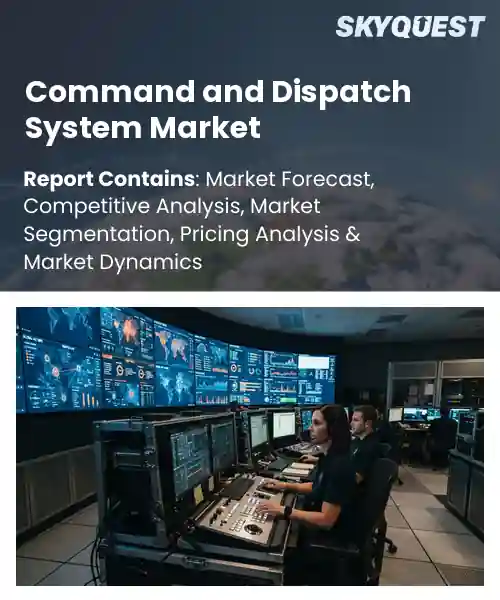
Command and Dispatch System Market
Report ID: SQMIG45E3237
Report ID: SQMIG45E3237
[email protected]
USA +1 351-333-4748
Report ID:
SQMIG45E3237 |
Region:
Global |
Published Date: September, 2026
Pages:
157
|Tables:
145
|Figures:
78


Global Command And Dispatch System Market size was valued at USD 12.64 Billion in 2024 and is poised to grow from USD 13.63 Billion in 2025 to USD 24.85 Billion by 2033, growing at a CAGR of 7.8% during the forecast period (2026-2033).
One the global command and dispatch system market comprises software and hardware platforms that enable coordination of field assets such as emergency responders, delivery fleets, and utility crews. Its significance stems from the growing demand for instant information flow and efficient resource allocation in complex operational environments. Historically, the market emerged from basic radio dispatch in the 1970s, evolved through computer-aided dispatch in the 1990s, and accelerated with the advent of cloud computing and IoT sensors in the past decade. For example, municipal fire departments now rely on predictive analytics to pre‑position units, illustrating how technological maturation has reshaped dispatch models. One of the key growth driver is integration of AI analytics, which transforms raw dispatch data into actionable insights and reduces response times. When agencies adopt routing, they can anticipate congestion and automatically reroute units, thereby lowering operational costs and improving service levels. This capability has attracted investment from logistics firms seeking to optimize delivery, as illustrated by an e‑commerce carrier that reduced missed deliveries by 15 percent after deploying a dispatch platform. Consequently, the market is expanding beyond safety into commercial sectors, creating significant revenue streams and prompting vendors to develop modular, subscription solutions that cater to user requirements.
How is AI-driven automation reshaping the command and dispatch system market?
AI driven automation is redefining command and dispatch systems by embedding predictive analytics, natural language processing, and real time decision support directly into workflow engines. Today operators rely on platforms that automatically prioritize incidents, suggest optimal routes, and allocate resources without manual intervention. The market has shifted from static call center consoles to dynamic hubs that fuse live sensor data, geographic information and historical patterns. Emergency services use these tools to reduce response times, while logistics firms apply them to streamline fleet coordination. The result is a more agile ecosystem where human operators focus on strategic oversight while algorithms handle routine triage and routing.Motorola Solutions announced an AI enhanced dispatch platform in June 2023, enabling automatic incident classification and resource matching across public safety networks. This rollout shortens decision cycles, boosts operational efficiency and illustrates how intelligent automation is accelerating growth in the command and dispatch market by integrating predictive analytics with real time data streams across agencies.
Market snapshot - (2026-2033)
Global Market Size
USD 12.64 Billion
Largest Segment
Software
Fastest Growth
Services
Growth Rate
7.8% CAGR
To get more insights on this market click here to Request a Free Sample Report
Global command and dispatch system market is segmented by component, deployment, application, end user, communication type and region. Based on component, the market is segmented into Software, Hardware and Services. Based on deployment, the market is segmented into Cloud-Based and On-Premises. Based on application, the market is segmented into Emergency Response, Public Safety, Transportation & Fleet Management and Utilities. Based on end user, the market is segmented into Law Enforcement, Fire & Rescue Services, Emergency Medical Services and Utilities. Based on communication type, the market is segmented into Land Mobile Radio, Cellular and Satellite. Based on region, the market is segmented into North America, Europe, Asia Pacific, Latin America and Middle East & Africa.
Software segment dominates because it provides the core intelligence that integrates disparate communication channels, automates incident analytics, and enables real time decision support. Its flexibility allows agencies to customize workflows, adapt to evolving standards, and deploy updates without extensive downtime. Consequently, vendors focus R&D on AI driven routing and data visualization, reinforcing software’s central role in delivering value across the command and dispatch ecosystem for public safety operations and municipal coordination.
However, hardware segment is witnessing the strongest growth momentum as agencies upgrade legacy radios, rugged tablets, and edge devices to meet higher bandwidth and resilience demands. Emerging sensor integration and IoT connectivity drive procurement, while decreasing device costs accelerate adoption. This surge expands the market by unlocking functionality and extending system reach to personnel.
Cloud based segment dominates because it offers elastic scalability that matches fluctuating incident volumes, reduces capital outlay, and simplifies multi agency collaboration through centralized data lakes. Vendors can roll out software updates instantly, integrate AI analytics, and provide seamless access across jurisdictions without complex infrastructure maintenance. These advantages make cloud deployment the preferred choice for agencies seeking rapid modernization and cost effective expansion of command capabilities.
On the other hand, on premises segment is emerging as the key high growth area as agencies prioritize data sovereignty, mission critical reliability, and low latency operations. Tight integration with legacy radio networks and dedicated edge servers drives renewed investment, while regulatory guidance encouraging local control fuels adoption. This momentum broadens market depth by creating niche solutions that complement cloud services and address sensitive operational requirements.
To get detailed segments analysis, Request a Free Sample Report
North America leads due to its mature public safety infrastructure and early adoption of integrated communication platforms. Robust funding mechanisms support continuous technology upgrades, enabling seamless interoperability among law enforcement, fire, and emergency medical services. A concentration of innovative vendors cultivates a competitive ecosystem that accelerates product development and customization. Strong regulatory frameworks encourage standardization, while extensive training programs ensure effective implementation across jurisdictions. Collaborative partnerships between government agencies and technology providers further reinforce market depth, creating a virtuous cycle of adoption and refinement that positions North America at the forefront of command and dispatch solutions.
Command and Dispatch System Market in the United States benefits from extensive federal and state initiatives that prioritize public safety modernization. The presence of leading technology firms drives a dynamic ecosystem of solutions tailored to diverse agency needs. Wide‑scale deployment across urban and rural environments fosters a deep talent pool, supporting advanced analytics and real‑time response capabilities. Ongoing collaboration between agencies and innovators sustains a culture of continuous improvement and resilience.
Command and Dispatch System Market in Canada is characterized by a strong emphasis on collaborative governance and bilingual interface design. Provincial agencies work closely with vendors to integrate geographic information systems that enhance situational awareness across vast territories. Investment in training ensures personnel can leverage sophisticated mapping and analytics tools effectively. The regulatory environment promotes data security and privacy, reinforcing confidence among stakeholders and encouraging broader adoption of next‑generation dispatch platforms.
Europe’s expansion is fueled by a strategic push toward harmonized emergency response standards and cross‑border cooperation. Governmental bodies champion digital transformation initiatives that integrate legacy systems into unified command platforms, enhancing coordination among diverse jurisdictions. Emerging public‑private partnerships accelerate innovation, delivering solutions that address complex urban environments and evolving security challenges. Emphasis on sustainability and resilient infrastructure encourages the adoption of energy‑efficient technologies. Moreover, a skilled workforce and strong research institutions support continuous improvement, positioning Europe as a dynamic hub for advanced command and dispatch capabilities.
Command and Dispatch System Market in Germany benefits from a robust federal framework that incentivizes technology integration across state agencies. Collaborative pilots between municipalities and leading vendors generate scalable solutions optimized for dense urban networks. A focus on precision engineering ensures high reliability and interoperability with existing public safety assets. Continuous professional development programs maintain a knowledgeable operator base, reinforcing the market’s leadership position.
Command and Dispatch System Market in the United Kingdom experiences rapid growth driven by ambitious national safety agendas and strong investment in smart city initiatives. Integrated platforms enable real‑time data sharing among police, fire, and ambulance services, enhancing response efficiency. Partnerships with academia foster innovative analytics and predictive capabilities, while regulatory emphasis on data protection builds public trust. The market’s velocity is further amplified by agile procurement processes that accelerate deployment of cutting‑edge solutions.
Command and Dispatch System Market in France is emerging through targeted modernization programs that prioritize interoperability and user‑centric design. Regional authorities collaborate with technology firms to pilot cloud‑based dispatch solutions tailored to varied geographic contexts. Emphasis on multilingual interfaces supports seamless communication across diverse communities. Investment in training ensures that operators can effectively harness advanced mapping and decision‑support tools, laying the groundwork for broader market expansion.
Asia Pacific is strengthening its position by leveraging rapid urbanization and a heightened focus on public safety resilience. Governments are embedding command and dispatch technologies within smart city frameworks, fostering real‑time coordination among multiple agencies. Regional cooperation initiatives encourage knowledge exchange and standardization across borders, while a burgeoning ecosystem of local innovators introduces cost‑effective, customizable solutions. Strong commitment to digital infrastructure development enhances connectivity, enabling sophisticated analytics and predictive response capabilities. This confluence of policy support, technological agility, and market demand propels the region toward greater prominence in the global landscape.
Command and Dispatch System Market in Japan is shaped by advanced automation and a culture of precision. Integration of AI‑driven analytics with traditional dispatch workflows improves situational awareness in densely populated zones. Collaborative efforts between municipal authorities and tech firms produce highly reliable platforms that align with stringent safety standards. Ongoing training emphasizes seamless human‑machine interaction, ensuring that operators can extract actionable intelligence swiftly.
Command and Dispatch System Market in South Korea thrives on a forward‑looking digital agenda that emphasizes seamless connectivity and rapid response. Strong governmental backing accelerates the rollout of unified command centers linking police, fire, and medical services. Partnerships with leading ICT companies foster the development of intuitive user interfaces and robust data integration. Continuous skill development ensures that personnel can exploit the full potential of real‑time decision‑support tools.
To know more about the market opportunities by region and country, click here to
Buy The Complete Report
Growing Demand For Real‑Time Coordination
Adopting Cloud‑Native Architecture
Stringent Data Privacy Regulations
High Implementation Costs
Request Free Customization of this report to help us to meet your business objectives.
Insufficient data to generate the requested content.
Top Player’s Company Profile
Recent Developments
SkyQuest’s ABIRAW (Advanced Business Intelligence, Research & Analysis Wing) is our Business Information Services team that Collects, Collates, Correlates, and Analyses the Data collected by means of Primary Exploratory Research backed by robust Secondary Desk research. As per SkyQuest analysis, the global command and dispatch system market is being propelled primarily by the growing demand for real‑time coordination, which pushes agencies to adopt platforms that fuse video, telemetry and geolocation into a single view. A second catalyst is the shift toward cloud‑native architecture that offers elastic scalability and faster integration of AI analytics, reducing capital outlay. The software segment remains the market’s dominant force, delivering the core intelligence that links diverse communication channels. North America leads the landscape, thanks to mature public‑safety infrastructure and strong vendor presence. However, stringent data‑privacy regulations pose a notable restraint, adding compliance complexity and potentially slowing adoption.
| Report Metric | Details |
|---|---|
| Market size value in 2024 | USD 12.64 Billion |
| Market size value in 2033 | USD 24.85 Billion |
| Growth Rate | 7.8% |
| Base year | 2024 |
| Forecast period | (2026-2033) |
| Forecast Unit (Value) | USD Billion |
| Segments covered |
|
| Regions covered | North America (US, Canada), Europe (Germany, France, United Kingdom, Italy, Spain, Rest of Europe), Asia Pacific (China, India, Japan, Rest of Asia-Pacific), Latin America (Brazil, Rest of Latin America), Middle East & Africa (South Africa, GCC Countries, Rest of MEA) |
| Companies covered |
|
| Customization scope | Free report customization with purchase. Customization includes:-
|
To get a free trial access to our platform which is a one stop solution for all your data requirements for quicker decision making. This platform allows you to compare markets, competitors who are prominent in the market, and mega trends that are influencing the dynamics in the market. Also, get access to detailed SkyQuest exclusive matrix.
Table Of Content
Executive Summary
Market overview
Parent Market Analysis
Market overview
Market size
KEY MARKET INSIGHTS
COVID IMPACT
MARKET DYNAMICS & OUTLOOK
Market Size by Region
KEY COMPANY PROFILES
Methodology
For the Command and Dispatch System Market, our research methodology involved a mixture of primary and secondary data sources. Key steps involved in the research process are listed below:
1. Information Procurement: This stage involved the procurement of Market data or related information via primary and secondary sources. The various secondary sources used included various company websites, annual reports, trade databases, and paid databases such as Hoover's, Bloomberg Business, Factiva, and Avention. Our team did 45 primary interactions Globally which included several stakeholders such as manufacturers, customers, key opinion leaders, etc. Overall, information procurement was one of the most extensive stages in our research process.
2. Information Analysis: This step involved triangulation of data through bottom-up and top-down approaches to estimate and validate the total size and future estimate of the Command and Dispatch System Market.
3. Report Formulation: The final step entailed the placement of data points in appropriate Market spaces in an attempt to deduce viable conclusions.
4. Validation & Publishing: Validation is the most important step in the process. Validation & re-validation via an intricately designed process helped us finalize data points to be used for final calculations. The final Market estimates and forecasts were then aligned and sent to our panel of industry experts for validation of data. Once the validation was done the report was sent to our Quality Assurance team to ensure adherence to style guides, consistency & design.
Analyst Support
Customization Options
With the given market data, our dedicated team of analysts can offer you the following customization options are available for the Command and Dispatch System Market:
Product Analysis: Product matrix, which offers a detailed comparison of the product portfolio of companies.
Regional Analysis: Further analysis of the Command and Dispatch System Market for additional countries.
Competitive Analysis: Detailed analysis and profiling of additional Market players & comparative analysis of competitive products.
Go to Market Strategy: Find the high-growth channels to invest your marketing efforts and increase your customer base.
Innovation Mapping: Identify racial solutions and innovation, connected to deep ecosystems of innovators, start-ups, academics, and strategic partners.
Category Intelligence: Customized intelligence that is relevant to their supply Markets will enable them to make smarter sourcing decisions and improve their category management.
Public Company Transcript Analysis: To improve the investment performance by generating new alpha and making better-informed decisions.
Social Media Listening: To analyze the conversations and trends happening not just around your brand, but around your industry as a whole, and use those insights to make better Marketing decisions.
REQUEST FOR SAMPLE
 REQUEST FREE CUSTOMIZATION


Want to customize this report? This report can be personalized according to your needs. Our analysts and industry experts will work directly with you to understand your requirements and provide you with customized data in a short amount of time. We offer $1000 worth of FREE customization at the time of purchase.
Feedback From Our Clients


 USA (+1) 351-333-4748

