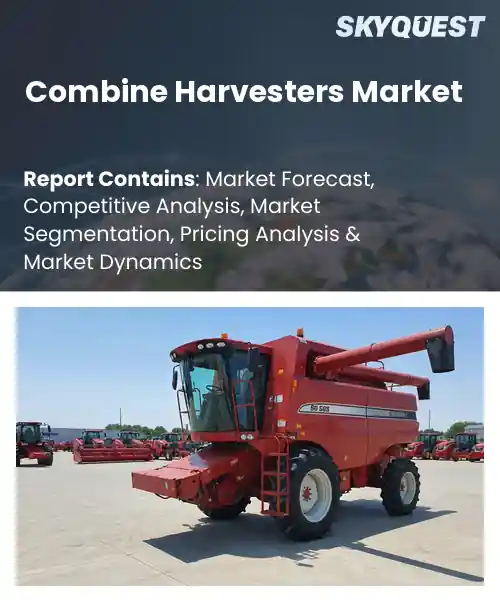
Combine Harvesters Market
Report ID: SQMIG20H2092
Report ID: SQMIG20H2092
[email protected]
USA +1 351-333-4748
Report ID:
SQMIG20H2092 |
Region:
Global |
Published Date: June, 2026
Pages:
157
|Tables:
117
|Figures:
77


Global Combine Harvesters Market size was valued at USD 13.66 Billion in 2024 and is poised to grow from USD 14.35 Billion in 2025 to USD 21.23 Billion by 2033, growing at a CAGR of 5.02% during the forecast period (2026-2033).
The global combine harvester market comprises manufacturers and distributors of self‑propelled machines that cut, thresh, and separate grain in a single operation. Its importance stems from the need to increase agricultural productivity while reducing labor costs, especially in regions facing workforce shortages. Since the 1970s, advancements in hydraulic systems and precision‑agriculture electronics have transformed simple reapers into sophisticated, GPS‑guided platforms. For example, John Deere’s 9R series integrates variable‑rate technology that optimizes input use, allowing farms to raise yields by up to 15 percent. This evolution reflects a broader shift toward mechanization that fuels market expansion today across major grain‑producing nations globally. The principal growth factor now is the adoption of precision‑farming solutions that embed telemetry, algorithms, and steering into combine harvesters. This integration lowers fuel consumption and harvest losses, which directly improves farm profitability; as a result, growers in North America and Brazil are investing in telematics‑enabled units to monitor performance in real‑time. Simultaneously, emerging markets such as India and Sub‑Saharan Africa are upgrading from labor‑intensive manual threshers to combines that can operate on small plots, unlocking untapped acreage. Consequently, component suppliers experience rising demand for sensors and connectivity modules, creating a lucrative niche for technology partners and fueling market velocity.
How is AI and IoT integration transforming the combine harvesters market?
AI and IoT are reshaping combine harvesters by embedding sensors that capture moisture, grain flow and engine health. The data streams to cloud platforms where machine learning models predict optimal settings and schedule maintenance before failures occur. Farmers can monitor each unit from a tablet, adjusting speed or threshing intensity based on field conditions. The technology also enables fleet coordination, allowing multiple harvesters to work together without overlap. As growers seek higher productivity and lower labor costs, these smart features are becoming a core expectation in new equipment. The market therefore sees a shift toward connected and autonomous machines that deliver consistent yields.John Deere March 2025, introduced the Series X autonomous combine harvester that uses AI driven vision and IoT connectivity to adjust harvesting parameters in real time, boosting efficiency and supporting market growth. The machine learns field conditions, communicates with farm management platforms and reduces operator fatigue, illustrating the transformative impact.
Market snapshot - (2026-2033)
Global Market Size
USD 13.66 Billion
Largest Segment
Self-Propelled Combine Harvesters
Fastest Growth
Power Take Off Powered Pull Harvesters
Growth Rate
5.02% CAGR
To get more insights on this market click here to Request a Free Sample Report
Global combine harvesters market is segmented by equipment mobility type, equipment drive mechanism, engine power output rating, target crop type application and region. Based on equipment mobility type, the market is segmented into Self-Propelled Combine Harvesters, Tractor-Mounted Combine Harvesters and Power Take Off Powered Pull Harvesters. Based on equipment drive mechanism, the market is segmented into Wheel Drive Systems and Track Drive Systems. Based on engine power output rating, the market is segmented into Less than 150 HP, 150 to 300 HP, 301 to 450 HP and Above 450 HP. Based on target crop type application, the market is segmented into Cereals Harvesting, Oilseeds Harvesting and Others. Based on region, the market is segmented into North America, Europe, Asia Pacific, Latin America and Middle East & Africa.
Self propelled combine harvesters segment dominates because integrated power and mobility eliminate the need for separate tractors, allowing continuous field operation and reducing turnaround time. This configuration aligns with farmer demand for streamlined workflows, lower labor inputs, and consistent crop flow. The built in grain handling system enhances throughput, while advanced telemetry supports precision farming, reinforcing its appeal as the preferred solution for large scale harvest operations throughout the harvesting season.
Meanwhile, tractor mounted combine harvesters emerge as the most rapidly expanding area because flexible attachment options enable farmers to upgrade existing tractor fleets, lowering capital expenditure. This adaptability appeals to small and medium producers adopting mechanization, and ongoing improvements in PTO efficiency accelerate market uptake, creating new growth pathways.
150 to 300 hp segment dominates because this power band matches the majority of commodity crops, delivering sufficient throat width and grain handling capacity without excessive fuel consumption. Manufacturers tailor engine performance to balance productivity and operational cost, satisfying the core requirements of midsized farms. The reliability of proven engine platforms and ease of maintenance further solidify its position as the go to choice for mainstream harvesting operations.
On the other hand, above 450 hp combine harvesters are witnessing the strongest growth momentum as large acreage producers seek higher throughput to meet tighter harvest windows. Advanced engines and reinforced frames handle bulky crops, while precision controls boost efficiency. This high power niche is opening fresh market avenues and spurring further innovation.
To get detailed segments analysis, Request a Free Sample Report
Asia Pacific leads the global combine harvesters market due to a convergence of fertile agricultural landscapes, high adoption of mechanised farming practices, and strong manufacturing capabilities in the region. The presence of advanced research and development centres drives continuous innovation, delivering machines that address diverse cropping patterns and challenging terrain. Robust supply chains and close proximity between manufacturers and end‑users enable rapid feedback loops and customization. Governmental support through favourable policies and investment in rural infrastructure further accelerates equipment uptake. The region also benefits from manufacturers that leverage scale to offer competitive pricing while maintaining quality standards. Growing emphasis on sustainable practices encourages integration of precision technologies, enhancing productivity and resource efficiency. Together, these factors consolidate Asia Pacific’s position as the dominant force in the global combine harvesters landscape.
Combine Harvesters Market Japan benefits from a strong legacy of engineering excellence and a dense network of equipment distributors that provide localized support. Farmers value precision features tailored to the country’s varied topography and rice‑focused cropping systems. Collaborative R&D initiatives between manufacturers and agricultural institutes foster continuous upgrades, while agricultural policy incentives promote mechanisation among both large estates and family farms, sustaining robust demand throughout the entire growing season and beyond.
Combine Harvesters Market South Korea is driven by intensive vegetable and cereal production that demands high efficiency and compact machine designs. Domestic manufacturers focus on advanced electronics and telematics, offering harvesters equipped with real‑time monitoring and automated controls. Strong collaboration with research universities accelerates the adoption of smart farming solutions, while government programmes aimed at reducing labour shortages encourage rapid equipment uptake across both large agribusinesses and smallholder farms the country.
Europe’s combine harvesters market is expanding rapidly as producers seek to balance high productivity with stringent environmental standards. Advanced engineering expertise across the continent yields machines that integrate precision farming tools, enabling optimal input use and reduced emissions. Policy frameworks that encourage sustainable intensification support investment in modern equipment, while abundant grain and oilseed cultivation creates a stable demand base. Collaborative networks between manufacturers, research institutes, and farmer organisations accelerate technology transfer and customization for diverse climatic zones. The combination of strong export capabilities, robust financing options, and a cultural emphasis on agricultural efficiency positions Europe as a leading growth engine for the global combine harvesters sector. Increasing consumer demand for responsibly sourced cereals fuels growers to adopt equipment that can meet traceability and quality benchmarks, further stimulating market momentum.
Combine Harvesters Market Germany is anchored by a tradition of precision engineering and a dense supplier ecosystem that delivers reliable machines. The country’s extensive arable land and focus on cereal production drive demand for harvesters with advanced telemetry and fuel‑efficiency features. Close cooperation between manufacturers and the Federal Ministry of Agriculture ensures alignment with sustainability targets, while export orientation helps German firms maintain a leading position in the European market.
Combine Harvesters Market United Kingdom is experiencing fast‑paced growth as farmers adopt high‑tech harvesters to meet rising grain demand and sustainability goals. Integration of data‑driven analytics and autonomous features enables operators to optimise field operations and reduce labour pressures. Government support for precision agriculture and access to flexible financing schemes encourage fleet upgrades, while a vibrant network of aftermarket service providers ensures minimal downtime and continuous performance improvements across the sector.
Combine Harvesters Market France is emerging as a contributor to the continental harvesters landscape, driven by diversified cropping patterns and growing adoption of mechanisation among farms. Manufacturers tailor solutions to the country’s mix of wheat, barley and oilseed production, emphasizing versatile chassis and modular accessories. Collaborative initiatives with agronomic research centers promote the integration of climate‑smart practices, while subsidies aimed at modernising rural infrastructure create conditions for significant market expansion.
North America is reinforcing its foothold in the combine harvesters arena through a blend of technological leadership, extensive farmland, and supportive policy environments. Manufacturers leverage cutting‑edge automation, GPS‑guided steering and advanced engine efficiency to deliver machines that meet the scale demands of large‑acre farms while reducing operational costs. Strong emphasis on research partnerships with universities accelerates the rollout of smart‑farming solutions, enhancing yield predictability and resource stewardship. Access to robust financing mechanisms and a well‑developed dealer network ensures rapid adoption across diverse agricultural operations. Moreover, a focus on sustainability drives the integration of low‑emission powertrains and precision input application, aligning equipment capabilities with evolving environmental expectations and cementing North America’s role as a key growth driver globally. Collaborative industry forums further expedite standards harmonisation, fostering a cohesive market ecosystem.
Combine Harvesters Market United States benefits from vast agronomic diversity and a high proportion of large‑scale farms that prioritize efficiency and productivity. Manufacturers concentrate on robust, high‑horsepower models equipped with telematics and autonomous capabilities to handle extensive acreage. Strong collaboration with agricultural extension services drives adoption of precision technologies, while readily available credit and leasing options facilitate fleet modernization across the Midwest and Great Plains, sustaining vigorous market activity continually.
Combine Harvesters Market Canada is shaped by a mix of grain and oilseed production across expansive, often challenging terrains. Producers favor compact yet powerful harvesters that integrate GPS‑based guidance and real‑time data analytics to optimise field efficiency and preserve soil health. Federal initiatives promoting technology adoption and targeted financing schemes support the transition to smarter equipment, while a well‑established dealer network provides reliable after‑sales service, reinforcing steady market growth continually.
To know more about the market opportunities by region and country, click here to
Buy The Complete Report
Increasing Global Food Demand
Advancements in Harvesting Technology
High Initial Capital Expenditure
Limited Access to Service Networks
Request Free Customization of this report to help us to meet your business objectives.
The combine harvester market is intensely competitive, with manufacturers racing to capture share as global demand expands. Competitive pressure is driven by the need for higher efficiency, lower emissions and integration of precision‑agriculture technologies. Companies are responding through strategic moves such as mergers, joint ventures and accelerated R&D programs that bring advanced sensor suites, autonomous capabilities and improved harvesting performance to market.
Top Player’s Company Profile
Recent Developments
SkyQuest’s ABIRAW (Advanced Business Intelligence, Research & Analysis Wing) is our Business Information Services team that Collects, Collates, Correlates, and Analyses the Data collected by means of Primary Exploratory Research backed by robust Secondary Desk research. As per SkyQuest analysis, the combine harvesters market is being propelled primarily by rising global food demand that pushes farms to adopt larger, more efficient machines, while the rapid integration of precision‑agriculture technologies such as IoT sensors and AI‑driven telemetry acts as a second catalyst accelerating productivity and reducing fuel use. The self‑propelled combine harvester segment leads the market because its integrated power and mobility streamline operations and lower labor requirements. Asia Pacific dominates geographically, benefitting from fertile lands, strong manufacturing bases and supportive policies. However, high upfront capital costs remain a significant restraint, limiting adoption among smaller growers and slowing overall market expansion.
| Report Metric | Details |
|---|---|
| Market size value in 2024 | USD 13.66 Billion |
| Market size value in 2033 | USD 21.23 Billion |
| Growth Rate | 5.02% |
| Base year | 2024 |
| Forecast period | (2026-2033) |
| Forecast Unit (Value) | USD Billion |
| Segments covered |
|
| Regions covered | North America (US, Canada), Europe (Germany, France, United Kingdom, Italy, Spain, Rest of Europe), Asia Pacific (China, India, Japan, Rest of Asia-Pacific), Latin America (Brazil, Rest of Latin America), Middle East & Africa (South Africa, GCC Countries, Rest of MEA) |
| Companies covered |
|
| Customization scope | Free report customization with purchase. Customization includes:-
|
To get a free trial access to our platform which is a one stop solution for all your data requirements for quicker decision making. This platform allows you to compare markets, competitors who are prominent in the market, and mega trends that are influencing the dynamics in the market. Also, get access to detailed SkyQuest exclusive matrix.
Table Of Content
Executive Summary
Market overview
Parent Market Analysis
Market overview
Market size
KEY MARKET INSIGHTS
COVID IMPACT
MARKET DYNAMICS & OUTLOOK
Market Size by Region
KEY COMPANY PROFILES
Methodology
For the Combine Harvesters Market, our research methodology involved a mixture of primary and secondary data sources. Key steps involved in the research process are listed below:
1. Information Procurement: This stage involved the procurement of Market data or related information via primary and secondary sources. The various secondary sources used included various company websites, annual reports, trade databases, and paid databases such as Hoover's, Bloomberg Business, Factiva, and Avention. Our team did 45 primary interactions Globally which included several stakeholders such as manufacturers, customers, key opinion leaders, etc. Overall, information procurement was one of the most extensive stages in our research process.
2. Information Analysis: This step involved triangulation of data through bottom-up and top-down approaches to estimate and validate the total size and future estimate of the Combine Harvesters Market.
3. Report Formulation: The final step entailed the placement of data points in appropriate Market spaces in an attempt to deduce viable conclusions.
4. Validation & Publishing: Validation is the most important step in the process. Validation & re-validation via an intricately designed process helped us finalize data points to be used for final calculations. The final Market estimates and forecasts were then aligned and sent to our panel of industry experts for validation of data. Once the validation was done the report was sent to our Quality Assurance team to ensure adherence to style guides, consistency & design.
Analyst Support
Customization Options
With the given market data, our dedicated team of analysts can offer you the following customization options are available for the Combine Harvesters Market:
Product Analysis: Product matrix, which offers a detailed comparison of the product portfolio of companies.
Regional Analysis: Further analysis of the Combine Harvesters Market for additional countries.
Competitive Analysis: Detailed analysis and profiling of additional Market players & comparative analysis of competitive products.
Go to Market Strategy: Find the high-growth channels to invest your marketing efforts and increase your customer base.
Innovation Mapping: Identify racial solutions and innovation, connected to deep ecosystems of innovators, start-ups, academics, and strategic partners.
Category Intelligence: Customized intelligence that is relevant to their supply Markets will enable them to make smarter sourcing decisions and improve their category management.
Public Company Transcript Analysis: To improve the investment performance by generating new alpha and making better-informed decisions.
Social Media Listening: To analyze the conversations and trends happening not just around your brand, but around your industry as a whole, and use those insights to make better Marketing decisions.
REQUEST FOR SAMPLE
 REQUEST FREE CUSTOMIZATION


Want to customize this report? This report can be personalized according to your needs. Our analysts and industry experts will work directly with you to understand your requirements and provide you with customized data in a short amount of time. We offer $1000 worth of FREE customization at the time of purchase.
Feedback From Our Clients


 USA (+1) 351-333-4748

