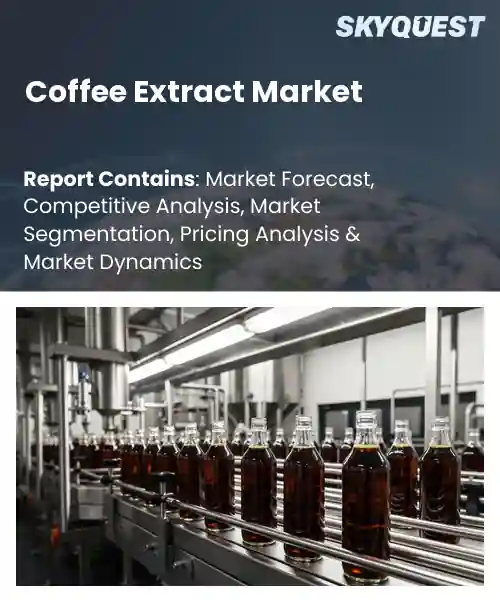
Coffee Extract Market
Report ID: SQMIG30I2881
Report ID: SQMIG30I2881
[email protected]
USA +1 351-333-4748
Report ID:
SQMIG30I2881 |
Region:
Global |
Published Date: March, 2026
Pages:
157
|Tables:
197
|Figures:
80


Global Coffee Extract Market size was valued at USD 1.67 Billion in 2024 and is poised to grow from USD 1.75 Billion in 2025 to USD 2.5 Billion by 2033, growing at a CAGR of 4.6% during the forecast period (2026-2033).
The main reason behind the coffee extract market growth is that consumers are increasingly looking for more convenient, consistent and functional ingredients that involve the use of coffee. This will drive manufacturers to develop concentrated, standardized extracts for use in food, beverage, and nutraceuticals. Coffee extracts are made up of liquid concentrates (i.e., ready to consume), powder (i.e., spray dried), and fractions of roasted or unroasted coffee beans.
The coffee extract market will play a critical role since they will allow coffee manufacturers to turn low-margin raw commodities, into finished goods or application-ready raw goods used in manufacturing, which will allow the manufacturer to create consistent flavours, while providing caffeine and antioxidant benefits. The evolution of the coffee extract market has continued to transition from low-cost/cost-plus café syrup by transitioning into high-performance beverage and nutritional ready-to-drink products where companies have been able to develop a range of ingredients with enhanced value attributes.
Key drivers of this growth will come from increased consumer demand for clean label and functional ingredients, increased desire from beverage and food manufacturers for ingredient transparency and measurable health and wellness attributes, and increased investment in advanced extraction methods/technology and standardized formulations. Producers are also exploring solvent-free extractions, and isolating specific compounds such as chlorogenic acids and decaffeinated fractions, to provide their customers with increased consistency of potency and improved labelling, which will facilitate the use of coffee extracts in a variety of applications including energy drinks and sports nutrition powders.
How is AI Enhancing Quality Control in the Global Coffee Extract Market?
The global coffee extract market is being changed dramatically by the use of automation, sensors, and data analytics. Quality control has evolved to include many different kinds of sensors, machine vision systems for identifying defects, and predictive controls that continuously monitor extraction conditions to ensure uniform taste and solubility from batch to batch. Quality control will continue to change with the ongoing adoption of edge-AI technology and the expansion of cloud-based sourcing and manufacturing systems by coffee manufacturers. As coffee manufacturers develop these new technologies, it will allow them to produce coffee extracts that not only meet consumers’ needs for extract-based and ready-to-drink products but also support the ability to generate new products quickly and to do so while minimizing waste.
For example, in July 2025, Westrock Coffee opened its second facility in Conway, Arkansas, using robotics and automation technologies, and creating a process for AI-based inspection and control of quality. This event will help bring together the coffee extract and ready-to-drink industries by ensuring consistent production and improving the quality assurance process for all manufacturers as their operations grow.
Market snapshot - (2026-2033)
Global Market Size
USD 1.67 Billion
Largest Segment
Liquid Extracts
Fastest Growth
Instant Extracts
Growth Rate
4.6% CAGR
To get more insights on this market click here to Request a Free Sample Report
Global coffee extract market is segmented into product type, source, formulation, application, formulation type, end user, distribution channel and region. Based on product type, the market is segmented into liquid extracts, powder extracts, instant extracts and others. Based on source, the market is segmented into arabica, robusta and blends. Based on formulation, the market is segmented into caffeinated and decaffeinated. based on application, the market is segmented into food industry, cosmetics, nutraceuticals and others.
Based on formulation type, the market is segmented into organic and conventional. based on end user, the market is segmented into food & beverage manufacturers, retailers and cosmetic brands. Based on distribution channel, the market is segmented into offline and online retail. Based on region, the market is segmented into North America, Europe, Asia Pacific, Latin America and Middle East & Africa.
The liquid extracts segment holds the majority of the coffee extract market share due to their concentration consistency and easy crossover into beverage and food recipes, thus providing manufacturers with more predictable flavour and functional profiles across all their production sites. These factors also make them suitable for automated dosing and compatibility with different matrices, therefore reducing the complexity of the processing and minimizing any wasted product. Furthermore, strong capabilities of suppliers using solvent-based or CO2 extraction technologies provide a quality perception for manufacturers, encouraging product developers to specify liquid extracts when creating recipes and providing opportunities for formulation standardization across various product categories
As per coffee extract market outlook, although liquid extracts are the primary segment, powdered extracts are experiencing the greatest growth as formulators develop formulations that are shelf stable in a dry format with low moisture content, which allows for dry blending and turnkey inclusion into powder mixes. Technological advancements in spray drying and carrier systems, as well as growing demand for powdered functional blends and ease of international logistics, will also expedite the adoption of powdered extracts and create new application opportunities.
As per coffee extract market forecast, arabica segment is that its diverse palate and perceived high quality influence manufacturers' desire to have premium formulation, for making white-label finished products. The aromatic complexity of the Arabica variety provides evidence of clean-labeling and sensory differentiation; this has driven developers to request Arabica extracts in their specialty beverages and high-value nutraceutical products. Furthermore, the strong traceability story associated with Arabica and the association between Arabica and sustainability claims improve the position of the brand and motivate an increase in investment in research and development and an emphasis on Arabica sourcing and extraction optimization by suppliers.
As per coffee extract market analysis, blends segment is emerging as the fastest growing option for formulators to obtain cost-effective solutions for developing a balanced flavour, having a continuous supply, and achieving a custom caffeine level. New blending techniques and standardized roast-extraction protocols provide formulators with repeatable results in the subject of sensory evaluation from one product to another; consequently, the use of blend products are increasing in mainstream beverage applications.
To get detailed segments analysis, Request a Free Sample Report
As per coffee extract market regional outlook, North America is the global supplier of coffee extracts due to a combination of established consumption patterns, advanced technological production capabilities and an innovation ecosystem. The prevalence of well-established coffee chains and an extensive, sophisticated retail environment create a continuous source of demand for high-quality and consistent-sized coffee extracts. Continued investment into formulation science and extraction technology will continue to provide opportunities for product differentiation across a variety of drink sizes, food ingredient categories and levels of functionality.
The United States coffee extract market is a large, diverse and stable source of demand for coffee extracts, as well as a well-established system of suppliers, manufacturers and large chain coffee companies. Innovations are found primarily in ready-to-drink beverage categories, premium formulations and functional enhancements, and coffee roasters and extract producers work closely together to develop new flavour profiles and test different application methods.
As per coffee extract market regional forecast, Canada places an emphasis on the premium and specialty segments of the market and consumers are particularly interested in product quality, traceability and sustainability. Both new and established coffee manufacturers produce extracts for the artisanal and craft coffee roaster segments of the coffee industry while the foodservice and retail segments have a strong emphasis on offering clean label and organic alternatives. The Canadian coffee extract market and the United States coffee extract market are linked by cross-border trade and create a steady supply of coffee extracts as well as an access point to advanced extraction technology. Externally sustained sources of supply and small-batch manufacture provide differentiating factors and appeal to consumers that want both convenience and provenance.
The coffee extract market in Europe is rapidly growing, fueled by shifting consumer preferences, a premiumization trend, and a well-established coffee culture supported by innovation. Harmonized regulations and efficient trade channels within Europe enable products to move easily and achieve scale across multiple markets. Demand for clean label, natural, and traceable ingredients is driving the reformulation and creation of specialized extracts tailored to a variety of culinary and beverage applications. Investment by domestic producers and international companies is resulting in enhanced manufacturing capacity and technical expertise related to extraction processes.
Increasing modern retail opportunities, independent specialty coffee shops opening, and foodservice experimentation are providing platforms to launch new formats and flavors. While sustainability commitments and transparency around the origin of products help build trust with consumers and encourage their willingness to interact with new extract-based products.
Germany has a well-developed industrial infrastructure and advanced manufacturing capabilities to support large-scale production and export markets for coffee extracts. Its manufacturers possess significant technical expertise pertaining to extraction and formulation. The collaboration between coffee extract manufacturers, specialty roasters, and ingredient developers has enabled the development of products that consistently offer the same flavour and delivery mechanism for both the domestic and international market.
The United Kingdom coffee extract market consists of a vibrant and rapidly changing consumer market that is driving increased acceptance of new formats beyond the traditional liquid ready-to-drink coffees as well as premium quality coffee extracts. The combination of independent coffee shops, boutique coffee roasteries, and growing retail channels is providing an excellent opportunity for companies to test new products quickly and scale them. Companies can target their launches using e-commerce and specialized distributors, while brand owners work together with extract producers to experiment with innovative new flavors and functional placements that align with changing lifestyles and increasing demands for convenience.
The French coffee extract market is being created by blending traditional café culture with premiumization, which emphasizes quality of taste and artisanal sourcing. There is increasing demand for flavor concentrates and clean label formulations, particularly in patisseries, foodservice, and specialty beverage industries. Artisan roasters and local producers are collaborating with extract manufacturers to create products that match the taste preferences of consumers in their region, as consumers and professional users place greater emphasis on sustainability and origin transparency.
In the coffee extract sector, the Asia Pacific region is continuing to enhance its position in global commerce by means of an increase in consumer sophistication, localization of product creation and key enhancements to manufacturing and distribution infrastructure. Rapid urbanization and increased modernised retail networks provide ample channels for both standard and premium product offerings. By investing heavily into extraction technology and flavour development, leading regional markets are able to fulfil the needs of large ready-to-drink and foodservice segments.
As per coffee extract industry analysis, Japan has high quality standards and takes extreme care to develop various flavour profiles and has advanced formulations to capture this consumer engagement. The strong demand for premium ready to-drink coffee drinks as well as products offered in the vending channel compel companies to introduce innovative concentrated coffee extracts and stable formulations.
A strong and vibrant cafe culture along with a trend-aware consumer base, who look for creative, high-quality ready-to-drink products, creates the demand within the coffee extract market in South Korea. The retail marketplace of South Korea is dynamic, and therefore, consumers are willing to try new flavours and new formats rapidly due to constant change influenced by their peers. Emerging companies, roasters and established beverage manufacturers are collaborating routinely to provide the market with new products through modernised retail channels and e-commerce, and the emphasis on premiumisation and unique flavours, combined with the ability to create a narrative about their brand, ensure that the market will remain dynamic.
To know more about the market opportunities by region and country, click here to
Buy The Complete Report
Increasing Consumer Preference for Convenience
Companies and brands now add coffee extracts to many types of ready-to-drink (RTD) and instant drinks. This is helping manufacturers quickly produce one-serving RTD or "to go" drinks. As a result of the increase in demand, many suppliers have made it much easier for customers by producing versatile and easy-to-use extract formats which significantly decrease the amount of time that it takes manufacturers to prepare them and simplify their supply chain processes. They have also created innovative packaging formats and many different flavours to accommodate time-poor consumers. Suppliers are now focusing on developing coffee extract-based products to attract convenience-seeking consumers and increase the number of products offered.
Expansion of Health and Wellness and Wellness Trends
Growing consumer interest in health and wellness encourages food and beverage manufacturers to incorporate coffee extracts as sources of natural flavor and perceived functional benefits, prompting the creation of fortified and clean label products that align with wellness positioning. Manufacturers are now creating "fortified" and "clean label" products that align with the wellness trend using coffee extracts. The coffee extract market trend has encouraged suppliers to ensure the highest quality and stability of their extracts for use in functional beverages, dietary supplements, and nutraceuticals. Thereby increasing the variety of products that can be made available to consumers. Manufacturers are using this trend to try and differentiate themselves, add additional product lines and meet consumer demand for transparency in sourcing ingredients, all of which is driving ongoing market development and innovation.
Volatility In Raw Material Supply
The uncertainty regarding the availability and quality of raw materials for extract supply is resulting in raw material supply volatility closing the market's normal growth opportunities. These leads developed extractor manufacturers to be cautious in their sourcing approach and with the potential for varying formulations; typically through the extraction process. The occurrence of unpredictable crop fluctuations causes suppliers to adopt a more conservative procurement strategy and limits their expansion capabilities. Suppliers doing so in conjunction with their volume/percentage of actual product quality drives them to issue additional processing standards and partner quality systems to their respective suppliers of green coffee beans. Overall, this confluence of factors inhibits both raw material supplier’s and the downstream brands ability to invest in new capacity quickly and create complications in long term planning, which subsequently retards overall market growth rate.
Regulatory Compliance and Labeling Challenges
An additional challenge that causes restraint to the rate of market expansion for coffee extract manufacturers is the complexity of and differences across the various regions of the world in regard to the regulatory compliance and labeling requirements that exist. These differences have led to many regulatory issues facing coffee extract manufacturers. The divergent FDA/CFFA and other regimes (such as the Euro-region) pertaining to acceptable ingredients, and the substantiation of claims by the manufacturer, result in extensive requirements for documentation and annual quality systems. This deters smaller manufacturers from entering the market, increases the involvement of larger companies in controlling market development, and results in manufacturers taking a more cautious growth strategy. With respect to regulated markets than non-regulated markets; thereby moderating growth across the entire market.
Request Free Customization of this report to help us to meet your business objectives.
Larger consumer packaged goods (CPG) companies are consolidating in the competitive market through mergers and acquisitions and developing relationships with retail partners. Conversely, new start-ups are taking advantage of technology to create their own unique identities and sell directly to consumers. Some examples of this are Nestlé’s acquistion of cold brew brands, direct-to-consumer concentrate makers partnering with third party logistics companies to grow their businesses.
SkyQuest’s ABIRAW (Advanced Business Intelligence, Research & Analysis Wing) is our Business Information Services team that Collects, Collates, Correlates, and Analyses the Data collected by means of Primary Exploratory Research backed by robust Secondary Desk research.
As per SkyQuest analysis, the global coffee extract industry is being driven primarily by growing consumer demand for convenient, consistent and functional coffee ingredients, with a secondary driver coming from rising clean-label and functionality preferences that push investment in advanced extraction and standardized formulations. The market is restrained by volatility in raw material supply which can disrupt quality and availability for extract producers. North America remains the dominant region due to mature consumption patterns and strong manufacturing and innovation ecosystems, while liquid extracts lead the product mix due to ease of integration and dosing in beverages and food formulations. Overall, these forces are shaping premiumization and technical advancement across the value chain.
| Report Metric | Details |
|---|---|
| Market size value in 2024 | USD 1.67 Billion |
| Market size value in 2033 | USD 2.5 Billion |
| Growth Rate | 4.6% |
| Base year | 2024 |
| Forecast period | (2026-2033) |
| Forecast Unit (Value) | USD Billion |
| Segments covered |
|
| Regions covered | North America (US, Canada), Europe (Germany, France, United Kingdom, Italy, Spain, Rest of Europe), Asia Pacific (China, India, Japan, Rest of Asia-Pacific), Latin America (Brazil, Rest of Latin America), Middle East & Africa (South Africa, GCC Countries, Rest of MEA) |
| Companies covered |
|
| Customization scope | Free report customization with purchase. Customization includes:-
|
To get a free trial access to our platform which is a one stop solution for all your data requirements for quicker decision making. This platform allows you to compare markets, competitors who are prominent in the market, and mega trends that are influencing the dynamics in the market. Also, get access to detailed SkyQuest exclusive matrix.
Table Of Content
Executive Summary
Market overview
Parent Market Analysis
Market overview
Market size
KEY MARKET INSIGHTS
COVID IMPACT
MARKET DYNAMICS & OUTLOOK
Market Size by Region
KEY COMPANY PROFILES
Methodology
For the Coffee Extract Market, our research methodology involved a mixture of primary and secondary data sources. Key steps involved in the research process are listed below:
1. Information Procurement: This stage involved the procurement of Market data or related information via primary and secondary sources. The various secondary sources used included various company websites, annual reports, trade databases, and paid databases such as Hoover's, Bloomberg Business, Factiva, and Avention. Our team did 45 primary interactions Globally which included several stakeholders such as manufacturers, customers, key opinion leaders, etc. Overall, information procurement was one of the most extensive stages in our research process.
2. Information Analysis: This step involved triangulation of data through bottom-up and top-down approaches to estimate and validate the total size and future estimate of the Coffee Extract Market.
3. Report Formulation: The final step entailed the placement of data points in appropriate Market spaces in an attempt to deduce viable conclusions.
4. Validation & Publishing: Validation is the most important step in the process. Validation & re-validation via an intricately designed process helped us finalize data points to be used for final calculations. The final Market estimates and forecasts were then aligned and sent to our panel of industry experts for validation of data. Once the validation was done the report was sent to our Quality Assurance team to ensure adherence to style guides, consistency & design.
Analyst Support
Customization Options
With the given market data, our dedicated team of analysts can offer you the following customization options are available for the Coffee Extract Market:
Product Analysis: Product matrix, which offers a detailed comparison of the product portfolio of companies.
Regional Analysis: Further analysis of the Coffee Extract Market for additional countries.
Competitive Analysis: Detailed analysis and profiling of additional Market players & comparative analysis of competitive products.
Go to Market Strategy: Find the high-growth channels to invest your marketing efforts and increase your customer base.
Innovation Mapping: Identify racial solutions and innovation, connected to deep ecosystems of innovators, start-ups, academics, and strategic partners.
Category Intelligence: Customized intelligence that is relevant to their supply Markets will enable them to make smarter sourcing decisions and improve their category management.
Public Company Transcript Analysis: To improve the investment performance by generating new alpha and making better-informed decisions.
Social Media Listening: To analyze the conversations and trends happening not just around your brand, but around your industry as a whole, and use those insights to make better Marketing decisions.
REQUEST FOR SAMPLE
 REQUEST FREE CUSTOMIZATION
Global Coffee Extract Market size was valued at USD 1.67 Billion in 2024 and is poised to grow from USD 1.75 Billion in 2025 to USD 2.5 Billion by 2033, growing at a CAGR of 4.6% during the forecast period (2026-2033).
Competitive landscape features consolidation by large CPG players through M&A and retail partnerships, while agile startups pursue technology driven differentiation and DTC distribution to capture share. Examples include Nestlé acquiring cold brew brands, DTC concentrates partnering with logistics providers to scale, and flash frozen extract innovators commercializing new formats to pressure incumbents on convenience and product quality. 'Nestlé', 'Starbucks', 'Kraft Heinz', 'Keurig Dr Pepper', 'JM Smucker Company', 'Illycaffè', 'Kona Coffee Purveyors', 'Caffè Nero', 'Lavazza', 'Dunkin' Brands', 'Tchibo', 'Peet's Coffee', 'Blue Bottle Coffee', 'Stumptown Coffee Roasters', 'Bulletproof 360', 'Death Wish Coffee Company', 'Café Bustelo', 'Allegro Coffee Company', 'Coffee People', 'Seattle's Best Coffee'
The rising consumer preference for convenient beverage solutions encourages manufacturers and brands to integrate coffee extracts into a broad range of ready to consume and instant products, enabling swift formulation of single serve options and on the go beverages. This demand leads suppliers to offer versatile, easy to use extract formats that reduce preparation time and simplify supply chains, while prompting innovation in packaging and flavor variety to match time pressed lifestyles. Consequently, market participants prioritize extract based product development to capture convenience seeking consumers and expand portfolios.
Premiumization Of Coffee Extracts: Producers and brands are shifting toward concentrated origin specific and specialty extracts emphasizing provenance, roasting nuance and sensory complexity. The trend encourages small batch processing, artisanal extraction methods and close partnerships with specialty roasters to deliver distinctive taste profiles for premium beverages and culinary applications. Marketing emphasizes storytelling, traceable sourcing and quality credentials to attract manufacturers and consumers willing to pay for differentiated sensory experiences that elevate products across foodservice, retail and personal care segments and broaden overall brand positioning.
Why does North America Dominate the Global Coffee Extract Market? |@12


Want to customize this report? This report can be personalized according to your needs. Our analysts and industry experts will work directly with you to understand your requirements and provide you with customized data in a short amount of time. We offer $1000 worth of FREE customization at the time of purchase.
Feedback From Our Clients


 USA (+1) 351-333-4748

