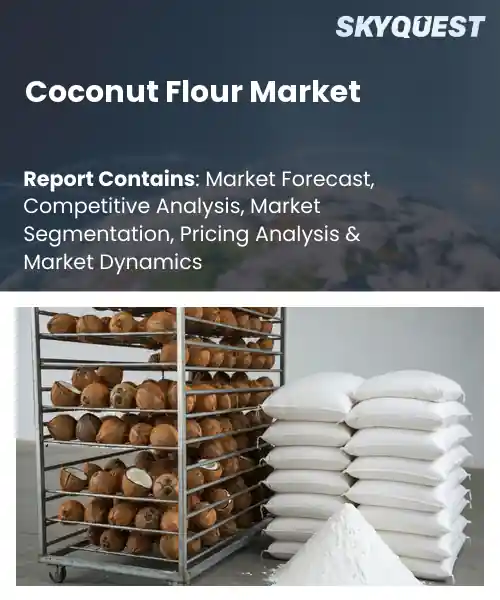
Coconut Flour Market
Report ID: SQMIG30I2754
Report ID: SQMIG30I2754
[email protected]
USA +1 351-333-4748
Report ID:
SQMIG30I2754 |
Region:
Global |
Published Date: February, 2026
Pages:
157
|Tables:
114
|Figures:
77


Global Coconut Flour Market size was valued at USD 5.69 Billion in 2025 and is poised to grow from USD 6.10 Billion in 2026 to USD 9.99 Billion by 2033, growing at a CAGR of 7.3% during the forecast period (2026-2033).
Primary driver of the coconut flour market has been the global shift toward health-conscious and specialty diets, where demand for gluten-free, high-fiber, and low-carbohydrate alternatives has risen sharply over the past decade. Coconut flour, a high-fiber, protein-rich byproduct of coconut milk and oil extraction, moved from a regional commodity in Southeast Asian producing nations to a global ingredient celebrated for its nutritional profile and sustainable credentials. The use of sweeteners in bakery mix applications, protein bar applications, etc., was utilized by both retailers and food manufacturers, while exporters were able to increase their processing capacity and become certified to be able to access Western markets as well as gain premium positioning in the Philippines and Indonesia.
Building on shifting consumer preferences, rising health consciousness and proliferation of specialty diets drive product development and market entry strategies as manufacturers respond to demand by investing in refined milling technologies that improve texture and reduce bitterness. With better processing techniques, production costs are reduced, which facilitate formulations into popular bakery products, ready-to-eat snack food, and meat alternatives to broaden retail distribution and stimulate contract farming in growing countries to ensure a stable supply. Processors who vertically integrate and are working toward organic or fair trade certifications receive premium pricing and create opportunities for small farmers, while the wide range of product categories help reduce seasonal swing, and also allows them to expand their markets.
How does Machine Learning Optimize Coconut Processing Parameters?
Supply chain analytics powered by AI help manufacturers identify yield and logistic bottlenecks and therefore source coconuts more efficiently and have fewer stockouts. Processing parameters are optimized using machine learning so that there is an increase in extraction yields, and production costs are decreased thus allowing firms to competitively price their coconut flour. Robotics and computer vision will automate quality inspections by minimizing contamination & creating consistent results that will encourage consumers to trust retailing & thus grow retail acceptance. Producers can scale their capacity, or launch SKUs that are ready to ship, by recognizing seasonal increases in demand (via predictive demand models). Furthermore, AI-driven personalization for marketing purposes increases targeted sales and new markets for exports, thus accelerating market growth. New developments include startups that utilize both IoT Sensors with Artificial Intelligence (AI) to provide traceability of products from farm-to-factory in real time.
In 2025, Nestlé partnered with IBM to deploy an AI-driven generative chemistry tool that accelerates discovery of novel sustainable packaging materials. This tool uses machine learning to analyze molecular structures and propose high-barrier, recyclable packaging that extends shelf life and reduces waste, a development reflecting how AI is reshaping food supply chains and product protection globally.
Market snapshot - 2026-2033
Global Market Size
USD 5.3 Billion
Largest Segment
Conventional Coconut Flour
Fastest Growth
Organic Coconut Flour
Growth Rate
7.3% CAGR
To get more insights on this market click here to Request a Free Sample Report
Global coconut flour market is segmented by product type, packaging type, formulation, end use and region. Based on product type, the market is segmented into organic coconut flour and conventional coconut flour. Based on packaging type, the market is segmented into bags and boxes. Based on formulation, the market is segmented into baking mixes and cooking mixes. Based on end use, the market is segmented into food industry, household use and others. Based on region, the market is segmented into North America, Europe, Asia Pacific, Latin America and Middle East & Africa.
Based on the global coconut flour market forecast, organic coconut Flour segment leads because consumer demand for clean label and naturally produced ingredients elevates its attractiveness among health conscious buyers. Retailers and brands are putting more value on products that have strong quality and sustainability, as they are creating a preference for those products to receive higher priority and investment in terms of certified sourcing. In turn, producers are providing dedicated supply chains and premium pricing strategies to create brand differentiation and higher product visibility within the marketplace, thus creating a cause and effect relationship that continues to hold market preference.
Conventional coconut flour is poised for fastest growth due to broader consumer acceptance, lower production costs, and strong availability compared with specialty alternatives. The widespread and economical use of this product leads to an increase in the number of consumers purchasing it for everyday baking and food processing, while the growth of distribution channels in developing countries will contribute to the increase in demand for it.
Baking Mixes segment dominates the market due to ready to use formulations mitigate texture and moisture challenges inherent to pure coconut flour, making product performance predictable for both manufacturers and consumers. Hydrocolloids and leavening systems are combined in specialized blends that provide similar results in baking so that there are lower technical barriers to adoption. As a result, food developers prefer using specialized blends because they require less time to develop products and produce consistent results, leading to increase shelf space availability, while also building consumer confidence through proven culinary experiences.
Cooking mixes are projected to grow fastest because they simplify meal preparation, appealing to time-pressed consumers seeking gluten-free, high-fiber options. Repeat orders from their ease of access and increased visibility through broader retail and e-commerce distribution support the increasing use of coconut flour across an expanding range of culinary applications as the demand for convenient, ready-to-use healthy foods continues to grow.
To get detailed segments analysis, Request a Free Sample Report
As per the global coconut flour market analysis, Asia Pacific dominance stems from integrated advantages that span raw material availability, established processing capacity, and strong regional demand dynamics. Being close to areas that produce coconuts reduces the logistical difficulties related to transporting goods, supports many processing methods that enable the company to produce products of varying quality, and uses methods that preserve the quality of the product. Because of the cultural familiarity with coconut products, there will be a faster acceptance by consumers and a rapid adaptation to the use of coconuts in the kitchen. The combination of advanced exporters, ports that can move products quickly from the region and internationally will allow for efficient distribution of the product. Suppliers and manufacturers in the region have come together to invest in standardizing products, establishing traceability for products and improving product innovation so that they can meet the needs of premium and health-oriented products in developed countries.
Coconut flour market in Japan benefits from sophisticated retail channels, strong consumer interest in health and specialty foods, and collaborative relationships with local distributors and food formulators. The demand for refined coconut flour varieties is influenced by premium positioning, expectations of product quality, and a growing trend towards clean label ingredients amongst both local processing and importing companies. Increased knowledge from consumers and chefs is driving greater innovation in products for both home bakers and convenience food companies.
Coconut flour market in South Korea is characterized by rising interest in functional and gluten free ingredients among urban consumers, together with foodservice and snack sectors seeking novel textures and flavors. Ingredient transparency and traceability is a key focus for both retailers and online players, who are asking suppliers to prove the quality of their products and their sources. Manufacturers and culinary professionals are working together to adapt products to meet consumer preferences in different regions, which is quickly increasing the number of products that include coconut flour in bakery, snack and convenience product portfolios.
Rapid expansion in North America is driven by converging trends in health oriented consumption, retail innovation, and proactive ingredient development by suppliers and manufacturers. Due to the growing popularity of alternative & gluten free baking solutions, consumers & food professionals are starting to experiment with coconut flour in both traditional & specialty product segments. The growth in e commerce & specialty retail channels is increasing the accessibility of coconut flour to both consumers and food professionals. The ingredient buyer's desire for documented supply chain transparency and consistent quality is driving investments in processing and traceability of the product. Private Label and artisan brands are increasing the visibility of the category. The collaborative development of bakery, snack, and convenient product applications between manufacturers and culinary experts is creating customized applications for the region; establishing it as a dynamic area with multiple channels and high-level expectations from buyers.
Coconut flour market in United States is driven by mainstream interest in alternative grain and gluten free ingredients across retail and foodservice channels. Bakers (both home-based and commercial) who purchase ingredients from sources within the USA have expressed interest in supply-chain transparency, clean-label ingredients, and versatility when using those ingredients to develop their finished goods. Manufacturers creating these products are specifically looking at how ingredients will affect the texture as they mix and develop them and continue to grow their use of various ADHs through the growth of private-label products sold in retail stores and online.
Coconut flour market in Canada reflects strong consumer interest in natural and free from ingredients, supported by an active specialty retail network and health focused foodservice operators. Buyers have been more focused on obtaining supplies that focus on sustainable sourcing, transparency in supply chains and certifications. To meet this need from buyers, manufacturers collaborate with ingredient suppliers to develop formulations for specific regions; therefore, using coconut flour in their products can be included across various specialty channels/markets, particularly in bakery and snack product lines, as well as ready-to-eat products.
As per the global coconut flour industry analysis, Europe is strengthening its position through a focus on sustainability credentials, certification alignment, and premium sourcing that meet discerning consumer expectations. Retailers and ingredient buyers increasingly seek organic and transparent supply chains, prompting suppliers to validate origin and processing practices. Food manufacturers invest in application development to adapt coconut flour for local culinary preferences and broaden mainstream and specialty use cases. Cooperation between certifying agencies, suppliers and distributors can strengthen the reputation of the specialty ingredients sector in the marketplace while promoting cross-border exchange of products. In addition, focused research and development together with consumer education can inform the public about the functional, versatile nature of specialty ingredients.
Coconut flour market in Germany is shaped by strong demand for organic and sustainably sourced ingredients among retailers and manufacturers. There is now a major focus on ingredient traceability along with ingredient certification which forces suppliers to also align their processing methods to European standards for products. There are food formulators experimenting with coconut flour in specialty bakery items and plant-based items as they search for functional, clean-label alternatives. There is also cooperation between distributors and specialty brands to increase product availability in both health food stores, as well as other retail channels.
Coconut flour market in United Kingdom benefits from diverse culinary trends and a strong presence of specialty grocers and online retailers that drive trial and innovation. The demand for certified organic and ethically sourced ingredients is driving opportunities for suppliers able to provide strong traceability. Suppliers should be developing products that meet consumer's needs for convenience, including ready-to-eat mixes and pre-packaged snacks catering to local preferences. Partnerships between small brands and regional distributors can help get products into independent retailers and grocery chains.
Coconut flour market in France is influenced by strong artisanal baking traditions and a growing interest in alternative flour options among chefs and bakers. Due to consumer interest in organic certification and the importance they place upon knowing where products come from, suppliers are offering more verified sources and improved ways to process food items. Food production companies are partnering up with culinary schools/colleges to change/sharpen product tastes and add new formats, as well as distributions that find new levels of success by focusing on specialty food retail, or bakery stores, premium retail locations that give consumers access to gourmet products made from high-quality, unusual ingredients.
To know more about the market opportunities by region and country, click here to
Buy The Complete Report
Rising Demand For Gluten Free Products
Coconut flour's suitability as a naturally gluten free and nutrient dense alternative encourages food manufacturers and artisanal producers to reformulate bakery and snack recipes, broadening product assortments and retail placement. The high fiber content and ability to bind as needed has allowed coconut flour to decrease overall usage of traditional flours while also complying with consumer demands for more natural or ‘clean’ labels. When looking for unique ingredients with health benefits, using coconut flour will provide you the opportunity to develop new products and market them in a way that creates production volume increases and commercial demand through retail and food service channels.
Expanding Applications In Food Industry
Coconut flour's versatile functional characteristics encourage product developers to integrate it into a wide range of formulations, from baked goods and savory coatings to plant based protein mixes and ready to eat snacks, increasing ingredient uptake. Moisture holding properties and fiber characteristics of this ingredient make it possible to reformulate both texture and nutrition of products without having to depend on wheat, allowing for the creation of "clean label" products. Through continued research and cooking adaptations, there will be increased uses of the ingredient thus increasing ingredient specifications. As a result, this will provide continued growth in procuring the ingredient and encourage manufacturers across all levels to broaden their supply chain investment in order to fulfil the various needs of applications.
Price Volatility and Supply Constraints
Fluctuating coconut availability and associated raw material pricing create uncertainty for manufacturers, reducing willingness to commit to long term contracts and large scale reformulations that rely on the global coconut flour market growth. Due to procurement difficulties and uncertain levels of supply risk, brands are limited to including products into their offering or using a mixed-ingredient strategy, resulting in slow growth within the category. Because there is variability in product quality and orders arriving sporadically, producers have difficulty completing their production schedule and additional sourcing costs create more incentive for processors with lower costs to adopt an alternate ingredient; thus, all of these factors combined will continue to slow growth for demand.
Price Volatility and Supply Constraints
While gluten-free products have been growing in popularity, most consumers still don’t know how coconut flour tastes, feels, or can be used. Because of its high absorbency and dense structure, using coconut flour can yield less-than-desirable results in recipes, which makes it less likely that consumers will buy these items again. Other roadblocks that hinder consumers from using coconut flour more widely include limited culinary ability, reformulation difficulties for manufacturers, and competition from almond and oat flour.
Request Free Customization of this report to help us to meet your business objectives.
The global coconut flour market outlook is moderately fragmented, led by established food ingredient players and niche natural-food firms such as A&B Ingredients, Bob's Red Mill, Sunhealth, Nutriorg and Island Fresh. Strategies include product diversification, vertical integration, co-packing partnerships, and geographic expansion. Bob's Red Mill emphasizes brand trust and retail penetration; Island Fresh focuses on sustainable sourcing and farmer partnerships; A&B invests in supply-chain scale and private-label contracts and digital traceability.
NICO: Established in 2019, their main objective is to process the whole coconut value chain into export grade ingredients including coconut flour. Recent development: they expanded production capacity, began exports to Bangladesh and to the United States, and introduced a packaged coconut milk beverage for retail. Management identifies improvements made to both supplier traceability and certification to support the overall supplier qualification efforts of meeting the needs of buyers.
Kaira Organic World: Established in 2019, their primary aim is to provide organic coconut products such as desiccated coconuts and coconut flour for their overseas customers. To date Kaira has listed coconut flour suitable for export; holds HACCP certification; and is operating as an MSME while providing ingredient lots to support retail and food manufacturing companies. Kaira maintains strict quality control procedures to ensure safe and acceptable products, while also assisting exporters in meeting the traceability requirements of their customers.
The Moregetherness consumer campaign was created by Bob's Red Mill with the support of celebrity partners Erin and Ben Napier to promote home baking and share recipes in the neighbourhood from September 2025. This campaign builds on the artisanal milling credentials of Bob's Red Mill as well as increasing the visibility of their speciality flours (e.g., coconut) by story telling and activating retail in the community.
Terrasoul Superfoods entered into a national distribution partnership with Vitacost in May 2025 enabling greater e-commerce and retail opportunities for its organic coconut flour products as well as improving the company’s position in the supply chain, showcasing their certified organic sourcing and clean label credentials that will support increased availability within the mainstream and retailer networks.
The Vita Coco Company introduced the Orange and Creme variant within its Vita Coco Treats line in March 2025, signaling brand-led diversification into coconut-based indulgent formats that broaden consumer exposure to coconut ingredients and indirectly support increased interest in coconut-derived baking ingredients such as coconut flour through cross-category marketing.
SkyQuest’s ABIRAW (Advanced Business Intelligence, Research & Analysis Wing) is our Business Information Services team that Collects, Collates, Correlates, and Analyses the Data collected by means of Primary Exploratory Research backed by robust Secondary Desk research.
As per SkyQuest analysis, the global coconut flour Industry is propelled primarily by rising consumer demand for gluten-free, high-fiber and low-carbohydrate alternatives, while price volatility and supply constraints remain a key restraint. Asia Pacific dominates the market due to raw material availability, established processing infrastructure and export capability, and the organic coconut flour segment leads through clean label credentials and certified sourcing that command premium placement. A second driver is improved processing, traceability and e-commerce expansion that reduce formulation barriers, enhance supply chain transparency and broaden retail access, enabling wider adoption across baking mixes, snacks and convenience applications and support sustainable sourcing models.
| Report Metric | Details |
|---|---|
| Market size value in 2025 | USD 5.69 Billion |
| Market size value in 2033 | USD 9.99 Billion |
| Growth Rate | 7.3% |
| Base year | 2024 |
| Forecast period | 2026-2033 |
| Forecast Unit (Value) | USD Billion |
| Segments covered |
|
| Regions covered | North America (US, Canada), Europe (Germany, France, United Kingdom, Italy, Spain, Rest of Europe), Asia Pacific (China, India, Japan, Rest of Asia-Pacific), Latin America (Brazil, Rest of Latin America), Middle East & Africa (South Africa, GCC Countries, Rest of MEA) |
| Companies covered |
|
| Customization scope | Free report customization with purchase. Customization includes:-
|
To get a free trial access to our platform which is a one stop solution for all your data requirements for quicker decision making. This platform allows you to compare markets, competitors who are prominent in the market, and mega trends that are influencing the dynamics in the market. Also, get access to detailed SkyQuest exclusive matrix.
Table Of Content
Executive Summary
Market overview
Parent Market Analysis
Market overview
Market size
KEY MARKET INSIGHTS
COVID IMPACT
MARKET DYNAMICS & OUTLOOK
Market Size by Region
KEY COMPANY PROFILES
Methodology
For the Coconut Flour Market, our research methodology involved a mixture of primary and secondary data sources. Key steps involved in the research process are listed below:
1. Information Procurement: This stage involved the procurement of Market data or related information via primary and secondary sources. The various secondary sources used included various company websites, annual reports, trade databases, and paid databases such as Hoover's, Bloomberg Business, Factiva, and Avention. Our team did 45 primary interactions Globally which included several stakeholders such as manufacturers, customers, key opinion leaders, etc. Overall, information procurement was one of the most extensive stages in our research process.
2. Information Analysis: This step involved triangulation of data through bottom-up and top-down approaches to estimate and validate the total size and future estimate of the Coconut Flour Market.
3. Report Formulation: The final step entailed the placement of data points in appropriate Market spaces in an attempt to deduce viable conclusions.
4. Validation & Publishing: Validation is the most important step in the process. Validation & re-validation via an intricately designed process helped us finalize data points to be used for final calculations. The final Market estimates and forecasts were then aligned and sent to our panel of industry experts for validation of data. Once the validation was done the report was sent to our Quality Assurance team to ensure adherence to style guides, consistency & design.
Analyst Support
Customization Options
With the given market data, our dedicated team of analysts can offer you the following customization options are available for the Coconut Flour Market:
Product Analysis: Product matrix, which offers a detailed comparison of the product portfolio of companies.
Regional Analysis: Further analysis of the Coconut Flour Market for additional countries.
Competitive Analysis: Detailed analysis and profiling of additional Market players & comparative analysis of competitive products.
Go to Market Strategy: Find the high-growth channels to invest your marketing efforts and increase your customer base.
Innovation Mapping: Identify racial solutions and innovation, connected to deep ecosystems of innovators, start-ups, academics, and strategic partners.
Category Intelligence: Customized intelligence that is relevant to their supply Markets will enable them to make smarter sourcing decisions and improve their category management.
Public Company Transcript Analysis: To improve the investment performance by generating new alpha and making better-informed decisions.
Social Media Listening: To analyze the conversations and trends happening not just around your brand, but around your industry as a whole, and use those insights to make better Marketing decisions.
REQUEST FOR SAMPLE
 REQUEST FREE CUSTOMIZATION
Global Coconut Flour Market size was valued at USD 5.3 Billion in 2024 and is poised to grow from USD 5.69 Billion in 2025 to USD 9.99 Billion by 2033, growing at a CAGR of 7.3% during the forecast period (2026-2033).
Competitive intensity in the global coconut flour market has risen as major ingredient suppliers, private label food manufacturers and regional processors pursue partnerships, certifications and capacity upgrades; concrete moves include Bob's Red Mill partnering with Fair Trade USA and Vita Coco expanding retailer collaborations, while Nutiva has broadened distribution through strategic retail deals, prompting rivals to pursue M&A, co manufacturing and processing innovation. 'Nutiva Inc.', 'Bob's Red Mill Natural Foods', 'Celebes Coconut Corporation', 'The Coconut Company', 'Healthy Traditions', 'Primex Coco Products', 'Nutrisure Ltd.', 'Connecticut Coconut Company', 'Van Amerongen & Son', 'Smith Naturals', 'Anthony's Goods', 'Let's Do Organic', 'Thrive Market', 'Spectrum Organic Products', 'Terrasoul Superfoods', 'Sunfood Superfoods', 'Nature's Way', 'Eden Foods', 'Bulk Barn Foods', 'Whole Foods Market'
Coconut flour's suitability as a naturally gluten free and nutrient dense alternative encourages food manufacturers and artisanal producers to reformulate bakery and snack recipes, broadening product assortments and retail placement. Its high fiber profile and functional binding properties enable reduced reliance on conventional flours while meeting consumer preferences for cleaner labels. As brands seek distinctive, health positioned ingredients, procurement of coconut flour supports new product development and marketing differentiation, thereby directly stimulating production volumes and commercial demand across multiple retail and foodservice channels.
Why does Asia Pacific Dominate the Global Coconut Flour Market? |@12


Want to customize this report? This report can be personalized according to your needs. Our analysts and industry experts will work directly with you to understand your requirements and provide you with customized data in a short amount of time. We offer $1000 worth of FREE customization at the time of purchase.
Feedback From Our Clients


 USA (+1) 351-333-4748

