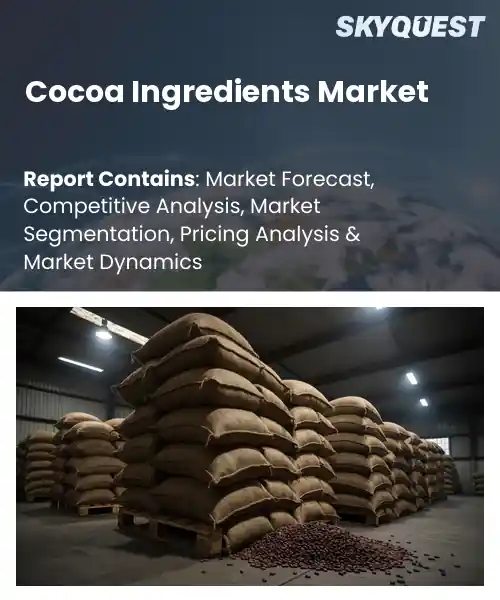
Cocoa Ingredients Market
Report ID: SQMIG30H2384
Report ID: SQMIG30H2384
[email protected]
USA +1 351-333-4748
Report ID:
SQMIG30H2384 |
Region:
Global |
Published Date: February, 2026
Pages:
157
|Tables:
121
|Figures:
77


Global Cocoa Ingredients Market size was valued at USD 13.8 Billion in 2024 and is poised to grow from USD 14.53 Billion in 2025 to USD 21.97 Billion by 2033, growing at a CAGR of 5.3% during the forecast period (2026-2033).
Demand for higher quality cocoa as well as niche products results in a transformation of commodity-based beans into a range of unique inputs across the food/beverage/personal care industries due to consumer demand. In the past, cocoa was traded primarily in its raw form (i.e., cocoa beans) with value being determined in market. However, over many decades, manufacturers have made large capital investments in facilities that produce cocoa butter, powder and liquor enabling the innovation of single-source dark chocolate, cocoa-based beverages and cosmetic applications. This transformation created a significant impact on pricing dynamics and concentration of value capture with processors with increasing scrutiny around sustainable practices throughout the supply chain resulting in changes to sourcing strategies and livelihoods of farmers.
Sustainable and ethical consumption and regulation are driving a fundamental transformation of the cocoa supply chain and companies must respond by providing traceability, support for agronomic practices and premium programs to meet the quality expectations from consumers. By making investments in traceability, agronomic support, and premium programs, manufacturers reduce variability in quality and ensure a consistent flow of beans. Barry Callebaut is one example of an organization supporting its suppliers through investments in training and providing premium pricing structures which have resulted in increased yields and lessened price volatility.
How is AI Improving Supply Chain Transparency In The Cocoa Ingredients Market?
Traceability of cocoa ingredients is achieved by providing transparent visibility throughout the supply chain from farmer to processor through verified location and compliance claims. The use of artificial intelligence to achieve this includes using satellite imagery, combining machine learning with sensor data, creating geographic maps of farm properties, identifying areas of risk for land use and aligning digital records of batches to physical shipments.
Cocoa processors, cocoa traders and cocoa ingredient suppliers have adopted electronic platforms that will apply tracking devices to shipments, identify inconsistencies within the supply chain, and facilitate verification of compliance procedures. This level of collaboration has been implemented in response to increased expectations from buyers and to comply with newly implemented regulations that require verification of origin data. The benefits to participants in the supply chain include a faster verification process, decreased occurrence of fraud, and improved feedback to farmers.
The use of AI will also allow participants in the supply chain to use predictive analytics to plan production schedules in conjunction with quality consistency of ingredients by correlating farm-grade signals with the resultant processing outputs. The first such example is the announcement of a carbon stock monitoring tool by ofi Cocoa. The tool was developed in conjunction with a company that specializes in geospatial technology to improve accuracy of forest cover as well as agricultural plot level risks, reduce speed and increase accuracy of rural development projects. The increased efficiency provided by artificial intelligence has created opportunities for improved market growth due to decreased costs associated with verification, which, in turn, facilitates increased volumes of trade.
Market snapshot - 2026-2033
Global Market Size
USD 13.8 Billion
Largest Segment
Cocoa Powder
Fastest Growth
Cocoa Nibs
Growth Rate
5.3% CAGR
To get more insights on this market click here to Request a Free Sample Report
The cocoa ingredients market is segmented into product, application, category, distribution channel and region. Based on product, the market is segmented into cocoa beans, cocoa powder, cocoa liquor, cocoa butter and cocoa nibs. Based on application, the market is segmented into chocolate & confectionery, bakery, beverages, dairy products, cosmetics & personal care, pharmaceuticals & nutraceuticals and others. Based on category, the market is segmented into conventional cocoa ingredients and organic cocoa ingredients. Based on distribution channel, the market is segmented into direct sales and indirect sales. Based on region, the market is segmented into North America, Europe, Asia Pacific, Latin America and Middle East & Africa.
The cocoa powder segment is dominant with large cocoa ingredients market share due to having a strong flavor, possessing various functional properties, and easily becoming incorporated into other formulations for confectionery, baked goods, beverages, and dairy products. It is easy to mix with other powders and makes it less complicated to ship than fats because it is in powder form. The use of cocoa powder provides formulators with a consistent profile for both colour and flavour. Thus, large-scale manufacturers choose to use cocoa powder for developing cost-effective and scalable products that have a long shelf life.
As per cocoa ingredients market analysis, cocoa nibs are the fastest growing product category because there is a trend towards premiumization and a demand for clean-label products. Cocoa nibs have minimal processing done to them, which appeals to health-conscious consumers and to those that are making artisanal products, creating new opportunities to use cocoa nibs in snacks, baked product inclusions, and functional foods. The growth of the cocoa nib market has resulted in higher margin premium product offerings and will encourage the development of innovative texture and artisanal-appearing products.
As per cocoa ingredients market forecast, the conventional cocoa ingredients segment continues to be favored by mass-market manufacturers due to its established supply chains, cost efficiencies, and familiarity with broad certifications. The stability of their quality and compatibility with current formulations reduces the potential risk of having to reformulate and allows for economies of scale across chocolate, baked goods, and beverages. Procurement teams are inclined towards conventional sources to provide a stable supply of ingredients at consistent prices, while also assuring consistent ingredient throughput into the high-volume production pipeline.
As per cocoa ingredients market outlook, the growth rate of organic cocoa ingredients segment is the highest due to increasing consumer demand for clean label products and sustainable production methods. This trend has led manufacturers to develop differentiated premium products and invest more heavily in traceable supply chains, inclusive sourcing models, and increased profit margins associated with chocolate, personal care, and nutraceuticals.
To get detailed segments analysis, Request a Free Sample Report
As per cocoa ingredients market regional outlook, Europe is the global leader in cocoa ingredients. This is due to strong, established industrial infrastructure; large consumer demand for premium chocolate products; deep expertise in ingredient innovation and quality assurance. Strong networks of specialty confectionery manufacturers and ingredient processors enable fast and efficient scaling and customization of cocoa powders, cocoa butter, and cocoa concentrates. Rigid regulatory frameworks and traceability standards support premiumization and create an environment for better partnerships between global suppliers and origin countries.
Germany is a significant cocoa ingredients market in Europe. Germany has many high-quality cocoa ingredient processing facilities, advanced food technologists, and a high level of collaboration between ingredient suppliers and premium chocolate manufacturer partners. There is a strong emphasis placed on traceability and sustainable sourcing for cocoa powders and cocoa butters, and this is creating strong demand for specialized cocoa powders and butters. Innovation hubs and contract manufacturing capabilities allow manufacturers to develop customized formulations for their confectionery and functional food products. Reliable and efficient distribution channels provide dependable access to cocoa ingredient buyers in Germany and other countries in Europe.
The cocoa ingredients industry in the UK is characterized by a variety of different retail formats, the strength of artisanal chocolate, and the need for product development. There is high demand for cocoa-derived products that meet clean-label and premium expectations. As a result, there are many collaborations between cocoa processors and manufacturers looking to develop new product lines. Sustainability certifications and transparent supply chains are increasingly shaping cocoa sourcing strategies, since processors are faced with consumers demanding transparency in their goods, and flavor and functional innovation supports product differentiation.
The cocoa ingredient sector in France has strong culinary roots, an emphasis on flavor, and an active artisan pastry and chocolate sector. Origin labeling and sustainably produced products play a prominent role in determining how suppliers select suppliers and how suppliers define their product specifications. Most ingredient processors are focused on producing high-quality cocoa butter and refined cocoa powders to be used in baking and pastry, while there is a trend toward developing distinctive and unique flavor profiles and developing new products through collaborations with culinary institutions.
As per cocoa ingredients market regional forecast, North America is experiencing fast growth, driven by current consumer trends, new applications for products made with cocoa as an ingredient, and growing investment in processing more flexibility. Consumers are looking for more premium, organic, functional types of confectionery items, leading to demand for a broader array of cocoa powder types, cocoa butter alternatives, and unique types of cocoa product concentrates.
The cocoa ingredients market is primarily driven by large-scale consumer demand for healthy and indulgent food items, leading the industry to continuously innovate new flavours and functionality for cocoa foods. Many ingredient suppliers now associate themselves with large reputable buyers that demonstrate they use clean label sources, provide custom flavour systems, and have scalability built into their buying processes. Many ingredient companies have established relationships with research facilities that allow them to quickly prototype both cocoa powder and butter variations. Similarly, suppliers have established relationships with distributors and manufacturers that can be counted on to deliver those cocoa products to either retail or food service locations efficiently.
As per cocoa ingredients industry analysis, Canada consists of manufacturers on both the artisan and larger industrial scale looking for versatility in their cocoa inputs. In addition to a focus on clean and sustainable sourcing, many ingredient manufacturers also try to adapt their products for local tastes, creating a robust demand for multiple types of cocoa formulations.
Ingredient suppliers promote themselves by providing the ability to trace their products from the time they are produced until they reach a retailer's shelf, along with having strong business relationships with their suppliers and a long-term vision around distribution networks. Through partnerships with specialty product producers and other manufacturers that participate within bakery or confectionery industries, cocoa ingredient manufacturers can promote small-scale flavour innovations and ingredient blends for their customers.
The cocoa ingredients market in Asia Pacific is experiencing growth through growing levels of consumer sophistication, higher levels of demand for premium categories of chocolate, and strategic investments in processing and quality. Regional producers are enhancing their technical capacities for producing refined cocoa powders, defatted cocoa, and customized blends of cocoa butter to meet the tastes of local consumers as well as the diverse culinary applications that exist in the region.
The cocoa ingredients market in Japan shows evidence of strong consumer demand for high-quality cocoa powders and sufficient butter fractions to reflect high-quality taste and refined textures. In addition, ingredient suppliers work closely with confectionery and beverage developers to develop solutions for customizing flavor intensity and solubility for applications where delicacy of flavors is important.
The cocoa ingredients market in South Korea is largely driven by higher levels of interest from consumers in premium, innovative confectionery products, and the increased use of cocoa in both snack food and beverages. Cocoa processors in the region produce cocoa powders and butter blends that are capable of being adapted to meet different flavor and supply stability requirements for a wide variety of applications. The focus on clean labeling and trends associated with urban retailing along with collaboration between food tech start-ups and ingredient suppliers creates an environment conducive to faster product development.
To know more about the market opportunities by region and country, click here to
Buy The Complete Report
Rising Demand for Confectionery
Growth in the Applications of Functional Foods
Volatility In Raw Cocoa Supply
Stringent Food Safety Regulations
Request Free Customization of this report to help us to meet your business objectives.
The competitive landscape consists of a combination of players that include established incumbent ingredient companies and technology driven entrants into the food products area as they all compete based on stable, sustainable sources of ingredients and parity in formulations. Growing volatility in prices of cocoa due to climate challenges has resulted in companies pursuing partnerships across the ingredient supply chain, mergers and acquisitions as well as investments using biotechnology.
For example, in order to scale production of cocoa-free chocolate and chocolate spreads, Cargill entered into a distribution agreement with Voyage Foods to provide commercial distribution of cocoa-free chocolate products. Other examples of how companies are using strategic alliances and technology investments as competitive advantages include Mondýlėz's investment in Celleste Bio, which uses cell culture to produce cocoa ingredients.
Premiumization and Product Diversification
Sustainable Traceability Adoption
SkyQuest’s ABIRAW (Advanced Business Intelligence, Research & Analysis Wing) is our Business Information Services team that Collects, Collates, Correlates, and Analyses the Data collected by means of Primary Exploratory Research backed by robust Secondary Desk research.
As per SkyQuest analysis, consumer demand for premium and specialty cocoa items is fueling the global cocoa ingredients industry. In contrast, the volatility of raw cocoa supply serves to restrain growth in this market. Europe is expected to remain the largest market since it has established processing capabilities, demand for premium products and strong R&D capabilities. The cocoa powder segment will lead the market because it is versatile and easy to work with. Another driver of cocoa ingredients market growth will be sustainability-driven transformation within the supply chain that focuses on increased traceability and producing higher margin, origin-processed ingredients. Therefore, suppliers that provide quality, traceability and innovation will have the greatest opportunity to grow within the global confectionery, bakery, beverage and personal care industries.
| Report Metric | Details |
|---|---|
| Market size value in 2024 | USD 13.8 Billion |
| Market size value in 2033 | USD 21.97 Billion |
| Growth Rate | 5.3% |
| Base year | 2024 |
| Forecast period | 2026-2033 |
| Forecast Unit (Value) | USD Billion |
| Segments covered |
|
| Regions covered | North America (US, Canada), Europe (Germany, France, United Kingdom, Italy, Spain, Rest of Europe), Asia Pacific (China, India, Japan, Rest of Asia-Pacific), Latin America (Brazil, Rest of Latin America), Middle East & Africa (South Africa, GCC Countries, Rest of MEA) |
| Companies covered |
|
| Customization scope | Free report customization with purchase. Customization includes:-
|
To get a free trial access to our platform which is a one stop solution for all your data requirements for quicker decision making. This platform allows you to compare markets, competitors who are prominent in the market, and mega trends that are influencing the dynamics in the market. Also, get access to detailed SkyQuest exclusive matrix.
Table Of Content
Executive Summary
Market overview
Parent Market Analysis
Market overview
Market size
KEY MARKET INSIGHTS
COVID IMPACT
MARKET DYNAMICS & OUTLOOK
Market Size by Region
KEY COMPANY PROFILES
Methodology
For the Cocoa Ingredients Market, our research methodology involved a mixture of primary and secondary data sources. Key steps involved in the research process are listed below:
1. Information Procurement: This stage involved the procurement of Market data or related information via primary and secondary sources. The various secondary sources used included various company websites, annual reports, trade databases, and paid databases such as Hoover's, Bloomberg Business, Factiva, and Avention. Our team did 45 primary interactions Globally which included several stakeholders such as manufacturers, customers, key opinion leaders, etc. Overall, information procurement was one of the most extensive stages in our research process.
2. Information Analysis: This step involved triangulation of data through bottom-up and top-down approaches to estimate and validate the total size and future estimate of the Cocoa Ingredients Market.
3. Report Formulation: The final step entailed the placement of data points in appropriate Market spaces in an attempt to deduce viable conclusions.
4. Validation & Publishing: Validation is the most important step in the process. Validation & re-validation via an intricately designed process helped us finalize data points to be used for final calculations. The final Market estimates and forecasts were then aligned and sent to our panel of industry experts for validation of data. Once the validation was done the report was sent to our Quality Assurance team to ensure adherence to style guides, consistency & design.
Analyst Support
Customization Options
With the given market data, our dedicated team of analysts can offer you the following customization options are available for the Cocoa Ingredients Market:
Product Analysis: Product matrix, which offers a detailed comparison of the product portfolio of companies.
Regional Analysis: Further analysis of the Cocoa Ingredients Market for additional countries.
Competitive Analysis: Detailed analysis and profiling of additional Market players & comparative analysis of competitive products.
Go to Market Strategy: Find the high-growth channels to invest your marketing efforts and increase your customer base.
Innovation Mapping: Identify racial solutions and innovation, connected to deep ecosystems of innovators, start-ups, academics, and strategic partners.
Category Intelligence: Customized intelligence that is relevant to their supply Markets will enable them to make smarter sourcing decisions and improve their category management.
Public Company Transcript Analysis: To improve the investment performance by generating new alpha and making better-informed decisions.
Social Media Listening: To analyze the conversations and trends happening not just around your brand, but around your industry as a whole, and use those insights to make better Marketing decisions.
REQUEST FOR SAMPLE
 REQUEST FREE CUSTOMIZATION
Cocoa Ingredients Market is projected to reach USD 21.97 Billion by 2033, growing at a CAGR of 5.3%, driven by rising chocolate, confectionery demand globally.
Key vendors in the Cocoa Ingredients Market include Barry Callebaut AG, Cargill Inc., Olam International (ofi), Archer Daniels Midland (ADM), Mars Inc., The Hershey Company, Nestlé S.A., Mondelez International, Blommer Chocolate Company, and Puratos Group, which dominate through large-scale sourcing, processing, and global distribution networks.
The key driver of the cocoa ingredients market is the rising global demand for chocolate and confectionery products, supported by increasing consumer preference for premium, organic, and dark chocolate. Expanding applications in bakery, beverages, and functional foods further boost market growth.
The key market trend in the cocoa ingredients market is the strong shift toward premium, organic, and ethically sourced cocoa products. Consumers increasingly prefer clean-label, high-cocoa-content, low-sugar formulations, along with sustainable and traceable sourcing practices, including fair-trade certifications and transparent supply chains.
Europe accounted for the largest share in the cocoa ingredients market, driven by strong chocolate consumption, presence of major confectionery manufacturers, and well-established processing industries. High demand for premium, organic, and sustainable cocoa products further strengthens Europe’s dominant position in the global market.


Want to customize this report? This report can be personalized according to your needs. Our analysts and industry experts will work directly with you to understand your requirements and provide you with customized data in a short amount of time. We offer $1000 worth of FREE customization at the time of purchase.
Feedback From Our Clients


 USA (+1) 351-333-4748

