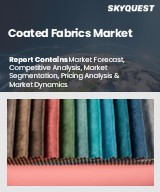
Coated Fabrics Market
Report ID: SQMIG15E2687
Report ID: SQMIG15E2687
[email protected]
USA +1 351-333-4748
Report ID:
SQMIG15E2687 |
Region:
Global |
Published Date: June, 2025
Pages:
186
|Tables:
92
|Figures:
71


Global Coated Fabrics Market size was valued at USD 24.27 Billion in 2024 and is poised to grow from USD 25.94 Billion in 2025 to USD 44.24 Billion by 2033, growing at a CAGR of 6.9% during the forecast period (2026–2033).
This development is due to the increasing applications of such rubber-coated textiles in the manufacturing of military attire and protective garments. This will lead to the global coated fabrics market growth during the forecast period.
A huge percentage of coated fabrics found in motor vehicles are in original equipment manufacturer (OEM) uses, notably airbags. Coated fabrics may also find applications in motor vehicle interiors, including upholstery, headliners, convertible tops, pickup-truck bed covers, heavy-truck covers, and sides, nose covers, and spare tire covers. With the significance of airbags, the largest substrate, in terms of area, to be used in the light vehicle industry is nylon.
The expansion can further be linked to the growing applications of the product for the production of industrial items like conveyor belts and PTFE tapes. Besides, the market is set to gain from the growing use of coated fabrics as cheap alternative leather for trim and upholstery. Volatile raw material prices and strict environmental protection laws are predicted to prompt the manufacturers to emphasize research & development of a substitute for leather. Moreover, technological advancements focused on the reduction of raw material prices and quicker and more efficient production are likely to propel growth.
Market snapshot - 2026-2033
Global Market Size
USD 22.7 billion
Largest Segment
Polymer Coated
Fastest Growth
Rubber Coated
Growth Rate
6.9% CAGR
To get more insights on this market click here to Request a Free Sample Report
Global Coated Fabrics Market is segmented by Product Type, Application and region. Based on Product Type, the market is segmented into Polymer-Coated Fabrics, Vinyl-Coated Fabrics, PU-Coated Fabrics, PE-Coated Fabrics, Rubber-Coated Fabrics and Fabric-Backed Wall Coverings. Based on Application, the market is segmented into Transportation, Protective Clothings, Industrial, Roofing, Awnings And Canopies, Furniture & Seatings and Others. Based on region, the market is segmented into North America, Europe, Asia Pacific, Latin America and Middle East & Africa.
Why Polymer Coated Fabrics Dominate the Coated Fabrics Market?
As per the 2024 global coated fabrics market analysis, polymer coated fabric had the highest market share as a result of increased demand for protective clothing in the automotive industries. They are synthetic fibers whose coating surfaces consist of different polymers such as polyethylene, polyvinyl chloride (PVC), and polyurethane. Polyurethane (PU) coated fabrics are used for protective clothing, footwear, rainwear, gloves, inflatable boats, and waterproof mattress cover because of their transparency, abrasion resistance, oil and grease resistance, and elasticity characteristics. They are mostly used in the transportation or automotive industry mainly for exterior, interior, covers, seatbelts, and airbags.
How the Transport Industry Fuels Demand for Coated Fabrics?
Based on the global coated fabrics market forecast, the transportation sector is expected to maintain the major share during the foreseeable future because of rising sales of vehicles and rise in road and rail transportation. They are primarily utilized in the automotive vehicle industry in the production of seat belts, roofing, automobile seats, air bags, and interiors. Stringent government legislation regarding automobile safety and security aspects can strengthen the use of airbags inside cars positively. Growth in automotive industry because of increasing demand for passenger and commercial vehicles shall advance market growth of coated fabrics.
To get detailed segments analysis, Request a Free Sample Report
How Automotive and Furniture Sectors are Boosting Coated Fabrics in Asia-Pacific?
Asia-Pacific dominated the coated fabrics market in 2024. This was primarily because of the increasing automobile sector in developing countries such as China, India, South Korea, and Japan. The sector is fueled by the increase in home furnishing demand and urbanization in the region. Demand is boosted, for example, by Hyundai and Toyota employing coated fabrics to dashboards, airbags, and seat coverings. Moreover, firms such as Teijin in Japan are manufacturing high-performance coated fabrics for industrial and automotive uses, which drive market growth.
South Korea Coated Fabrics Market
Demand for coated fabrics utilized in airbags, seat belts, and interiors is stimulated by South Korea's booming automotive manufacturing industry, headed by Hyundai and Kia. The demand for durable and sustainable PU-coated textiles has grown following the South Korean government's efforts in encouraging the production of environmentally friendly cars. Furthermore, LG Chem is investing in bio-based coated textiles that maximize fabric performance while minimizing environmental damage. Car safety and interior coated fabric applications continue to grow in sync with EV and luxury car exports growth.
Japan Coated Fabrics Market
A leader in the coated fabrics market, Japan hosts prominent automobile manufacturers such as Toyota, Honda, and Nissan. The creation of nanotechnology-boosted coated textiles with fire-resistance, waterproofing, and self-cleaning capabilities is led by Japanese organizations like Teijin and Toray Industries. In line with its sustainability policy, Toyota has minimized its dependency on conventional PVC coatings by augmenting the utilization of bio-based PU coatings within automobile interiors. Japan's emphasis on high-performance, low-weight materials continues to propel industrial and automotive innovation.
How Protective Clothing and Automotive Growth Drive Coated Fabrics in North America?
North America is expected to grow at a 6.3% CAGR because of increasing demand for safety equipment, stringent FDA regulations, and growing oil and gas activities. Another significant point is the growing control of automobile manufacturers such as Tesla, General Motors, and Ford. An example is Tesla's use of vegan leather seats, which are made from materials coated with PU. Protective clothing made from flame-retardant treated fabrics is also used by workers in the oil and gas sectors in Texas and Alberta, thus driving demand.
United States Coated Fabrics Market
The growth of protective clothing for the construction, defense, and oil & gas sectors has established the United States as a leading coated fabrics market. For example, DuPont manufactures high-performance coated fabrics used in chemical-resistant coveralls and fire-resistant uniforms. Automakers such as Ford and GM use coated textiles in airbags, seats, and convertible tops, driving market growth.
Canada Coated Fabrics Market
Environmentally friendly and lightweight coated materials are increasingly demanded as EV use increases. The severe Canadian climate heightens the demand for weather-resistant and insulating coated fabrics in the construction and automotive sectors. Intertape Polymer Group and other companies produce PVC and PU-coated fabrics that enhance durability and flexibility during extreme weather conditions. Furthermore, Alberta's growing oil sands sector has spurred an increase in the use of flame-retardant coated fabrics for protecting workers. The demand for eco-friendly vehicle textiles is also increasing due to Stellantis and Honda's investments in Ontario's growth in EV manufacturing.
Why Europe is Investing in Eco-Friendly Coated Fabrics?
The robust automotive and industrial industries are the leading causes of the projected 5.7% compound annual growth rate in Europe. The presence of established carmakers such as Volkswagen, BMW, and Renault are one of the key drivers. The large-scale application of sustainable coated textiles is due to stringent EU sustainability and fire safety regulations. For example, BMW's adoption of PU-coated vegetable-based leather substitutes over PVC aligns with Europe's green policy. Coated textiles are also extensively applied in protective workwear and train transportation.
United Kingdom Coated Fabrics Market
The demand for recycled and bio-based coated textiles is being fueled by the UK's focus on sustainability in the automotive and furniture sectors. Firms such as Camira Fabrics are lowering their carbon footprint by manufacturing coated fabrics from recycled ocean waste. The automotive industry is also moving towards PVC-free coatings for vehicle interiors, spearheaded by Jaguar Land Rover. For safety and passenger seating, the UK rail and air transport industries are also applying more fire-retardant and antimicrobial-coated fabrics.
Spain Coated Fabrics Market
Demand for high-performance coated fabrics in vehicles and manufacturing is increasing in Spain, a renowned hub for automobile production. SEAT and Renault Spain are investing in PU and PVC-coated fabrics for the airbag, seats, and convertible top. Waterproof and stain-resistant coated fabrics are equally in high demand in office and domestic furniture following Spain's prosperous furniture industry. Market expansion is equally being facilitated by Spain's growing textile exports, more so automobile and coated fabric interior upholstery.
To know more about the market opportunities by region and country, click here to
Buy The Complete Report
Growth within the Automobile Industry
Increasing Demand for Protective Clothing
PVC Coatings and Environmental Issues
High Costs of Producing Advanced Coated Textiles
Request Free Customization of this report to help us to meet your business objectives.
Companies in the industry have a stringent hold on mergers and acquisitions to acquire a competitive advantage in terms of market share. In addition, companies such as International Incorporated use the strategy to expand into new markets thereby evading the opening of manufacturing or distribution channels. Omnova Solutions holds the highest percentage, then Spradling International Inc., and Takata Corporation. The industry giants invest a lot of money in research and development of new products.
How AI is Improving Defect Detection in Coated Fabrics?
Artificial Intelligence (AI) is transforming the global coated fabrics industry by enhancing material optimization, defect detection, and quality management. AI-driven automation guarantees increased coating application precision, minimizes material waste, and improves fabric durability.
One such technology is Cognex ViDi, an artificial intelligence-powered solution from Cognex Corp that optimizes coated fabric layouts using advanced fabric pattern recognition. This artificial intelligence-powered tool enhances accuracy and reduces fabric waste during the cutting process by automatically adjusting the pattern. In automotive, industrial, and protective clothing uses, where homogeneity of fabric and coatings with no defects are imperative, this breakthrough is highly advantageous.
Moreover, live computer vision based on AI identifies irregularities on treated textiles, enhancing the value of the product. The coated fabrics market holds the promise of accelerated growth and innovation in the years to come as AI increasingly drives automation, sustainability, and efficiency.
How Startups are Driving Innovation in Coated Fabrics Industry?
USA-based Dropel Fabrics (Founded in 2015)
Through eco-friendly nanotechnology processes that produce natural fabrics that are stain and water repellent, Dropel textiles is transforming the business of coated fabrics. In contrast to other coatings, Dropel's method enhances durability without losing softness or breathability. The company optimizes fabric performance for clothing, furniture, and outdoor equipment through AI-driven material science. Their invention dramatically minimizes dependence on synthetic water-repellent coatings, making coated fabrics more sustainable and consumer-friendly in terms of durability and comfort.
USA-Based 4tify (Founded in 2017)
By empowering producers to manufacture sustainable coated fabrics from renewable plant-derived materials such as bamboo, hemp, organic cotton, and soybean, 4tify is redefining AI-commissioned fabric technology. Sustainable coated fabrics are more applicable in upholstery and fashion with its AI-enabled solution, which enhances elasticity, durability, and ease of maintenance. 4tify enhances product performance while minimizing waste and energy usage in the textile industry by optimizing coating applications.
India-Based Stylumia (Founded in 2015)
With AI-based fashion analytics, Stylumia revolutionizes the coated textiles sector, enabling marketers to forecast trends, maximize demand, and maximize design efficiency. Stylumia minimizes waste and overproduction by helping producers create highly demanded coated textiles based on market data and customer information. By maximizing material usage, improving coating durability, and synchronizing textile production with existing market demand, Stylumia's AI-based insights render fashion sustainable. This technology maximizes the industry's profitability and sustainability.
Evolution of Coated Fabrics with Innovation and Sustainability
SkyQuest’s ABIRAW (Advanced Business Intelligence, Research & Analysis Wing) is our Business Information Services team that Collects, Collates, Correlates, and Analyses the Data collected using Primary Exploratory Research backed by robust Secondary Desk research.
As per SkyQuest analysis, with increasing demand in the automotive, protective wear, and industrial industries, the global coated fabrics market outlook is predicted to change gradually. The market is transforming due to new developments in sustainable coatings, including nanotechnology-coated textiles and bio-based PU. North America and Europe focus on sustainability and safety standards, whereas Asia-Pacific dominates the market with the growth of the automobile sector. High production costs and environmental issues remain issues. The market is also expected to grow further as companies invest in green solutions and innovative manufacturing methods, providing high-performance, long-lasting, and environmentally sustainable coated textiles for various global applications.
| Report Metric | Details |
|---|---|
| Market size value in 2024 | USD 24.27 Billion |
| Market size value in 2033 | USD 44.24 Billion |
| Growth Rate | 6.9% |
| Base year | 2024 |
| Forecast period | 2026-2033 |
| Forecast Unit (Value) | USD Billion |
| Segments covered |
|
| Regions covered | North America (US, Canada), Europe (Germany, France, United Kingdom, Italy, Spain, Rest of Europe), Asia Pacific (China, India, Japan, Rest of Asia-Pacific), Latin America (Brazil, Rest of Latin America), Middle East & Africa (South Africa, GCC Countries, Rest of MEA) |
| Companies covered |
|
| Customization scope | Free report customization with purchase. Customization includes:-
|
To get a free trial access to our platform which is a one stop solution for all your data requirements for quicker decision making. This platform allows you to compare markets, competitors who are prominent in the market, and mega trends that are influencing the dynamics in the market. Also, get access to detailed SkyQuest exclusive matrix.
Table Of Content
Executive Summary
Market overview
Parent Market Analysis
Market overview
Market size
KEY MARKET INSIGHTS
COVID IMPACT
MARKET DYNAMICS & OUTLOOK
Market Size by Region
KEY COMPANY PROFILES
Methodology
For the Coated Fabrics Market, our research methodology involved a mixture of primary and secondary data sources. Key steps involved in the research process are listed below:
1. Information Procurement: This stage involved the procurement of Market data or related information via primary and secondary sources. The various secondary sources used included various company websites, annual reports, trade databases, and paid databases such as Hoover's, Bloomberg Business, Factiva, and Avention. Our team did 45 primary interactions Globally which included several stakeholders such as manufacturers, customers, key opinion leaders, etc. Overall, information procurement was one of the most extensive stages in our research process.
2. Information Analysis: This step involved triangulation of data through bottom-up and top-down approaches to estimate and validate the total size and future estimate of the Coated Fabrics Market.
3. Report Formulation: The final step entailed the placement of data points in appropriate Market spaces in an attempt to deduce viable conclusions.
4. Validation & Publishing: Validation is the most important step in the process. Validation & re-validation via an intricately designed process helped us finalize data points to be used for final calculations. The final Market estimates and forecasts were then aligned and sent to our panel of industry experts for validation of data. Once the validation was done the report was sent to our Quality Assurance team to ensure adherence to style guides, consistency & design.
Analyst Support
Customization Options
With the given market data, our dedicated team of analysts can offer you the following customization options are available for the Coated Fabrics Market:
Product Analysis: Product matrix, which offers a detailed comparison of the product portfolio of companies.
Regional Analysis: Further analysis of the Coated Fabrics Market for additional countries.
Competitive Analysis: Detailed analysis and profiling of additional Market players & comparative analysis of competitive products.
Go to Market Strategy: Find the high-growth channels to invest your marketing efforts and increase your customer base.
Innovation Mapping: Identify racial solutions and innovation, connected to deep ecosystems of innovators, start-ups, academics, and strategic partners.
Category Intelligence: Customized intelligence that is relevant to their supply Markets will enable them to make smarter sourcing decisions and improve their category management.
Public Company Transcript Analysis: To improve the investment performance by generating new alpha and making better-informed decisions.
Social Media Listening: To analyze the conversations and trends happening not just around your brand, but around your industry as a whole, and use those insights to make better Marketing decisions.
REQUEST FOR SAMPLE
 REQUEST FREE CUSTOMIZATION


Want to customize this report? This report can be personalized according to your needs. Our analysts and industry experts will work directly with you to understand your requirements and provide you with customized data in a short amount of time. We offer $1000 worth of FREE customization at the time of purchase.
Feedback From Our Clients


 USA (+1) 351-333-4748

