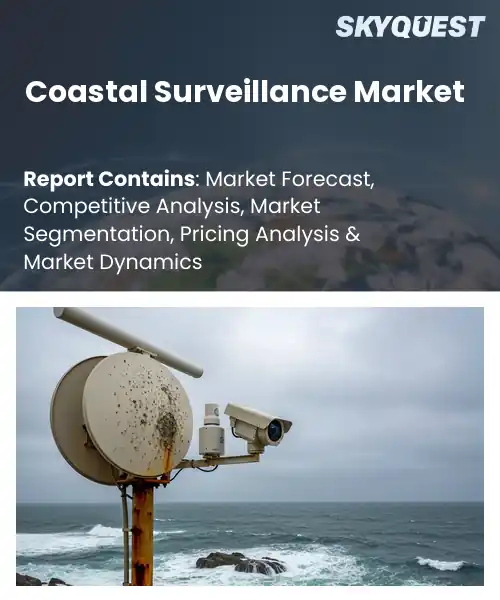
Coastal Surveillance Market
Report ID: SQMIG20A2689
Report ID: SQMIG20A2689
[email protected]
USA +1 351-333-4748
Report ID:
SQMIG20A2689 |
Region:
Global |
Published Date: June, 2026
Pages:
157
|Tables:
149
|Figures:
78


Global Coastal Surveillance Market size was valued at USD 26.4 Billion in 2024 and is poised to grow from USD 28.3 Billion in 2025 to USD 49.36 Billion by 2033, growing at a CAGR of 7.2% during the forecast period (2026-2033).
AI-based data fusion that yields actionable intelligence from sensor feeds to cut down on false alarms and speed up interdictions is driving the coastal surveillance market. Governments are spending on solutions, opening up a market for vendors offering cloud analytics and autonomous patrol drones due to tighter maritime rules, rising cargo flows and increasing geopolitical tensions. Singapore’s Smart Port initiative demonstrates how predictive analytics can aid vessel scheduling, deter illicit activity and India’s use of coastal radar nodes with machine-learning classifiers shows scalable efficiency. So, technology readiness and more regulation are helping to create public-private partnerships and open revenue streams across developed world economies.
The global coastal surveillance market includes technologies such as radar, AIS, drones and AI-powered analytics to monitor maritime borders, ports and offshore properties. The reason for its importance is the rise in illegal fishing, smuggling and geopolitical conflicts that threaten national security and the environment. The sector started with radar installations in the 1970s, then progressed to satellite-based AIS in the 2000s and now utilizes surface vessels and machine-learning platforms. For example, the US Coast Guard has deployed Lidar-enhanced cutters and European ports combine hubs to ease traffic. The need for real-time data is driving this, and surveillance is becoming a pillar of maritime governance.
How is AI integration enhancing real-time detection in the coastal surveillance market?
The integration of AI with real-time analytics and sensor stream fusion is revolutionizing coastal monitoring. Machine-learning models scan radar, AIS and optical feeds, flagging anomalies that might be missed by human operators. This reduces response latency, and increases situational awareness in congested littoral environments. “Edge computing enables us to do the processing on the vessels themselves, which reduces the bandwidth requirements and gives us immediate alerts. The adaptive algorithms learn the vessel patterns and enhance the detection accuracy as the traffic varies. Thus the monitoring network is more resilient and can expand with increased maritime activity and new threats. AI is a cornerstone of the modern coastal defense.
In June 2026 Thales launched a new AI-powered detection platform that can better detect small craft and illegal activities in real time, increase operational efficiency, and support market growth.
Market snapshot - (2026-2033)
Global Market Size
USD 26.4 Billion
Largest Segment
Hardware
Fastest Growth
Software
Growth Rate
7.2% CAGR
To get more insights on this market click here to Request a Free Sample Report
Global coastal surveillance market is segmented by component, platform, application, end user, deployment type and region. Based on component, the market is segmented into Hardware, Software and Services. Based on platform, the market is segmented into Shore-Based Systems, Shipborne Systems, Airborne Systems and Unmanned Systems. Based on application, the market is segmented into Maritime Border Security, Port & Harbor Security, Search & Rescue Operations, Environmental Monitoring, Illegal Fishing & Smuggling Prevention and Others. Based on end user, the market is segmented into Navy, Coast Guard, Port Authorities, Maritime Law Enforcement Agencies and Others. Based on deployment type, the market is segmented into Fixed Surveillance Systems and Mobile Surveillance Systems. Based on region, the market is segmented into North America, Europe, Asia Pacific, Latin America and Middle East & Africa.
The hardware segment is expected to drive the market with the demand for physical sensing and processing capabilities essential for robust coastal monitoring. Robust radars, electro-optical cameras and communication terminals form a backbone for the continuous detection of vessels and environmental conditions. Market adoption is driven by civilian and defense stakeholders, with hardware as the main driver. Operators rely on physical assets to deliver high-resolution coverage, survive in harsh maritime weather and work with existing networks.
At the same time, the Software segment is seeing the strongest growth momentum as advanced analytics, AI-driven threat identification, and cloud-based data fusion are becoming essential for actionable intelligence. Subscription models have the advantage of a lower entry barrier, resulting in a higher adoption rate by different maritime agencies, hence a wider functional scope of the market. Faster integration of machine learning models means a shorter decision cycle.
The Shore-Based Systems segment is the dominant one, as stationary installations can host large-aperture radars, high-resolution electro-optical sensors and powerful processing units that provide persistent wide-area coverage. Fixed sites have reliable power, secure enclosures and direct fiber links that can be conveniently connected to command centers. They are required for national maritime domain awareness, facilitate coordination of response operations, and foster cross-agency collaboration as they can monitor high-traffic zones 24/7.
While, in the meantime, the Unmanned Systems segment is starting to emerge as the key high-growth area, with drone-borne radar and sonar payloads providing flexible, rapid-deployment surveillance over hard-to-reach littoral zones. The demand for more static coverage from maritime agencies, driven by autonomy, extended endurance and lower operational costs, stimulates large market opportunities and innovative use cases.
To get detailed segments analysis, Request a Free Sample Report
Asia Pacific is the world leader in coastal surveillance, with its vast maritime borders, increasing strategic importance of sea lanes and heavy investment in advanced sensor and autonomous technologies. Governments across the region are trying to improve their knowledge of the maritime domain, to safeguard trade routes, fisheries and national security. This has created a collaborative ecosystem between the defense ministries, technology innovators and research institutions. This environment accelerates the deployment of integrated surveillance networks using satellite, radar and unmanned platforms. Advanced electronics and shipbuilding industries provide a strong industrial base to quickly ramp up production of advanced solutions . Changing regulatory environment promotes sharing of data across borders and joint exercises . These factors together provide a strong base for the market, and Asia Pacific is the most important growth engine in the global coastal surveillance market.
Japan Coastal Surveillance Market has a tradition of maritime alertness and a strong tech industry that produces high-precision sensors and autonomous ships. The government is integrating satellite imagery and coastal radar to improve threat detection, and collaborations with local manufacturers are facilitating the deployment of next-generation monitoring systems. The focus on safeguarding busy shipping routes and environmentally sensitive areas continues to drive the expansion of data analytics and real-time response capabilities, further solidifying Japan’s position as a leader in advanced coastal monitoring.
South Korea Coastal Surveillance Market is driven by strategic focus on securing critical ports and naval installations from evolving maritime threats. Defense agencies and major electronics companies are collaborating closely to accelerate the deployment of AI-enabled radar and unmanned surface vehicles. Investment in integrated command and control architectures allows sensor data to be processed and pushed out to the right people very quickly. The multi-dimensional approach increases South Korea’s ability to monitor busy coastal traffic and effectively respond to security challenges.
The North America’s coastal surveillance market is growing at a fast pace due to rising awareness of threats to maritime security, increasing commercial shipping activity and a strong focus on technology innovation by federal and regional agencies. The United States and Canada share the goal of developing interoperable sensor networks that incorporate the latest radar, lidar and unmanned aerial systems to provide broad coverage of large coastlines. The policy frameworks enable public-private partnerships that can rapidly integrate commercial satellite data and AI-based analytics into existing monitoring infrastructures. The emphasis on resilient, real-time situational awareness supports both defense objectives and environmental stewardship, bolstering the region’s push for a unified, state-of-the-art coastal surveillance capability.
The United States is spurred by large research organizations and a vibrant defense industry to continually innovate in maritime monitoring. Multi-layered sensor arrays are deployed on autonomous platforms by federal agencies to protect critical ports and marine resources. We work with technology startups on collaborative programs to rapidly prototype AI-enhanced analytics for increased detection speed and accuracy. This ecosystem provides a robust national framework for safeguarding the country’s extensive coastline and maritime commerce.
Canada Coastal Surveillance Market is driven by a strategic focus to protect the vast Arctic and Atlantic coastlines and also to support sustainable fisheries and resource extraction. Government programs are tackling remote area monitoring problems with a mix of satellite surveillance and shore-based radar. Working with indigenous communities and local tech companies is essential to build customized and environmentally friendly solutions. This collaborative approach will help Canada to better maintain maritime domain awareness in a variety of, and sometimes harsh, marine environments.
Europe is bolstering its coastal surveillance stance by rolling out harmonized regulatory standards, forging deep research partnerships and showing a robust commitment to embedding cutting-edge sensor technologies throughout the member countries. Collaboration facilitates standardization of data sharing at sea, allowing national authorities and multinational organizations to exchange information seamlessly. We are building on traditional radar and optical systems, investing in AI-powered analytics and autonomous patrol vessels to provide better detection capabilities. The emphasis on environmental protection and maritime safety is connected to wider policy objectives and encourages the creation of sustainable surveillance solutions. The building of a cohesive network of academic, industrial and governmental partners further cements Europe’s role as a leader in comprehensive, interoperable coastal monitoring.
Germany Coastal Surveillance Market is driven by strong engineering industry and strategic focus on integration of high resolution radar with advanced data processing platforms. Federal ministries and research institutions are joining forces to implement interoperable sensor networks in the busy North Sea and Baltic Sea corridors. By focusing on automated threat assessment and real-time information sharing, Germany will strengthen its ability to protect critical maritime infrastructure and further regional security objectives.
The UK Coastal Surveillance Market utilizes advanced surveillance solutions by leveraging the maritime heritage and strong defense procurement structure. Coastal radar, satellite imagery and unmanned systems combine to give good coverage of important shipping lanes and off-shore installations. Government initiatives are working with tech companies to develop AI-powered analytics that can accelerate the response to new threats and environmental incidents.
The extensive Atlantic and Mediterranean coastlines of France coupled with marine research and commercial activities with strategic emphasis is pushing the coastal surveillance market in France upwards. They work with navy officials and aerospace firms to bring together advanced sensor packages and autonomous patrol drones. An emphasis on data fusion and cooperative monitoring with European partners helps to augment France’s ability to maintain alert maritime domain awareness.
To know more about the market opportunities by region and country, click here to
Buy The Complete Report
Increasing Maritime Border Security
Adoption Of AI‑Powered Sensors
High Installation Capital Requirements
Complex Regulatory Compliance Issues
Request Free Customization of this report to help us to meet your business objectives.
The desire to monitor the seas in real-time is driving strategic partnerships, including Anduril’s partnership with the U.S. Navy to deploy its Lattice platform and Thinking Machines Lab’s partnership with NVIDIA to accelerate the development of AI-enabled surveillance tools. Defense-tech firms race to merge AI and sensors to capture coastal surveillance market.
SkyQuest’s ABIRAW (Advanced Business Intelligence, Research & Analysis Wing) is our Business Information Services team that Collects, Collates, Correlates, and Analyses the Data collected by means of Primary Exploratory Research backed by robust Secondary Desk research. As per SkyQuest analysis the global coastal surveillance market is being propelled primarily by the growing need for maritime border security, which pushes governments to invest heavily in integrated monitoring solutions. A second strong catalyst is the rapid adoption of AI‑powered sensors that transform raw radar, AIS and optical feeds into real‑time, actionable intelligence, accelerating decision making. The hardware segment remains the market’s dominant force because robust radars, electro‑optical cameras and communication terminals provide the essential backbone for reliable coverage. Asia Pacific leads the market, benefitting from extensive coastlines and aggressive modernization programs. However, high installation capital requirements act as a notable restraint, tempering the pace of deployment in cost‑sensitive regions.
| Report Metric | Details |
|---|---|
| Market size value in 2024 | USD 26.4 Billion |
| Market size value in 2033 | USD 49.36 Billion |
| Growth Rate | 7.2% |
| Base year | 2024 |
| Forecast period | (2026-2033) |
| Forecast Unit (Value) | USD Billion |
| Segments covered |
|
| Regions covered | North America (US, Canada), Europe (Germany, France, United Kingdom, Italy, Spain, Rest of Europe), Asia Pacific (China, India, Japan, Rest of Asia-Pacific), Latin America (Brazil, Rest of Latin America), Middle East & Africa (South Africa, GCC Countries, Rest of MEA) |
| Companies covered |
|
| Customization scope | Free report customization with purchase. Customization includes:-
|
To get a free trial access to our platform which is a one stop solution for all your data requirements for quicker decision making. This platform allows you to compare markets, competitors who are prominent in the market, and mega trends that are influencing the dynamics in the market. Also, get access to detailed SkyQuest exclusive matrix.
Table Of Content
Executive Summary
Market overview
Parent Market Analysis
Market overview
Market size
KEY MARKET INSIGHTS
COVID IMPACT
MARKET DYNAMICS & OUTLOOK
Market Size by Region
KEY COMPANY PROFILES
Methodology
For the Coastal Surveillance Market, our research methodology involved a mixture of primary and secondary data sources. Key steps involved in the research process are listed below:
1. Information Procurement: This stage involved the procurement of Market data or related information via primary and secondary sources. The various secondary sources used included various company websites, annual reports, trade databases, and paid databases such as Hoover's, Bloomberg Business, Factiva, and Avention. Our team did 45 primary interactions Globally which included several stakeholders such as manufacturers, customers, key opinion leaders, etc. Overall, information procurement was one of the most extensive stages in our research process.
2. Information Analysis: This step involved triangulation of data through bottom-up and top-down approaches to estimate and validate the total size and future estimate of the Coastal Surveillance Market.
3. Report Formulation: The final step entailed the placement of data points in appropriate Market spaces in an attempt to deduce viable conclusions.
4. Validation & Publishing: Validation is the most important step in the process. Validation & re-validation via an intricately designed process helped us finalize data points to be used for final calculations. The final Market estimates and forecasts were then aligned and sent to our panel of industry experts for validation of data. Once the validation was done the report was sent to our Quality Assurance team to ensure adherence to style guides, consistency & design.
Analyst Support
Customization Options
With the given market data, our dedicated team of analysts can offer you the following customization options are available for the Coastal Surveillance Market:
Product Analysis: Product matrix, which offers a detailed comparison of the product portfolio of companies.
Regional Analysis: Further analysis of the Coastal Surveillance Market for additional countries.
Competitive Analysis: Detailed analysis and profiling of additional Market players & comparative analysis of competitive products.
Go to Market Strategy: Find the high-growth channels to invest your marketing efforts and increase your customer base.
Innovation Mapping: Identify racial solutions and innovation, connected to deep ecosystems of innovators, start-ups, academics, and strategic partners.
Category Intelligence: Customized intelligence that is relevant to their supply Markets will enable them to make smarter sourcing decisions and improve their category management.
Public Company Transcript Analysis: To improve the investment performance by generating new alpha and making better-informed decisions.
Social Media Listening: To analyze the conversations and trends happening not just around your brand, but around your industry as a whole, and use those insights to make better Marketing decisions.
REQUEST FOR SAMPLE
 REQUEST FREE CUSTOMIZATION
Global Coastal Surveillance Market size was valued at USD 26.4 Billion in 2024 and is poised to grow from USD 28.3 Billion in 2025 to USD 49.36 Billion by 2033, growing at a CAGR of 7.2% during the forecast period (2026-2033).
The coastal surveillance market is shaped by intense competition among defense‑tech firms leveraging AI and sensor integration, with rising demand for real‑time maritime monitoring driving strategic moves such as Anduril’s partnership with the U.S. Navy to field its Lattice platform and Thinking Machines Lab’s collaboration with NVIDIA to accelerate AI‑driven surveillance solutions. 'RTX Corporation', 'Thales Group', 'Saab AB', 'Leonardo S.p.A.', 'Indra Sistemas, S.A.', 'HENSOLDT AG', 'Elbit Systems Ltd.', 'Israel Aerospace Industries Ltd.', 'L3Harris Technologies, Inc.', 'Lockheed Martin Corporation', 'Northrop Grumman Corporation', 'Kongsberg Gruppen ASA', 'Terma A/S', 'Japan Radio Co., Ltd.', 'Bharat Electronics Limited', 'CETC International Co., Ltd.', 'GEM elettronica S.r.l.', 'Rohde & Schwarz GmbH & Co. KG', 'Teledyne Technologies Incorporated', 'Accipiter Radar Technologies Inc.'
The growing emphasis on protecting national coastlines against illegal activities and environmental threats drives investment in surveillance solutions. Governments and private operators view advanced monitoring as essential for early detection of incursions, pollution events, and unauthorized fishing. This perception creates strong demand for integrated radar, camera, and drone systems, encouraging manufacturers to expand product portfolios and services. As stakeholders prioritize maritime safety, budgeting cycles increasingly allocate resources to acquire and upgrade coastal monitoring technologies across regions, thereby accelerating market growth.
Autonomous Patrol Integration: Coastal authorities are increasingly deploying unmanned surface and aerial vehicles equipped with advanced sensors to conduct persistent surveillance without human crews. These autonomous platforms coordinate with shore‑based command centers, enabling rapid response to suspicious activities and reducing operational costs. The ability to operate in adverse weather and during night hours expands coverage, while real‑time data streaming enhances situational awareness. As regulatory frameworks mature, self‑navigating vessels are becoming a cornerstone of next‑generation maritime security strategies for national resilience.
Why does Asia Pacific Dominate the Global Coastal Surveillance Market? |@12


Want to customize this report? This report can be personalized according to your needs. Our analysts and industry experts will work directly with you to understand your requirements and provide you with customized data in a short amount of time. We offer $1000 worth of FREE customization at the time of purchase.
Feedback From Our Clients


 USA (+1) 351-333-4748

