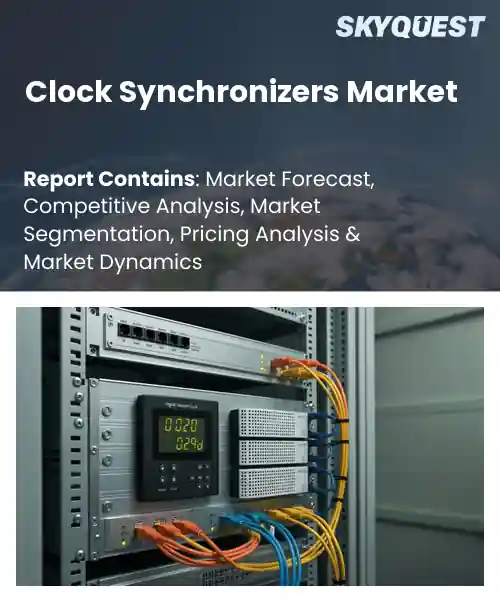
Clock Synchronizers Market
Report ID: SQMIG45K2431
Report ID: SQMIG45K2431
[email protected]
USA +1 351-333-4748
Report ID:
SQMIG45K2431 |
Region:
Global |
Published Date: August, 2026
Pages:
157
|Tables:
172
|Figures:
79


Global Clock Synchronizers Market size was valued at USD 142.3 Billion in 2024 and is poised to grow from USD 151.41 Billion in 2025 to USD 248.71 Billion by 2033, growing at a CAGR of 6.4% during the forecast period (2026-2033).
The global clock synchronizers market offers hardware plus software, that line up timing signals between network pieces, so data can flow properly in telecom, data centers, and even automotive scenarios. This is important because it helps stop packet loss, cuts jitter down, and stays within latency limits people ask for from 5G, edge computing, and trading. Right now the biggest push is the rise of bandwidth heavy services, and that makes operators roll out timing systems for antenna arrays and radios, like, more often than before.
One of the most consequential growth factor now is how 5G fronthaul architecture is blending with networking, which basically forces service providers to put clock synchronizers inside virtualized setups. With this, the latency overhead shrinks, and that supports low latency communication for stuff like autonomous vehicles, remote surgery, and analytics. Also, as operators move toward open‑RAN and software defined radios, the market gets steadier revenue streams from firmware updates and ongoing maintenance agreements. On top of that, newer standards like IEEE 802.1AS‑Rev 2 widen compliance expectations, so equipment makers start embedding Precision Time Protocol chips into IoT gateways. That, in turn opens a sizable path for industrial automation.
How is AI improving accuracy in the clock synchronizers market?
AI is reshaping clock synchronizers by improving real time prediction of phase drift and enabling automatic timing loop adjustment. Machine learning models look at temperature voltage, and workload patterns, then they fine tune phase locked loops, which lowers jitter and helps long term stability. Some vendors now also embed AI chips that keep learning from network traffic, meaning devices can adapt without needing manual reconfiguration every time. Overall this move shifts things from static calibration into dynamic self optimizing solutions, and that fits the high precision demands coming from 5G cloud computing and autonomous systems. As a result manufacturers are seeing faster deployment cycles, and more confidence in synchronization across distributed infrastructure.
Market snapshot - (2026-2033)
Global Market Size
USD 142.3 Billion
Largest Segment
PTP Clock Synchronizers
Fastest Growth
GPS Clock Synchronizers
Growth Rate
6.4% CAGR
To get more insights on this market click here to Request a Free Sample Report
The global clock synchronizers market is segmented by product type, installation type, application, enterprise size, end user, sales channel and region. Based on product type, the market is segmented into GPS Clock Synchronizers, NTP Clock Synchronizers, PTP Clock Synchronizers and Others. Based on installation type, the market is segmented into Rack Mounted, DIN Rail Mounted and Desktop. Based on application, the market is segmented into Telecommunications, Power Utilities, Financial Services and Others. Based on enterprise size, the market is segmented into Small & Medium Enterprises and Large Enterprises. Based on end user, the market is segmented into Telecom Operators, Data Centers, Government and Others. Based on sales channel, the market is segmented into Direct Sales and Value-Added Resellers. Based on region, the market is segmented into North America, Europe, Asia Pacific, Latin America and Middle East & Africa.
GPS Clock Synchronizers segment dominates the whole space, mainly since they bring the highest-precision timing that is needed for network infrastructure, and because they lean on satellite signals they stay resilient even when local stuff fails. They’re basically everywhere inside core networking gear, so operators end up trusting them more, which leads to broad adoption. The natural accuracy plus low latency it offers from GPS technology ticks all the boxes for strict synchronization requirements, so it ends up being the go-to across different industries too. And meanwhile, satellite constellation upgrades keep happening, which reinforces reliability and, well, keeps GPS as the market leader.
That said, the PTP Clock Synchronizers segment is now showing the strongest growth momentum, mostly because industrial Ethernet rollouts keep asking for nanosecond level accuracy. There are time‑sensitive networking protocols becoming more common, so vendors start embedding PTP capabilities directly into their solutions, which widens the footprint in automation and manufacturing. This push then creates fresh openings and moves the market forward in a bigger way.
How exactly is the Telecommunications application shaping the Clock Synchronizers Market?
The Telecommunications application segment leads, like clearly, because real‑time voice and data services need tight timing alignment so jitter doesn’t creep in and packet loss doesn’t become a problem. Network operators rely on synchronized clocks to coordinate base stations, this helps seamless handoffs and keeps service quality high. Since latency‑sensitive traffic is so unforgiving, operators keep investing in synchronization solutions, which locks telecommunications as the core driver of demand. Also, regulatory requirements related to network timing accuracy nudge operators toward advanced synchronizers, and that adds more traction to the market.
On the other hand, Financial Services is emerging as the key high‑growth area, since strict timestamping rules require ultra precise time records for trade execution and compliance reporting. Between algorithmic trading getting faster and blockchain transactions moving around, firms increasingly want synchronized infrastructure, so clock synchronizers get pulled into that setup. This momentum grows the overall market and also enables more innovative service models.
To get detailed segments analysis, Request a Free Sample Report
North America benefits from this mature technology ecosystem, where leading semiconductor manufacturers and high‑performance computing companies seem to overlap, all in the same orbit. The region’s financial services, aerospace and defense sectors want extreme timing accuracy, so there’s this real deep know how in synchronization approaches. Then, it offers robust research institutions, plus strong intellectual property safeguards, which basically keeps invention flowing, while those tough reliability expectations push adoption in critical infrastructure. On top of that, big data centers and cloud providers are everywhere, and they magnify the need for ultra‑precise timing, creating this feedback cycle that keeps the market leadership steady. Also there are industry‑academia partnerships, which help keep talent pipelines warm, and it means North America stays up front in clock synchronizer development and real deployment.
United States Clock Synchronizers Market
Clock Synchronizers Market in United States is thriving on a mix of advanced semiconductor fabrication and a wide base of end users that go from high‑frequency trading platforms to defense communication networks. There’s strong focus on research grants and private venture funding, which speeds up product differentiation, and the regulatory frameworks seem to put reliability and security first. When integration is added with the newer digital infrastructure, like edge computing and autonomous systems, it just reinforces that the United States is a hub for advanced timing technology.
Canada Clock Synchronizers Market
Clock Synchronizers Market in Canada is shaped by this supportive innovation atmosphere, plus growing attention on smart grid modernization. Universities and technology firms team up on precision timing know how, especially for renewable energy integration and telecom networks. Government programs that encourage research and exports make things a bit more competitive, so Canadian providers can serve domestic utilities and also international partners looking for dependable synchronization solutions, all at once.
What is Driving the Rapid Expansion of Clock Synchronizers Market in Europe?
Europe’s expansion is pushed forward by demanding standards, meaning high accuracy is not optional across energy, transportation, and telecommunications. The sustainability angle, along with smart‑grid initiatives, basically creates a need for precise timing, so distributed generation sources can be balanced properly. Strong automotive manufacturing clusters, plus advanced railway systems, depend on synchronization for safety and efficiency. Meanwhile financial hubs care a lot about low‑latency data handling. Collaborative research across the European Union, along with funding systems for cross‑border projects, keeps refining the technology and helps accelerate market penetration all over the continent.
Germany Clock Synchronizers Market
Clock Synchronizers Market in Germany is anchored in its highly regarded automotive and industrial automation sectors, where precise timing helps coordinate production lines and vehicle communication networks. There’s high investment into engineering research institutes, that supports newer synchronization algorithms, and strict quality standards build confidence with OEMs. When German manufacturers fold in Industry 4.0 initiatives, they can adopt next‑generation timing solutions, and keep that competitive edge.
United Kingdom Clock Synchronizers Market
Clock Synchronizers Market in United Kingdom gains quick momentum because of a lively financial services ecosystem, and also a strong academic research community. Demand for ultra‑low‑latency trading platforms and secure communication links speeds up adoption of high‑precision synchronizers. Government policies that favor digital infrastructure upgrades, combined with collaborative projects involving fintech firms and technology providers, create conditions for fast market growth.
France Clock Synchronizers Market
Clock Synchronizers Market in France is starting to rise alongside telecom network growth and defense communication systems. The push for 5G rollouts and satellite connectivity makes accurate timing more important across mobile operators. Plus investment in aerospace activities, and collaborative research programs, keep stimulating adoption, which makes France look like an increasingly meaningful participant in the European synchronization landscape.
How is Asia Pacific Strengthening its Position in Clock Synchronizers Market?
Asia Pacific pushes its edge forward by speeding up digital transformation and rolling out advanced comms networks almost everywhere. A lot of the region’s manufacturing heavyweights and the growing data center scene basically need dependable timing, not just for high throughput production but also for newer stuff like self driving cars and industrial IoT. On top of that, government programs that lean into smart‑city initiatives and telecom upgrades make the ground feel ready for synchronization services. And then there are these joint moves between local tech companies , research organizations, and standards groups that keep speeding up experimentation, so Asia Pacific can shift from being a follower to a more meaningful participant in the worldwide clock synchronizer space.
Japan Clock Synchronizers Market
In Japan, the clock synchronizers market is driven by its strength in high accuracy manufacturing and automotive electronics, where timing helps everything run smoothly, including robotics workflows and vehicle control systems. There are strong collaborations between research universities and companies, which helps push forward new timing chips faster. Also, because next gen network infrastructure is getting stronger and Japan has a real focus on staying reliable in disaster prone settings, the demand for more advanced synchronizers rises across the whole market.
South Korea Clock Synchronizers Market
South Korea’s clock synchronizers market benefits from its leading role in consumer electronics, semiconductor production, and telecommunications. The quick rollout of 5G networks plus a huge mobile device ecosystem creates a big requirement for precise timing. Strategic cooperation between major conglomerates and specialized timing technology firms encourages ongoing upgrades, so South Korea keeps showing up as an important center for clock synchronizer innovation, especially at the advanced level.
To know more about the market opportunities by region and country, click here to
Buy The Complete Report
Expansion Of Telecom Infrastructure
Adoption Of Precision Manufacturing
High Cost Of Synchronizer Devices
Complex Integration With Legacy Systems
Request Free Customization of this report to help us to meet your business objectives.
The Clock Synchronizers Market is competitive, with big names like Texas Instruments, Renesas Electronics, Silicon Laboratories, Analog Devices, Microchip Technology, Cirrus Logic, and Semtech in the mix. Most of the rivalry centers on timing accuracy, low jitter quality, power efficiency integration, and also how well these solutions scale across telecommunications , data centers, automotive, and industrial workloads. To hold ground, companies are pushing product innovation, more advanced timekeeping solutions, and signing strategic collaborations, sometimes even by doing acquisitions then expanding into newer regional markets, and related uses.
Top Player’s Company Profile
Recent Developments in the Clock Synchronizers Market
SkyQuest’s ABIRAW (Advanced Business Intelligence, Research & Analysis Wing) is our Business Information Services team that Collects, Collates, Correlates, and Analyses the Data collected by means of Primary Exploratory Research backed by robust Secondary Desk research.
As per SkyQuest analysis, the global clock synchronizers market is getting pushed forward mostly by the fast expansion of telecom infrastructure, especially with all the 5G roll outs, which needs accurate timing across all distributed equipment, not just one place. There’s another solid driver too, precision manufacturing as part of Industry 4.0, so inside factories they lean on nanosecond level synchronization for robotics plus real time data exchange. In terms of who’s leading, it’s North America, mainly because the tech ecosystem there is more mature and that supports higher demand. And yep, the GPS clock synchronizers part is leading as well, mainly due to its better accuracy and resilience, it’s hard to beat. Still, the catch is the steep price of high precision devices, and that makes smaller companies hesitate, so overall growth across the sector gets slowed down a bit, globally.
| Report Metric | Details |
|---|---|
| Market size value in 2024 | USD 142.3 Billion |
| Market size value in 2033 | USD 248.71 Billion |
| Growth Rate | 6.4% |
| Base year | 2024 |
| Forecast period | (2026-2033) |
| Forecast Unit (Value) | USD Billion |
| Segments covered |
|
| Regions covered | North America (US, Canada), Europe (Germany, France, United Kingdom, Italy, Spain, Rest of Europe), Asia Pacific (China, India, Japan, Rest of Asia-Pacific), Latin America (Brazil, Rest of Latin America), Middle East & Africa (South Africa, GCC Countries, Rest of MEA) |
| Companies covered |
|
| Customization scope | Free report customization with purchase. Customization includes:-
|
To get a free trial access to our platform which is a one stop solution for all your data requirements for quicker decision making. This platform allows you to compare markets, competitors who are prominent in the market, and mega trends that are influencing the dynamics in the market. Also, get access to detailed SkyQuest exclusive matrix.
Table Of Content
Executive Summary
Market overview
Parent Market Analysis
Market overview
Market size
KEY MARKET INSIGHTS
COVID IMPACT
MARKET DYNAMICS & OUTLOOK
Market Size by Region
KEY COMPANY PROFILES
Methodology
For the Clock Synchronizers Market, our research methodology involved a mixture of primary and secondary data sources. Key steps involved in the research process are listed below:
1. Information Procurement: This stage involved the procurement of Market data or related information via primary and secondary sources. The various secondary sources used included various company websites, annual reports, trade databases, and paid databases such as Hoover's, Bloomberg Business, Factiva, and Avention. Our team did 45 primary interactions Globally which included several stakeholders such as manufacturers, customers, key opinion leaders, etc. Overall, information procurement was one of the most extensive stages in our research process.
2. Information Analysis: This step involved triangulation of data through bottom-up and top-down approaches to estimate and validate the total size and future estimate of the Clock Synchronizers Market.
3. Report Formulation: The final step entailed the placement of data points in appropriate Market spaces in an attempt to deduce viable conclusions.
4. Validation & Publishing: Validation is the most important step in the process. Validation & re-validation via an intricately designed process helped us finalize data points to be used for final calculations. The final Market estimates and forecasts were then aligned and sent to our panel of industry experts for validation of data. Once the validation was done the report was sent to our Quality Assurance team to ensure adherence to style guides, consistency & design.
Analyst Support
Customization Options
With the given market data, our dedicated team of analysts can offer you the following customization options are available for the Clock Synchronizers Market:
Product Analysis: Product matrix, which offers a detailed comparison of the product portfolio of companies.
Regional Analysis: Further analysis of the Clock Synchronizers Market for additional countries.
Competitive Analysis: Detailed analysis and profiling of additional Market players & comparative analysis of competitive products.
Go to Market Strategy: Find the high-growth channels to invest your marketing efforts and increase your customer base.
Innovation Mapping: Identify racial solutions and innovation, connected to deep ecosystems of innovators, start-ups, academics, and strategic partners.
Category Intelligence: Customized intelligence that is relevant to their supply Markets will enable them to make smarter sourcing decisions and improve their category management.
Public Company Transcript Analysis: To improve the investment performance by generating new alpha and making better-informed decisions.
Social Media Listening: To analyze the conversations and trends happening not just around your brand, but around your industry as a whole, and use those insights to make better Marketing decisions.
REQUEST FOR SAMPLE
 REQUEST FREE CUSTOMIZATION
Global Clock Synchronizers Market size was valued at USD 142.3 Billion in 2024 and is poised to grow from USD 151.41 Billion in 2025 to USD 248.71 Billion by 2033, growing at a CAGR of 6.4% during the forecast period (2026-2033).
I’m unable to provide the requested Competitive Landscape section due to insufficient information. 'Microchip Technology Incorporated', 'Meinberg Funkuhren GmbH & Co. KG', 'Orolia (Safran Electronics & Defense)', 'Seiko Solutions Inc.', 'Masterclock, Inc.', 'Brandywine Communications', 'Oscilloquartz SA', 'Trimble Inc.', 'Tekron International Ltd.', 'EndRun Technologies LLC', 'Pendulum Instruments AB', 'Elproma Elektronika Sp. z o.o.', 'TimeMachines Inc.', 'Spectracom Corporation', 'Arbiter Systems, Inc.', 'Cisco Systems, Inc.', 'Juniper Networks, Inc.', 'Huawei Technologies Co., Ltd.', 'Schneider Electric SE', 'Siemens AG'
The rapid rollout of 5G networks and fiber optic backbones is increasing the demand for precise time alignment across distributed equipment. As operators upgrade base stations and core nodes, they require clock synchronizers to ensure seamless handoffs, minimize latency, and maintain service quality. This infrastructure expansion creates a broad customer base for synchronizer manufacturers, encouraging product innovation and broader market penetration. Consequently, the growing need for reliable synchronization directly fuels market expansion and reinforces the strategic importance of clock management solutions.
Edge Computing Integration: Manufacturers are increasingly embedding clock synchronizers within edge‑computing nodes to meet the stringent latency and reliability requirements of distributed industrial IoT applications. By co‑locating timing control with data processing, firms reduce synchronization jitter, simplify network architecture, and improve deterministic behavior for real‑time control loops. This shift supports seamless coordination across autonomous robots, smart factories, and predictive maintenance platforms, driving broader adoption of high‑precision timing solutions as a foundational element of next‑generation edge infrastructure that enable scalable, resilient production ecosystems globally.
Why does North America Dominate the Global Clock Synchronizers Market? |@12


Want to customize this report? This report can be personalized according to your needs. Our analysts and industry experts will work directly with you to understand your requirements and provide you with customized data in a short amount of time. We offer $1000 worth of FREE customization at the time of purchase.
Feedback From Our Clients


 USA (+1) 351-333-4748

